eBook - ePub
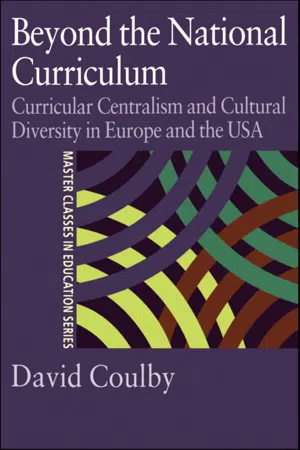
Beyond the National Curriculum
Curricular Centralism and Cultural Diversity in Europe and the USA
- 144 pages
- English
- ePUB (mobile friendly)
- Available on iOS & Android
eBook - ePub
Beyond the National Curriculum
Curricular Centralism and Cultural Diversity in Europe and the USA
About this book
The National Curriculum is due for review. This is a central area of educational debate in England and Wales. Increasingly politicians and their entourages are looking for quick fixes from abroad to solve what they see to be problems in the educational system of the UK. Drawing on insights from other European curricular systems, this provocative book will contribute, in a timely way, to the debate on reformations of the National Curriculum. The style is concise, with points for discussion and lists of further reading. debate in England and Wales. Increasingly politicians are looking for quick fixes from abroad to solve what they see to be problems in the educational system. Drawing on insights from other European curricular systems, this volume will contribute, in a timely way, to the debate on the reformations of the National Curriculum. The style is short and concise, with points for discussion and lists of further reading. _
Information
1
Introduction: Transitions in Europe and the Central Role of Knowledge
Europe in Transition
Some political transitions are highly visible. The destruction of the Berlin wall and its subsequent fate as trophies for western politicians and tourist souvenirs gave visible expression to the collapse of the Iron Curtain, the end of Soviet domination of Eastern Europe and the eventual reunification of Germany. Sometimes the visible moments are themselves misleading. Romania was to wait several years after the demise of Ceaucescu before the securitate relaxed its grip on the state and the modernization of the economy and the polity could slowly proceed. Some transitions, by no means less fundamental, are less readily symbolized. Perhaps the big bang which accompanied the liberalization and computerization of the London stock exchange in the mid-1980s might symbolize a new economic order in the United Kingdom and the United States which was quickly followed by the other European Union (EU) states.
Reagan came to power in 1978, Thatcher in 1979. In the period since then the states of the expanding European Union and those of Eastern Europe and the former Soviet Union have all undergone major transitions. With the introduction of the common currency for eleven EU members in 1999 and with the planned expansion of the Union to the east and to the south (accession negotiations are currently proceeding with Estonia, Poland, the Czech Republic, Hungary, Slovenia and Cyprus), along with new accessions to NATO (Hungary, Poland and the Czech Republic joined in 1999), a further period of social and political turbulence is likely. At the same time international capital has never been more footloose. The investment and disinvestment decisions of trans-national corporations are of major importance to the economic prosperity of all European states and to the political stability of many. Meanwhile the latest tranche of information and communications technology (ICT) developments is transforming all modes of production, distribution and consumption. The European countries are in the midst of profound and by no means completed transitions (see many of the chapters in Coulby, Cowen, and Jones (2000).
This chapter attempts briefly to identify and differentiate important features of these transitions. It is against this background that the discussion of knowledge in the succeeding chapters needs to be understood. Unfortunately not everything can be said at once. Inevitably there are terms and concepts used in the opening chapters which are only clarified or problematized later in the text. In particular, ‘postmodernism’, the notion of a Europe divided between East and West, and the relationships between states and nations are revisited in some depth in later chapters.
Transitions are different between the east and western states. In Eastern Europe features that characterize this transition so far include:
- political freedom
- economic liberalization
- nationalism
- the breakdown of social order
- a renewed interest in the west.
In the United States and Western Europe the features include:
- the reconfiguration of global capitalism
- uncontested US political power
- the rapid development of ICT and the related emergence of the knowledge economy
- ‘postmodernism’
- a revised interest in the east.
Of course not all states display all these features. They constitute the generalizations within which individual exemplifications can be identified.
Eastern Europe in Transition
To take Eastern Europe first, the benefits, or for that matter the extent, of political freedom must not be overstated. Whilst speech, publication, worship and media are certainly substantially freer in a great many states from the Czech republic to Estonia, there are many groups who would question the nature of their new-found freedom: Crimean Tartars, Russian speakers in Latvia, Chechens, Magyar speakers in Serbian Vojvodina to name but a few. Nevertheless, in almost the whole of Eastern Europe there is an exceedingly widespread awareness of a greatly enhanced perspective of personal freedom and renewed political participation. The communist parties themselves have in many cases performed a miraculous transformation into electable democratic groups.
This political liberalization has been the accompaniment, if not the precondition, for economic liberalization. With varying degrees of pain – starvation until recently in winter in Sofia, for example – the Eastern European economies are transforming to participate in the global market. While massive inflows of international capital are still, in most states, eagerly awaited, some economies are on clear convergence with their western neighbours as is recognized by the planned admission of Estonia, Poland, the Czech Republic, Hungary and Slovenia to the EU. A further tranche of east European countries are almost certain to follow. The admission of Poland and Estonia will give the EU further land boundaries with Russia (in addition to the Finland–Karelia border). (NATO is following a similar but not identical pattern of expansion. In both cases there are many more states wishing to join the two international organizations than are currently being accepted.) However, the earlier assumption that the Eastern European economies were on a convergence with those of the west are having to be revised (Pinder 1998). Romania and Bulgaria as well as many of the states of former Yugoslavia have gone into serious economic decline in the 1990s. In economic and indeed political terms the very notion of transition may be seen to be sanguine here (Lieven 1998), unless a substantial time-scale is implied.
In addition to the applications to join NATO and the EU, the renewed interest in the west is also manifested in the expanded membership of the Council of Europe. English and German are already more widely spoken. English language films, television programmes, books, magazines, pop music and software are widely available. Cities such as Cracow or Prague have become the romantic destination of western tourists. With less triumphalism and financial self-assurance the stream of eastern tourists and visitors to the west begins to rise. EU Tempus and Soros Foundation funds have assisted the educational and academic component of this rapprochement and these excursions.
This transition has not been without its downside, the breakdown of social order and the re-emergence of nationalism being among the two most notable aspects. Crime rates have exploded in Sofia as well as in Moscow and St Petersburg. Drug abuse and vandalism have accompanied Microsoft and Coca-Cola into Eastern Europe. Especially for the older generation, there is a widespread perception of a breakdown of social order that, along with the perceived tardiness of western financial and military commitment, provides much of the groundswell towards the born-again communist parties.
The manifestations of re-emergent nationalism have varied from the citizenship laws of the Baltic states and the break-up of Czechoslovakia, to civil wars in Yugoslavia, Georgia and Chechnia (Cohen 1996; Ignatieff 1994; Pavkovic 1997; Lieven 1998). This nationalism has highly particularistic loyalties and is capable of generating the most intense passions. It is exacerbated by apparent economic disparities, between Slovenia and Serbia, or between Czechia and Slovakia. It constitutes a major threat to the stability of many part of the region: currently, Kosovo, Macedonia (FYROM) and Bosnia. Furthermore, Russian nationalism and its uneasy relationship with that of many of its new neighbours, the Baltic states, Georgia, Moldova, and so on, may also come to constitute a continental threat. If the period of transition in Eastern Europe is not to be even bloodier, then some control over nationalist feelings and activities appears to be essential. In addition the economic and political stability of Russia continues to be a matter of concern. Current NATO involvement in Kosovo, combined with economic stagnation, the growth of crime and the resurgence of nationalism in Byelorussia as well as Russia, provides a mixture in which continuing transitions will be, at the least, uneasy.
Western Europe in Transition
Western European states have undergone rapid economic change. This has involved participation in the global market for labour, finance, goods and services. It has involved a rapid recognition of the economic strength of Japan and of the emergent Asian countries, and responses to this increased competition both by individual states and by the EU. It has recognized the urgent need for inward investment, often from these emergent states. More fundamentally it has seen the evolution towards a knowledge economy, one based on services rather than manufacture. The introduction of ICT into so many processes of financing, design, management, production, distribution and consumption has been a significant stage in this evolution (see, especially, Chapter Five). The countries of the west and of the Pacific rim are attempting, with varying degrees of determination, to transform themselves into ‘smart’ states.
Knowledge has emerged as a major trading commodity in the international market. Knowledge and knowledge-based processes both underpin material production and are themselves becoming ever more important aspects of production and consumption. Knowledge in fields such as armaments developments, pharmaceutical production and medical techniques is highly sought after across the world. Design of clothing, cars or food can be more remunerative than their manufacture or sale. The media and publications industries now look to global, multi-media production with a string of associated, franchized products. The design of computer systems, and especially software and operating and filing systems, has facilitated the mushrooming of global monopolies. The economies of the EU and the United States are gradually shifting to this knowledge production and reproduction. This gives an increasingly enhanced role to the curriculum of schools and universities. Educational institutions, as is indicated in Chapter Eight, may be in a race between on the one hand meeting the needs of the knowledge economy or on the other hand irrelevance and obsolescence.
The power of the USA has been virtually unchallenged in political terms since the breakup of the Soviet Union. While the economic power of Japan, the latent strength of Russia and the gradual coalescence of Europe all indicate that this is likely to be a temporary phenomenon, it has meant that the fundamental economic transitions are taking place against a background of relative international stability. The systematic global terror of the cold war has been replaced by ongoing neo-colonial adventures such as Desert Storm or Grand Alliance. The latter provides a stark example: NATO (effectively the USA) engaged in the bombardment and invasion of the territory of the former Yugoslavia without apparently risking global conflict. This would have been unimaginable in the cold war context.
‘Postmodernism’ must at first appear in scare quotes until it is clear that this is not a historical epoch, nor a mode of social solidarity or economic organization but rather a critique, a stance or a way of regarding the world and oneself. Postmodernism is a sceptical, consumerist playfulness, which increasingly describes a wide range of social and cultural phenomenon in the European Union and the United States. It is characterized by:
- a distrust of grand narratives, including progress, science and Marxism
- a tendency to look to give voice to marginalized perspectives, be they those of women, black people, the handicapped (see Chapter Five) or homosexuals
- a tendency to deconstruct dominant discourses and discursive strategies
- a tendency to collage, play and eclectic allusion, particularly in the arts
- a psychology which focuses on identity but only to insist upon its multiplicity
- life styles that self-consciously individualize and commodify taste and culture.
While the political consequences of the profound economic change may have yet to reveal themselves, the eclectic, self-referring, sceptical voice of postmodernism may well be its cultural accompaniment (see especially Chapter Seven).
Just as the events of 1989 and 1991 brought about changed attitudes in the east to the west, so policies and philosophies have adjusted also in the opposite direction. One may hope that the period of western triumphalism is coming to an end. The opportunity is being taken to consolidate the European Union and NATO in the eastern part of the continent, thereby, it is hoped, ensuring continued peace and, if the EU’s past record is anything to go by, enhanced prosperity. If this process is carried out smoothly and quickly, it is possible that the not inconsiderable resentment of those likely to be last admitted to the club (Romania, Bulgaria, Bosnia) may be minimized and the danger of their looking again to Moscow may be avoided. In this process of rapprochement the west has had to learn the limits of both its economic wisdom and its political effectiveness, as the record of the Union’s interference in Yugoslavian affairs so dismally witnesses. NATO’s apparent success in Kosovo is put into perspective by its inability to prevent the destruction of Grozny.
Education in Times of Transition
Just as states differ in the extent to which they are involved in the transitions described above, so they differ in the extent to which they seek to adapt their education systems to address these changing circumstances. While there certainly are structural aspects to this adaptation – the growth of higher education in the west and the emergence of private institutions in Eastern Europe – it is on curricular aspects that this book concentrates. To what extent have the curricular systems of Eastern and Western European schools and universities been adapted to recognize and facilitate the wider transitions? In beginning to answer this question, the remainder of this chapter introduces themes that are subsequently developed in the rest of the book.
One of the important curricular responses to transition has been the reformulation of nationalism. This can most readily be seen in terms of languages. Language education was not the only instrument of Russification (Haarmann 1995). Other, less subtle techniques had been used: mass murder and deportation, the influx of Russian speakers, and party or citizenship restrictions on national language speakers. The Soviet approach to asymmetric bilingualism had been at best assimilationist, and at worst attempted the destruction of nations such as the Inguchetians, the Chechens, the Volga Germans and the Crimea Tartars (Khazanov 1995). National language speakers in the three Baltic states felt that their languages too had been taken to the edge of elimination. Language, then, was a critical area of nation building in many of the newly independent states. In Estonia, Latvia and Lithuania, Russian ceased to be the language of many schools and is rapidly being replaced in the universities. The first foreign language ceased to be Russian and became English.
Other important changes involved the abandonment of Marxist-Leninism as the paradigm discourse for a variety of subjects from sociology to biology in schools and universities across the former Soviet Union and Eastern Europe. History too had to be rapidly re-written and Soviet internationalism to be revealed as a further aspect of the centuries long expansion of the Muscovy state. ‘In the former Soviet Union,’ the joke goes, ‘the past is always unpredictable’. Across Eastern Europe paragraphs on Soviet friendship and brotherhood were deleted from history and social science textbooks and replaced by ones on the suppression and ultimate triumph of the national destiny (Silova 1996). (See especially Chapter Four.)
National culture, no longer in the shadow of the Moscow-financed, state-ideologized, culture machine, found itself with a central dimension in the curricula of schools. In Latvia, for instance, folk song and folk dance, manifestations of the rich national tradition, could take up the school time previously given over to dreary, polytechnical wishful thinking. Schools and universities were set free to celebrate the nation, to reinforce the strength of its language, to remake its history and to re-shape its civil society. In this emancipatory, epistemological transformation, many states are still engaged. Unfortunately there was a down side.
As the example of the Russification of the Soviet Union itself indicates, nation-building and nationalism-building are all too often closely connected. Following 1991, in many states of the former Soviet Union this took the form of the denigration of Russia and all things Russian, which too often had as its political accompaniment harsh restrictions on citizenship (Lieven 1993). In Eastern Europe too the re-writing of history and the celebration of culture too readily focused on a narrow definition of what the nation was, who the true citizens were, and who the historical enemies had been. The rediscovery of the nation and national identity was accompanied by a rediscovery or recreation of the other (UNDP 1995; Cucos 1997; Coulby 1997a). The Serbs reasserted their difference from Bosnians and Croatians; more peacefully the Slovaks revised their distinctiveness. Russians and Chechens threw off the fiction of peaceful, Soviet internationalism. In Latvia, Russian speakers were stripped of their citizenship and many associated human rights. Of course nationalism figures as a continuity as well as a transition. The treatment of Magyars and Gypsies in Romania was little improved in the new democracy from their conditions under the xenophobic Ceaucescu regime.
In this reassertion of nationalism the schools and universities played their parts. A surprising number of the most fervent Serbian nationalists, the architects of ethnic cleansing and the proponents of Greater Serbia were university academics (Judah 1997). In the invention of tradition, the school and university curricula stressed a particular view of history, the Battle of Kosovo, say, or the 1939–45 period, which identified peoples of other languages, scripts or religions as others; in extreme cases as enemies. The sense of solidarity invoked by literary masterpiece, folk song or common enjoyment of sacred landscape has too readily become a sense of solidarity against the other (see, especially, Chapter Seven). The shift to English as the second language is leading to the neglect of the other languages of the state and of near neighbours. The unfortunate and, in some instances disastrous, concomitants of reawakened national identity have been revived xenophobia and regional isolationism: a process in which school and university curricula have played a significant part.
Faced with the political, economic and cultural uncertainties of a period of transition, many states in the west as well as the east have attempted to consolidate traditional values within the school curriculum. The National Curriculum in England and Wales is an obvious example (see, especially Chapter Two). Others would include the Hellenocentric stress in the Greek curriculum (Allison and Nicolaidis 1997; Chouliaras 1993; Flouris 1995; Flouris 1996; Fl...
Table of contents
- Cover Page
- Title Page
- Copyright Page
- Series Editors’ Preface
- Acknowledgements
- Introductory Remarks
- 1: Introduction: Transitions in Europe and the Central Role of Knowledge
- 2: The State Control of Knowledge
- 3: Cultural Diversity and State Knowledge
- 4: The Creation and Re-Creation of Tradition in Schools and Universities
- 5: The Knowledge Economy
- 6: Modernist Knowledge and Prejudice: Special Educational Needs
- 7: Knowledge and Warfare
- 8: State Knowledge and Identity
- References
Trusted by 375,005 students
Access to over 1.5 million titles for a fair monthly price.
Study more efficiently using our study tools.
Frequently asked questions
Yes, you can cancel anytime from the Subscription tab in your account settings on the Perlego website. Your subscription will stay active until the end of your current billing period. Learn how to cancel your subscription
No, books cannot be downloaded as external files, such as PDFs, for use outside of Perlego. However, you can download books within the Perlego app for offline reading on mobile or tablet. Learn how to download books offline
Perlego offers two plans: Essential and Complete
- Essential is ideal for learners and professionals who enjoy exploring a wide range of subjects. Access the Essential Library with 800,000+ trusted titles and best-sellers across business, personal growth, and the humanities. Includes unlimited reading time and Standard Read Aloud voice.
- Complete: Perfect for advanced learners and researchers needing full, unrestricted access. Unlock 1.5M+ books across hundreds of subjects, including academic and specialized titles. The Complete Plan also includes advanced features like Premium Read Aloud and Research Assistant.
We are an online textbook subscription service, where you can get access to an entire online library for less than the price of a single book per month. With over 1.5 million books across 990+ topics, we’ve got you covered! Learn about our mission
Look out for the read-aloud symbol on your next book to see if you can listen to it. The read-aloud tool reads text aloud for you, highlighting the text as it is being read. You can pause it, speed it up and slow it down. Learn more about Read Aloud
Yes! You can use the Perlego app on both iOS and Android devices to read anytime, anywhere — even offline. Perfect for commutes or when you’re on the go.
Please note we cannot support devices running on iOS 13 and Android 7 or earlier. Learn more about using the app
Please note we cannot support devices running on iOS 13 and Android 7 or earlier. Learn more about using the app
Yes, you can access Beyond the National Curriculum by Professor David Coulby,David Coulby in PDF and/or ePUB format, as well as other popular books in Education & Education General. We have over 1.5 million books available in our catalogue for you to explore.