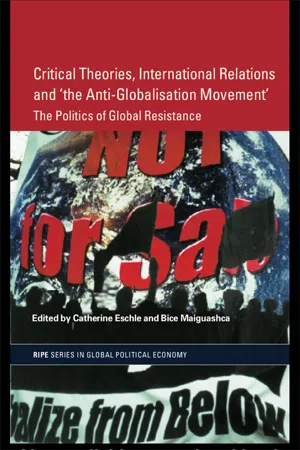
This book provides a comprehensive and nuanced analysis of the 'anti-globalisation' struggles taking place around the world. It shows the complexity and diversity of these movements and illustrates this with detailed empirical studies of local, national and transnational resistance in the United States, Europe, Asia and Africa. The authors introduce a variety of competing theoretical perspectives from international political economy, social movement theory, globalisation studies, feminism, and postmodernism, explaining how activism has influenced theory and how theory can help activists to modify their tactics.
eBook - ePub
Critical Theories, International Relations and 'the Anti-Globalisation Movement'
The Politics of Global Resistance
- 288 pages
- English
- ePUB (mobile friendly)
- Available on iOS & Android
eBook - ePub
Critical Theories, International Relations and 'the Anti-Globalisation Movement'
The Politics of Global Resistance
About this book
Information
Part I
Power/resistance/movement
1 Constructing ‘the anti-globalisation movement’
Catherine Eschle1
Introduction
This chapter asks a deceptively simple question: is there a transnational anti-globalisation social movement?
Some critics of the movement have already produced its obituary. They point to the failure to rival the spectacle of the Battle of Seattle and, more fundamentally, to the ramifications of the September 11 attacks. The space for protest is understood to have closed down and the movement thrown into an identity crisis (see discussion in Martin 2003; Callinicos 2003a: 16–19). I am not responding in this chapter to such contentious claims, nor to the undoubtedly changing conjuncture for activism. Rather I want to interrogate the more basic proposition that there has ever been such a thing as ‘an anti-globalisation movement’.
This is not a particularly original course of enquiry but it is not one that has yet been undertaken in the discipline of International Relations (IR) in a systematic way. As made clear in the Introduction to this book, phenomena associated with ‘the anti-globalisation movement’ have been discussed by IR scholars (e.g. Falk 1999; Gills 2000b; Sklair 2002; Glasius et al. 2002; Held and McGrew 2002; Gill 2003). Activist tactics, ideologies and organisations may be assessed (e.g. Halliday 2000a) but generally the focus is on nongovernmental organisations or civil society; global power and governance; or the politics of resistance. This tendency to avoid the concept of ‘movement’ could stem from a tacit agreement with those who fear it imposes totalising and hierarchical assumptions about anti-globalisation identity and organisation (e.g. Esteva and Prakash 1998: 13; Whitaker 2003). I will argue below that it is more accurate to think of movements as heterogeneous and continually reconstructed. More pertinently here, I think avoidance is more likely to derive from the general neglect in IR of ‘social movements’ and social movement theory. Movements have traditionally been seen as located not in the international but in the domestic, and not in the political but in the social (Walker 1994). They are, therefore, doubly invisible in IR and the proper subject matter of sociology. In addition, they disrupt the usual categories of state-centric, pluralist or structuralist IR and are difficult to assess through the dominant IR methodologies of empiricist quantification, analysis of historical continuities or Marxist materialism (Eschle and Stammers 2004).
This chapter does not provide a straightforward empirical (and empiricist) response that recounts evidence of activism in order to trace the outlines of ‘the anti-globalisation movement’. There are many surveys by activists and commentators that can be consulted for that purpose, of which I will provide a short summary later. I want to focus more on conceptual, methodological and political issues: what do the labels ‘social movement’ and ‘anti-globalisation’ mean? On what theoretical and empirical resources could we draw to find out? On what basis have some interpretations become dominant over others? What are the ramifications of intervening in such debates, for IR theorists as well as activists?
In what follows, I adopt an eclecticism which is both pragmatic (given space constraints and the lack of similar work in IR) and principled (derived from a belief in the importance of paying attention to multiple discourses of activism and anti-globalisation). I draw on various theories, including constructivist social movement theory and feminism. I also foreground activist representations of themselves, from publications and from the websites of the following groupings: Peoples’ Global Action, an anar-chistically inclined network of local organisations, founded in Geneva in order to expand the transnational solidarity work begun by the Zapatistas in Mexico; the World Social Forum, a vast gathering of diverse activists held parallel to the World Economic Forum, the culmination of a rolling process of national and regional activist meetings intended to generate visions of alternative worlds; and the British group Globalise Resistance, a membership organisation run predominantly by activists associated with the Socialist Workers’ Party.
In the first part of what follows, I focus on the notion of a ‘social movement’. I argue that a movement has indeed emerged, albeit in a highly contested and complex form with activists, opponents and commentators constructing competing movement identities. This chapter is itself complicit in such a process – and seeks to further a particular construction of the movement as a site of radical–democratic politics. In the second part, I examine ‘anti-globalisation’. Focusing their opposition on globalised neolib-eralism and corporate power, activists represent their movement either as anti-capitalist or as constructing alternative kinds of globalised relationships. Threading through both parts of the chapter is a normative plea to confront the diverse structures and relations of power involved in both globalisation and movement construction, as many commentators and activists are already doing, in order that globalised solidarities be truly democratic. This is to challenge hierarchical visions of how best to construct ‘the anti-globalisation movement’. I conclude by emphasising the importance of the self-understanding of movement activists for theorising globalisation and resistance in IR.
Constructing a movement
I couldn’t escape a growing conviction that what I was seeing was the fumbling birth of a genuinely new political movement – something international, something different and something potentially huge.
(Kingsnorth 2003: 8)
Many activists and commentators have remarked upon what they see as the emergence of a new movement in recent years. Surveys typically include some variation of the following: the armed rebellion of the Zapatistas against NAFTA and the Mexican state; high-profile protests against corporate power, free trade and international financial institutions; environmental groups; campaigns against Third World debt; student anti-sweatshop activism in North America; struggles against the privatisation of utilities and basic resources; organised labour and trade unions (e.g. Bircham and Charlton 2001; Danaher and Burbach 2000; Cockburn et al. 2000; Globalise Resistance 2002a). Paul Kingsnorth (2003), quoted above, also includes West Papuan struggles for independence, and Amory Starr (2000), whose account remains perhaps the most thorough, adds small-business campaigners, peace activists and religious nationalists. There is certainly plentiful evidence here of the proliferation of resistances. But the question remains: how can such radically diverse activities be taken as evidence of the existence of a – single, new – movement?
In part, this depends on what is meant by a ‘movement’. Here the field of social movement theory may be helpful. The earliest systematic approach in this field defined its subject as ‘crowd psychology’ and ‘collective behaviour’, focusing on large-scale mobilisations in the streets as a sign of social dysfunction and irrationality (e.g. Smelser 1962). More recently, ‘resource mobilisation’ theorists have interpreted social movements as the rational result of individuals coming together to pursue collective interests. This approach focuses on the enabling effect of available social resources, particularly the role of movement ‘entrepreneurs’ in formal organisations (e.g. McCarthy and Zald 1977). Developing on these foundations, ‘political opportunity structures’ theorists emphasise changes in the political context and particularly in state structures (e.g. Tarrow 1998). The impact of globalisation on the state and thus on movements has received some attention recently in this approach (Tarrow n.d.; Smith et al. 1997). Indeed, it is here we find a few analyses of ‘the anti-globalisation movement’ itself (Smith and Johnston 2002). The focus generally remains on organisations oriented towards political institutions, and/or on the material and cultural resources used by such organisations to ‘frame’ their goals and mobilise supporters. This focus is challenged by the ‘new social movement’ (NSM) school, which begins from the assumption that there have been profound changes in recent activism, responding to structural shifts in late modernity. Movements are depicted as organised in socially embedded, diffuse, horizontal networks; as primarily concerned with culture and identity; and as aiming to constrain state and economic power rather than to gain access to it (e.g. Cohen 1982; Melucci 1989). This movement form is seen to be spreading around the world in conditions of cultural globalisation (Melucci 1996a).
There are problems with all of these approaches, but the key thing I want to point to here is the perhaps rather surprising fact that there is no agreement about what a social movement actually is (Diani 2000). Some theorists include mobilisation on the basis of identity, others emphasise shared interest; some emphasise irrationality, others rationality; some emphasise formal organisation, others horizontal networks; some institutionally orientated lobbying, others extra-institutional activism. I want to suggest that all these forms and orientations can be part of movement activism; this is to say that they can, and do, co-exist within the same movement. Mario Diani makes it clear that, although ‘social movements are not organisations’, organisations may well be part of a movement. Indeed, ‘bureaucratic interest groups and even political parties’ can be included (2000: 165–7). But he also insists that a social movement need not give rise to any formal organisations at all. Jean Cohen and Andrew Arato argue that movements typically have ‘dual faces’ and adopt a ‘dual strategy’: ‘a discursive politics of identity and influence that targets civil and political society and an organized, strategically rational politics of inclusion and reform that is aimed at political and economic institutions’ (1992: 550). In sum, the claim here is that movements are typically diverse in organisational form and orientation.
Thus the diversity apparent amongst modes of ‘anti-globalisation’ activism does not exclude the possibility that a movement has emerged. However, if we cannot judge when a movement has emerged by recourse to empirical evidence of a specific ideological or organisational formation, how can we identify one? In other words, on what basis can it be asserted that ‘an anti-globalisation movement’ has in fact emerged? I suggest that we know that movements exist when activists claim that they are part of one and participate in efforts to define ‘their’ movement in particular ways. This requires attention to activist representations of themselves.
I adopt this idea from social movement theorist Alberto Melucci’s ‘constructivist’ approach (1989; 1996a)2 Melucci’s starting point is a critique of the assumption that movements act as ‘unified empirical datum’ or ‘personages’, each with a coherent identity, pre-formed interest and single will. He defines a social movement as ‘a composite action system, in which differing means, ends and forms of solidarity and organization converge in a more or less stable manner’ (1989: 28). In other words, movements are ongoing processes in which diverse actors construct a common frame of reference. One element in this construction, or one result of it (Melucci is elusive on this point), is the formation of a collective identity through which participants establish relationships to each other, locate themselves in their environment, differentiate themselves from others, and gain recognition as a collectivity. Approaching ‘the anti-globalisation movement’ in the light of this claim, it becomes evident that common identity themes can be found on the websites of Peoples’ Global Action (n.d.), the World Social Forum (2002) and Globalise Resistance (2002a). All insist that participants share opposition to free trade, corporate power and international financial institutions. They all claim to support extra-institutional, direct action as a key mode of struggle. Further, they all state that they recognise the diversity of the movement as a strength. Significant differences remain, of which more below, but Melucci’s framework implies that identity is forged through a continuous process of ongoing communication, negotiation and decision-making among participants; total agreement and closure is thus not to be expected. The key point is that activists have to participate in a shared process through which identity is (re)negotiated. The websites of Peoples’ Global Action, Globalise Resistance and the World Social Forum all indicate that their participants see themselves as part of a wider struggle and explicitly appeal to others identified with that struggle.
For Melucci, identity-formation processes occur largely within ‘subterranean’ networks through which people meet face to face in everyday life, with movements only occasionally surfacing as visible, public actors. It is this subterranean dimension of activism that should thus be the focus of those studying movement construction (1989: 70–3; 1996a: 113–16). However, this approach needs modification when considering the possibility of ‘an anti-globalisation movement’. First, there is the widely recognised significance of the Internet in constructing networks among geographically dispersed activists who may never actually meet. There needs to be more critical interrogation of the limitations that a reliance on the Internet for networking, and for studying the movement, brings with it. It is possible that a ‘geekocracy’ is emerging (Klein 2002: 18); many groups are excluded from access to the Internet and thus from many conceptualisations of the movement; and ‘virtual’ connections may remain rather weak.
Second, it would seem that collective identity has also congealed in the face-to-face, but highly visible, public gatherings at Seattle, Prague, Genoa, Porto Alegre and elsewhere. These have received an extraordinary emphasis in much activist commentary as well as catching the eye of some academics (e.g. Cockburn et al. 2000; Smith 2002). They may be particularly key in transnational movements in which subterranean networks are otherwise ‘virtual’ or stretched very thinly over great distances. In the case of ‘the anti-globalisation movement’ they have also functioned to construct the movement in ways that foreground the travelling protestor and the politics of the spectacle. Again, this means that other kinds of activism are marginalised within the movement and our understandings of it, particularly ongoing community-based struggles (Dixon n.d.; Crass n.d.).
Third, Melucci’s exclusive emphasis on the role of participants in movement construction can be criticised for ignoring the possible role of exterior social processes, public discourses and other actors. In the case of ‘the anti-globalisation movement’, it has been suggested that the limited and largely negative representation of the movement in the mainstream media is one factor behind the proliferation of alternative, independent media. These aim to represent movement activism to its participants and to the public in a more positive, nuanced, light (Rodgers 2002). Or see Naomi Klein’s book of ‘dispatches from the front lines of the globalization debate’ (2002). Klein is centrally concerned to respond to elite, police and media representations of the movement as violent, as the politics of the spectacle, and as ‘anti-globalisation’, and to put forward alternatives. Evidently, representations of the movement by external actors have political implications and can act as a spur to new identity constructions by movement activists.
This brings me to the possibility that academic analyses may also play a role in movement construction. Indeed, Alex Callinicos argues that ‘[o]ne reason we can talk about a global movement is that it has found ideological articulation in a body of critical writing produced by a variety of intellectuals’ (2003a: 9, emphasis in original). Callinicos draws attention to the high-profile figures crossing between academia and activism, directly intervening in movement construction. However, I want to extend this point and make the case that even those apparently external to a movement, engaged in study of it for solely academic purposes, are also engaged in its construction. Melucci (1996b) and others are critical of the empiricist assumption that we study movements as pre-existing objects ‘out there’; rather, it is the researcher who constructs the social movement they are studying by interpreting activism through a particular lens. This is a strong version of the post-positivist view now widespread in IR that academic study is both shaped by and constitutive of the world around it: we approach the world from a particular perspective and our work can have concrete effects upon it. It means that social movement theory is implicated in the interaction through which a social movement is constructed and should thus be self-consciously interrogated in the process of research.
Further, I suggest that the study of social movements is a political act. In taking the possibility of a particular movement seriously, social movement scholars are helping to call it into existence. They are using the label persuasively, in an effort to give scholarly and political legitimacy to their research and its subject matter. This chapter, for example, is contributing to an academic discourse that claims diverse moments of ‘anti-globalisation’ activism do indeed constitute a movement that should be taken seriously. What is more, I seek in this chapter to encourage the construction of a particular kind of movement. I want to draw attention to a strand of activism that aims to confront hierarchical power relations in the movement and to reconstruct it as a site of radical–democratic politics.
Now, Melucci’s framework does not pay sustained attention to the structures and relations of power through which some movement identities become dominant over others. Most approaches to social movements, and most activists, focus rather on the power structures in the wider social context, which may enable effective mobilisation or present a target. Moveme...
Table of contents
- Cover Page
- Title Page
- Copyright Page
- Contributors
- Series editors’ preface
- Preface and acknowledgements
- Abbreviations
- Introduction
- Part I Power/resistance/movement
- Part II Discourse/identity/culture
- Part III Politics/strategy/violence
- Bibliography
Trusted by 375,005 students
Access to over 1.5 million titles for a fair monthly price.
Study more efficiently using our study tools.
Frequently asked questions
Yes, you can cancel anytime from the Subscription tab in your account settings on the Perlego website. Your subscription will stay active until the end of your current billing period. Learn how to cancel your subscription
No, books cannot be downloaded as external files, such as PDFs, for use outside of Perlego. However, you can download books within the Perlego app for offline reading on mobile or tablet. Learn how to download books offline
Perlego offers two plans: Essential and Complete
- Essential is ideal for learners and professionals who enjoy exploring a wide range of subjects. Access the Essential Library with 800,000+ trusted titles and best-sellers across business, personal growth, and the humanities. Includes unlimited reading time and Standard Read Aloud voice.
- Complete: Perfect for advanced learners and researchers needing full, unrestricted access. Unlock 1.5M+ books across hundreds of subjects, including academic and specialized titles. The Complete Plan also includes advanced features like Premium Read Aloud and Research Assistant.
We are an online textbook subscription service, where you can get access to an entire online library for less than the price of a single book per month. With over 1.5 million books across 990+ topics, we’ve got you covered! Learn about our mission
Look out for the read-aloud symbol on your next book to see if you can listen to it. The read-aloud tool reads text aloud for you, highlighting the text as it is being read. You can pause it, speed it up and slow it down. Learn more about Read Aloud
Yes! You can use the Perlego app on both iOS and Android devices to read anytime, anywhere — even offline. Perfect for commutes or when you’re on the go.
Please note we cannot support devices running on iOS 13 and Android 7 or earlier. Learn more about using the app
Please note we cannot support devices running on iOS 13 and Android 7 or earlier. Learn more about using the app
Yes, you can access Critical Theories, International Relations and 'the Anti-Globalisation Movement' by Catherine Eschle, Bice Maiguashca, Catherine Eschle,Bice Maiguashca in PDF and/or ePUB format, as well as other popular books in Politics & International Relations & Globalisation. We have over 1.5 million books available in our catalogue for you to explore.