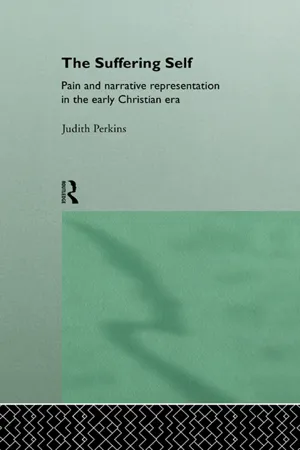
The Suffering Self is a ground-breaking, interdisciplinary study of the spread of Christianity across the Roman empire. Judith Perkins shows how Christian narrative representation in the early empire worked to create a new kind of human self-understanding - the perception of the self as sufferer. Drawing on feminist and social theory, she addresses the question of why forms of suffering like martyrdom and self-mutilation were so important to early Christians.
This study crosses the boundaries between ancient history and the study of early Christianity, seeing Christian representation in the context of the Greco-Roman world. She draws parallels with suffering heroines in Greek novels and in martyr acts and examines representations in medical and philosophical texts.
Judith Perkins' controversial study is important reading for all those interested in ancient society, or in the history `f Christianity.
eBook - ePub
The Suffering Self
Pain and Narrative Representation in the Early Christian Era
- 264 pages
- English
- ePUB (mobile friendly)
- Available on iOS & Android
eBook - ePub
About this book
1
Death as a Happy Ending
Second-century Christian writings present a world of pain, suffering and death. Graphic detail pictures both the human body and the body social as universally lacerated and harassed. The portrayal in Christian documents of the physical body scraped with claws, pierced with knives, roasted, whipped, strangled and mauled by beasts is a microcosm for a community assailed on every side according to Melito (Eusebius Historia Ecclesiastica 4.26.2), Hermas (Pastor 3.2.1), and Justin (II Apologia 12).1 If a culture’s reality, its sense of the “way things really are,” is a product of its systems of representations, the processes and peculiarities used to bring its cultural world to consciousness, the centrality of pain, suffering and death in early Christian representation suggests that Christian “reality” was unrelentingly filled with risk, pain and death.
The traditional explanation for the emphasis on suffering in Christian texts has been that it reflected the desperate situation of a hounded community, but modern scholarship has called this explanation into question. Persecution in the second century appears to have been in T.D.Barnes’ words “local, sporadic and random” (Barnes 1968a:38).2 Christianity was dangerous to embrace, certainly—a crime punishable by death. But in the early empire there was no concerted state effort to seek out Christians for persecution. The traditional conception of Christians during this period as all in great danger and hiding from authorities is disproved in many contemporary texts both Christian and non-Christian. Lucian, for example, in his depiction of the career of Proteus Peregrinus, a Cynic who killed himself at the Olympian games in A.D. 165, offered a picture of the typical situation. During Peregrinus’s Christian period, he somehow had come to official notice and was imprisoned. Peregrinus’ arrest, however, did not affect or suspend the public behaviors of other Christians, whom Lucian described as attending Peregrinus, bringing him food and books, even spending the night with him.
Lucian’s description emphasized the crowds of Christians coming to the prison to support their leader, and demonstrated that these public actions performed by the Christians did not place the Christian crowd in any danger. Lucian’s depiction might be distrusted as part of his satire if his picture was not supported by similar Christian testimony. Ignatius, for example, sentenced to death, traveled from Antioch to Rome; his letters show that all along his route he was visited and supported by representatives of the Christian communities he passed through. Perpetua, imprisoned with a group of martyrs in Carthage, also described the visits of members of her Christian community who like Peregrinus’s supporters had bribed the guards to insure better conditions for the imprisoned (ACM 3.7). Such descriptions display the selectivity of persecution in the early period and the relative safety of many Christians even as they publicly acted out their Christian beliefs. Local persecutions did occur; but before the mid-third century, persecutions against Christians arose primarily from local outbreaks of animosity. The situation in this period was as De Ste. Croix has stated, “the ordinary Christian who did not insist on openly parading his confession was most unlikely to become a victim of the persecution at all” (De Ste. Croix 1954:104).
This is not to say that there were no persecutions. Persecutions did occur and for their victims and witnesses they were horrendous and harrowing. It is in no sense my intention to minimize the heroic witness of Christian martyrs as I question why so much of Christian representation focused on the pain, suffering and death of Christians. But so long as it is uncritically accepted that the emphasis of Christian texts on pain and death resulted from widespread and inclusive persecutions, the extraordinary Christian effort to bring into consciousness a world centered on these topics will go unrecognized. It is my contention that Christian representation in the early Roman empire functioned to offer a particular self-representation to Christians—the Christian as sufferer. The fact that at this point persecutions occurred relatively infrequently gives this representation added significance. For if Christians were not writing texts focused on suffering, and passing these around from community to community to buttress their adherents’ resolve to endure systematic and unavoidable persecution, why were they constructing such a subject? And why would the representation of such a subject succeed in attracting adherents in the Greco-Roman world?
These questions are important for understanding one means by which Christianity accomplished its growth. For the so-called “triumph of Christianity” was, as I suggested above, a representational revolution. Through the agency of Christian representation, numbers of persons acquired a changed selfunderstanding and a changed world-view. Numerous elements likely contributed to this revolution, but a central element in its success was that the Christian representation of pain and death played into a constellation of concerns already manifest in the culture.
Ramsay MacMullen in his Christianizing the Roman Empire offered a piece of salutary advice for studying conversion to Christianity in this early period and one that will allow the basis for Christianity’s representational success to emerge. MacMullen submitted that any study of conversions must begin from an examination of what Christianity offered its audience: “What did Christianity present to its audience? For plainly the process of conversion, that interests me, took place in peoples minds on the basis of what they knew, or thought they knew” (MacMullen 1984:19–20). MacMullen’s advice is helpful because it suggests a method to bracket off the great load of assumptions all moderns carry around as heirs of the Christian thought-world. Modern commentators are entangled, wittingly or not, in the shared perspective of centuries of Christianity. Following MacMullen’s advice, the focus shifts from modern assumptions about what attracted converts to Christianity to an analysis of what contemporaries focused on or considered significant about this new cult. By examining what contemporaries picked out for notice, Christianity can be located in the context of the surrounding culture’s preoccupations and concerns.
MacMullen suggested that before any conversions could take place, inhabitants of the empire would have had to be attracted to the sect on the basis of what they knew or thought they knew about it—that is to say, on the basis of what was generally known, “in the air” so to speak. Tracing out what its audience found noteworthy or provoking should therefore help explain the grounds for Christianity’s appeal. MacMullen suggested that Christianity’s wonder-working prowess was a major element in its attraction, and at least in part this was most likely true. The early empire was a world full of wonder-workers (see Chapter 5). Christianity would have been viewed as deficient without the capacity to work miracles, and many early Christian documents testified to the cult’s superior ability in this regard. But by highlighting wonder-working as the major factor in Christianity’s appeal, MacMullen neglected his own advice to concentrate on what Christianity’s audience knew, or showed evidence of knowing, about the sect. For the early pagan references to Christianity reflected very little interest in, or knowledge of, Christian wonder-working. Rather, the part of the Christian message that was getting through sufficiently, so that traces of it appeared in the general circulation of knowledge, is very clear. What did inhabitants of the early Roman empire know about Christianity? Notwithstanding the paucity of sources for the period and their elite bias, it is safe to say that one thing contemporaries knew about Christianity (in fact, for some the only thing they give any evidence of knowing) is that Christians held death in contempt and were ready to suffer for their beliefs. Robert Wilken (1984) has provided a useful survey of pagan3 attitudes and knowledge about Christianity and his study established clearly that the earliest pagan references situated Christianity in a context of punishment and pain. In the earliest pagan reference, Christianity’s burgeoning growth and wide appeal was already emphasized. About the year A.D. 111, the Roman senator, Pliny, serving as governor of Bithynia and Pontus wrote to the emperor, Trajan, for instructions on dealing with the Christians in his province (Sherwin-White 1966). Part of his reason for approaching the emperor on this topic was the large number of Christians “of every age and status, of both sexes” (Epistula 10.96). Pliny wrote to Trajan concerning the proper judicial disposal of cases involving these Christians. His problems were not with confessed Christians—he executed these—but with the lapsed or those who were willing to deny their Christianity in court and offer sacrifice.
The next earliest pagan reference to Christianity appeared in The Annals of Tacitus who described how, after the great fire in Rome, Nero picked out as “culprits and punished with the utmost refinements of cruelty a class of men, loathed for their views, whom the crowd called Christian” (15.44). Tacitus said these Christians were convicted, “not so much on the count of arson as for hatred of the human race.” Tacitus described their punishment in graphic detail. They were torn to pieces by dogs, fastened to crosses and ignited. The two earliest pagan witnesses to Christianity, thus both referred to its adherents’ punishment and death, their anti-social attitudes, and their neighbors’ dislike of them. Tacitus spoke of the Christians’ hatred of the human race and Pliny of their inflexible stubbornness in court. Such are the impressions of Christianity presented by two members of the Roman upper class in the early second century.
Later in the century, the doctor Galen mentioned Christians more favorably but within similar parameters of interest. In a discussion of the difficulty some people have in following logical arguments, Galen considered the efficacy of using parables for instruction. The mention of parables brought to mind the Christians whom Galen described:
drawing their faith from parables and miracles, and yet sometimes acting in the same way as those who practice philosophy. For their contempt of death and of its sequel is patent to us every day, and likewise their restraint in cohabitation.
(Walzer 1949:15)
Galen also noted the Christian self-discipline in food and drink and their sense of justice, and his words suggest a certain familiarity with Christian practice. He displayed a knowledge of their teaching methods, their contempt for death, their abstemious habits and their pursuit of justice. Marcus Aurelius and Epictetus had both less knowledge and less regard for the Christians. A central motif of Marcus Aurelius’ Meditations was the naturalness of death. The emperor expressed admiration for all those ready at any moment to accept release from life, but he refused to include people like Christians in his admiration. According to the emperor, they embraced death for the wrong reasons:
But the readiness must spring from a man’s inner judgement and not be the result of mere opposition as is the case with Christians. It must be associated with deliberation and dignity and if others are to be convinced, with nothing like stage heroics.
(Meditations 11.3)
This explicit reference to Christians is perhaps an interpolation, but in any case, Marcus Aurelius would have included their behavior in his general disapproval for any theatrics of death.4
The Stoic philosopher, Epictetus, had also heard of Christian fearlessness in the face of death and danger, but he dismissed this attitude on their part as resulting from “habit,” ethos (Discourses 4.7.6). Epictetus’ comment showed that he considered the Christians’ contempt for death as so naturally a part of their Christian life to be unreflective.
This rapid survey of early pagan references to Christianity supports one point conclusively: that if Christianity was known at all, it was known for its adherents’ attitude toward death and suffering.
The more developed literary reference to Christianity in Lucian’s Proteus Peregrinus (1936) corroborates this point. Lucian in his satiric attack on Proteus Peregrinus, the Cynic philosopher who incinerated himself at the Olympic games, quoted Peregrinus’ reason for his death: “to teach others to despise death and remain strong in misfortunes” (Lucian 1936:23). Lucian’s detailed depiction of Peregrinus’ career and death indicates a certain cultural fascination with death seekers during the period. Lucian dismissed Peregrinus on account of his thirst for notoriety and censured the setting and method of his death for its showiness. Just as Marcus Aurelius had discredited theatricality in the face of death, Lucian was put off by Peregrinus’ self-dramatization (Francis 1995:67–77). In Lucian’s opinion, Peregrinus should have waited for death in its natural course, or if he chose to die, to have picked a less ostentatious method and setting than leaping onto a burning bier at the Olympic games (Lucian 1936:21).
Peregrinus is a historical figure mentioned in a number of other sources.5 Aulius Gellius called him a “serious and steadfast man” (Noctes Atticae 8.3). Only Lucian offered evidence for Peregrinus’ Christian phase (Edwards 1989). His narrative suggested a pattern in this notorious death-seeker having had an earlier stage as a Christian. Lucian described Peregrinus’ instruction in Christianity in Palestine, his quickly acquired status in the cult, becoming “a prophet, a cult leader, head of a synagogue, and everything, all by himself” (11). Eventually Peregrinus was arrested as a Christian. Lucian explained his arrest as another example of his quest for prominence. The Christian community supported Peregrinus in prison. At first they attempted to rescue him, and when this failed they enveloped their leader in constant attention: “from the very break of day aged widows and orphan children could be seen waiting near the prison, while their officials even slept inside with him after bribing the guards” (12). Christians brought Peregrinus elaborate meals and money, coming from all over Asia at their communities’ expense to encourage him in his imprisonment. Lucian mocked these Christians for their gullibility, even as he provided testimony for their readiness to donate money in support of their community-member: “so if any charlatan or trickster who can size up the situation comes among them, he quickly acquired sudden wealth by imposing upon simple folk” (18). Lucian’s description emphasized both the central role played by the martyr in the Christian community and the connection between the martyr’s high standing and the Christians’ selfunderstanding: “The poor wretches have convinced themselves, first and foremost, that they are going to be immortal and live for all time, in consequence of which they despise death and even willingly give themselves into custody most of them” (13). Peregrinus’ imprisonment provided a cultural performance of their beliefs for the whole community. Christians clustered around, representatives came from all over to watch Peregrinus act out his contempt for death. Peregrinus performed his Christian faith, just as later he would enact his Cynic convictions in his fiery end after the Olympic festival.
On this occasion, however, the governor of Syria, according to Lucian, refused to play his part in Peregrinus’ death drama. He recognized that Peregrinus “would gladly die in order that he might leave behind him a reputation for it, [so] he freed him…” (14). Later, Lucian reported, Peregrinus had a falling out with the Christian community and began the trajectory that resulted in his conspicuous final moments.
Lucian’s depiction of Peregrinus’ release by the governor is supported by other testimony from the period. Several of the Martyr Acts depicted judges reluctant to punish Christians and attempting to reason them into a safer course. Tertullian offered actual examples of judges in Africa who released confessed Christians unpunished; he cited the notorious and very likely hyperbolic example from Asia when all the Christians in a community presented themselves before Arrius Antoninus who let most of t...
Table of contents
- Cover
- Half Title
- Title Page
- Copyright
- Dedication
- Contents
- Permissions
- Acknowledgements
- Introduction
- 1. Death as a Happy Ending
- 2. Marriages as Happy Endings
- 3. Pain without Effect
- 4. Suffering and Power
- 5. Healing and Power: The Acts of Peter
- 6. The Sick Self
- 7. Ideology, not Pathology
- 8. Saints’ Lives: The Community of Sufferers
- Notes
- Bibliography
- Index
Trusted by 375,005 students
Access to over 1.5 million titles for a fair monthly price.
Study more efficiently using our study tools.
Frequently asked questions
Yes, you can cancel anytime from the Subscription tab in your account settings on the Perlego website. Your subscription will stay active until the end of your current billing period. Learn how to cancel your subscription
No, books cannot be downloaded as external files, such as PDFs, for use outside of Perlego. However, you can download books within the Perlego app for offline reading on mobile or tablet. Learn how to download books offline
Perlego offers two plans: Essential and Complete
- Essential is ideal for learners and professionals who enjoy exploring a wide range of subjects. Access the Essential Library with 800,000+ trusted titles and best-sellers across business, personal growth, and the humanities. Includes unlimited reading time and Standard Read Aloud voice.
- Complete: Perfect for advanced learners and researchers needing full, unrestricted access. Unlock 1.5M+ books across hundreds of subjects, including academic and specialized titles. The Complete Plan also includes advanced features like Premium Read Aloud and Research Assistant.
We are an online textbook subscription service, where you can get access to an entire online library for less than the price of a single book per month. With over 1.5 million books across 990+ topics, we’ve got you covered! Learn about our mission
Look out for the read-aloud symbol on your next book to see if you can listen to it. The read-aloud tool reads text aloud for you, highlighting the text as it is being read. You can pause it, speed it up and slow it down. Learn more about Read Aloud
Yes! You can use the Perlego app on both iOS and Android devices to read anytime, anywhere — even offline. Perfect for commutes or when you’re on the go.
Please note we cannot support devices running on iOS 13 and Android 7 or earlier. Learn more about using the app
Please note we cannot support devices running on iOS 13 and Android 7 or earlier. Learn more about using the app
Yes, you can access The Suffering Self by Judith Perkins in PDF and/or ePUB format, as well as other popular books in History & Ancient History. We have over 1.5 million books available in our catalogue for you to explore.