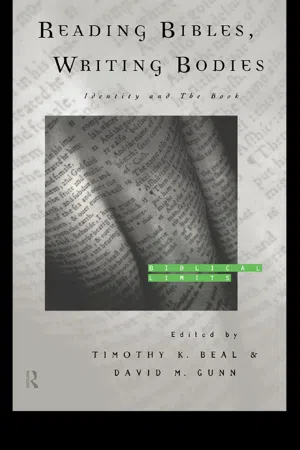
The Bible is often said to be one of the foundation texts of Western culture. The present volume shows that it goes far beyond being a religious text. The essays explore how religious, political and cultural identities, including ethnicity and gender, are embodied in biblical discourse. Following the authors, we read the Bible with new eyes: as a critic of gender, ideology, politics and culture. We ask ourselves new questions: about God's body, about women's role, about racial prejudices and about the politics of the written word.
Reading Bibles, Writing Bodies crosses boundaries. It questions our most fundamental assumptions about the Bible. It shows how biblical studies can benefit from the mainstream of Western intellectual discourse, throwing up entirely new questions and offering surprising answers. Accessible, engaging and moving easily between theory and the reading of specific texts, this volume is an exciting contribution to contemporary biblical and cultural studies.
- 312 pages
- English
- ePUB (mobile friendly)
- Available on iOS & Android
eBook - ePub
About this book
PART I
GLEANINGS
In a sense the humans have led God out of paradise. Why does God follow?…There is no return to simplicity, for human beings or for God.
Danna Nolan Fewell and David M.Gunn
The human body, then, was the site at which conflicting cultural impulses met and clashed. It was that conflict that made the Jews more than just a People of the Book. They also became a People of the Body.
Howard Eilberg-Schwartz
The Father’s disappointment in his children appears to be mirrored by his daughters’ disappointment in him! Ironically, the information concerning this muted (minority?) view of the ‘daughters’ is preserved by the patriarchal YHWH opposition to it.
Athalya Brenner
Moses may wield God’s rod, but never its power. For Freud, Oedipus wrecks. So too for Moses.
Ilona N.Rashkow
To call God Sophia is not on the same level as calling God a mother hen. Sophia is a powerful naming, a root metaphor, that names God with the same fullness as the name Jesus Christ.
Claudia V.Camp
DIVINE BODIES
This part focuses on questions concerning the characteristics and problematics (and problematic characteristics) of God’s identity in biblical literature and in the religious communities that read it. What is “the image of God”? What are the implications of putting God into writing? Insofar as biblical texts often use metaphors that involve language of the body, what are the implications of God’s incorporation into Scripture? Is God’s inscription (being put into writing) also God’s embodiment (a “theological corpus”)? Relatedly, how is divine subjectivity entangled in issues of sameness and difference? How does biblical literature struggle with these conundrums? How do “people of the Book” struggle with them? How do such problematics constrain and/ or empower theological discourse in contemporary politics?
1
SHIFTING THE BLAME
God in the Garden1
Danna Nolan Fewell and David M.Gunn
And God created humankind in his own image, in the image of God he created it, male and female he created them. And God blessed them, and God said to them, “Be fruitful and multiply, and fill the earth and subdue it; and subjugate…” And God saw everything that he had done, and behold, it was very good.
(Genesis 1:27–28, 31)
Then YHWH God said, “It is not good that the human should be alone; I will make it a helper, a counterpart for it.”
(Genesis 2:18)
And the human said: “This at last is bone of my bones and flesh of my flesh; this shall be called ‘woman,’ because from man was this taken.” (Hence a man forsakes his father and his mother and cleaves to his woman, so that they become one flesh.)
(Genesis 2:23–24)
And God said: “Have you eaten from the tree of which I said not to eat?”
The man said, “The woman whom you gave to be with me, she gave me fruit of the tree, and I ate.” And YHWH God said to the woman, “What is this that you have done?” And the woman said, “The serpent beguiled me, and I ate.” And YHWH God said to the serpent….
The man said, “The woman whom you gave to be with me, she gave me fruit of the tree, and I ate.” And YHWH God said to the woman, “What is this that you have done?” And the woman said, “The serpent beguiled me, and I ate.” And YHWH God said to the serpent….
(Genesis 3:12–14)
For good and evil, Genesis 1–3, perhaps more than any other biblical text, has influenced the way men and women relate to one another in the Western world. For good and evil—because good and evil have a way of changing their spots, as this text invites us to see.
The story is about the origins of humankind. It is also a story about the divinity, God, or YHWH God, as the narrator goes on to call him (we use the masculine pronoun advisedly) in chapter 2. Indeed we could say that God is the dominant character in this story of origins. Yet curiously, while commentators over the centuries have had an overabundance of observations to make about the character of the humans, and especially of Eve, whose failings have provided them with rich pickings, they have been remarkably reticent regarding the character of YHWH and, in particular, notably reluctant to put the deity under the same kind of critical scrutiny as the humans.
As any family therapist worth their salt would want to ask, however, how can you understand the children without understanding something of the parents and the interrelational dynamics of all? Families are systems. So here we have a story of what appears to be a single parent family, a family which, the narrator suggests, enjoys a measure of dysfunction (which some theologians have termed “The Fall”). If we wish to understand the daughter and son, Eve and Adam, it makes sense to take a searching look at this curious figure who seems to function as their father, namely God.
He is a talker. He talks the world into existence.
He appreciates the need for rest. Sabbath marks the culmination of creation.
He appreciates the need for rest. Sabbath marks the culmination of creation.
He has a strong penchant for order. The story begins in Genesis 1 with a strong bias towards the binary. God divides up the world in clear categories: light and dark, day and night, wet and dry, plants and animals, heaven and earth. We see a desire to divide, differentiate, categorize and, in a word, name. Of course, differentiation could be said to be indispensable to creation. Certainly separation, division, difference is indispensable to meaning. Meaning is difference. A world that is no longer simply tohu vabohu (“a formless void,” New English Bible) is a world of difference. Naming, the shaping of the world in language, is the manipulation of difference. Naming is the prerequisite of a meaningfully ordered world. Naming, as is often observed of this account, may also be an expression of control.
On the other hand, when the account reaches a climax with the creation of humankind, that is, the creature in the image of God (Genesis 1:26–30), we see movement against that desire to differentiate. Blurring the binary poles, God desires to create likeness or sameness, to recreate self, a desire impossible to achieve.
Equally interesting are the sharp edges of God’s naming. The binary impulse is there very clearly. Yet in all this careful defining, separating, and opposing there is a curious slippage. God “himself” is unsure whether he is plural or singular, echoing the narrator’s grammatical confusion of a plural name (’elohim, which may or may not be a proper noun!) and a singular verb (Genesis 1:26–29):2
Then God(s) [or “divinity”] said [sing.] “Let us make humankind in our image, after our likeness”…So God(s) created [sing.] humankind in his own image, in the image of God(s) he created him, male and female he created them…And God(s) said, “Behold, I have given you [pl.]….”
Significantly the slippage extends from the God(s) to the human(s) created in his/their image. While humankind is one (him/it) it is also plural—male and female (them).
Thus, despite the appearance of a world ordered and sustained by exclusive and fixed definitions, God’s own blurred and slipping self-definition suggests that things might be otherwise. This world might in fact be as inherently indeterminable as the identity that creates it.
Within this system of divisions and separations, God begins to institute a hierarchy of dominion: the greater light is to rule over the day, the lesser light over the night. At the creation of the human, however, the language of dominion grows stronger (1:26–28, 31):
And God said, “Let us make humankind in our own image, after our likeness; and let them subjugate [radah: trample, put under foot] the fish of the sea and the birds of the air, and the cattle, and all the earth, and every creeping thing that creeps upon the earth.” And God created humankind in his own image, in the image of God he created it, male and female he created them.
And God blessed them, and God said to them, “Be fruitful and multiply, and fill the earth and subdue it [kabash: bring into bondage]; and subjugate all fish of the sea and birds of the air and every living thing that moves upon the earth.” …And God saw everything that he had done, and behold, it was very good.
And God blessed them, and God said to them, “Be fruitful and multiply, and fill the earth and subdue it [kabash: bring into bondage]; and subjugate all fish of the sea and birds of the air and every living thing that moves upon the earth.” …And God saw everything that he had done, and behold, it was very good.
Rule, subjugate, subdue. The language is, disturbingly, the language of totalitarian power, as others have observed. It would be at home, for example, in the Assyrian imperial annals. Humankind’s first mandate is to subdue the earth and subjugate every living thing that moves upon it. Not to cooperate with, be partners with, share with, but bring into bondage and subjugate. On the other hand, God seems to envision this subjugation as a blessing for the humans, along with being fruitful and multiplying and filling the earth, which lead to the instruction to subjugate.
“And God saw that it was good.” That constant refrain speaks of discovery. This creator God is plainly not, as Christian theology would have it, omniscient. He does/says something new, observes it, and remarks upon his discovery: “it is good!” God is experimenting. God desires to explore. God desires something new and greets with enthusiasm each new discovery of his own handiwork. By the same token we suspect that there may come a point when he will exclaim “it is not good!” And indeed God does so in chapter 2: “It is not good,” he finally admits, after trying out a single human being, “that the human [ha’adam] should be alone.” This, too, is a discovery on God’s part.
The very phrase, “not good,” however, reminds us that meaning cannot simply be confined within binary terms. The true opposite of “good” is “evil.” Intriguingly, the narrator manages in chapter 1 to insist repeatedly that God’s creative differentiations are good without ever mentioning the term evil. That is kept out of sight until chapter 2. Some readers, on the other hand, may have already begun to wonder whether, in the face of such protestations of goodness, somewhere there must be evil, even if only in the imagination of God’s heart (cf. the discussion within Jewish mysticism [Kabbalah]). They might also have begun to wonder whether evil is already latent in that ordered world as an expression of God’s desire for himself to have dominion over the earth and for his viceroy, the creature made in his image, to subjugate all living things. The desire to subjugate is an ethically ambiguous one, for it may mean the desire to subjugate good (where subjugation is evil) or to subjugate evil (where subjugation is good).
And YHWH God planted a garden in Eden, in the east, and put there the human whom he had formed. And he made grow from the ground every tree that is pleasant to look at and good to eat—and the tree of life was also in the midst of the garden, and the tree of the knowledge of good and evil.
(Genesis 2:8–9)
So the story confirms that this discriminating God does indeed know good and evil, though clearly his eagerness to proclaim his own work as “good” suggests that he desires good rather than evil.
In Genesis 1 (through 2:4a) the narrator has opened up a broad and highly schematized view of creation. From 2:4b, the account takes a different shape and the focus falls upon a particular category of creation: the human.3
On the day that YHWH God made the earth and the heavens…YHWH God formed the human, dust of the ground, and blew into its [his] nostrils the breath of life, and the human became a living being…And YHWH God took the human and put it [him] in the garden of Eden to till it and tend it.
(Genesis 2:4, 7, 15)
Although the new episode goes on to present the human divided into its binaries, man and woman, it deals little with biological difference. In 1:26–30, the narrator has recounted the creation of the male and female of humankind in order to show how humankind as a species is to be fruitful and multiply— so as to fill the earth and subjugate it (cf. Bird 1981). In Genesis 2–3 it is gender that is under construction: here the social roles of man and woman are being defined. And what we shall discover is that, as usual, binaries are less equal than they at first appear. The apparent (biological) equity of Genesis 1:27 (“in the image of God he created them; male and female he created them”) dissolves under closer scrutiny. Simple binaries in fact lend themselves to hierarchies. One term becomes Subject and Norm, the other becomes Object and Other. And hierarchy has a cunning way of ordering, of putting and keeping things—and people—in their “proper” place.
Let us trace the story further as it tells of God and humankind in the garden. Two trees grow at the center of the garden. The fruit from the tree of life is at first freely available (though it is not clear that the human knows of it). The other tree’s fruit has not been put at the human’s disposal. God’s first words to the human, therefore, are characteristically authoritarian. He permits and prohibits (2:16–17).
And YHWH God commanded the human, “You may certainly eat from any tree of the garden, but from the tree of the knowledge of good and evil you shall not eat, for the day you eat from it you shall certainly die.”
The forbidden tree has been put before the human and named: the knowledge of good and evil. But to what purpose? This, after all, is a highly ambiguous gesture by God. Some have answered that the point is to instill trust. Perhaps so. But we could equally as well identify the action—as Francis Landy (1983:188) suggests in his wonderfully rich (and, for us, influential) reading between the texts of Genesis 2–3 and the Song of Songs—as temptation. “Do not seek this knowledge,” God tantalizes, “trust me!” “Stay ignorant—or seek it at your own risk!”
Of course, one might argue that God has no well-conceived plan for either of the trees. The narrator seems reluctant to implicate God in their planting. While God plants every tree that is a delight to see and good to eat, the narrator says, somewhat remotely, “the tree of life was in the midst of the garden as well as the tree of the knowledge of good and evil.” God himself says that the latter tree is not good for food—“if you eat of it you will die”—thus further distinguishing it from the trees God is said to have planted. Perhaps God’s control of the design and contents of this garden is less than complete. Certainly the serpent’s later behavior will suggest this to be the case.
For most commentators, however, the issue is not one of control but of authority. As Walter Brueggemann (1982:46) puts it:
There is a prohibition (v. 17). Nothing is explained. The story has no interest in the character of the tree. What counts is the fact of the prohibition, the authority of the one who speaks and the unqualified expectation of obedience.
We are less sure than Brueggemann about the story’s lack of interest in the tree. The tree is specifically labeled an intriguing name, by both the narrator (2:9) and God (2:17). Moreover, it turns out that to eat of it is not only to acquire the knowledge of good and evil but to “become like God, knowing good and evil” (3:22). Those characteristics are not incidentally mentioned, but p...
Table of contents
- COVER PAGE
- TITLE PAGE
- COPYRIGHT PAGE
- NOTES ON CONTRIBUTORS
- ACKNOWLEDGEMENTS
- PREFACE
- OPENING: CRACKING THE BINDING
- PART I
- PART II
- PART III
- BIBLIOGRAPHY
Trusted by 375,005 students
Access to over 1.5 million titles for a fair monthly price.
Study more efficiently using our study tools.
Frequently asked questions
Yes, you can cancel anytime from the Subscription tab in your account settings on the Perlego website. Your subscription will stay active until the end of your current billing period. Learn how to cancel your subscription
No, books cannot be downloaded as external files, such as PDFs, for use outside of Perlego. However, you can download books within the Perlego app for offline reading on mobile or tablet. Learn how to download books offline
Perlego offers two plans: Essential and Complete
- Essential is ideal for learners and professionals who enjoy exploring a wide range of subjects. Access the Essential Library with 800,000+ trusted titles and best-sellers across business, personal growth, and the humanities. Includes unlimited reading time and Standard Read Aloud voice.
- Complete: Perfect for advanced learners and researchers needing full, unrestricted access. Unlock 1.5M+ books across hundreds of subjects, including academic and specialized titles. The Complete Plan also includes advanced features like Premium Read Aloud and Research Assistant.
We are an online textbook subscription service, where you can get access to an entire online library for less than the price of a single book per month. With over 1.5 million books across 990+ topics, we’ve got you covered! Learn about our mission
Look out for the read-aloud symbol on your next book to see if you can listen to it. The read-aloud tool reads text aloud for you, highlighting the text as it is being read. You can pause it, speed it up and slow it down. Learn more about Read Aloud
Yes! You can use the Perlego app on both iOS and Android devices to read anytime, anywhere — even offline. Perfect for commutes or when you’re on the go.
Please note we cannot support devices running on iOS 13 and Android 7 or earlier. Learn more about using the app
Please note we cannot support devices running on iOS 13 and Android 7 or earlier. Learn more about using the app
Yes, you can access Reading Bibles, Writing Bodies by Timothy K. Beal,David Gunn in PDF and/or ePUB format, as well as other popular books in History & Ancient History. We have over 1.5 million books available in our catalogue for you to explore.