eBook - ePub
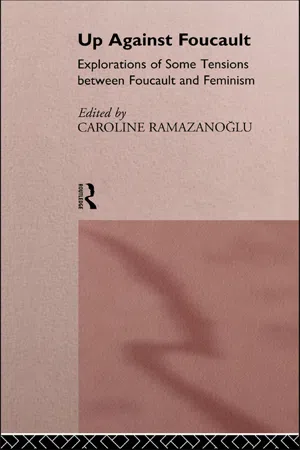
Up Against Foucault
Explorations of Some Tensions Between Foucault and Feminism
- 288 pages
- English
- ePUB (mobile friendly)
- Available on iOS & Android
eBook - ePub
About this book
Up Against Foucault introduces key aspects of Foucault's work to feminists, in ways which are less abstracted than much of the existing literature in this area. It includes an introduction to Foucault's terms, and fills a gap in the literature by clarifying the links between the everyday realities of women's lives and Foucault's work on sexuality and power. The contributors explore the implications of analysing power relations, sexuality or the body, without also thinking about gender and other social divisions. They bring their expertise from social theory and philosophy to bear on the same core issues; the ways in which Foucault provokes feminists into questioning their grasp of power relations, and the implications of the absence of gender in his own work. Up Against Foucault shows that in spite of his lack of interest in gender, Foucault does have much to offer feminism - proposing new ways of understanding the control of women and especially the control of sexuality and bodies. This book offers new ground in relating Foucault's challenge to feminism to feminisms challenge to Foucault. Feminists are up against Foucault because he questions the key conclusions which feminists have come to about the nature of gender relations, and men's possession of power. It is an appraisal of how seriously we need to take this challenge.
Information
Chapter 1
Introduction
Caroline Ramazanoglu
COMING TO TERMS WITH FOUCAULT
I arrived late at a women’s meeting towards the end of the annual conference of the British Sociological Association a few years ago, to find some women expressing indignation at finding session after session of the conference dominated by men talking in terms of ‘postmodernism’. These women said they felt silenced, intimidated, excluded, put down and angry. They did not know whether ‘postmodernism’ was something they should take seriously, because they could not engage with a debate which made the issues inaccessible to them. In her chapter, Susan Bordo describes her own negative encounters as a graduate student with the ‘elitism’ of poststructuralist thought.
The general areas of thought which have been defined (in various ways) as postmodernist and poststructuralist are, however, the intellectual context of Foucault’s work. Much of the work in this area has been characterised by intellectual elitism, and a level of abstraction from experience which makes it far removed from most English-speaking feminist work. This has turned discussion of the wider relevance of Foucault’s thought into a demanding academic specialism which has had little impact on feminism outside academic circles. In discussions of Foucault, those most sympathetic to his work tend to disappear into his terminology.
French feminism has been closer to engagement with the work of Foucault, within a shared intellectual context which incorporates debates over poststructuralism and postmodernism (Duchen 1986). Recent French feminist social theory has taken a distinctive approach to sexual politics and differs in its relation to women’s experience from most of English-speaking feminism, although their respective concerns have some common threads (Braidotti 1991). In this book, the focus is on the implications of particular tensions around power, knowledge, identity and the body between English-speaking feminism and the work of Foucault.
It is quite feasible for feminists to come to terms with Foucault, and increasing numbers of academic feminists, particularly in North America, Australia and the United Kingdom, are doing this, even though some may initially have felt hostile to his approach to social theory. Some key concepts which are necessary for making sense of Foucault’s ideas are commented on in the last section of this chapter. These are marked in the course of the chapter by the symbol ‘*’. Further definitions are given by individual contributors in the course of their arguments.
Coming to terms with Foucault can be a confusing process since, at some levels, Foucault appears to have much to offer in enhancing feminist understandings. He has enabled feminists to look in new ways at the control of women and especially at sexuality and women’s bodies. At other levels, though, Foucault can be said to challenge or even undermine feminism. Directly or indirectly, he questions many of the conclusions which feminists have come to about the nature of social life, and so disintegrates collective political strategies for transforming gendered power relations. This book is intended as an appraisal of how seriously we need to take this challenge.
The contributors comment on Foucault’s lack of interest in gender, which raises the question of why feminists should want to make the effort of paying attention to his work. In different ways, however, and with different degrees of warmth towards him, they explore three grounds for claiming that what Foucault is saying should be attended to.
First, his approach to understanding power* relations can offer feminists new and productive insights into women’s relations with men and with one another. While feminists have been developing theories of the social construction of gender, sexuality and the body, Foucault has opened up a parallel but rather different theory of social construction through new ways of deconstructing history* and of analysing present power relations.
A second reason for taking Foucault seriously is his challenge to a number of the key assumptions about the nature and causes of women’s subordination on which various versions of feminism are based. Foucault’s ideas on power, knowledge*, the self* and sexuality, for example, are not compatible with feminist ideas in any simple way, and suggest considerable problems in feminist uses of these terms. Foucault is not simply offering interesting ideas which we can add on to feminism if we wish. The implications of his argument suggest that feminist political practices are based on a misunderstanding of the power relations that feminism aims to transform.
Feminists cannot afford to ignore Foucault, because the problems he addresses and the criticisms he makes of existing theories and their political consequences identify problems in and for feminism. In her chapter, Jean Grimshaw comments that Foucault’s work is useful in pointing out that theories of emancipation tend to be blind to their own dominating tendencies, and feminism is not innocent of power. There is a strong case for women to respond to the ways in which Foucault challenges feminism, by thinking again across our social divisions about what we mean by, for example, autonomy, empowerment, justice, sexual politics, oppression and liberation.
A third reason for attending to Foucault is that feminist knowledge poses a considerable challenge to the validity of his work. Because feminism, until recently, has developed largely outside poststructuralist and postmodernist thought, and because Foucault largely ignored feminism, there has been very little engagement between Foucault’s ideas and those of English-speaking feminism. The force of this feminist challenge has, as in other areas of social theory and philosophy, been inadequately recognised. Recently there has been growing interest in Foucault’s work among academic feminists, with both enthusiastic applications of his ideas, and more critical evaluations of his work (for example, Diamond and Quinby 1988; Fraser 1989; Bartky 1990; Butler 1990; Nicholson 1990; Hekman 1990; Braidotti 1991; Sawicki 1991; Barrett and Phillips 1992). There is no equivalent literature from male scholars sympathetic to Foucault, which provides a comparable critical assessment of feminism.
In this book, the focus is specifically on appraisal of the work of Foucault, rather than more generally on poststructuralism or postmodernism, because of the distinctive contribution Foucault has made to thinking on issues of importance to feminism. The contributors invite us to consider what it means to analyse power relations, sexuality or the body, without also thinking about gender and other social divisions in the light of women’s experience. There is no attempt here to cover all the diverse areas of history, literature or cultural studies in which Foucault’s ideas have been influential, nor all the diverse political standpoints from which his work could be appraised. The contributors focus, from their different locations in social theory and philosophy, on the same core issues; the ways in which Foucault provokes feminists into questioning their grasp of power relations, and the implications of the absence of gender in his work.
FOUCAULT’S CHALLENGE TO FEMINISM
Although Foucault offered no particularly direct challenge to feminists himself, and seemed personally sympathetic to women’s desire to change power relations, his work has particular implications for feminist thought and feminist politics. Feminists are up against Foucault in the sense that his work, like that of some of his contemporaries, invites us to think differently about the nature of knowledge and power, and questions in particular the ways in which feminists have thought about men having power over women.
Looking at power relations with Foucault’s insights upsets key assumptions in feminist thinking. Feminism developed in reaction to established ways of western thought, which subordinated, separated or devalued everything female. At the same time, feminists were constrained in how they could think about power and knowledge by the categories of thought that already existed (Acker 1989:73; Hekman 1990:188). There are, in particular, assumptions about reality and truth, cause and effect, freedom and the nature of human agency, which have become so taken for granted since the period of the Enlightenment* in western thought, that many feminists have adopted them more or less uncritically. Foucault intentionally disturbs and upsets what we have taken to be true.
The ways in which Foucault’s work challenges feminism, however, is by no means straightforward. While Foucault might criticise feminism for the limitations and rigidities of its conception of the ‘truth’ of patriarchy, feminists could criticise Foucault because he did not recognise that his supposedly neutral analysis of truth, power and sexuality as produced in discourses*, comes from a male perspective. It is not a simple question of feminism being able to counter Foucault’s masculinist analysis with an alternative woman-centred analysis. Rather, the interaction between Foucault’s penetration into the nature of power, and the grounding of feminist explanations in women’s diverse experiences, confront us with peculiarly difficult problems of explanation.
Foucault’s deconstruction of abstract schemes of power, such as patriarchy or capitalism, led him to emphasise the unstable ways in which power is constantly created. Although he certainly recognised domination—for example, in the prison system—he thought it was a mistake to study it as a system benefiting a particular group, and analyse it from the top down. He conceptualised people’s experiences of domination and subordination as ‘effects’ of power rather than as proceeding from a specific source of power. This view has enabled feminists to look at power relations with new eyes, but, where feminists ground their conceptions of power in women’s accounts of their experiences, it also opens up a potential gulf between followers of Foucault and his feminist critics. Taking women’s diverse experiences of subordination as a source of knowledge, however, is a complex business. The contradictions and inconsistencies of feminist thought should alert us to see that feminism is deeply contradictory because women’s lives are contradictory (Ramazanoglu 1989). This is not because of any intellectual fragility of feminist thinkers, but because close examination of the diversity of women’s experiences poses immensely difficult problems of explanation which have not been adequately tackled by existing social theories, including Foucault’s. The tensions between Foucault and feminism bring out fundamental problems of explaining power relations which social theory has failed to resolve. It is this complex interaction that is pursued with different emphases by the contributors to this volume.
Foucault’s work provides a sharp critique of some of the ways in which feminists have set about explaining gendered power, but Foucault’s impact on feminism has also been positive, as all the contributors acknowledge. What he has usefully done is to provide new means for thinking through some of the areas of understanding social life which have proved contradictory and problematic. These contradictions and problems are not necessarily specific weaknesses of feminism, but the consequences of feminism’s somewhat pragmatic and ad hoc approach to some of the most profound problems of explanation confronting social theory.
The work of Foucault has been influential in supporting the view that not only gender, but also sex and bodies, are social constructions. Foucault takes aspects of our selves which in western culture have come to be taken as fixed, and analyses them as historical effects of power which are constituted by shifting social forces, rather than by our fixed, physical being. Sex and bodies can then be seen as social productions rather than as material; as giving us the possibility of multiple social identities, rather than confining us to an essential self which is ‘truly’ us. Although he may not have intended to abstract his analysis from material existence (Rabinow 1991:10), feminists have found his emphasis on social construction both useful and problematic.
Whereas feminists have, in recent years in particular, been paying attention to what Foucault has said about the social construction of sexuality, power and pleasure, Foucault himself, and poststructuralists and postmodernists more generally, have tended to ignore, simplify or distort what feminists have said about sexuality and power. This risks leaving feminist theories as rooted in rather simplistic forms of biological essentialism which can easily be dismissed. Such interpretations make Foucault’s challenge to feminism an overwhelming one, and reinforce feminist fears of being caught out as guilty of implicit essentialism or reductionism.
Various conceptions of social construction are characteristic of all versions of feminism, but the bugbear of biological essentialism—the idea that there is an essential femaleness or essential maleness in our physical being that might help explain social differences between women and men, has proved a persistent problem for the potential coherence of feminist thought. Different feminists have taken radically different attitudes towards such claims. Relatively few have ever taken on these views explicitly, wholeheartedly and persistently in the face of criticism. As Maureen Cain’s chapter shows, there is now a much more careful consideration of issues of epistemology, methodology and philosophy of social science in attempts to explain gender relations than was the case in the 1960s. But as feminism has diversified over the last twenty years or so, there is little sign of more agreement on whether, or how, to regard material bodies as more than social. Feminist criticisms of Foucault raise again the problem of how we can take our feelings and material existence into account without reducing explanation of social life to biological determinants.
Rather than feminists having to choose between being either biologically essentialist or not, the possibility of biological nature, or material bodies, playing some part in explanation of gender difference runs under the fields of feminism like a camouflaged sewer into which the unwary may trip and so be contaminated without fully realising their danger. It is not that feminist assumptions, in contrast to those of Foucault, are built on biological essentialism, or particular versions of materialism, but that many feminists, by paying close attention to women’s daily lives, and to common elements in diverse women’s experiences, have found the odour of biological essentialism clinging to them. This stumbling over how best to understand the material levels of our existence has been taken as a critical weakness of feminism.
Foucault offers us a theory that bodies and sex are social constructions and are produced as effects of power. This has seemed attractive to many who want to escape any charge of biological essentialism. It enables them to view bodies as only explicable in terms of truths that are socially produced. However, treating material bodies as wholly irrelevant to explanations of sexual and other social relations remains an area which has perhaps been the subject of too much assumption and too little analysis. Foucault’s version of social construction does not resolve problems about how we understand the body from the vantage point of subordinated women’s bodily experiences.
Feminists are divided over what ‘truth’ status should be accorded to feminist knowledge, as continuing debates over feminist methodology indicate. The simplest position is that a women’s subjective knowledge is ‘true’ because it directly articulates women’s experience. This position is problematic because it poses no challenge to the dualisms of thought that western culture has inherited from the Enlightenment. Claiming that women’s subjectivity produces ‘true’ knowledge of, for example, domestic violence, is simply the other side of the argument that men’s knowledge is ‘true’ because it is rational, objective and neutral. A more logical position for feminists is that, since subjectivity and objectivity cannot ever be separated in the way that the dominant scientific models of western social theory proposed, we always have to interpret and conceptualise accounts of women’s disparate experiences. Knowledge of domestic violence cannot then be produced without taking account of women’s experience, but such knowledge is not confined to that experience, it is simultaneously always also embodied and conceptualised.
DIFFERENCE IN DANGER—THE POLITICS OF RELATIVISM
Using Foucault for feminist purposes is complicated by the fact that his position shifted in some respects between his major works, and again in the many interviews and discussions with him which have been recorded. His later reflections on his earlier work can be particularly confusing for those seeking consistency in his thought. If consistency is looked for, feminists are at risk of being lured into some version of political pluralism in which feminist politics are undermined by political relativism. There can be a further slippage here between the complexity, inconsistencies and contradictions of Foucault’s work and the tendency of some of those attracted to his ideas to simplify and unify his thought.
Just as feminism is becoming a significant intellectual force in the production of knowledge, it is in danger of being thwarted by an elitist, but academically respectable, relativism and pluralism which ignores gender, disempowers women and diminishes difference. Since academic social theorists are increasingly under some pressure to acknowledge feminist social theory, those unsympathetic to feminist politics are offered a level of engagement between feminism, poststructuralism and postmodernism which is intellectually challenging, but extremely abstracted and also insensitive to the political point of f...
Table of contents
- Cover Page
- Title Page
- Copyright Page
- Contributors
- Chapter 1: Introduction
- Part I: Reflections on the value of Foucault’s Argument for Feminism
- Part II: Identity, Difference and Power
- Part III: Bodies and Pleasures Power and Resistance
Trusted by 375,005 students
Access to over 1.5 million titles for a fair monthly price.
Study more efficiently using our study tools.
Frequently asked questions
Yes, you can cancel anytime from the Subscription tab in your account settings on the Perlego website. Your subscription will stay active until the end of your current billing period. Learn how to cancel your subscription
No, books cannot be downloaded as external files, such as PDFs, for use outside of Perlego. However, you can download books within the Perlego app for offline reading on mobile or tablet. Learn how to download books offline
Perlego offers two plans: Essential and Complete
- Essential is ideal for learners and professionals who enjoy exploring a wide range of subjects. Access the Essential Library with 800,000+ trusted titles and best-sellers across business, personal growth, and the humanities. Includes unlimited reading time and Standard Read Aloud voice.
- Complete: Perfect for advanced learners and researchers needing full, unrestricted access. Unlock 1.5M+ books across hundreds of subjects, including academic and specialized titles. The Complete Plan also includes advanced features like Premium Read Aloud and Research Assistant.
We are an online textbook subscription service, where you can get access to an entire online library for less than the price of a single book per month. With over 1.5 million books across 990+ topics, we’ve got you covered! Learn about our mission
Look out for the read-aloud symbol on your next book to see if you can listen to it. The read-aloud tool reads text aloud for you, highlighting the text as it is being read. You can pause it, speed it up and slow it down. Learn more about Read Aloud
Yes! You can use the Perlego app on both iOS and Android devices to read anytime, anywhere — even offline. Perfect for commutes or when you’re on the go.
Please note we cannot support devices running on iOS 13 and Android 7 or earlier. Learn more about using the app
Please note we cannot support devices running on iOS 13 and Android 7 or earlier. Learn more about using the app
Yes, you can access Up Against Foucault by Caroline Ramazanoglu in PDF and/or ePUB format, as well as other popular books in Social Sciences & Critical Theory. We have over 1.5 million books available in our catalogue for you to explore.