- 224 pages
- English
- ePUB (mobile friendly)
- Available on iOS & Android
eBook - ePub
About this book
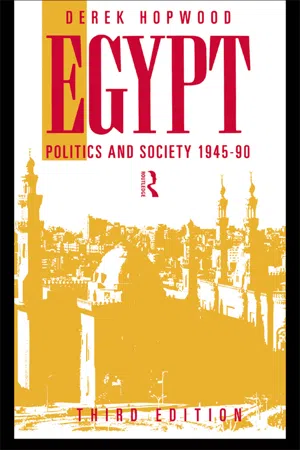
The second edition of this lucid and accessible work rapidly established itself as a textbook for universities and colleges. This new edition brings it further up to date and places the achievements and failures of President Mubarak in context. The new material includes an examination of Egypt's role in the Gulf Crisis. The book is divided by topic and areas covered include: * The political ideologies of Presidents Nasser and Sadat * The economic problems facing the nation * The role of Islam in politics and in society * Egyptian culture and literature
1 Egypt and the Egyptians
They have worked their way through history by tenacity. (Louis Awad)
Our Egyptian civilization—which dates back 7000 years— has always been inspired by man’s love of, and attachment to the land. (Anwar Sadat)
Geography and Society
Egypt is a country overburdened with history and geography—a history overwhelming yet inspiring, a geography restricting yet lifegiving. She cannot develop as a nation without looking back over her shoulder at the past, nor develop as a country without taking the Nile into account. Egypt has been the prisoner as well as the gift of the Nile. Historically, the Egyptian people have been led to the Nile valley and delta and have drawn their sustenance from the waters of the river. The Nile valley was rather closed and self-contained and although foreign rulers have come and gone, the people have preserved themselves and a way of life for thousands of years without much break in continuity. Egypt has often participated in Middle Eastern events and has been affected by them but has never lost an essential Egyptian identity, integrating whatever was received or imposed, asserting continuously her own character. Egypt is part of Africa linked physically to Asia by the Sinai peninsula. A long coastline and the port of Alexandria have drawn her into the Mediterranean world. The Nile pulls her down into Africa and the control of its head-waters has been of primary concern to Egypt’s rulers. The country is thus uniquely situated to participate in several worlds, the African, the Arab and the Mediterranean.
Lower Egypt consists of the area from Cairo northwards which includes the Delta where the Nile splits into several branches. This is the most fertile, populous and cultivated region. To the east and west lie deserts and further east Suez and Sinai leading to the frontiers of Israel, Jordan and Saudi Arabia. Upper Egypt is mainly the river with cultivated strips of land on either side varying in width from two to fifteen miles. The cultivated area stops abruptly and is replaced by arid desert which on the eastern side reaches the Red Sea and in the west merges into the Sahara. There are five scattered oases in the Western Desert. The area of the whole country is some 385,000 square miles of which less than 5 per cent is cultivable land. On the map this resembles a flying kite—the triangular delta attached to the long string of the Nile. The climate is mostly arid and hot with little rain except on the Mediterranean coast. The desert is virtually rainless; Cairo has about 1·3 inches of rain a year. Aswan which was once rainless now on occasions experiences mist and cloud and even rain caused by the proximity of the artificial lake formed behind the High Dam.
Apart from the northern coast the seasons vary little, except for the intensity of the heat. Far more important and central to Egyptian life was the annual flooding of the Nile in autumn. This was a sign that Egypt could live a further year; a low flood could mean a ‘lean’ year. Life centred round the river, a benefactor which bestowed or withheld an annual bounty. It provided the rhythm of life and rarely could the thoughts of the peasant have been far from the Nile and the incessant work it demanded. Whereas ancient Egyptians worshipped the Nile, modern Egypt calls it ‘the sea’ as a token of its greatness, and the cultivable land on its banks is ‘the mud’. Prayers were said to encourage the annual flooding and when this was too low prices rose, land dried up and a general feeling of malaise easily spread. The river together with its canals also provided a convenient means of transport, while from its mud were made bricks to build dwellings. Now because of the High Dam the river will no longer flood; water is released regularly and ‘scientifically’; the old flood levels are pointed out, the fall in the height of the river is wondered at. Can such a radical change fail to affect the attitude to life itself?
Extreme heat is an inescapable feature of life in the Middle East. The sun, which to Northern Europeans is something to be welcomed and enjoyed, is something to be shunned and escaped from into shade or air conditioning. It is a constant factor of life which can enervate and lead to indifference, or fray tempers. The lack of rain causes an all pervasive dust in most Middle Eastern towns and a wind raising the dust on a hot day can make life well nigh unbearable. Heat determines modes of life, regulates the day’s work and its effects must be reckoned with in an account of Arab society. Egypt is not the hottest of Arab countries, but summer temperatures in Cairo rise to 40°C and in Upper Egypt to 50°C. For those who can afford it the Mediterranean coast is a welcome relief in summer. Another escape is the shuttered, curtained house or flat which keeps out the worst effects of heat and light.
Whereas the Nile and its villages have been a very slowly changing aspect of Egypt, the capital city, Cairo, bears witness in stone to a long involvement with other peoples and cultures. Most foreign rulers and dynasties have left some evidence of their stay in civil, military and religious architecture. Cairo (the name is the European version of the Arabic, al-Qahira—‘the victorious’ —given to celebrate the entry of a new ruler), founded in 969 near the site of another city more than three centuries older, is sited just south of the barrage (completed in 1861) that regulated the flow of water into the Delta through the two branches of the lower Nile. It stands astride the gateway to the Delta and has controlled its destiny but is open to attack from the north, east and west and has been subject to a long series of invaders from the Arabs to the British. It has dominated the country as its capital and one out of every six Egyptians lives within the metropolitan area which also contains most industry, universities and colleges, and central government and financial offices. It is the centre of economic, cultural, religious and intellectual life and acts as a magnet to the rest of Egypt and to parts of Africa and Asia. It is a great and lively city and a city having to struggle with all the modern problems of housing, servicing and transporting a multitudinous population.
The original Arab city of Fustat was founded as a military encampment in about 640 on the eastern bank of the Nile by invading Muslim forces. A series of other invading forces gradually moved the focus of the city, the most important being the Fatimids from North Africa. Their city of al- Qahira took over from Fustat, which gradually fell into ruin. Their most notable monument is the university mosque of al-Azhar. Great city walls and a citadel were built under the rule of Saladin in the twelfth century, while all the time urban domestic and economic quarters were growing, usually in the traditional Middle Eastern manner of grouping trades together. The following centuries, dominated by other foreign rulers, Circassian and Turkish, added other monuments which still stand today— mosques, houses, mausoleums, bazaars. In the fifteenth century Cairo was probably greater in extent and population than any city in Europe and excited the wonder of European visitors.
A change was brought about when Egypt fell in 1517 to Ottoman Turkish rulers from Anatolia. Cairo became a provincial capital subordinate to Constantinople, which attracted to itself the intellectual and artistic talents of the Ottoman Empire. Arab civilisation and Arabic fell into the doldrums. Cairo declined in population and to some extent economically. The city in a sense withdrew into itself until Napoleon arrived with his army in 1798. While the French were there too short a time basically to alter the face of the city, the invasion so disrupted the existing state of affairs that it can justly be considered a turning point both in the history of Cairo and of Egypt. The French withdrawal led to the establishment of a new dynasty of Albanian origin which ruled Egypt until 1952. Avowedly westward looking, they were responsible for introducing into the country ideas of westernisation and modernisation. As far as Cairo was concerned a new city patterned on European lines was built alongside the existing mediaeval one. The French had begun to impose a new street system on the city, mainly for military reasons, but it was two rulers from the new dynasty, Muhammad Ali (1805–48) and Ismail (1863–79) who undertook the development of Cairo. By the end of the nineteenth century the city consisted of two parts which symbolised the new departure in Egyptian history. The western type city was growing separately from the older eastern Islamic, just as new ideas were entering the country and developing alongside deeply held older convictions. Moreover the population of the new areas held a large proportion of European immigrants whose presence was to affect subsequent Egyptian history.
In the new city which stretched to the Nile streets were widened, paved and lit, new bridges built across the river, swamps, ditches and ponds filled in. Paris was the model emulated, with its boulevards, squares and parks, opera house and hotels. New quarters were developed for residential, business and government purposes, and until the end of the century Cairo grew largely in the way determined by the planners of Ismail. The population reached about 600,000, still split into two fairly separate entities. The mediaeval city gradually filled with immigrants from the countryside, while the new European style city spread outside its boundaries remaining socially and physically distinct from the old.1
The new century brought great changes. New tramlines opened up new areas which gradually coalesced into the city. The population increased dramatically until it had reached 6 million by 1970. The city spilled over into surrounding districts engulfing villages and rural areas, creating new districts such as Heliopolis, a middle class suburb, and continually crowding more people into existing ones, imposing strains on all the existing municipal services.
Egypt’s life is tied to the Nile, and much urban development outside Cairo is also on the Nile. In the far south Aswan has developed around the dams built there. Luxor is chiefly a tourist centre built near the sites of ancient Thebes and Karnak. Of the numerous other towns between Luxor and Cairo, Asyiut, Minya and Sohag are among the largest. The Delta from Cairo to the coast is a densely populated and cultivated area. The Delta road north from Cairo is a complex mix of local rural traffic, donkeys, bullocks and carts, and lorries and cars on inter-city journeys.
donkeys, bullocks and carts, and lorries and cars on inter-city journeys. Egypt’s second largest city, Alexandria, lies off the Nile and was for long a city of the Mediterranean rather than of Egypt. Built on a Greek site, its population was a mixture of Greeks, Italians, Maltese, Lebanese and others, together with the Egyptians. The foreign minorities tended to predominate in many aspects of the city’s life such as trade, banking, tourism and culture and it developed a way of life described as ‘Levantine’. Manners, customs and taste were based on an imitation of certain aspects of a European lifestyle implanted in an Eastern Mediterranean setting. It has been best described in the novels of Lawrence Durrell and it produced at least one poet of international reputation, the Greek Cavafy. Since the revolution of 1952 the foreign population has gradually left Alexandria leaving it to the Egyptians whose numbers have been swollen by large-scale immigration.
The remainder of the urban population is concentrated in new industrial complexes such as Helwan and Mahalla al-Kubra, in one or two Mediterranean coastal towns, in the el-Arish oasis in Sinai, and in the towns on the Suez Canal. These latter were abandoned and partly destroyed when Israeli forces were on the east bank of the canal but are now being rapidly repopulated and developed. There are also plans to build new cities in various parts of the desert, which are slowly taking shape.
The geography of Egypt has moulded the way of life of most Egyptians which has changed only slowly over the centuries. For over 5,000 years peasants have drawn water from river and canal to irrigate their plot of land. Their lives have been days in the field and evenings in the village, the women working alongside the men. Life has been harsh and the earth indifferent. Their society has been formed by the twin influences of Egypt and Islam which have imposed on them a pattern of existence resistant to change. Not totally isolated but often remote from the centre of authority, the changes of ruler have left them largely unaffected. This and a long history have given the Egyptian a certain melancholy and lack of excitement in the face of change, as though few were ready to plunge the country into chaos to risk the anxiety of facing a new unknown life. The weight of history, which may sometimes provide an excuse for inertia, also gives to Egyptian life a compassion lacking in other nations. A leading critic and journalist, Louis Awad, has written of the fundamentally moderate temper of the Egyptians who
…look with suspicion on all forms of extremism, fanaticism and intoxication. They have worked their way through history by tenacity and not by passion or violence. This is what gives the stamp of permanence and indeed timelessness to our life and institutions…We have known the weariness of longevity and the drabness of immortality, but at least we have shunned the follies of more youthful nations which burn themselves to ashes with the fire of fickle fantasies and follow the paths of glory though they lead to the grave.
Presumably the peasant in the field does not view life in terms formulated by an intellectual but perhaps he senses that he is part of a greater whole that has had a long historical existence and that his life is shaped by forces over which he has little control. Despite large-scale migration to the cities the peasants still form just under 60 per cent of the population and further migration must harm Egypt’s agricultural production and add to the urban pressures. Despite quoting Awad above, such generalisations must be taken with caution. Some Egyptians are impatient with inertia and the constraints of history. The urbanised élite has often followed the ‘follies and fantasies’ of other nations and has been in the van of those demanding change and reform. The members of this élite and the intelligentsia have had an ambivalent attitude towards the peasant, as was the case in nineteenth-century Russia. They see him as part of the soil, the authentic expression of the land, but have an aversion to the dirt and poverty of the village. They have despised and misunderstood him, having little patience with his acceptance of his lot and his apparent ‘stubbornness’.
It is in the towns that the élite has flourished, government officials, military officers, businessmen, intellectuals and, until recently, big landowners. Wealth, occupation and education have fixed a gap between rich and poor, well-to-do city dweller and the urban and rural poor, widened by the greater contact of the city with Western techniques and education, which tended to disrupt those traditional values which had provided a point of contact between the two. It is in the towns that the ‘isms’ of our time have blossomed—fascism, Marxism, fundamentalism —and more importantly where the concepts of nationalism have been nurtured, abused and glorified. No modern nation can tolerate this division of the people by wealth, education or culture and it will be shown later what efforts have been made to create a unified nation and to try to eliminate such a gap.
Another feature of life given to Egypt by its geography has been a centralised government. In a society based on a river—a hydraulic society— the ruler is indispensable for controlling the supply of the water. In such a society he is the intermediary between man and the river. The people’s lives depend on water and proper irrigation and on order imposed by the government. A bureaucracy imposes itself to oversee the development and maintenance of canals and ditches. Only in a centrally organised bureaucratic society could such supreme monuments as the pyramids have been built. But life also depended on co-operation. Water had to be shared and had to flow from the river to irrigate the land of all. No peasant could monopolise the supply or prevent its passage to land of neighbours. The need for co-operation and strong government could easily lead to an acceptance of despotism and to servile submission. An Egyptian student has written: ‘He does not know Egypt’s history who denies that despotism and oppression from one side, submission and flattery from the other, are among the deepest and worst features in Egyptian life throughout the ages, that they are the sad leitmotiv in the drama of Egyptian history’. Submission, a belief in the futility of opposition, and the other side of the coin, the moral value attached to patience, have given rise to a number of proverbs which express the peasants’ feelings, such as ‘Water will not run uphill’. At the same time complaint is a constant feature of Egyptian life. In Egyptian songs ‘complaint’ is expressed with deep sadness and an awareness of the futility of the complaint. ‘To whom shall I complain, when all are suffering injustice?’ Nevertheless the peasant has not always accepted his lot and when driven too far has risen in revolt, although the geography of the country and a strong government has made the suppression of revolts relatively easy.
Islam
The influences on Egyptian society discussed above have themselves been modified by another important factor—the Islamic religion. Islam was first proclaimed by the prophet Muhammad during the early years of the seventh century in the towns of Mecca and Medina in present day Saudi Arabia. His message was that of a simple faith, obedience to God (Allah) and his prophet, strict observance of the duties of prayer and almsgiving, pilgrimage to Mecca, and the promise of punishment or reward in the next world. By force of circumstances, Muhammad found himself the leader of a community in Medina for which he had to establish a system of government, laws and institutions. Henceforward, Islam became a total way of life, regulating society and government, family and private life. Unlike Christendom, no distinction was made between church and state, and no church with rituals and hierarchy was ever established. For thirteen centuries this religion has influenced the life and society of Egypt. Islam brought radical and lasting changes, not only in religious practice but in the whole of life. Egypt has been one of the leading centres of Islamic teaching in the world with the mosque of al-Azhar in Cairo the focal point. No visitor to Cairo can fail to be struck by the number of mosques, the number of people praying, the call of the muezzin (or in these days tape-recordings) and the celebration of various religious festivals, especially during and after the fast of the month of Ramadan. All these combine to give a noticeable religious flavour to Egypt. In the older parts of Cairo during the festivals there is the feeling of being in a city of religion just as much as in Rome or Jerusalem.
Islam is deeply embedded in Egypt and demands a response on the part of the people. As in the West, religous festivals can be observed with little religious conviction but at least until recently Islam has been widely and sincerely observed and there are now clear signs of a revival of observance. In Cairo the intellectual tradition has had a leading position through the dominance of al-Azhar university mosque, although in certain poorer quarters of Cairo and in provincial towns and villages a more popular form of religion, often connected with mystical orders, has been prevalent. Local saints’ days have been the occasion for great popular festivals, sometimes frowned upon by the more orthodox. Most Egyptians would recognise Islam as a bond in their life and a factor uniting them, although there have been and are those who question the place of Islam in society, who have tried to find ways of bringing into religion the scientific, social and economic ideas of the twentieth century, and those who have abandoned the attempt and have turned to secularism. (An interesting and perhaps significant fact is that some of those who are openly secularist or agnostic still call themselves Muslim—using the term in an exclusively cultural and social context.) Opposed to the secularist and reformist trend there has been a strong current of religious fundamentalism, sometimes in an organised movement, of those who preach that the only remedy for a society afflicted by non-Islamic ideas and goals is a return to the pure form of Islam as practised by the early Muslims. Such movements appeal to deep feelings in an Islamic country, in Egypt or elsewhere, and can strike responses in those who suspect that their society erred when it admitted the West, whether Christian or secular-scientific, into its midst. Thirdly, there are those Muslims, either scholar-clerics (ulama) or lay-believers, who continue to practise their religion according to the tradition of their forefathers, little troubled by doubts or questioning, clinging to religion as an unchanging rock in a changing world. The certainty of faith can be seen both in the faces of those women who visit saints’ tombs in the hope of fertility and of those dignified ulama who walk the streets of Cairo in the assurance of an unshakeable faith.
History to 1945
In 1962 President Nasser presented to the Egyptian people a National Charter. Its first section was a general introduction which characterised Egyptian history as a ‘constant struggle for a better life’ during ‘centuries of despotism and injustice’. Being an Egyptian and a nationalist it was natural for Nasser to see the history of his people as a continual series of invasions and foreign rulers, but it was historical licence to view the reaction of the people as an unending struggle against the invader. Once the native Egyptian rule of the Pharaohs had collapsed it is true that, strictly speaking, foreigners ruled the ...
Table of contents
- Cover Page
- Title Page
- Copyright Page
- List of Maps
- Preface to the Third Edition
- 1: Egypt and the Egyptians
- 2: The End of the Old Regime: 1945–1952
- 3: The First Years of the New Government: 1952–1956
- 4: The Unfinished Revolution: 1956–1970
- 5: Nasser’s Ideology
- 6: Sadat’s Revolution of Rectification
- 7: The Search for Economic Progress
- 8: Education and the Growth of Culture
- 9: The Life of the People
- 10: Mubarak’s Middle Way
- 11: Conclusion
- Notes
- Bibliography
Trusted by 375,005 students
Access to over 1.5 million titles for a fair monthly price.
Study more efficiently using our study tools.
Frequently asked questions
Yes, you can cancel anytime from the Subscription tab in your account settings on the Perlego website. Your subscription will stay active until the end of your current billing period. Learn how to cancel your subscription
No, books cannot be downloaded as external files, such as PDFs, for use outside of Perlego. However, you can download books within the Perlego app for offline reading on mobile or tablet. Learn how to download books offline
Perlego offers two plans: Essential and Complete
- Essential is ideal for learners and professionals who enjoy exploring a wide range of subjects. Access the Essential Library with 800,000+ trusted titles and best-sellers across business, personal growth, and the humanities. Includes unlimited reading time and Standard Read Aloud voice.
- Complete: Perfect for advanced learners and researchers needing full, unrestricted access. Unlock 1.5M+ books across hundreds of subjects, including academic and specialized titles. The Complete Plan also includes advanced features like Premium Read Aloud and Research Assistant.
We are an online textbook subscription service, where you can get access to an entire online library for less than the price of a single book per month. With over 1.5 million books across 990+ topics, we’ve got you covered! Learn about our mission
Look out for the read-aloud symbol on your next book to see if you can listen to it. The read-aloud tool reads text aloud for you, highlighting the text as it is being read. You can pause it, speed it up and slow it down. Learn more about Read Aloud
Yes! You can use the Perlego app on both iOS and Android devices to read anytime, anywhere — even offline. Perfect for commutes or when you’re on the go.
Please note we cannot support devices running on iOS 13 and Android 7 or earlier. Learn more about using the app
Please note we cannot support devices running on iOS 13 and Android 7 or earlier. Learn more about using the app
Yes, you can access Egypt 1945-1990 by Derek Hopwood in PDF and/or ePUB format, as well as other popular books in History & Middle Eastern History. We have over 1.5 million books available in our catalogue for you to explore.