- 360 pages
- English
- ePUB (mobile friendly)
- Available on iOS & Android
eBook - ePub
About this book
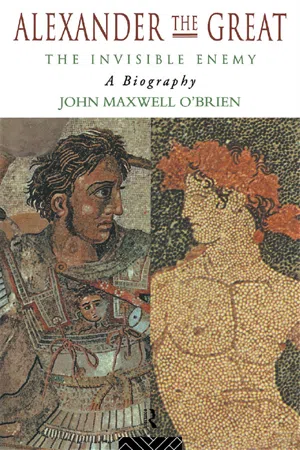
Despite Alexander the Great's unprecedented accomplishments, during the last seven years of his life, this indomitable warrior became increasingly unpredictable, sporadically violent, megalomaniacal, and suspicious of friends as well as enemies. What could have caused such a lamentable transformation?
This biography seeks to answer that question by assessing the role of alcohol in Alexander the Great's life, using the figure of Dionysus as a symbol of its destructive effects on his psyche. The unique methodology employed in this book explores various aspects of Alexander's life while maintaining an historical framework. The exposition of the main theme is handled in such a way that the biography will appeal to general readers as well as scholars.
1 The coming of age in Macedonia
DIONYSUS IN THE ROYAL TOMBS
In 1977 the Greek archaeologist Manolis Andronicos began unearthing three ancient tombs at Vergina in Macedonia, two of which had miraculously escaped pillage.1 When Andronicos removed the keystone from the vault at the back end of Tomb II, he gazed upon a repository of magnificent artifacts in situ from over 2,300 years ago. His discovery confirmed the suspicion of N.G.L.Hammond that Vergina was once Aegae, the ancestral capital city of Macedonia and the traditional burial ground for its rulers.2
The contents of Tomb II were particularly impressive. The sarcophagus located in the main chamber held a 24–pound gold chest with a Macedonian starburst (or sunburst) emblazoned on its cover.3 Inside the chest was a golden oak wreath, representing the tree sacred to Zeus, complete with delicately wrought branches, oak leaves, and golden acorns. Beneath the wreath lay the cremated remains of a man in his mid-forties who had taken his last breath during the fourth century BC. Traces of the purple cloth that had covered him were still evident.
The tomb itself was constructed some time between 350–310 BC, and since Alexander III (the Great) had been entombed in Alexandria, there were only two Macedonian kings to whom these bones could be attributed. Andronicos, the discoverer of the tomb, and a number of historians, including Hammond, have argued that this is, in all likelihood, the tomb of Philip II (359–336), the father of Alexander the Great. Other scholars have suggested Philip Arrhidaeus, the half-brother of Alexander the Great who ruled as Philip III (323–317), as a more plausible candidate.4 The absence of any identifying inscription prevents a final word on this matter, but in either case, the occupant was a blood relative and a contemporary of Alexander the Great.
The burnt bones of a young woman in her twenties were found wrapped in a gold and purple cloth placed in a smaller gold chest in the antechamber of Tomb II. Vestiges of a male teenager were uncovered in Tomb III. Tomb I, which had been denuded by grave robbers, contained the skeletal deposits of a woman, a man, and what may have been a newborn infant. These bones, and other human remains from the Royal Tombs at Vergina, continue to inspire speculation and impassioned controversy among researchers.5 The identities of the occupants of these tombs will probably never be established conclusively.
Within the walls of the unpillaged tombs, however, there lurked another tenant, whose wraithlike presence is indisputable, striking, and ubiquitous: Dionysus. This god, who could appear as a subterranean (chthonios) deity cloaked in a black goatskin (melanaigis),6 must have been at ease under the huge mound that crowned these burial vaults for over two millennia, for he was no stranger to death. Here, in the unlooted tombs at Vergina, Dionysus manifested himself as the god of wine. Tomb II contained an appreciable number and variety of drinking cups (see Appendix A). It also housed both large and small wine jars, a bucket to transport the sacred liquid, a mixing bowl, a spoon, a ladle, and a strainer—in short, all of the paraphernalia necessary for an epic drinking party other than the wine itself and the presence of a few live quaffers. The findings at Vergina are therefore consistent with Eugene N.Borza’s assertion that “thus far, the archaeological evidence seems to support the notion that the Macedonian gentry was a hard-drinking lot.”7
MACEDONIAN DRINKING
In their midst
stand bowls
brimming
with
wine
(Ba. 221–2)
In a surviving fragment from his lost On the Death of Alexander and Hephaestion, Ephippus, an Olynthian scandal-monger who joined Alexander on his Asian expedition, characterizes the Macedonians as a people who “never understood how to drink in moderation.”8 Ephippus claims that they drank so much at the beginning of a feast that they were drunk by the time the first course was served. In Plato’s Gorgias, one of the disputants, Polus, accuses Archelaus of usurping the Macedonian throne by hosting his rivals, getting them drunk, carrying them off in a wagon, and murdering them.9 Such tales strain credulity, but corroborate the fact that the Macedonians were singled out as a people who drank excessively. Ancient Greeks diluted their wine with water—possibly for economy, but certainly to discourage intemperance.10 Moderation was the hallmark of the civilized, while gulping was for the vulgar, and drunkenness was the way of the barbarian. The Greeks were highly critical of Macedonians, who, like barbarians, drank wine undiluted and in prodigious amounts.11 And the prototypical Macedonian drinker was Philip II, the father of Alexander the Great. The Athenian orator Demosthenes and the historian Theopompus of Chios, both of whom knew King Philip II, provide us with graphic descriptions of his drinking. Demosthenes likens Philip to a sponge;12 Theopompus claims that the Macedonian king not only got drunk on a daily basis, but was often in this same state when he rushed into battle.13 Political and personal biases permeate these accounts, but there is no question that Philip’s drinking was, as J.R.Hamilton claims, “notorious.”14 Philip gave protracted drinking parties, engaged in drinking bouts, and got drunk with predictable regularity.15 His drinking seems to have followed the pattern of a reward cycle: great expenditures of energy on the battlefield were followed by raucous celebrations and the consumption of huge quantities of “uncut” wine.16 Theopompus rightly characterized Philip, who was rumored to sleep with a gold drinking cup under his pillow, as a philopotes, a lover of drink.17
For most of his life this extraordinarily successful man appears to have been a rather genial drunk who accepted criticism, laughed at himself, and even modified his deportment when admonished. In one incident an aggrieved woman complained about one of Philip’s decisions, and he asked to whom she appealed. She stated, with clear reference to his condition, that her appeal was to a sober Philip. The king quickly came to his senses, reconsidered the case, and decided in the woman’s favor.18 After his great victory at Chaeronea in 338 “Philip downed a large amount of unmixed wine and…paraded through the midst of his captives, jeering all the time at the misfortunes of the luckless men” (D.16.87.1). When the Athenian captive Demades shouted that Philip acted more like the Homeric anti-hero Thersites than Agamemnon, the king abandoned his revelry and freed Demades in reward for his courageous reprimand.
Philip’s drinking prowess had its advantages. In a warrior society, where epic toping was a source of admiration and intemperance a virtue, the cavalier and extravagant way Philip carried on must have contributed to his personal mystique. He kept boon companions, comedians, and musicians close at hand for impromptu drinking parties, and seemed to favor those who drank as he did. Theopompus claimed that Philip spent most of his time with these men “because of their love of drinking and their vulgarity, and with them he used to hold deliberations on the most important matters.”19
While it appears that some temperate drinkers with essential skills also became members of his court, they could easily become targets of the king’s sardonic humor. For instance, Philip’s abstemious general Antipater was once singled out in the king’s ritualistic announcement of his intention to get drunk: “Now we must drink; for it is enough that Antipater is sober.”20 It is clear from this reference that his nondrinking companions were few.
Heavy drinking was also admired by some non-Macedonians, and in this respect Philip’s virtuosity was to his advantage. Theopompus claimed that Philip won over most Thessalians “by parties rather than by presents.”21 Catering to those with an appetite for wine similar to his own, Philip used his great capacity as an instrument of diplomacy. There must have been difficult moments, however, for those who failed to share his gargantuan appetite for drink at all hours. One might imagine the look of stoic resignation on the faces of Athenian envoys bracing for free-flowing wine at the crack of dawn.22
It is not surprising that Philip’s son attempted to emulate the royal tippler par excellence. When holding his own at a drinking party (symposium), Alexander’s drinking probably elicited almost as much admiration from his men as his heroics on the battlefield. It also served to confirm in an odd but significant way that this boy was his father’s son and a worthy successor. It is ironic that Alexander, who would see so little of Philip during his boyhood and who was determined to distinguish himself from him, would in this and a multitude of other ways come to replicate so many of his father’s attitudes and actions.
PHILIP AND ALEXANDER
Brilliant men rarely produce brilliant sons, and Alexander was fearful at an early age that the shadow cast by his father would eclipse his own ambitions.23 He was incapable of sharing in Philip’s glory, and became determined from the outset to make his own mark. His father was said to be “a man without precedent in Europe.”24 In war and peace, battles and celebrations, negotiations and philandering, Philip exhibited an irrepressible exuberance and a unique personality. These qualities, coupled with his intelligence and courage, and his succession of unparalleled victories on the battlefield, made him a folk hero among Macedonians. He was the savior of an imperiled country, a valiant warrior, second to none in fighting and drinking, and the idol of his battle-scarred veterans.25 Alexander would have to demonstrate that he, too, was a man of singular distinction. Furthermore, he had to show the world that he was not merely the equal of, but actually superior to, his famous father.
Philip’s early attitude toward Alexander offers every indication of paternal pride, affection, and a personal commitment to the boy’s future. Plutarch, our main source for Alexander’s youth, relates a story probably told many times over by Alexander himself.26 When Alexander was nine or so,27 his father was inspecting a Thessalian horse being offered for sale. This black stallion, with either a white patch on his forehead or an ox-head brand that earned him the name Bucephalas (“ox-head”)”,28 proved to be unmanageable, and Philip ordered him to be taken away.
“What a horse they are losing, and all because they don’t know how to handle him, or dare not try!” (P.6.2), declared Alexander. Philip asked his son if he found fault with his elders. Did he think he knew more than they? Could he handle a horse better? Alexander was quick to respond that at least he could handle this one better. Then Philip wanted to know if Alexander would be willing to set a value on his impertinent claim. Without hesitation, Alexander answered that he would pay the full price of the horse if he were proven to be wrong. This pronouncement drew a chorus of laughter. The selling price of the horse was said to be thirteen talents,29 an astronomical sum, and no one expected young Alexander to succeed where accomplished horsemen had failed. Nevertheless, his father offered him the opportunity to prove his claim.
They are difficult horses for mortal men to manage...
all except Achilleus [Achilles]
(Il. 10.402–4)
Alexander began by turning the head of Bucephalas toward the sun. With the perceptivity so characteristic of his later behavior on the battlefield, he had noticed that the horse shied away from his own shadow, and this simple maneuver eliminated an unsettling distraction. Alexander calmed the horse and trotted alongside him until the proper moment, when he gingerly leaped upon his back. Philip and his companions held their breath “until they saw Alexander reach the end of his gallop, turn in full control, and ride back triumphant and exulting in his success. Thereupon the rest of the company broke into loud applause, while his father, we are told, actually wept for joy, and when Alexander had dismounted, he kissed him and said, ‘My boy, you must find a kingdom big enough for your ambitions. Macedonia is too small for you’” (P.6.8).
Demaratus of Corinth, a diplomat, purchased the horse and presented him as a gift to Alexander. Until Bucephalas was 30 years old he carried his master into some of Alexander’s most celebrated battles. The king’s fondness for this animal was such that later in life, on the banks of the Jhelum River in modern Pakistan, he honored his horse by founding the city of Bucephala in his memory.30
the finest of all horses beneath the sun
(Il. 5.266–7)
Philip must have appeared impressive and admirable to his young son on the one hand, yet imperious and intimidating on the other. The king’s biting humor and jovial cynicism may have kept Alexander, as it had so many others, tentative and cautious when in his father’s presence. A clue to the relationship between father and son is found in an anecdote recorded by Plutarch, who tells us that Alexander complained about Philip’s siring of children by women other than the boy’s mother. His quick-witted father ignored the accusation and adroitly transferred the problem to his son. “Well then, if you have many competitors for the kingdom, prove yourself honourable and good, so that you may obtain the kingdom not because of me, but because of yourself,” he exclaimed.31
And Peleus the aged was telling his own son Achilleus
to be always best in battle
and pre-eminent beyond
all
others
(Il. 11.783–4)
From an early age Alexander was intensely concerned with the way in wh...
Table of contents
- Cover Page
- Title Page
- Copyright Page
- Preface
- Acknowledgments
- Frequently cited sources in the text
- Maps
- Prologue
- 1 The coming of age in Macedonia
- 2 A Homeric king
- 3 The metamorphosis
- 4 The ambivalent victor
- 5 Death in Babylon
- Epilogue
- Appendix A: The Royal Tombs
- Appendix B: Attributes of wine in Alexander the Great’s readings
- Postscript
- Key to abbreviations of frequently cited journals
- Notes
- Topics in the bibliography
- Bibliography
Trusted by 375,005 students
Access to over 1.5 million titles for a fair monthly price.
Study more efficiently using our study tools.
Frequently asked questions
Yes, you can cancel anytime from the Subscription tab in your account settings on the Perlego website. Your subscription will stay active until the end of your current billing period. Learn how to cancel your subscription
No, books cannot be downloaded as external files, such as PDFs, for use outside of Perlego. However, you can download books within the Perlego app for offline reading on mobile or tablet. Learn how to download books offline
Perlego offers two plans: Essential and Complete
- Essential is ideal for learners and professionals who enjoy exploring a wide range of subjects. Access the Essential Library with 800,000+ trusted titles and best-sellers across business, personal growth, and the humanities. Includes unlimited reading time and Standard Read Aloud voice.
- Complete: Perfect for advanced learners and researchers needing full, unrestricted access. Unlock 1.5M+ books across hundreds of subjects, including academic and specialized titles. The Complete Plan also includes advanced features like Premium Read Aloud and Research Assistant.
We are an online textbook subscription service, where you can get access to an entire online library for less than the price of a single book per month. With over 1.5 million books across 990+ topics, we’ve got you covered! Learn about our mission
Look out for the read-aloud symbol on your next book to see if you can listen to it. The read-aloud tool reads text aloud for you, highlighting the text as it is being read. You can pause it, speed it up and slow it down. Learn more about Read Aloud
Yes! You can use the Perlego app on both iOS and Android devices to read anytime, anywhere — even offline. Perfect for commutes or when you’re on the go.
Please note we cannot support devices running on iOS 13 and Android 7 or earlier. Learn more about using the app
Please note we cannot support devices running on iOS 13 and Android 7 or earlier. Learn more about using the app
Yes, you can access Alexander the Great: The Invisible Enemy by J M O'Brien,John Maxwell O'Brien in PDF and/or ePUB format, as well as other popular books in History & Ancient History. We have over 1.5 million books available in our catalogue for you to explore.