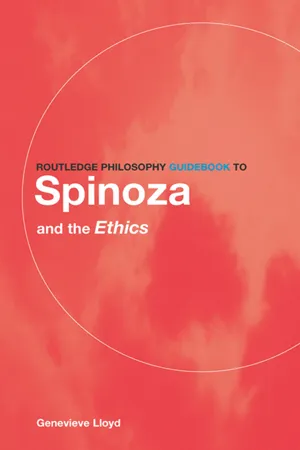
Spinoza is a key figure in modern philosophy. Ethics is his most studied and well known work. Being both up-to-date and clear, this Guidebook is designed to lead the reader through this complex seminal text.
Spinoza's Ethics introduces and assess:
* Spinoza'a life, and its connection with his thought
* The text of the Ethics
* Spinoza's continuing relevence to contemporary philosophy
- 176 pages
- English
- ePUB (mobile friendly)
- Available on iOS & Android
eBook - ePub
Routledge Philosophy GuideBook to Spinoza and the Ethics
About this book
Information
Chapter 1
Spinoza in his time and ours
The outsider
Cursed be he by day and cursed be he by night; cursed be he when he lies down, and cursed be he when he rises up; cursed be he when he goes out, and cursed be he when he comes in. The Lord will not pardon him; the anger and wrath of the Lord will rage against this man, and bring upon him all the curses which are written in the Book of the Law, and the Lord will destroy his name from under the Heavens…
(Wolf 1927:146)
Thus did the wardens of the Amsterdam synagogue excommunicate the 24-year-old Baruch Spinoza, on 27 July 1656. The record of excommunication mentions ‘horrible heresies which he practised and taught’ and ‘monstrous actions which he performed’. The content of the ‘heresies’ can be reconstructed from contemporary reports of his beliefs and from his writings. Spinoza held unorthodox views on the nature of God and of the human soul, on immortality and on the status of prophecy. Spinoza’s early biographers make it clear that his views were widely despised. The nature of the ‘monstrous deeds’ mentioned in the record of excommunication is more difficult to determine.
There are two old biographies of Spinoza. One was written by a Lutheran clergyman, Johan Cohler—Latinized as ‘Colerus’—and first published in 1705. The other, by Jean Maximilian Lucas—a freethinking French refugee living in Holland—is thought to have been written soon after Spinoza’s death in 1677, though not published until 1719.1 Colerus describes Spinoza’s physical appearance: ‘He was of a middle size, he had good features in his Face, the Skin somewhat black, black curl’d Hair, long Eye-brows, and of the same Colour, so that one might easily know by his Looks that he was descended from Portuguese Jews’ (Pollock 1899:394). Spinoza’s doctrines are presented by Colerus as ‘impious’, ‘absurd’ and ‘pernicious’; but he grudgingly acknowledges the integrity and amiability of the character from which they issued.
The older biography makes the allegation of ‘monstrous actions’ even less plausible. Lucas, who knew Spinoza personally, presents him as a lover of solitude, enjoying nonetheless the company of the ‘real men of learning’ who sought him out in The Hague, where he eventually settled. Lucas offers a picture of a man given over to a passionate love of learning, but delighting too in the joys of sociability—a lover of company who was not dependent on the admiration of others. His Spinoza is a man with a ‘well-seasoned’ wit, whose misfortune resulted not from monstrous deeds but from his being ‘too good and too enlightened’. Lucas stresses Spinoza’s freedom from concern with fame or appearances. When he was dying Spinoza requested that his name should not be put on the Ethics, saying that such affectations were unworthy of a philosopher. Lucas reports, too, that Spinoza consciously avoided the cultivation of untidiness which is often the mark of the philosopher, quoting him as suggesting that ‘such affectation of negligence is the mark of an inferior mind’ (Wolf 1927:64). Colerus in contrast describes Spinoza as careless in dress, to the point of slovenliness, quoting him as saying that ‘it is unreasonable to wrap up things of little or no value in a precious Cover’ (Pollock 1899:394). Whatever the facts of his appearance, we can take it that Spinoza was not motivated by a desire to impress others.
His excommunication was clearly a significant event in the life of the young Spinoza; but Lucas’s version of the story presents him as anything but a passive victim. On hearing of the ban, Spinoza responded: ‘All the better; they do not force me to do anything that I would not have done of my own accord if I did not dread scandal’ (Wolf 1927:51). It is true that the young heretic, who now called himself ‘Benedict de Spinoza’, was condemned to exile. But, if Lucas is to be believed, the sentence, ‘very far from injuring Mr de Spinosa, favoured the longing which he felt to leave Amsterdam’. What was crucial for Spinoza was ‘the love of solitude in which, he had no doubt, he would find Truth’ (Wolf 1927:56). The same love, reinforced perhaps by a shrewd caution, later led Spinoza to refuse the offer of a professorship at Heidelberg, saying that the instruction of the young would be an obstacle to his own studies and indicating his discomfort about the stipulated condition that he would not abuse his freedom of speech to ‘disturb the established religion’. In the lack of any income from his philosophical pursuits, Spinoza met his frugal needs—without sacrificing his independence and solitude—by making lenses for optical instruments. His vigorous intellectual life was not matched by physical robustness; and his work with glass contributed to the consumption which caused his early death. The cause of death prompted Hegel, in his account of Spinoza’s life in the Lectures on the History of Philosophy, to engage in fanciful speculation on the connections between Spinoza’s life and his work:
Spinoza died on the 21st February, 1677, in the forty-fourth year of his age. The cause of his death was consumption, from which he had long been a sufferer. This was in harmony with his system of philosophy, according to which all particularity and individuality pass away in the one substance.
(Hegel 1840:254)
Spinoza’s fatal choice of lens grinding as a livelihood was for Hegel no more incidental than his resulting death; it expressed—whether or not he was aware of it—his philosophical commitment to the oneness of things. ‘It was no arbitrary choice that led him to occupy himself with light, for it represents in the material sphere the absolute identity which forms the foundation of the oriental view of things’ (Hegel 1840:253).
We may well be sceptical about Hegel’s bold projections from the content of Spinoza’s philosophy to the details of his life. But an understanding of some aspects of the life does allow a richer appreciation of what is distinctive about the philosophy. This is especially true of the complex cultural and religious tensions within which Spinoza came to maturity. Spinoza was born in Amsterdam, on 24 November 1632, into a community of ‘Marranos’, who had left Portugal in the 1590s for the comparatively tolerant environment of the Netherlands. The Marranos were Portuguese and Spanish Jews, forcibly converted to at least an outward observance of Christianity, who had maintained Jewish practices in private until their position became increasingly precarious with the spread of the Inquisition.
Physical, cultural and political dualities provided a context for the dominant themes of Spinoza’s philosophy: the unity of a reality which nonetheless undergoes a myriad transformations; the dynamic character of bodies, minds and ideas; the transformation of emotions through understanding them. Seventeenth-century Netherlands culture was itself thickly layered with dualities—with tensions and movements between opposites—as new identities were forged in differentiation from the cultural patterns associated with Spanish rule.2 But in the midst of the dualities that found expression in seventeenth-century Dutch culture, the consciousness of Marrano Jews was subjected to a further set of tensions and ironies.
Yirmiyahu Yovel, in his study of Spinoza, The Marrano of Reason, gives a fascinating account of the ways in which Spinoza’s Marronite background shows up in his philosophy. Yovel sees it reflected in the style of the Ethics as well as in its content: in Spinoza’s mastery of dual language and equivocation—the capacity to speak to different audiences in different ways, masking his true intentions to some while disclosing them to others. Spinoza’s break with both Judaism and Christianity is, for Yovel, a ‘harbinger of the modern era’, with its scepticism and its breakdown of traditional structures (Yovel 1989:13). These compulsory converts to Christianity, he points out, were in an ambivalent position in relation to both religions. As refugees from the Inquisition they were ‘exiles within an exile’ with no firm social or spiritual identity, living in a state of existential alienation (Yovel 1989:22–4). Their former lives in Spain or Portugal involved a duality between their inner being as Jews and the outward forms of their lives. But in their new cultural context the Jewishness of the Marranos was often treated with suspicion by the local rabbis.
The phenomenological experience of Marronism was thus predominantly an experience of dualities and tensions—of a split between inner being and outward behaviour. This tension between truth and appearance may initially have been a survival strategy under conditions of persecution. But it was internalised, Yovel argues, as a more complex tension between a reclaimed Judaism and a residual Christianity in the symbols, attitudes and world images the Marranos carried with them (Yovel 1989:28). Spinoza repeated the dualistic life patterns of the Marranos twice over. He played out the rift between the inner and the outer both as a young dissenter within the Jewish community and as a free-thinker and reputed atheist in Calvinist-dominated Holland. Spinoza, on this construction, becomes a ‘Marrano of Reason’ anticipating, before it is a social reality, the modern ideal of a ‘genuine individual’, marked only by rational powers—a ‘universalist’ capacity, with no root or affiliation in a particular religious community (Yovel 1989:34).
Spinoza was thus an outsider in his immediate social context, not only in relation to the prevalent Calvinist culture—which was itself in turn reacting against Spanish Catholicism—but also in relation to the Jewishness of his immediate Marrano context; and that context was itself in turn in tension with local orthodoxy. The capacity for distance, detachment and irony—and for the intellectual play and transformation of ideas which those capacities make possible—are evident in the content and in the style of the Ethics. Spinoza draws on a wealth of philosophical sources. But constantly in the text we see concepts appropriated from earlier thought turn into something dramatically different
This capacity to transform philosophical ideas is particularly marked in the Ethics. Spinoza—at times with manifest irony—pushes concepts to the point where they turn into something quite unlike their sources. To read the Ethics is to see a succession of old, well-worn philosophical ideas made over in new and often startling forms. Themes from ancient thought—from the Stoics, Epicureans and Neoplatonists as well as from Plato and Aristotle—reverberate in the text. There are strong echoes too of medieval voices—of Maimonides, the twelfth-century philosopher and commentator on biblical and Talmudic texts, and of St Thomas Aquinas’s thirteenth-century appropriations of Aristotelian thought—as well as of his contemporaries, Descartes and Hobbes. A brief look at some of the themes which Spinoza takes over from other philosophers, and at their transformations, will help us see the dynamic character of his thought.
Spinoza’s treatment of knowledge, and of the relations between minds and bodies, centres on a concept familiar from seventeenth-century philosophy—the concept of ‘idea’.3 But his use of the term draws ingeniously on both its seventeenth-century connotations of mental content and older connotations drawn from ancient Greek philosophy. Spinoza’s version of ‘ideas’ has connections with Aristotle’s concept of form—the intelligible principle of a thing. But there are crucial differences as well as continuities between Aristotelian ‘forms’ and Spinoza’s ‘ideas’. The difference comes out in Spinoza’s famous treatment of the mind as ‘idea’ of the body. For Aristotle the soul as ‘form’ is the intelligible principle, in knowing which we know the capacities of the living human being—not only intellect but also sensation, locomotion and growth. The soul is the ‘form’ of the body. It is what we know in knowing the body. But it is not a mental object, set over against the body. It makes the body the living thing it is. The closeness this gives the mind-body relation is echoed in Spinoza’s insistence of the unity of mind and body. But this unity now has a different rationale.
Spinozistic minds, like other ‘ideas’, are expressions of reality under the ‘attribute’ of thought. And the same reality is expressed under another attribute—matter or extension—as finite bodies. Each attribute is a way in which the same reality becomes intelligible. Mind and body draw even closer here than in the Aristotelian framework; they are the same reality, though expressed in different ways. Yet into this new version of mind-matter unity, Spinoza has incorporated also the seventeenth-century preoccupation with ideas as mental contents. Spinoza’s ‘ideas’ differ from Aristotelian ‘forms’ in being essentially mental items, rather than ways in which matter is constituted or determined. But the mind’s status in relation to these mental contents is not what we might expect from familiarity with other seventeenth-century versions of ‘ideas’. The individual mind—rather than being the repository of private mental contents, set over against an outer world—becomes itself an idea with the human body as its object. The mind’s awareness is not directed at some mental item from which it infers the existence of body as something external. The immediacy of this new relation between mind and matter contrasts especially with the mediated relation characteristic of earlier Cartesian treatments of the mind-body relation. It harks back to the Aristotelian doctrine of the mind as the form of the body, the intelligible principle through which body is understood. Spinoza has brought the old closeness of the relation between form and living matter into the framework of seventeenth-century epistemology, yielding a new way of looking at minds and bodies.
Such startling shifts between different conceptual frameworks are, as we shall see, a recurring feature of the Ethics. To take another example, Spinoza’s extraordinary claim that the human mind is an idea in the mind of God—the claim which he himself acknowledges will make many of his readers pause in initial incomprehension—takes us back to Aristotelian ideas and their reconstructions in medieval thought—to Maimonides and St Thomas Aquinas. Spinoza evokes the ways in which some of the Hebrews perceived ‘as if through a cloud’ the unity of God, his intellect and the things he understands. The identity echoes Maimonides’s talk, in the Guide for the Perplexed, of the philosophical principle that God is ‘the intellectus, the intelligens and the intelligibile’ and that in him these three things are one and the same (Maimonides 1956: Ch. LXVIII, 101–2).4 Maimonides’s unities echo in turn Aristotle’s account in the Metaphysics (Book XII, Ch. 9) of the ‘active intellect’ of God. In thinking the object of its thought, says Aristotle, this intellect thinks itself: its thought and the object of its thought are the same. Aquinas affirms similar identities in the Summa Theologiae (I, Ia, 68). But Spinoza, as we shall see, transforms this unity of the divine intellect and its objects into the idea that reality itself is one and the same, whether it be grasped under the attribute of extension or that of thought. An esoteric doctrine of the nature of divine knowledge here becomes an innovative metaphysical theory of the relation between mind and matter in general.
Spinoza’s central concept of conatus—the ‘striving’ through which a thing endeavours to stay in being—likewise has a distinguished history. Harry Wolfson (1934), in his exhaustive study of Spinoza’s sources, traces it back to the ideas of ancient Stoicism—the philosophy which takes its name from the stoa poikile or Painted Porch in Athens, where its founder Zeno taught in the fourth-century BC. Stoic thought continued through a long tradition of distinctive theories of logic, physics and ethics, resonating in medieval philosophy and through the subsequent philosophical tradition. The early chronicler of ancient philosophers, Diogenes Laertius, attributed to the Stoics the idea that an animal has self-preservation as ‘the object of its first impulse’ (Long and Sedley 1987: I, sec. 57, 346). A similar idea surfaces in the writings of Augustine, in the fourth-century AD, and of Aquinas, in the thirteenth, as the idea of a basic impulse towards staying in existence—a natural force which impels living things away from self-destruction (Wolfson 1934: II, 195–9). Spinoza’s version of conatus, unlike its ancient counterparts, is not confined to animate things. Here physics and biology come together; there are echoes of ancient principles of motion as well as of Greek and Latin concepts of appetite. Spinoza identifies conatus with the very being of finite things, claiming—at first sight paradoxically—that a thing’s endeavour to persist in being is identical with its very essence. Another striking feature of Spinoza’s version of the concept is that, in the case of those finite individuals which are human, conatus is intimately connected with reason—the faculty commonly set over against natural drives towards self-preservation. Here again there are echoes of Stoic conceptions of living in accordance with reason as ‘natural’ for rational beings—of reason supervening as ‘the craftsman of impulse’ (Long and Sedley 1987: I, sec. 57, 346). But the metaphor of the craftsman is at odds with the way Spinoza grounds his version of a ‘natural’ reason in the understanding of necessary bodily forces. Spinoza’s concept of conatus—like the similar concept of his contemporary Thomas Hobbes—is grounded in the physics of motion.5 In his commentary on Descartes’s Principles, Spinoza defines the ‘striving for motion’ as not having to do with any thought, but rather with a part of matter being ‘so placed and stirred to motion, that it really would go somewhere if it were not prevented by any cause’ (Curley 1985:297). But Spinoza pushes much further than Hobbes the connections between conatus and the very essences of finite things; and he uses it, as we shall see, to transform the Hobbesian idea that all things necessarily seek their own self-preservation. Connections are already drawn, in the appendix to the commentary, between the concept of conatus, and Spinoza’s transformation of the idea of the Good; and the conce...
Table of contents
- Cover
- Halftitle
- Title
- Copyright
- Dedication
- Contents
- Acknowledgments
- Abbreviations
- 1 Spinoza in his time and ours
- 2 God, minds and bodies
- 3 From bondage to freedom
- 4 Intuitive knowledge and the intellectual love of God
- 5 The way to wisdom
- Notes
- Bibliography
- Index
Trusted by 375,005 students
Access to over 1.5 million titles for a fair monthly price.
Study more efficiently using our study tools.
Frequently asked questions
Yes, you can cancel anytime from the Subscription tab in your account settings on the Perlego website. Your subscription will stay active until the end of your current billing period. Learn how to cancel your subscription
No, books cannot be downloaded as external files, such as PDFs, for use outside of Perlego. However, you can download books within the Perlego app for offline reading on mobile or tablet. Learn how to download books offline
Perlego offers two plans: Essential and Complete
- Essential is ideal for learners and professionals who enjoy exploring a wide range of subjects. Access the Essential Library with 800,000+ trusted titles and best-sellers across business, personal growth, and the humanities. Includes unlimited reading time and Standard Read Aloud voice.
- Complete: Perfect for advanced learners and researchers needing full, unrestricted access. Unlock 1.5M+ books across hundreds of subjects, including academic and specialized titles. The Complete Plan also includes advanced features like Premium Read Aloud and Research Assistant.
We are an online textbook subscription service, where you can get access to an entire online library for less than the price of a single book per month. With over 1.5 million books across 990+ topics, we’ve got you covered! Learn about our mission
Look out for the read-aloud symbol on your next book to see if you can listen to it. The read-aloud tool reads text aloud for you, highlighting the text as it is being read. You can pause it, speed it up and slow it down. Learn more about Read Aloud
Yes! You can use the Perlego app on both iOS and Android devices to read anytime, anywhere — even offline. Perfect for commutes or when you’re on the go.
Please note we cannot support devices running on iOS 13 and Android 7 or earlier. Learn more about using the app
Please note we cannot support devices running on iOS 13 and Android 7 or earlier. Learn more about using the app
Yes, you can access Routledge Philosophy GuideBook to Spinoza and the Ethics by Genevieve Lloyd in PDF and/or ePUB format, as well as other popular books in Philosophy & Ethics & Moral Philosophy. We have over 1.5 million books available in our catalogue for you to explore.