Deconstruction and pragmatism constitute two of the major intellectual influences on the contemporary theoretical scene; influences personified in the work of Jacques Derrida and Richard Rorty. Both Rortian pragmatism, which draws the consequences of post-war developments in Anglo-American philosophy, and Derridian deconstruction, which extends and troubles the phonomenological and Heideggerian influence on the Continental tradition, have hitherto generally been viewed as mutually exclusive philosophical language games.
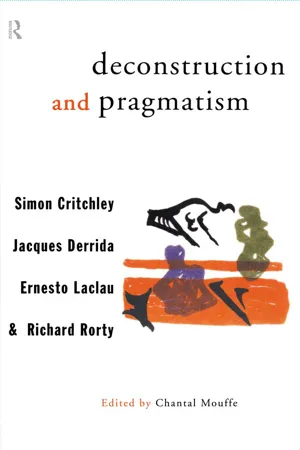
The purpose of this volume is to bring deconstruction and pragmatism into critical confrontation with one another through staging a debate between Derrida and Rorty, itself based on discussions that took place at the College International de Philosophie in Paris in 1993. The ground for this debate is layed out in introductory papers by Simon Critchley and Ernesto Laclau, and the remainder of the volume records Derrida's and Rorty's responses to each other's work. Chantal Mouffe gives an overview of the stakes of this debate in a helpful preface.
eBook - ePub
Deconstruction and Pragmatism
- 112 pages
- English
- ePUB (mobile friendly)
- Available on iOS & Android
eBook - ePub
Deconstruction and Pragmatism
About this book
Information
1
Deconstruction, Pragmatism and the Politics of Democracy
Chantal Mouffe
Jacques Derrida and Richard Rorty are at the centre of many controversies and this is not surprising since the implication of their work is radically to undermine the very basis of the dominant rationalist approach. It is no wonder then that Derrida’s deconstruction and Rorty’s new pragmatism have been repeatedly decried by traditional philosophers. This has not prevented their books, however, from exerting a major influence; indeed, their impact has been felt world-wide. Their perspectives are, no doubt, very different but their common rejection of a foundationalist conception of philosophy locates them on the same side in a great number of debates, especially those concerning the legacy of the Enlightenment.
Derrida and Rorty are at one in refusing Habermas’s claim that there exists a necessary link between universalism, rationalism and modern democracy and that constitutional democracy represents a moment in the unfolding of reason, linked to the emergence of universalist forms of law and morality They both deny the availability of an Archimedean point – such as Reason – that could guarantee the possibility of a mode of argumentation that would have transcended its particular conditions of enunciation.
Nevertheless, their critique of rationalism and universalism does not prevent them being strongly committed to the defence of the political side of the Enlightenment, the democratic project. Their disagreement with Habermas is not political but theoretical. They share his engagement with democratic politics but they consider that democracy does not need philosophical foundations and that it is not through rational grounding that its institutions could be made secure.
To stress the existence of a common ground between Derrida and Rorty does not preclude the recognition of important differences between their approaches. However, it is to suggest that a fruitful dialogue can be envisaged between them despite – or rather one might say precisely because of – those differences. Such was the aim of the symposium that is at the origin of this volume. Its purpose was to inquire in which way Derridean deconstruction and Rortyian pragmatism could contribute to the elaboration of a non-foundationalist thinking about democracy. The idea was to examine their points of convergence as well as their disagreements in this particular terrain and to discuss their respective insights. For that purpose, we invited two other theorists who have helped to develop the deconstructive approach along slightly different lines: Simon Critchley, who complements it with a Levinasian opening to the ethical experience of the other, and Ernesto Laclau, who has proposed to link deconstruction with the logic of ‘hegemony’.
Deconstruction and Politics
Several issues were at stake in the encounter. To begin with, we had to scrutinize the relevance of deconstruction for politics. This could not be taken for granted and it did constitute a moot point in the exchange. Indeed, while celebrating the importance of Derrida as a world-disclosing ironist, Rorty has consistently denied the political implications of his work. According to the distinction between ‘private ironist’ and ‘public liberal’, which he proposes in Contingency, Irony and Solidarity, Derrida should be seen as a ‘private ironist’. His work has no public utility and nothing to contribute to political life in a liberal society.
Such a thesis was examined and rejected by Simon Critchley, who made a claim for the overriding ethical significance of deconstruction. According to Critchley, Derrida should be seen as a public thinker and his work, with its growing emphasis on justice and responsibility, has important ethical and political implications. To be sure, Derrida’s conception of justice as an ‘experience’ of the undecidable1 cannot be instantiated in the public realm, but that does not mean that it has no consequence for politics. It is Rorty’s over-rigid distinction between public and private which blinds him to the complexity of the weaving between the two spheres, and which leads him to denounce any attempt to articulate the quest for individual autonomy with the question of social justice.
Ernesto Laclau, for his part, brought to the fore the relevance for politics of two dimensions of deconstruction: undecidability and decision. In his view, the central theme of deconstruction is the politico-discursive production of society. By showing the structural undecidability of numerous areas of the social, deconstruction reveals the contingency of the social, widening in that way the field of political institution. It is therefore primarily a political logic. While compatible with a variety of political strategies, it is particularly important for democratic theory because it permits radicalization of some of its trends and arguments. For Laclau, undecidability and decision are constitutive of the tension which makes possible a political society However, he argues that in order to produce all its political effects, deconstruction requires a theory of hegemony, i.e. a theory of the decision taken in an undecidable terrain. Only hegemony can help to theorize the distance between structural undecidability and actuality
Rorty’s New Pragmatism
With respect to Rorty’s version of pragmatism, the controverted issue was not its relevance for politics, which nobody denies, but the kind of liberal Utopia and the piecemeal type of social engineering that it promotes. By insisting on the need to keep completely apart the private and the public realms and by envisaging politics solely in terms of pragmatic, short-term compromises, isn’t he missing an important dimension of the democratic vision? Can such a reformism do justice to the multiplicity of struggles which call for a radicalization of the democratic ideal?
Critchley took issue with Rorty’s assertion that there is no way to unite or reconcile the public and private domains and that we must come to terms with the fact that we have two irreconciliable final vocabularies: one where the desire for self-creation and autonomy dominates, and another one where what dominates is the desire for community. When he declares that those different vocabularies function in two different languages games, the public and the private, and that it is dangerous to confuse their field of application, Rorty deprives us of the rich critical potential opened by public ironists like Nietzsche and Foucault. Moreover, wonders Critchley, doesn’t such a distinction of the self into ironist and liberal create the conditions for political cynicism?
According to Laclau, it is only in a rationalistic world – one clearly at odds with Rorty’s anti-foundationalist premises – that the demands of self-realization and those of human solidarity could be so neatly differentiated. In his view, the distinction public/private, important as it is for democratic politics, is not one of essence. It should be problematized and envisaged as an unstable frontier constantly trespassed, with personal autonomy investing public aims and the private becoming politicized. There is therefore no reason to oppose in such a drastic way the private demands for self-creation and the public ones for human solidarity
To criticize Rorty’s politics does not signify, though, that we should renounce pragmatism. While unhappy with the liberal piecemeal politics advocated by Rorty, Laclau points out that he is not calling for a rejection of the pragmatic approach. Indeed, he stresses his agreement with several aspects of the Rortyian outlook, which, he says, is compatible with different types of politics. Pragmatic premises do not necessary lead to the type of liberalism favoured by Rorty and they can, for instance, be articulated with a radical-democratic perspective.
Despite the fact that their arguments did not manage to convince Rorty, it seems to me that both Critchley and Laclau presented, albeit in different ways, a convincing case for the importance of deconstruction for politics. Their views are not, however, entirely convergent. Both of them agree that an argument concerning structural undecidability cannot provide, in and of itself, any positive grounding for a decision and that something else is required. But with respect to the kind of complement that is needed, their positions differ. This something else is found by Critchley in an ethical grounding along Levinasian lines: the radical opening to the other is a primary experience from which normative contents can be derived. For Laclau, on the contrary, this moment of quasi-grounding (the decision) is something akin to a self-grounding which is, however, radically contingent – it points in that sense to a primacy of politics rather than ethics and to a theory of ‘hegemony’ as the bridge between undecidability and decision.
Democracy and Rationality
One point on which there was an agreement was that, despite the fact that it was impossible to derive one single type of politics from either deconstruction or pragmatism, both approaches could provide important insights for democratic politics. It is on this issue that I want to make a few further comments taking the ensemble of the discussion into account.
Rorty is, I think, most useful when he criticizes the pretensions of Kantian-inspired philosophers like Habermas, who want to find a viewpoint standing above politics from which one could guarantee the superiority of democracy. Surely he is right to assert: ‘We should have to abandon the hopeless task of finding politically neutral premises, premises which can be justified to anybody, from which to infer an obligation to pursue democratic politics.’2 According to Rorty, we have to acknowledge that our democratic and liberal principles define only one possible language game among others. It is then futile to search for arguments in their favour which would not be ‘context-dependent’ in order to secure them against other political language games.
Against Apel and Habermas, Rorty argues that it is not possible to derive a universalistic moral philosophy from the philosophy of language. There is nothing, for him, in the nature of language that could serve as a basis for justifying to all possible audiences the superiority of liberal democracy. He insists that envisaging democratic advances as if they were linked to progresses in rationality is not helpful, and that we should stop presenting the institutions of liberal Western societies as offering the rational solution to the problem of human coexistence; as the solution that other people will necessarily adopt when they cease being ‘irrational’. In his view, what is at stake here has nothing to do with rationality but is a matter of shared beliefs. To call somebody irrational in this context, he states, ‘is not to say that she is not making proper use of her mental faculties. It is only to say that she does not seem to share enough beliefs and desires with one to make conversation with her on the disputed point fruitful. So force, rather than persuasion, will have to be used.’3
Democratic action, in this perspective, does not require a theory of truth and notions like unconditionality and universal validity but rather a variety of practices and pragmatic moves aimed at persuading people to broaden the range of their commitments to others, to build a more inclusive community. For Rorty, it is through sentiment and sympathy, not through rationality and universalistic moral discourse, that democratic advances take place. This is why he considers books like Uncle Tom’s Cabin to have played a more important role than philosophical treatises in securing moral progress.
This is certainly a more promising way of thinking about democratic politics and I share Rorty’s conviction that it is high time to ‘peel apart Enlightenment liberalism from Enlightenment rationalism’.4 It is particularly important in the present conjuncture, characterized as it is by an increasing disaffection towards democracy, to understand how a strong adhesion to democratic values and institutions can be established and that rationalism constitutes an obstacle to such understanding. It is necessary to realize that it is not by offering sophisticated rational arguments nor by making context-transcendent truth claims about the superiority of liberal democracy that democratic values can be fostered. The creation of democratic forms of individuality is a question of identification with democratic values and this is a complex process that takes place through a diversity of practices, discourses and languages games.
This is something that Rortyian pragmatism, with the importance it gives to shared vocabularies, can help us to grasp much better than can universalist and rationalist moral theories. By putting an exclusive emphasis on the arguments needed to secure the legitimacy of liberal institutions, recent moral and political philosophy have been asking the wrong question. The real issue is not to find arguments to justify the rationality or universality of liberal democracy that would be acceptable by every rational or reasonable person. Liberal democratic principles can only be defended in a contextualist manner, as being constitutive of our form of life, and we should not try to ground our commitment to them on something supposedly safer. To secure allegiance and adhesion to those principles what is needed is the creation of a democratic ethos. It has to do with the mobilization of passions and sentiments, the multiplication of practices, institutions and languages games that provide the conditions of possibility for democratic subjects and democratic forms of willing.
Most liberal theorists are bound to miss the relevance of that kind of reflection because they operate with a metaphysical conception which sees the individual as prior to society, bearer of natural rights, utility maximizer or rational subject – according to the brand of liberalism that they follow – but, in all cases, as abstracted from social and power relations, language, culture and the whole set of practices that make agency possible. Indeed, what is precluded in all those approaches is the crucial question of how is democratic agency possible; what are the conditions of existence of the liberal democratic subject?
Against the type of liberalism that searches for universal rational justification and believes that democratic institutions would be more stable if it could be proven that they would be chosen by rational individuals under the veil of ignorance or in a situation of undistorted communication, Rorty’s pragmatism reminds us of the limits of the claims of reason. By urging us to think in term of practices, it compels us to confront the real issues that have to be tackled in order to enhance democratic citizenship.
Philosophy, Politics and Democracy
However, once Rorty’s important contribution has been acknowledged, the shortcomings of his approach also need to be pointed out. Like Critchley and Laclau, I have serious reservations with respect to his liberal Utopia and the dangers of complacency that it entails. I want to suggest that the basic problem lies in the fact that Rorty does not fully acknowledge the complexity of politics and that this is linked to his dismissal of any kind of theoretical inquiry into the nature of the political realm. For him, politics is ‘a matter of pragmatic, short-term reforms and compromises.5 It is something to be deliberated about in banal, familiar terms’.
The enemies of human happiness in his view are greed, sloth and hypocrisy and no deep analysis is required to understand how they could be eliminated. What ‘we liberals’ should aim at is to create the largest possible consensus among people about the worth of liberal institutions. What is needed is a bigger dose of liberalism – which he defines in terms of encouraging tolerance and minimizing suffering – and a growing number of ...
Table of contents
- Cover
- Half Title
- Title Page
- Copyright Page
- Table of Contents
- Notes on Contributors
- Acknowledgements
- 1 Deconstruction, Pragmatism and the Politics of Democracy
- 2 Remarks on Deconstruction and Pragmatism
- 3 Deconstruction and Pragmatism - Is Derrida a Private Ironist or a Public Liberal?
- 4 Response to Simon Critchley
- 5 Deconstruction, Pragmatism, Hegemony
- 6 Response to Ernesto Laclau
- 7 Remarks on Deconstruction and Pragmatism
Trusted by 375,005 students
Access to over 1.5 million titles for a fair monthly price.
Study more efficiently using our study tools.
Frequently asked questions
Yes, you can cancel anytime from the Subscription tab in your account settings on the Perlego website. Your subscription will stay active until the end of your current billing period. Learn how to cancel your subscription
No, books cannot be downloaded as external files, such as PDFs, for use outside of Perlego. However, you can download books within the Perlego app for offline reading on mobile or tablet. Learn how to download books offline
Perlego offers two plans: Essential and Complete
- Essential is ideal for learners and professionals who enjoy exploring a wide range of subjects. Access the Essential Library with 800,000+ trusted titles and best-sellers across business, personal growth, and the humanities. Includes unlimited reading time and Standard Read Aloud voice.
- Complete: Perfect for advanced learners and researchers needing full, unrestricted access. Unlock 1.5M+ books across hundreds of subjects, including academic and specialized titles. The Complete Plan also includes advanced features like Premium Read Aloud and Research Assistant.
We are an online textbook subscription service, where you can get access to an entire online library for less than the price of a single book per month. With over 1.5 million books across 990+ topics, we’ve got you covered! Learn about our mission
Look out for the read-aloud symbol on your next book to see if you can listen to it. The read-aloud tool reads text aloud for you, highlighting the text as it is being read. You can pause it, speed it up and slow it down. Learn more about Read Aloud
Yes! You can use the Perlego app on both iOS and Android devices to read anytime, anywhere — even offline. Perfect for commutes or when you’re on the go.
Please note we cannot support devices running on iOS 13 and Android 7 or earlier. Learn more about using the app
Please note we cannot support devices running on iOS 13 and Android 7 or earlier. Learn more about using the app
Yes, you can access Deconstruction and Pragmatism by Simon Critchley,Jacques Derrida,Ernesto Laclau,Richard Rorty, Chantal Mouffe in PDF and/or ePUB format, as well as other popular books in Philosophie & Déconstruction en philosophie. We have over 1.5 million books available in our catalogue for you to explore.