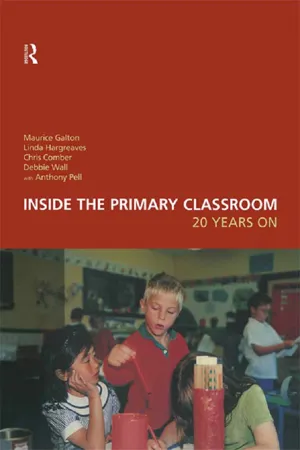
eBook - ePub
Inside the Primary Classroom: 20 Years On
- 272 pages
- English
- ePUB (mobile friendly)
- Available on iOS & Android
eBook - ePub
Inside the Primary Classroom: 20 Years On
About this book
In recent years primary education has been the subject of continuing debate with questions of standards and their apparent decline being raised with alarming regularity. Central in informing these debates has been the ORACLE study of groupwork in primary classrooms. Published during the 1980s, the study described in detail the daily life of the primary classroom, the teaching styles used by teachers and the responses of pupils. That research has now been replicated - with over two thirds of the schools originally studied being revisited, using the same tests and observation instruments. This book presents the findings of this second round of research, and is therefore unique in being able authoritatively to document the changes - or lack of them - in primary education and teaching practice over the last twenty years.
Information
1
Two Decades of Primary Education
Donna Leason was born in October 1965. She now lives on a council estate on the edge of an east Midlands city, the same one where she spent her early childhood.1 She began school in April 1971 when she was five years and six months old. Her friend Allison, who lived next door, had started school the previous September because she had her fifth birthday two weeks before the school year began. During those first two terms of the school year before Donna started school, there were only twenty children in the reception class, and Mrs Cooper, the teacher, had been able to devote extra time to helping each pupil with their reading and number work.2 After the April intake, however, the number increased by fifteen and it became more difficult to give each child sufficient attention.
Donna didn’t do particularly well at school and left in April 1982 without bothering to turn up for her Certificate of Secondary Education (CSE) examinations. In the following September she applied and was accepted for a training course at the local Further Education College, and found a job as a care assistant in a local authority home for the elderly. There she met Neal, who was working as a Community Volunteer, and moved into his bedsit. Hayley was born in November 1985. The couple were given a council house on the same estate as Donna’s parents, but Neal moved out and Glen, an unemployed labourer, took his place. Two other children, Jason and Kristen, were born in 1987 and 1990. When Glen also left, shortly after the birth of the third child, Donna decided to ‘give up on men and better herself’, and in 1992, when Jason had started school, she began a GCSE course at the local community school where there was a ‘toddlers’ club’ for Kristen. She surprised herself by getting an A for English and a B for Mathematics and is now studying A level Biology, and Health and Social Care for an NVQ with a view to taking a degree in social work at one of the local universities.
It is now the 1995–96 school year, and Donna’s eldest child, Hayley, has entered year 6 in the same primary school that her mother went to. Donna is a frequent visitor to the school and comes in whenever she has time to help with the poor readers. Unlike her mother, Hayley had the advantage of a full year in the reception class and is doing very well. She will take the Key Stage 2 tests at the end of the year and move to the local high school next to the community college where Donna is finishing her ‘A’ levels. Although neither of these two schools has done well in the published league tables, Donna has decided to let her eldest daughter go on to the high school because her own experience suggests that the teachers care about the pupils and also because most of Hayley’s friends will move with her. There is also another reason. It would cost money to bus Hayley to another school and Donna already finds it difficult to manage on her family allowance and what she gets from Social Security.
This brief biography of Donna offers a useful reference point for our study of Inside the Primary Classroom: 20 Years On. What then does this parent notice about her daughter’s classroom compared to how it was when she sat there as a child in the 1970s? Is her first impression one of ‘busyness’, as it was all those years ago when visitors entered the classroom?3 Are the children still seated in groups, either around flat topped tables or desks drawn together to form working surfaces? Will the children still be talking intermittently to each other as they go about their tasks as Donna herself did twenty years ago? Are pupils still free to move around the room when seeking help or a resource? Do some children find ways of slowing down their work rate despite the prevailing air of busyness? In Donna’s time a favoured dodge was to move to the back of the queue just before reaching the teacher’s desk to have your book marked.
A more detailed examination of this busy classroom may reveal distinct differences between Donna’s own experience as a pupil and that of her daughter. In 1976, typically, the teacher would have been moving around the room for most of the time, talking first to one group of children and then another, or to an individual child within the group. Such exchanges would in all likelihood have been very brief, variously concerned with giving information or directions, suggesting how to tackle a problem, asking someone how they were getting on, telling another pupil how to spell a word, correcting a sum, or occasionally giving a cautionary reprimand for disruptive or antisocial behaviour. At other times there may have been quiet periods when Donna was expected to work on her own, either colouring a picture, completing a mathematics worksheet or doing a comprehension exercise from her English book. During these quiet periods, various pupils might be called out to the teacher’s desk to have their work marked. One consequence of this teaching strategy was that a different picture of the classroom emerged if a visitor decided to concentrate their attention on one of the pupils rather than on the teacher. Because the teacher’s exchanges were for the most part with individual pupils, and with typically between thirty and thirty-five pupils in the class, the proportion of time devoted to each child during a day was necessarily limited. Thus when asked by the visitor to comment on a typical day the teacher might respond, ‘I’m exhausted, I’ve been talking with children all day’, while a pupil might say ‘I just got on with it. I only talked with the teacher for a few minutes when she either marked my work, said “well done” or “do it again” or told me when I’d finished I should get on with my picture.’
This kind of analysis, based upon observation of moment-by-moment exchanges between teachers and pupils, has been one of the major strands of research in primary education. It generally involves an observer selecting a sample of ‘target’ pupils, either randomly or matched by ability and gender, and carrying out several rounds of observation in which each target is observed according to a predetermined pattern at fixed time intervals. In some studies the observation of pupils is also interspersed by extended observation of the teacher in order to give both the adult’s and child’s view of the classroom.
One of the first British studies to make use of this style of observation was the ORACLE study (Observational Research and Classroom Learning Evaluation). This programme commenced in 1975, and over three years, beginning in September 1976, carried out observations in fifty-eight primary classrooms, distributed across three local authorities. In the third year of the observation, the children were followed as they transferred out of their primary or first school into their next phase of education. During each of the three years of observation the children’s academic progress was also measured, using standardised tests of reading, language and mathematics. The study was able to identify a number of different teaching styles and to describe the effects of these styles on pupils’ behaviour and on the pupils’ attainment. Over the three-year period during which the fieldwork took place, a mass of information was acquired. There were, for example, 47,000 observations of the fifty-eight teachers, and 84,000 observations of 489 pupils (Galton et al., 1980; Galton and Simon 1980).
Turning the progressive tide?
The ORACLE study was completed in 1980. In the intervening period up to the present time, there have been a number of other studies either using the same or similar systems of observation. In the early 1980s the Curriculum Provision in Small Schools (PRISMS) Project (Galton and Patrick 1990) used a version of the ORACLE observation system in which the observation categories were extended to include more details about the curriculum. The study involved sixty-eight small schools (schools with less than a hundred pupils on roll) drawn from nine local authorities, during which 188 teachers and their classes were observed. During the same period there was also a study that used observation to examine the problems associated with the one in five pupils who were designated as having special needs (Croll and Moses 1985) and in the mid–1980s, two studies of London schools, one which studied the early years (Tizard et al. 1988) and one in the junior age range (Mortimore et al. 1988). Following on from this work there was a study of primary classrooms in Leeds (Alexander et al. 1989; Alexander 1995). Taking us into the 1990s, there have been two further studies which have coincided with the introduction of the National Curriculum. One of these was located in small schools (Galton et al. 1998). The other, the PACE (Primary Assessment Curriculum and Experience) project, which began in 1989, was designed to track the impact of the 1988 Education Reform Act on primary school practice. PACE has reported its findings on early years classrooms (Pollard et al. 1994) and on the junior years in Croll (1996a).
Despite this almost continuous scrutiny of primary practice, there has been continued disagreement about the changes that have taken place over the last two decades. One popular view within media and political circles is that back in the 1970s, ‘progressivism’ ruled, and it was ‘the wild men’, although not in those days women, who were bent on destroying our education system.4 Depending on party allegiance, it was either the brave intervention of the then Labour Prime Minister, James Callaghan (1976) in his Ruskin speech, or else his replacement by a Conservative, Margaret Thatcher, following her party’s victory in the 1979 General Election, which halted this progressive tide. Eighteen years of Conservative rule saw the ‘new right’ gain increasing control of education policy (Ball 1990). Beginning with a series of ‘position’ papers emanating from the Centre for Policy Studies, the right wing ‘think tank’, this faction in the Conservative party played a key role in the design of the 1988 Education Reform Act and the introduction of a National Curriculum by the then Secretary of State for Education, Kenneth Baker (Baker 1993).
However, a decade after these reforms were introduced there are those who argue that this tide of progressivism has yet to be stemmed. Chief among those expressing this view is the current HM Chief Inspector of Schools, Chris Woodhead, who argues that progressive ideology still dominates primary practice and that the greatest barrier to raising standards is the progressive’s contempt for the study of ‘all the matters which most concern us, the best which has been thought and said in the world’ (Woodhead 1995a; 1995b).5 A more extreme view has been expressed by the journalist Melanie Phillips (1996), who not only agrees with the Chief Inspector that these progressive trends have brought about a decline in academic standards, but also argues that they are the cause of serious moral turpitude within contemporary society.
Part of the cause of this continued uncertainty about the extent of change in primary schooling over the last two decades, despite the apparent wealth of observational data, stems from the fact that many political and media activists choose to fit the facts around their theories rather than the other way round when they write on such matters. Journalists, by the nature of the profession, tend to oversimplify and generally focus on the negative features of any incident since, to paraphrase the late Lord Rothermere, ‘If the reader feels angry, disgusted or worried that’s news but if they are merely better informed that’s public relations.’ More controversially, however, Colin Richards (1997), a former senior inspector in the Office of Standards in Education (OFSTED), commenting on the Chief Inspector’s annual reports, has argued that OFSTED inspection data have been manipulated for political reasons.
Uncertainty in the interpretation of the research among some academics has, it must be admitted, fuelled this media debate. Differences in interpretation have arisen either because the observations of primary practice have had different emphases, or because different sampling techniques were used, or because the research was carried out in different parts of the country where it could be argued that pupil performance in multi-cultural inner city schools could not be equated with that recorded by pupils from small schools in rural areas. The strength of the study reported in the following chapters is that it represents both the beginning and end of an era, marked respectively by the defeat of one Labour government and the election of another. New Labour now offers educational prescriptions which are almost identical to those emanating from the previous Conservative regimes. Indeed, recent pronouncements have perhaps gone further than the previous government would have dared. For example, the first act of the new Labour government’s Secretary of State for Education and Employment, David Blunkett, was to ‘name and shame’ eighteen failing schools.6
Throughout this debate, with its charge and counter charge, the original ORACLE research, although based on observations carried out twenty years ago, still retains a pre-eminent position. While critics such as Scarth and Hammersley (1986; 1987) and Edwards and Westgate (1987) have doubted whether an observer can reliably categorise teachers’ questions without knowledge of their intentions, the central findings appear to have stood the test of time, and have been admired for their ‘growing sophistication at both policy and methodological level’ (Hargreaves 1997). Furthermore, in a review on the lessons to be learnt from primary research, Caroline Gipps (1992) devotes nearly a third of her twenty-seven pages to the ORACLE findings. The research has also been cited by critics of primary practice such as Melanie Phillips (1996) and Chris Woodhead (1995a) as well as by supporters. Moreover, since many of the other studies referred to in the previous paragraphs have tended to confirm many of its findings, ORACLE has remained the most authoritative source of data on primary practice, until, perhaps, the recent PACE studies (Pollard et al. 1994).
What better, therefore, than to repeat the original ORACLE study, using exactly the same instruments, the same attainment tests and the same schools? For if ORACLE findings have, by and large, been accepted as one of the most authoritative statements on primary classroom practice in the pre-National Curriculum period, then it should be difficult for either present critics or supporters of primary education to dispute its replication using the same methodology and the same schools. Some minor changes in the research design have been necessary; for example the observation schedules have been expanded to provide more detailed information, attainment tests have been modified to replace words which were commonplace in the 1970s but have now either changed their meaning or have become politically incorrect, and some of the secondary-phase schools have changed their age of entry. At present-day values, the full 1975 ORACLE programme would cost over a million pounds. The grant for this replication study was just over £50,000. Not every school in the 1975 sample could, therefore, be included, and six rather than eight target pupils were observed during each teaching session. However, before describing these changes in more detail and setting out the main purposes of this research, it may prove useful to place primary schooling in a contemporary context. This includes, in particular, the effects of ‘globalisation’ associated with the growth of the ‘Tiger’ economies around the Pacific Rim and the resulting changes to our personal lives in this post-traditional society (Giddens 1994). Primary schools not only have to reflect and interpret existing societal characteristics, but also have to anticipate future trends, since children now entering school are being educated for work and leisure well beyond the millennium. Given that the period between 1975 and the present has been one of rapid change politically, educationally, economically and socially, this is not an easy task. In reading the remaining chapters of this book, which deal specifically with changes in primary practice, these varying contexts need to be continually borne in mind.
The 1975 version of primary education
When ORACLE began, English primary education was still thought by many people to be the ‘best in the world’. It was also assumed to have had a stable and uniform structure, the result of the reforms enacted some thirty years previously following the passing of the 1944 Education Act. Then, in the mid–1960s, the post-war consensus that had sustained this stability started to break down as more radical ideas began to dominate educational debate. In primary education the key event was the publication of the Plowden Committee’s Report (1967) which critics described as ‘a progressive’s charter’.7
A more accurate picture, as described by Brian Simon in the first volume of the ORACLE research output, Inside the Primary Classroom, was that after the 1944 Act and into the 1970s, periods of change were followed by yet more periods of change, ‘a state of almost continuous transition’ (Galton et al. 1980:42). In the 1950s separate infant and junior schools were merged into ‘all through’ primary schools.8 Then in the late 1960s, as the comprehensive movement expanded, a three-tier system catering for five to eight and five to nine year-old children was created t...
Table of contents
- Cover
- Title
- Copyright
- Dedication
- CONTENTS
- List of figures
- List of tables
- Abbreviations
- List of contributors
- Introduction
- 1 Two decades of primary education
- 2 The classroom environment: a framework for learning
- 3 Teaching in today’s primary classroom
- 4 Pupils and their teachers in the KS2 classroom
- 5 Establishing a working consensus: teaching styles and pupil types
- 6 Pupil performance in basic skills: 1976 and 1996
- 7 Why have standards fallen?
- 8 Primary education for the millennium
- APPENDIX 1
- APPENDIX 2
- APPENDIX 3
- APPENDIX 4
- APPENDIX 5
- APPENDIX 6
- References
- Index
Trusted by 375,005 students
Access to over 1.5 million titles for a fair monthly price.
Study more efficiently using our study tools.
Frequently asked questions
Yes, you can cancel anytime from the Subscription tab in your account settings on the Perlego website. Your subscription will stay active until the end of your current billing period. Learn how to cancel your subscription
No, books cannot be downloaded as external files, such as PDFs, for use outside of Perlego. However, you can download books within the Perlego app for offline reading on mobile or tablet. Learn how to download books offline
Perlego offers two plans: Essential and Complete
- Essential is ideal for learners and professionals who enjoy exploring a wide range of subjects. Access the Essential Library with 800,000+ trusted titles and best-sellers across business, personal growth, and the humanities. Includes unlimited reading time and Standard Read Aloud voice.
- Complete: Perfect for advanced learners and researchers needing full, unrestricted access. Unlock 1.5M+ books across hundreds of subjects, including academic and specialized titles. The Complete Plan also includes advanced features like Premium Read Aloud and Research Assistant.
We are an online textbook subscription service, where you can get access to an entire online library for less than the price of a single book per month. With over 1.5 million books across 990+ topics, we’ve got you covered! Learn about our mission
Look out for the read-aloud symbol on your next book to see if you can listen to it. The read-aloud tool reads text aloud for you, highlighting the text as it is being read. You can pause it, speed it up and slow it down. Learn more about Read Aloud
Yes! You can use the Perlego app on both iOS and Android devices to read anytime, anywhere — even offline. Perfect for commutes or when you’re on the go.
Please note we cannot support devices running on iOS 13 and Android 7 or earlier. Learn more about using the app
Please note we cannot support devices running on iOS 13 and Android 7 or earlier. Learn more about using the app
Yes, you can access Inside the Primary Classroom: 20 Years On by Chris Comber,Maurice Galton,Linda Hargreaves,Debbie Wall in PDF and/or ePUB format, as well as other popular books in Education & Education General. We have over 1.5 million books available in our catalogue for you to explore.