- 336 pages
- English
- ePUB (mobile friendly)
- Available on iOS & Android
eBook - ePub
About this book
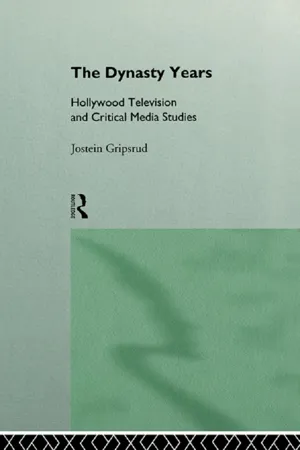
The Dynasty Years documents and analyses in detail 'the Dynasty phenomenon', the hotly debated success of the Hollywood-made 'Rolls Royce of a primetime soap' which heralded a profound transformation of European television.
From the operatic camp of Krystle and Alexis' fight in the lilypond or the Moldavian wedding massacre to the unprecedented gay sub-plot, Dynasty represented, in the words of co-producer Esther Shapiro, "the ultimate dollhouse fantasy for middle-aged women". Using evidence from audience survey results, newspaper and magazine clippings and letters to broadcasters and drawing on semiotics, psychoanalysis, feminism and critical social theories, Jostein Gripsrud examines every aspect of Dynasty's production, reception and context.
The result is a groundbreaking critical study. Jostein Gripsrud offers a theoretical but empirically grounded critique of many central positions in media studies, including notions of 'audience resistance' and the 'sovereign' audience and its freedom in meaning-making, arguing against what he perceives as the uncritical celebrations of the soap-opera genre in much contemporary media criticism.
Information
1
Hollywood Speaks
To write a history of the culture of the popular classes exclusively from inside those classes, without understanding the ways in which they are constantly held in relation with the institutions of dominant cultural production, is not to live in the twentieth century.
(Hall 1981:231)
Studies of Media Production
The research literature on media production is quite sparse if compared to the overwhelming number of publications concentrating on various forms of audience research (in mass communication and some cultural studies) and textual analysis/ criticism (in literature, film and other arts). This is particularly the case in the area of television fiction, in spite of what was once called ‘the pervasiveness and importance of television drama in relaying social meanings and cultural forms’ (Murdock 1976: 184). Some of the most useful work has been done by mass communication researchers who belong to what may be termed hermeneutically oriented social science (e.g. in the UK, Burns 1977; in the US, Cantor 1971, 1981; Gitlin 1985). But these contributions rarely if ever include thorough analysis of that which is produced, texts, and never encompass also the moment(s) of reception.
In various kinds of media research in the humanities, studies of production processes have been few. Since the late 1960s there has been a growing interest in reception in some circles. This has challenged the previous neartotal concentration on the texts and their histories, but production studies have still suffered from low interest—not least for theoretical reasons. To include, as I do in this book, a study of the production of texts in what is basically a study of reception, has been out of the question in critical film, media and cultural studies since their discovery of Althusser, his therapist Lacan and later a couple of essays by Roland Barthes and Michel Foucault (Barthes’s ‘The Death of the Author’ (1982) and ‘From Work to Text’ (1982) and Foucault’s ‘What Is an Author?’ (1979)). Structuralist and poststructuralist critique of the romanticist ideology of authorship developed another untenable position: ‘Whereas the ideology of authorship presents writers as ventriloquists who speak through their works, structuralist criticism, led by Barthes, casts them in the role of dummy, manipulated by the hidden hands of language’ (Murdock 1993:131). Consequently, notions of authorial intention (and ‘auteurism’) have been considered reactionary and hence declared stone dead. Since the mid-1970s the whole idea that the production of media texts in some ways might determine some of what audiences get out of them has been slightly suspect in significant parts of the academic community in these fields.
The most notable exception to this general picture in film studies is Bordwell, Staiger and Thompson’s The Classical Hollywood Cinema (1985), which meticulously describes classical studio production, but, conversely, hardly discusses issues of reception in relation to their analyses at all. The useful and in many ways very solid study of the US independent production company MTM Enterprises (Feuer, Kerr and Vahimagi 1984) is as far as I know the only book of its kind in television studies. It includes analyses of specific shows (The Mary Tyler Moore Show. Lou Grant and Hill Street Blues), but not of reception. An interesting case study of the production and textual characteristics of the BBC serial Doctor Who (Tulloch and Alvarado 1983) similarly lacks actual analysis of its reception. The only study of television I know of which covers both production, text and reception is David Buckingham’s book about EastEnders (1987). Buckingham’s is also the only study of television reception I know of besides my own which really seeks to integrate an empirical analysis of public debate and printed media coverage. But on the other hand it limits the analysis of ‘ordinary’ viewers and their ‘readings’ of the text to interviews of sixty young people between 7 and 18 years old, and does not really consider the social differentiation of the total audience (cf.Chapter 3 below).
This situation is both puzzling and deplorable if one considers the social functions of various forms of media studies. They are academic disciplines which deliver candidates for careers in the media industries on the one hand and as prospective teachers and critics on the other. The lack of attention to the determinations of media communication on the production side has been coupled with a wave of writing which has pointed out and celebrated the ability of audiences to make their own ‘aberrant’ or ‘oppositional’ meanings out of whatever material they are offered. If the conditions, intentions and practices of producers are more or less irrelevant to an understanding of texts and receptions, there is little reason why universities should bother to educate people for these positions. It might as well be left completely to the businesses in question. If, on the other hand, media audiences are by themselves perfectly able to act as fully competent, critical ‘readers’ of media texts, who needs critical studies, why spend time learning textual analysis?
The Role of Production—in Theory
The theoretical climate in which an interest in authorship and production processes is marginalized may be related to the ‘postmodern’ mood of much cultural and literary criticism since the late 1970s. Elements of poststructuralist philosophy and textual theory have been used to critique fundamental assumptions of previous ‘modernist’ notions of historical developments (the ‘grand narratives’) as well as the spatial and temporal metaphors employed in the study of communication and cultural phenomena (‘transportation of messages’, ‘high’ and ‘low’ culture, etc.). Included in this highly generalized and often dubious critique of ‘modernism’ prevalent in critical theoretical work these days has also been a more or less political condemnation of the traditional marxist subordination of consumption to production in the analysis of historical forces and social power. The logic of such condemnation is well exemplified by Andreas Huyssen in the following passage:
There seem to be fairly obvious homologies between this modernist insistence on purity and autonomy in art, Freud’s privileging of the ego over the id and his insistence on stable, if flexible, ego boundaries, and Marx’ privileging of production over consumption. The lure of mass culture, after all, has traditionally been described as the threat of losing oneself in dreams and delusions and of merely consuming rather than producing.
(Huyssen 1986:199)
This kind of ‘homological’ thinking in effect places Marx’s privileging of production over consumption as just another instance of male bourgeois ideology. Theories which claim to be logically consistent constructions of basic principles underlying social developments or to explain the structures and processes of the human psyche are immediately equated with specific normative ideas about art and culture. What happens is that very different scholarly and more loosely critical discourses on very different subjects are only regarded from a ‘formal’ rhetorical point of view; they are not regarded in the light of their relative validity in terms of adequacy or degree of truth, to use a word postmodernists always avoid or put in quotation marks (even if they still claim that their general ideas about history, society and culture are basically correct).
While it is certainly true that there are interesting ‘similarities’ between the ideas Huyssen mentions, they can neither be countered nor criticized in the same way. It is perfectly possible to agree with basic points in both Marx’s and Freud’s theories without subscribing to ideas about ‘purity’ in art and the dangers of ‘losing oneself’ in popular culture. The latter idea is, for instance, obviously related to the classical ‘Protestant’ work ethic, in which production is also given priority over consumption—but a moral priority, not one of social theory and analysis. ‘Homological’ thinking, such as that represented by Huyssen here, may imply the erasure of distinctions between social fields that are central to an adequate understanding of society and culture. It may also lead to a disregard of important distinctions in the traditional bourgeois ideology it is intended to characterize. Bourgeois ideology has always distinguished between different kinds of production and consumption, and not all forms of ‘losing oneself’ have been feared or tabooed. One of the reasons for this is that mainstream bourgeois ideology has always kept remnants of romanticism sacred, so that, for instance, ‘being carried away’ when listening to serious music has been perfectly legitimate. Artists who may have held ideas about the ‘purity and autonomy of art’ may likewise have stressed the importance of irrational or spiritual elements in (the proper appreciation of) art.
Marx’s own dialectical discussion of the relationship between production and consumption in the introduction to Grundrisse (1973) is in fact well worth rereading in our context. It is a logical (not ‘homological’) analysis of a basic economic relationship, pointing out that production is always consumption and that consumption is always production, in a number of ways. He also metaphorically foreshadows a fundamental idea in literary reception theory when pointing out that ‘a railway on which no trains run, hence which is not used up, not consumed’ is a railway only potentially (Marx 1973:91). Still, what he concludes is that even if consumption and production are ‘moments of one process’, production is ‘the point of departure for realization and hence also its predominant moment; it is the act through which the whole process again runs its course’ (ibid.: 94).
This is a totally abstract, logical point, which in a sense has nothing to do with the Dynasty phenomenon as a concrete historical ‘event’. But even so, it directs one’s attention to an investigation of production’s relation to consumption in terms of relative dominance in the historically specific field of television production and consumption. If we now leave the level of grand abstractions and turn to the case of the television industry, it is in fact empirically evident that the ‘consumption’ (reception) of a TV serial like Dynasty in Norway and elsewhere, was to a certain extent determined by its American production.
Not only was the production of Dynasty in Hollywood, rooted in circumstances specific to the competition in the American TV industry for American markets, a logical precondition of any consumption of the product in Norway (and some ninety other countries). Production, according to Marx’s abstract logic, ‘also gives consumption its specificity, its character, its finish’. Production produces the ‘manner of consumption’, Marx argues, and he goes on to exemplify: ‘Hunger is hunger, but the hunger gratified by cooked meat eaten by knife and fork is a different hunger from that which bolts down raw meat with the aid of hand, nail and tooth’ (1973:92). This classic formulation is in fact worth remembering when one studies the reaction of Norwegian viewers to the fictional format which Dynasty presented to them for the very first time: the open-ended soap opera, created for commercial broadcasting. According to Marx’s analysis, this specific kind of product would demand a specific ‘manner of consumption’, which implies a certain subjective experience of the product in question, and thus also produces a certain consumer subject.
Transferred to the area of TV ‘consumption’, this line of thinking suggests that a specific form of televisual fiction demands a certain attitude or way of watching from its audiences which differs from that of other (actual or conceivable) televisual forms. In my view this is quite plausible, and as a hypothesis it lends itself to empirical validation. As I will try to show in the next chapters, Dynasty was extremely popular with large audience groups because it could answer an accumulated desire for entertainment in the form of popular drama. In other words, a quite unspecified ‘need’ for narrative entertainment was experienced as ‘satisfied’ by Norwegian audiences by the form of the primetime soap opera, a genre they did not know beforehand and consequently could not ‘demand’ except as an international ‘event’ they wanted to be acquainted with. If this line of reasoning seems acceptable, one might say that the introduction of Dynasty delivered a specific kind of object for an accumulated need or desire which in principle might also have been met by other conceivable objects, for instance an aesthetically and ideologically different form of family melodrama. The extremely powerful position of US television production in the transnational television market in effect decided how the ‘need’ was to be met, and thus also what kind of television consumers or audiences would be produced from the ‘consumption of the object’ (attitudes to television, viewers’ competence, ideological inputs, etc.).
The Power(s) of US Television Production
Dynasty was able to play its role on account of the world dominance of the American television industry. This dominance is in part based on the sheer size of the industry, related to the size of its domestic market. The production volume is currently more than 250,000 programming hours per year (Syvertsen 1992:175). A year has 8,760 hours. Since shows successful in the American domestic market have normally already earned more than enough to pay for production costs, prices in foreign markets can be kept surprisingly low, adjusted to the financial possibilities of different customers. The NRK paid approximately US $1,500 per episode of Dynasty in 1983. In comparison, the NRK would at that time have had to pay about $20,000 for a Norwegian feature film, and the production of a particular half-hour satirical comedy (designed for the Montreux television festival) had cost about $6,000 per minute (Nationen, 4 June 1983). Examples of maximum prices paid per half hour for US series in 1985 are Italy $48,000, Canada $20,000, West Germany $18,000, UK $14, 000, France $10,000, Japan $7,000, Sweden $2,500, Chile $375, Bermuda $45 (Hoskins and Mirus 1988:511, quoting Variety, 17 April 1985). In Canada, production of drama costs about ten times as much as the import of American merchandise (ibid.).
American television’s world dominance is of course also supported by generations of US world hegemony in general, and in cultural production particularly. Not only is an effective distributional apparatus at hand, the US has through the work of its cultural industries also long been established as a common ‘mythic universe’ to people all over the world. The cultural heterogeneity of the US domestic market has probably also helped to make the marketing of almost any American cultural product quite easy. They are from the outset constructed for audiences with a wide range of cultural backgrounds. All of these things contribute to an explanation of American television’s international dominance.
Neglecting these elementary factors of economic, political and cultural power on the side of production when investigating ‘the apparent ease with which American television programmes cross cultural and linguistic frontiers’ (Katz and Liebes 1986: 187) necessarily leads to what must be termed apologetic research. One must then search for the answer only in a kind of magic either inherent in the programmes themselves or/and in the relationship between the programmes and their viewers. This is in fact the basic premise of, for instance, Katz and Liebes’s project on Dallas. Their project’s ultimate aim is, it seems, to ‘explain the diffusion of a programme like Dallas’ (ibid.: 187) in a perspective which is clearly opposed to those of research traditions in which US cultural ‘imperialism’ or cultural dominance is regarded as undesirable or at least problematic. In Katz and Liebes’s project the explanation for the ‘diffusion’ of US television is only sought for in the interactive relationship between viewers and the text. They do not ask why the text is there to be interacted with in the first place.
Dallas is credited by Liebes and Katz with the capacity to stimulate the imagination and social interaction of different audiences. But without the power of production as part of the interpretive framework, it is impossible to ask, for instance, if other kinds of production might not only stimulate audience activities in a similar way, but also provide a form of entertainment which would address the viewers’ lives more specifically, with a different influence on their way of looking at their conditions of existence.
I wish to stress again what I said in the introduction to this book, that this does not mean that research such as that of Katz and Liebes is without interest. As a contribution to a better understanding of how viewers interact with television texts, their work is important, and I will be drawing on their efforts in Chapter 3. Still, the interpretation of their observations should take place in a framework that differs from their own—a perspective which acknowledges the many-sided power of the American television industry over viewers’ reception(s).
Hollywood in US Television
The fact that Hollywood is the centre of both the film and television industries is an indication of how intimately the two are intertwined. This has been so since the mid-1950s. The film industry initially regarded television as an unwanted competitor. As cinema attendance showed signs of decline, this attitude was replaced by the considerably more profitable policy of cooperation in the role of supplier. The New York-based production of live anthology dramas died out, and Hollywood’s filmed episodic series became the staple fare of US TV fiction (Barnouw 1975:166, 193ff.).
There were a number of reasons for this development. For television, the shift from live transmissions to the more controllable production on film—both in terms of content and in terms of expenses—held many advantages. The series format meant that production could be rationalized and costs more precisely calculated. Live programmes transmitted from New York in the late afternoon would become prime-time viewing in California because of the four hours of time difference between the coasts. Filmed series could be distributed to the various local stations in advance, and thus make it possible for programming to be adjusted to the different time-zones in the US. They could also be redistributed or ‘syndicated’ after the first showing. They facilitated the shift from the financing system where a single company sponsored a whole programme to spot advertising. This increased the creative control of the networks, since no single company could claim the right to decide whether a programme served its interests any more. It also reduced the risk taken by advertisers, who could now spread their advertising across different programmes. Last but not least, the audience attendance of an established series could be more accurately predicted than that of a one-off anthology drama, with the help of A.C. Nielsen’s ratings.
The geographical move from New York to Hollywood was also one of cultural significance—from a traditional centre for ‘high’ culture in the US, to the traditional centre for ‘low’ culture. The television historian Eric Barnouw mentions the worries sponsors had over the ideological implications of the kind of drama the New York artists had produced in the early and mid-1950s. These dramas, one suspected, tended to work against the interests of sponsors. Commercials and dramas dealt with the same problems,...
Table of contents
- Cover
- Half Title
- Title Page
- Copyright
- Dedication
- Contents
- List of plates
- Preface and acknowledgements
- Introduction: Signalling a position
- 1. Hollywood Speaks
- 2. ‘The Cultural Debate of the Ages’: History, culture and media politics in public reception
- 3. Dimensions of Domestic Reception
- 4. Reconsidering (Prime-Time) Soap Opera
- 5. The not so ‘Polysemic’ Dynasty Text
- 6. The Social Meanings of Soap Opera and the Dynasty Event
- Appendix
- Bibliography
- Index
Trusted by 375,005 students
Access to over 1.5 million titles for a fair monthly price.
Study more efficiently using our study tools.
Frequently asked questions
Yes, you can cancel anytime from the Subscription tab in your account settings on the Perlego website. Your subscription will stay active until the end of your current billing period. Learn how to cancel your subscription
No, books cannot be downloaded as external files, such as PDFs, for use outside of Perlego. However, you can download books within the Perlego app for offline reading on mobile or tablet. Learn how to download books offline
Perlego offers two plans: Essential and Complete
- Essential is ideal for learners and professionals who enjoy exploring a wide range of subjects. Access the Essential Library with 800,000+ trusted titles and best-sellers across business, personal growth, and the humanities. Includes unlimited reading time and Standard Read Aloud voice.
- Complete: Perfect for advanced learners and researchers needing full, unrestricted access. Unlock 1.5M+ books across hundreds of subjects, including academic and specialized titles. The Complete Plan also includes advanced features like Premium Read Aloud and Research Assistant.
We are an online textbook subscription service, where you can get access to an entire online library for less than the price of a single book per month. With over 1.5 million books across 990+ topics, we’ve got you covered! Learn about our mission
Look out for the read-aloud symbol on your next book to see if you can listen to it. The read-aloud tool reads text aloud for you, highlighting the text as it is being read. You can pause it, speed it up and slow it down. Learn more about Read Aloud
Yes! You can use the Perlego app on both iOS and Android devices to read anytime, anywhere — even offline. Perfect for commutes or when you’re on the go.
Please note we cannot support devices running on iOS 13 and Android 7 or earlier. Learn more about using the app
Please note we cannot support devices running on iOS 13 and Android 7 or earlier. Learn more about using the app
Yes, you can access The Dynasty Years by Jostein Gripsrud in PDF and/or ePUB format, as well as other popular books in Social Sciences & Feminism & Feminist Theory. We have over 1.5 million books available in our catalogue for you to explore.