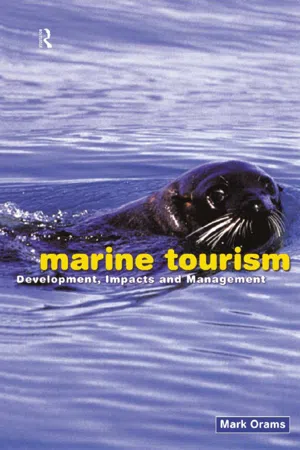
Marine Tourism examines both successful and unsuccessful tourism in coastal and marine environments. The author provides an overview of the history, development and growth of marine tourism and describes the characteristics of 'marine tourists' and the 'vendors' of these tourist activities. The book includes case studies of specific types of tourism including:
* the cruise ship industry, * whale and dolphin watching,
* yachting - the America's Cup,
* personal water crafts and other water sports
* and maritime museums and festivals. in locations including Brighton, UK, the Florida Keys and Hawaii, USA Caribbean islands, New Zealand and Australia's Great Barrier Reef. The final section examines tourism impacts on marine ecosystems and coastal communities and explores management techniques aimed at reducing negative impacts and maximizing the benefits of marine tourism.
- 136 pages
- English
- ePUB (mobile friendly)
- Available on iOS & Android
eBook - ePub
About this book
1
INTRODUCTION
Travel for recreational purposes is not a new phenomenon. It has existed for centuries and dates back to pre-biblical times (Adler, 1989). However, it has only become a globally significant enterprise in the latter part of the twentieth century. The growth of tourism has been so dramatic that many claim that it now constitutes the single largest industry in the world (Miller, 1990; Jenner and Smith, 1992).
Tourism has become a significant contributing sector of the global economy. During 1996 the World Tourism Organisation (1997a) estimates that there were a total of 592 million international tourism arrivals, an increase of 4.5 per cent from 1995. Expenditure from these tourists amounted to around $US423 billion, a 7.6 per cent increase on the previous year. Predictions for the future of global tourism are for a continuation of this rapid growth at an average rate of 4.3 per cent per year, to a total of 1.6 billion international travellers in the year 2020 spending more than $US5 billion every day. These predictions estimate that in 2020 there will be three times the number of international tourists there were in 1995 and they will spend nearly five times more (World Tourism Organisation, 1997b). In addition, it must be remembered that many, many more millions of people travel domestically. Tourism is, therefore, a large and rapidly growing global industry. The growth of tourism as an activity, and more recently as an industry, has received much attention in the literature. Organisations such as the United Nations, the World Conservation Union (IUCN), national governments, large corporations, nonprofit groups and education institutions, as well as researchers, have all recognised this global phenomenon of travel.
As a result of this interest, a multitude of texts, periodicals and other publications that focus on the travel and tourism industry have been produced since the late 1970s. In recent years a number of authors have begun to examine specialist segments of this large and diverse industry in greater detail. However, few of these works include specific consideration of marine-based tourism. There are, for example, only a handful of papers in periodicals that focus specifically on marine tourism (for example, those by Miller, 1993 and Miller and Auyong, 1991). There are a number that assess the growth and impact of tourism on specific marine locations such as the Great Barrier Reef (Kenchington, 1991; Dinesen, 1995), Korea’s coast (Kim and Kim, 1996) and islands of the Indian Ocean (Gabbay, 1986). Some specific marine tourism activities have received attention; for example, a recent issue of the Journal of Tourism Studies (volume 7, number 2) focuses on the cruise-ship industry. Probably the most important publication to date on marine tourism is that of the proceedings of the first international conference on the subject, held in Hawaii in 1990 (Miller and Auyong, 1990). The proceedings of a conference held in 1996 have also now been published (Miller and Auyong, 1998). However, there is currently no university-level text that provides a structured consideration of the development, the impacts and the management of marine tourism. While a number of texts consider the management of marine resources (for example, Kenchington, 1990b), marine parks (for example, Salm and Clark, 1989) and coastal zones (for example, Jolliffe, Patman and Smith, 1985), the work contained in this book is the first attempt at an introductory textbook on the subject of marine tourism itself.
WHAT IS THE MARINE TOURISM INDUSTRY?
A diverse range of businesses forms the marine tourism industry. Those directly associated with marine tourism include small, one-person operations such as charter fishing-boat operators, sea-kayak tour guides and scuba-diving instructors. They also include moderate-sized private companies like whale-watch cruise operators and charter-yacht companies, and large, multinational corporations such as cruise-ship companies. An even greater number of businesses and agencies are indirectly associated with marine tourism. Examples include boat maintenance shops, coastal resorts, scuba tank-fill shops, windsurfer rental agencies, fishing equipment suppliers, island ferry services, souvenir collectors, artists and even rubbish collectors. Government agencies also have an important role in the monitoring and management of marine tourism; examples include marine park management authorities, fisheries control agencies, tourism marketing and promotion bodies, law enforcement agencies and marine safety organisations. In addition, there are many non-profit groups that form an important component of the industry, such as clubs for scuba diving, surf life-saving, yachting, windsurfing, surfing and fishing. Environmental groups are also important ‘stakeholders’ within the industry. Thus, it is both large and diverse.
There is no estimate of the value of the marine tourism industry; however, there is no doubt that the annual turnover is substantial and that it forms a significant business sector with widespread economic influence. This is particularly so for island and coastal communities, where marine tourism can form the single most important economic activity (Miller, 1990).
Because so many businesses, government agencies and other organisations (such as sport clubs and environmental groups) are involved in marine tourism it is difficult to define the industry tightly. The concept of marine tourism is discussed further and a definition is developed in the next chapter.

Plates 1.1 and 1.2 The marine tourism industry is as diverse as an individual windsurfing or people holidaying on a cruise ship.
WHY STUDY MARINE TOURISM?
Travel to coastal areas for recreation has existed for probably as long as humans have. The sea has a strong attraction for people, which is not surprising given its importance as a source of food and transport. This importance is reflected in the fact that the great majority of the world’s population resides along the coast (Miller, 1990). Coastal and marine tourism is, quite simply, a huge business that forms a significant component of the wider tourism industry. For many island and coastal nations it is the primary focus of their tourism industries (Miller and Auyong, 1991). Marine tourism is, therefore, in many situations, the only type of tourism. However, in many cases, it is merely an integral part of the wider tourism industry.
Why then separate marine tourism out from other types? There are several good reasons, first because marine tourism is characterised by different features from other types of tourism. For example, it occurs in an environment in which we do not live and in which we are dependent on equipment to survive. Second, it is growing at a faster rate than most of the rest of the tourism industry. Third, it is having significant negative impacts; and fourth, it presents special management challenges.
‘GAIA’ AND MARINE TOURISM
The view that our planet is a living organism was originally proposed by James Lovelock in 1979. The hypothesis arose from a study that focused on identifying the conditions that would be necessary to sustain life on other planets. When this same study was applied to our own planet, a new perspective emerged. This was termed ‘Gaia’, which was defined as:
A complex entity involving the Earth’s biosphere, atmosphere, oceans, and soil, the totality constituting a ‘feedback’ or ‘cybernetic’ system which seeks an optimal physical and chemical environment for life on this planet.
(Lovelock, 1985:100)
Thus, all life, including humans, can be viewed as integral parts of a single living entity, ‘Gaia’. From a conservation-oriented paradigm the Gaia hypothesis has value because it recognises the interconnectivity of all living things. More specifically, Gaia recognises that the alteration of one part of an ecosystem will cause changes in another. The following description by Thomas expresses the Gaia idea eloquently:
The most beautiful object I have ever seen in a photograph, in all my life, is the planet Earth seen from the distance of the moon, hanging there in space, obviously alive. Although it seems at first glance to be made up of innumerable separate species of living things, on closer examination every one of its working parts, including us, is interdependently connected to all the other working parts. It is, to put it one way, the only truly closed ecosystem that any of us knows about. To put it another way, it is an organism.
(Thomas, 1985:258)
Thomas’s ‘world view’ can be taken a step further. The living organism that is our planet is not ‘Planet Earth’; it is more accurately ‘Planet Water’. The great majority, around 70 per cent, of our planet’s surface is water. These oceans and seas contain a greater diversity of life than terrestrial environments (Earle, 1995). Thus, in terms of Gaia, the functioning of marine environments is enormously influential and important. Furthermore, near-shore environments form the most critical component of the Gaia organism.
Estuaries, wetlands, rocky and coral reefs and protected bays and sheltered harbours are the life-support system of our oceans. This is because the most biologically productive marine areas occur in near-shore environments:
The narrow coastal fringes of the world’s ocean are at once its most productive and most vulnerable zones. Their shallow waters, saturated with sunlight and richly supplied with nutrients, provide the basis of most of our fisheries. Coastal and island ecosystems also serve as a great meeting ground between land and sea; large numbers of people live here, whether in traditional fishing communities or in cities…
The four vital ecosystems for humankind and for all marine lifeforms are saltmarshes, mangroves, estuaries and coral reefs.
(Myers, 1985:74)
This fact is what causes the most concern with regard to marine recreation. The future health of the sea is dependent upon the health of environments that are the most popular for tourism. While a number of authors are discussing the development of polar tourism as the ‘final frontier’ of tourism development (for example, Carvallo, 1994; Hall and Johnston, 1995), a much larger-scale tourism development with far greater implications has been occurring since the 1960s. The ‘frontier’, which has traditionally been the coast, is being expanded, developed and impacted upon on an ever increasing scale. Marine tourism is massive and growing quickly. From a Gaian perspective it is tremendously influential.
THE ISSUE OF ACCESS AND IMPACTS
In the past the majority of our planet’s marine environment has been ‘protected’ from tourist use because of its inaccessibility, safety concerns and the relatively high cost of recreating in the sea. However, since the 1960s a significant number of new inventions has made the marine environment more accessible in both real and economic terms. Examples include self-contained underwater breathing apparatus (SCUBA), electronic satellite-based navigation and emergency location aids like global positioning systems (GPS) and emergency position indicator radio beacons (EPIRBs), massive aluminium high-speed catamarans, personal watercraft, windsurfers and submarines.
In addition, interest in the marine environment has grown. Television nature shows, such as those pioneered by Jacques Cousteau, magazines and films have exposed millions of people to a world that was once unknown, but is now not only interesting, but also accessible. The resultant increase in demand for marine activities has added to a tradition of sea, sand and sun holidays, and consequently millions of people now visit marine environs for recreational pursuits. There is no doubt that marine tourism is a significant issue with widespread implications for the next century:
As the 21st century comes into focus, tourism is being revealed as a major sociocultural force with a potential to destroy, protect, or otherwise dramatically reconfigure coastal and marine ecosystems and societies.
(Miller and Auyong, 1991:75)
The causes of this increased amount and diversity of marine tourism are threefold. First, the world’s population continues to grow at a rapid rate. There are now twice as many Homo sapiens on the planet as there were in the late 1970s—we now number around six billion. Our population will continue to increase and is predicted to reach eight billion by the year 2118 (Wright, 1990). Because the majority of this population will reside close to the coast, the use of the marine environment for recreational and other purposes will show a corresponding increase (Griffin, 1992). Second, the rapid rise in mass tourism has resulted in more people travelling away from their places of residence for recreational purposes. A significant (but as yet unquantified) proportion of this travel is to coastal areas. Of particular interest is the exposure to areas of the world that were previously undeveloped and unexposed to high levels of human use. The rise of tourism has contributed significantly to the geographical spread of human recreational activities. The third factor that has had enormous influence on the marine environment has been the invention and mass production of materials and vehicles that have improved access to and safety in marine settings. Many hundreds of machines and a wide variety of equipment now permit safe and relatively easy access to the sea. The result is an increasingly diverse range of activities in an increasing number of settings.
As the growth of marine tourism has become widespread, an increasing number of cases show that significant environmental, social, cultural and even economic damage results from tourism development and use. The question arises, therefore, of what it is that makes the difference between successful and unsuccessful tourism, particularly in the marine environment. The questions posed by Johnston reflect the concerns of many:
Is tourism development compatible with the ideals of ‘sustainable’ development? Can tourism, an industry that inherently creates dependency relationships, truly be tailored in a socially responsible and environmentally viable fashion?
(Johnston, 1990b:2)
These issues, and others, are explored in this book.
THE STRUCTURE OF THE BOOK
The intention of this book is to provide a brief overview of the history and development of tourism that is based upon the marine environment, to examine the characteristics of marine tourists, and to consider the providers of marine tourism activities and opportunities. The book then looks at the impacts that these activities are having upon marine ecosystems and upon human societies. Lastly it examines the management techniques which may be appropriate to reduce the negative impacts and to maximise the benefits of marine tourism.
This work is not intended to be a comprehensive review of all marine tourism world-wide. Its purpose is to introduce the reader to a topic that has received little attention and to identify the important issues. It will, therefore, be of interest to resource managers who deal with marine environments, undergraduate students and all those who wish to gain a broader understanding of the marine tourism area, its problems, potential solutions and future challenges. It is hoped that this book will be a catalyst for further thinking and works on tourism that is based on the marine environment, for there is one thing that appears certain: such tourism will continue to grow.
REVIEW QUESTIONS
- Debate whether you think a conservation-based paradigm is appropriate for a study of marine tourism. What are the likely advantages and disadvantages of such an approach?
- Why is marine tourism worthy as a specialist topic for study?
- Give an explanation of why the issue of access is so critical in studying marine tourism.
2
THE HISTORY AND DEVELOPMENT OF MARINE TOURISM
INTRODUCTION
Marine tourism has similarities with, but also differs from, the wider tourism industry. As is the case with tourism generally, tourism based upon the sea has shown a rapid increase in popularity (Miller, 1993). This rapid growth has produced significant impacts on local, regional and national communities. However, an important distinction is that marine tourism occurs (for the most part) on, in and under a medium that is alien to humans. This has a significant influence over the nature of marine tourism activities because, first, most are dependent upon equipment (such as boats and other vessels) and, second, safety issues are of greater importance. It can be argued that marine tourism is ‘nature-based tourism’. For most marine tourism activities—for example, scuba diving, surfing, fishing, sailing, water skiing, sea kayaking, windsurfing—this argument is valid. However, defining some marine activities as ‘nature based’ is dubious. For example, on most cruise ships, where thousands of passengers holiday on floating cities, there is little direct contact with or focus on nature. Thus, when marine tourism is examined it is difficult to define tightly what it includes and its characteristics.
This chapter begins by offering a definition for marine tourism, for it is important to differentiate between it and other forms of tourism. The history and development of marine tourism are then detailed. In particular, the influence of technology is investigated, as human inventions have had a major impact on our ability to access and recreate in the marine environment. Finally, the recent rapid growth in popularity and attraction of marine wildlife is discussed.
Defining marine tourism
Whenever one attempts to define a term or topic strictly, difficulties inevitably arise. Marine tourism is no exception to this rule. There are a number of activities that are obviously within the marine tourism realm; examples include scuba diving, deep-sea fishing and yacht cruising. However, a...
Table of contents
- Cover Page
- Title Page
- Copyright Page
- Illustrations
- Figures
- Tables
- Preface
- Acknowledgements
- 1: Introduction
- 2: The History and Development of Marine Tourism
- 3: Who are Marine Tourists?
- 4: The Supply of Marine Tourism Opportunities
- 5: Impacts of Marine Tourism
- 6: Management Approaches
- 7: The Future
- Bibliography
Trusted by 375,005 students
Access to over 1.5 million titles for a fair monthly price.
Study more efficiently using our study tools.
Frequently asked questions
Yes, you can cancel anytime from the Subscription tab in your account settings on the Perlego website. Your subscription will stay active until the end of your current billing period. Learn how to cancel your subscription
No, books cannot be downloaded as external files, such as PDFs, for use outside of Perlego. However, you can download books within the Perlego app for offline reading on mobile or tablet. Learn how to download books offline
Perlego offers two plans: Essential and Complete
- Essential is ideal for learners and professionals who enjoy exploring a wide range of subjects. Access the Essential Library with 800,000+ trusted titles and best-sellers across business, personal growth, and the humanities. Includes unlimited reading time and Standard Read Aloud voice.
- Complete: Perfect for advanced learners and researchers needing full, unrestricted access. Unlock 1.5M+ books across hundreds of subjects, including academic and specialized titles. The Complete Plan also includes advanced features like Premium Read Aloud and Research Assistant.
We are an online textbook subscription service, where you can get access to an entire online library for less than the price of a single book per month. With over 1.5 million books across 990+ topics, we’ve got you covered! Learn about our mission
Look out for the read-aloud symbol on your next book to see if you can listen to it. The read-aloud tool reads text aloud for you, highlighting the text as it is being read. You can pause it, speed it up and slow it down. Learn more about Read Aloud
Yes! You can use the Perlego app on both iOS and Android devices to read anytime, anywhere — even offline. Perfect for commutes or when you’re on the go.
Please note we cannot support devices running on iOS 13 and Android 7 or earlier. Learn more about using the app
Please note we cannot support devices running on iOS 13 and Android 7 or earlier. Learn more about using the app
Yes, you can access Marine Tourism by Mark Orams in PDF and/or ePUB format, as well as other popular books in Physical Sciences & Geography. We have over 1.5 million books available in our catalogue for you to explore.