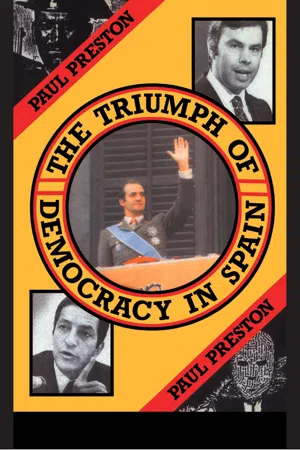
The Triumph of Democracy in Spain tells a gripping story of the tortuous creation of Spain's constitutional monarchy. The book provides an authoritative account of the tribulations of the forces of progress, beginning in 1969 with the disintegration of Franco's dictatorship and ending with the remarkable Socialist election victory in 1982.
- 288 pages
- English
- ePUB (mobile friendly)
- Available on iOS & Android
eBook - ePub
The Triumph of Democracy in Spain
1
The internal contradictions of Francoism 1939–69
When Franco died on 20 November 1975, few Spanish politicians of either right or left could have predicted with any precision the country’s political development over the subsequent decade. Only the broad outlines were vaguely discernible. With their Caudillo gone, all but the most frenzied defenders of the Francoist fortress realized that concessions would have to be made to the democratic enemy at the gates. There was hope, but no certainty, that a passage to a pluralist regime might be managed bloodlessly through negotiation between the more liberal supporters of the dictatorship and the more moderate members of the opposition. Yet even the most reasonable men and women on both sides had widely differing views about what they expected from such dealings. Moreover, there existed powerful elements at the extremes of the spectrum who were unlikely to relinquish their maximalist positions. In the event, the skill and steadfastness of Adolfo Suárez, King Juan Carlos and the principal opposition leaders ensured a relatively tranquil transition. However, only the most percipient observer could have foreseen that their stumbling progress towards democracy would be through the ambushes laid by terrorists of right and left and across the minefields of military recalcitrance.
From the vantage point of 1969, the eventual scenario after the death of Franco in 1975 would have seemed unlikely in the extreme. Franco and his political advisers had by the late 1960s prepared the ground for a succession to a Francoist monarchy, to be personified in Juan Carlos and to be irrevocably tied to the principles of the military uprising of 18 July 1936. Those principles involved belligerent opposition to communism, socialism and liberalism, to democratic pluralism and to any form of regional devolution. Accordingly, the Prince was formally committed to take over a form of backward-looking centralist, authoritarian state which was already on a collision course with Spain’s modern society and economy. It was not a prospect which boded well for the long-term survival of the monarchy in Spain. The transfer of power and the subsequent invigilation of the process was to be entrusted to Franco’s faithful henchman, Admiral Luis Carrero Blanco. He had assumed the vice-presidency of the government in 1967 and was increasingly taking over the day-to-day running of the country from Franco. Contrary to the hopes of staunch Francoists, however, the rule of Carrero Blanco was to mark the disintegration rather than the consolidation of the regime. From 1969 until his assassination in 1973, Carrero witnessed the incessant penetration of the dictatorship’s veneer of invulnerability by ETA terrorism. At the same time, faced with an inexorable rise in working-class and student dissent, he could find no more creative response than the traditional Francoist reflex of repression.
Gradually, Carrero’s cabinets of technocrats and hard-liners found themselves forced to seek assistance even further to the right of the political spectrum. In the early 1970s, the government was seen to be permitting the squalid organizations of the extreme right to do its dirty work. In consequence, many Francoists were driven to wonder about the likely efficacy of Franco’s plans to continue his regime after his death, a political option spoken about quite openly and seriously as continuismo. Supporters of Juan Carlos were beginning tentatively to wonder if his future was not being compromised by making it part of the continuista operation. The brutal incompetence which continued to poison relations with the Basques, the clergy and the workers caused growing disquiet among the more perceptive elements of Francoism.
A readiness to think beyond Francoist continuismo and to toy with the idea of an opening of the system (aperturismo) emerged very slowly. It was most common among the younger and almost apolitical functionaries who were more concerned with their own futures than with the shibboleths of the Civil War. An early trickle of defections under Carrero turned into a flood under his successor, Carlos Arias Navarro, once it became clear that his rhetorical commitment to reform could not withstand reactionary pressure. The cumulative effect of the Carrero and Arias periods was to demonstrate to moderates in both the regime and the opposition that only compromise could avoid bloodshed. This book is based on the premise, developed in chapters two and three, that the nature of the transition to democracy and of the subsequent period of crisis-torn politics can be properly understood only in terms of the deepening of the internal contradictions of the regime during these last six years of the dictator s life.
The most profound of those contradictions had arisen out of the economic growth over which the dictatorship had uneasily presided. The backward-looking rhetoric and authoritarian mechanisms of the regime were inappropriate to the needs of a modernizing state on the doorstep of the European Community. The Francoist incapacity to respond to the demands for liberalization coming from many sectors of a newly dynamic Spanish society was the most notable feature of the period 1969–75. The fact that the blind inflexibility of the regime drove its more liberal servants to consider dialogue with the opposition was, of course, only an inadvertent part of the Francoist legacy. The way in which the newly launched democracy nearly foundered between 1977 and 1981 must also be attributed in large measure to the problems bequeathed by the dictatorship. Franco’s intransigent centralism and its heavy-handed application to the Basque Country were at the heart of ETA terrorism and the considerable popular backing which it enjoyed, at least until 1978.
Equally damaging was the deliberate and dogged maintenance of the Civil War division of Spaniards into the victorious and the defeated. The belief that democracy engendered chaos and national disunity was a central tenet of the regime’s educational and cultural policy. Especially vehement in the military academies, it was behind the instinctive and violent rejection of democracy by the army and Franco’s more extreme supporters after 1975. Until the Socialists came to power in October 1982, the issues of terrorism and military subversion remained intractable. Yet, as chapters four to seven argue, they were the central questions of the period during which Spanish democracy was being constructed. The problems faced by both UCD and the Socialists in government were similarly part of the Francoist burden. Unemployment and inflation may have been the consequence of the world situation but their resolution was rendered the more difficult by the serious economic imbalances left by the dictatorship.
Military interventionism, the virulence of the extreme right and the violence of the Basques, obsolete industries and uneven development have all conditioned Spain’s political trajectory since 1975. What they have in common is that they are all symptoms of the fact that, under Franco, Spain was governed as if it were a conquered territory in the sway of an invading army. That is not to say that the military was the beneficiary of the dictatorship or the recipient of its plunder. The Spanish army was starved of modern equipment and turned into an instrument of social control rather than of national defence. In that sense, it could be argued that, in the distortions it suffered, the army was also a victim. It does, however, mean that despite its many advances and achievements Spanish democracy is, in both its birth and its formative development, a child of the Franco dictatorship.
The central function of the Franco regime was to institutionalize the Nationalist victory in the Spanish Civil War. The war had been provoked and fought by a coalition of right-wing forces in order to defend their sectional interests against a series of reforming challenges posed by the Second Republic. Landowners wished to preserve the existing structure of landed property; capitalists wished to safeguard their right to run industry and the banks without trade union interference; the army wished to defend the centralized organization of the Spanish State and the Church wished to conserve its ideological hegemony.1 Each contributed as best it could to the Francoist war effort, financially, militarily or ideologically. Both their victory and its subsequent consolidation and defence were made possible by the co-option of a politicomilitary bureaucracy consisting of those members of the middle and working classes who might be denominated the ‘service class’ of Francoism. For various reasons, wartime geographical loyalty, conviction or opportunism, they threw in their lot with the regime.2
After the Civil War, these variegated forces of Francoism were united in various ways. There were networks of patronage and corruption and, above all, the so-called ‘pact of blood’ which linked them in complicity in the repression.3 The triumph of Franco had divided Spain into the victors and the vanquished and the war between them smouldered on. This was apparent in the post-1939 repression. The regime admitted to 271,139 political prisoners in 1939. Prisons, concentration camps and labour camps remained full well into the 1940s. Until the tide turned against the Axis at the battle of Stalingrad and the Francoists began to fear for their own futures, executions continued on a large scale.4 A sporadic guerrilla war took place all over Spain, reaching its peak between 1945 and 1947 and coming to an end only in 1951. It was hardly surprising therefore that the several ‘families’ or political groups which made up the Francoist alliance were held together by a fear that any relaxation of institutionalized repression might lead to renewed civil war and acts of revenge by their victims.
The unity of the victors was made to seem even more solid than it really was by the political dominance of the Falange. Unchallenged while Hitler was in the ascendant and still powerful thereafter, the Falange’s youth and women’s organizations, its rallies and its control of the regime propaganda apparatus, provided a totalitarian veneer to 1940s Francoism. Backed by a Gestapo-trained police force, that veneer seemed real enough to the vanquished. However, within the narrow circle of the victors, there was competition for power and influence.5 The regime families, Catholics, monarchists, soldiers, clergymen, Falangists and technocrats, were formally united within the amalgamated single party known as the Movimiento. In practice, they were locked in a rivalry, the manipulation of which was to be General Franco’s greatest achievement. At moments of special tension, the ‘families’ even committed acts of violence against one another.6 For most of the time, however, their jockeying for pre-eminence took the form of intrigue and conspiracy within Franco’s court. The Caudillo maintained his personal control in a number of ways. He used ministerial positions and state preferment with great skill. He exercised a blind eye where corruption was concerned. At the same time, his manipulation of the threat both of the exiled left and of international hostility to the regime caused most of the political élite to huddle around him. Moreover, the competing groups regularly appealed to Franco as arbiter in their conflicts.
The feuding forces of the right used their economic strength and their international connections in the internal competition for power and position. Ultimately, that struggle took place between two poles. On the one hand, there were the benefits, economic and social, of unity under Franco; on the other, the threats posed by the left, a potentially hostile population and the vagaries of the international situation. Accordingly, the socioeconomic development of Spain was not merely the object of regime policies but it also in turn was to have a determining impact upon the internal dynamics of the regime. In 1939, the big landlords of the south were the paymasters of the regime, the Axis powers its main allies and the armed forces its greatest strength. By the 1960s, the economically dominant forces were multinational companies and indigenous banks, the main external influences the USA and the EEC, and the army reduced to being the regime’s poor relation.7 The relation of forces thus altered constantly, not only of one ‘family’ to another, but of all the Francoist ‘families’ to their democratic enemies. In consequence, rivalries grew more intense towards the end of the Franco period and even developed, or degenerated, into a barely concealed scramble for survival.8 The forces which united in 1936 to save themselves were to split in 1976 in order to save themselves yet again, albeit this time with an accommodation to, rather than the destruction of, the forces of democracy. In death, as in birth, the legacy of Francoism was political opportunism.
The ultimate disintegration of the Francoist forces could barely have been foreseen in the 1940s. The main efforts of the regime were then devoted to eradicating the memory of the Second Republic, repressing its political cadres and harshly disciplining the working class and the peasantry. The traditional trade unions were destroyed, their funds and property seized by the state and the Falange. They were replaced by non-confrontational corporative or ‘Vertical’ syndicates for various branches of trade and production. Within their confines, management, government and workers were theoretically represented although in practice they tended to be instruments for the elimination of strikes and the maintenance of low wages. A system of safe-conducts and certificates of political reliability made travel and the search for work extremely difficult. It thus turned those of the defeated who escaped prison or execution into second-class citizens.
The lower classes were thus forced to bear the cost of economic policies aimed at rewarding the regime’s forces for their wartime support. Commitment to the southern latifundistas saw the maintenance of starvation wages and precluded the agrarian reform necessary for self-sustained growth. Autarkic tariff, currency and trade policies cut off the regime from the locomotive of Marshall Plan aid which contributed so much to the rebuilding of Europe’s post-war economy. There was little about 1940s Francoism to justify later assertions that it was a developmental dictatorship. Indeed, by providing landowners with a passive and cheap labour force and with protection from foreign imports, the regime confirmed agricultural inefficiency and deprived industry of a peasant market. Autarky became a strait-jacket which confirmed the dominance of agriculture while simultaneously preventing it meeting any new demands placed upon it.9
By the end of the 1940s, the regime was to have increasing difficulty in containing the contradictions and imbalances of the economy. Inflation, rumblings of labour discontent and growing pressure for industrial development eventually forced the abandonment of autarky. Agricultural imbalances and inefficiency and the lack of coherent irrigation policies meant that Spain desperately needed to import food. Raw materials and energy were also in short supply. Deficiencies could not be made good without linking the country to the international economy or seeking American credit. In the deepening atmosphere of the Cold War, Franco’s fierce anti-Communism made him an attractive ally. Similarly, his repressive labour legislation, fostering as it did high profit margins, made Spain equally attractive to investors. The link-up with the United States reduced pressure on Franco from inside and outside the regime, both by preventing further drops in living standards and by projecting the country into a worldwide anti-Communist crusade which helped to revive the spirit of the Civil War.10 However, the first steps to economic liberalization caused resentment among some of the regime’s ‘families’, notably the agrarians and the Falangists.
Some Francoist ‘families’ adapted to economic change, but others remained locked in a 1940s time-warp. The Falange maintained a vacuous rhetoric of social concern. It remained committed to the self-evidently hollow ideology of peasant sovereignty, despite evidence of the privileged position of the big landowners, and for long was oblivious to the massive social changes brought about by industrialization. Fundamental changes were to become widely visible in the 1960s, but as early as 1956 clashes occurred between progressive and backward forces within the Francoist camp.11 In 1956, strikes and a violent university crisis saw Franco remove his most liberal minister, the social Catholic Joaquín Ruiz Giménez. He thus limited competition within the regime to the rivalry between Falangists and the technocrats of the immensely powerful Catholic pressure group, Opus Dei, known by its enemies as the ‘holy mafia’. The logic of industrialization favoured the technocrats. Continued strikes and student unrest led Franco reluctantly to bring them into the cabinet in February 1957.
In a sense, the Caudillo was bringing the political superstructure into line with the social and economic changes already instituted. However, he was also acquiescing in a difficult gamble. Economic liberalization in a context of political authoritarianism implied a bid to create sufficient affluence to obviate strikes and deflect opposition. For a reactionary, agrarian regime like that of Franco, to make such a bid was to sow the seeds of its own disintegration. It signified acquiescence in the creation of a mass industrial proletariat whose political loyalty or apathy would depend on continuing prosperity. It also signified a gradual switch of power towards bankers and industrialists whose interests were far more internationally orientated and determined than those of the narrow Francoist élite.12
The post-957 commitment to modern capitalist economic development ended the dominance of the Falange but did not alter the repressive nature of the regime. Economic liberalization was carried out behind the shield of reinforced army representation in the government. Most crucial in this regard was the appointment of General Camilo Alonso Vega as Minister of the Interior to provide swift and brutal repression when the social dislocation of liberalization led to rising discontent. The stringent austerity of the 1959 Stabilization Plan did in fact lead to an immediate plummeting of working-class living standards. By the early sixties, however, per capita income began to increase dramatically. The new working class was quick to flex its muscles and won a series of strikes in 1962 because, in the boom atmosphere, industrialists were loath to lose production.13 Such consequences of the sprint for modernization caused great disquiet in many Francoist circles, especially the army and the Falange.
For the Opus Dei technocrats led by the Minister of Commerce, Alberto Ullastres, the solution to all Spain’s problems lay in its full integration into Western capitalism. In pursuit of that goal, application was made in February 1962 for associate membership of the EEC, a development fiercely opposed by die-hard Falangists. Integration into a modern democratic Europe signified the end of their uniquely Spanish ideological concoction. For them the free interplay of political parties was a recipe for civil war. They preferred the safely authoritarian form of non-elective ‘organic democracy’ bestowed by Franco. Europe and democracy would expose the farce of the great paternalistic umbrella known as the Movimiento within which all the ‘families’ coexisted to the exclusion of the mas...
Table of contents
- Cover Page
- Title Page
- Copyright Page
- Preface
- Abbreviations
- 1. The Internal Contradictions of Francoism 1939–69
- 2. Holding Back the Tide: The Carrero Blanco Years 1969–73
- 3. A Necessary Evil: The Arias Navarro Experience 1974–6
- 4. Reconciling the Irreconcilable: The Political Reform of Adolfo Suárez 1976–7
- 5. Building a New World With the Bricks of the Old: The Democratic Pact 1977–9
- 6. Chronicle of a Death Foretold: The Fall of Suárez 1979–81
- 7. Out of the Ashes: The Consolidation of Democracy 1981–2
- Dramatis Personae
- Glossary of Frequently Used Spanish Words
- Appendix 1: Spain’s Eleven Military Regions and Their Commanders On 23 February 1981
- Appendix 2: The Evolution of ETA’s Principal Factions
- Notes
- Bibliographical Note
- Bibliography
Trusted by 375,005 students
Access to over 1.5 million titles for a fair monthly price.
Study more efficiently using our study tools.
Frequently asked questions
Yes, you can cancel anytime from the Subscription tab in your account settings on the Perlego website. Your subscription will stay active until the end of your current billing period. Learn how to cancel your subscription
No, books cannot be downloaded as external files, such as PDFs, for use outside of Perlego. However, you can download books within the Perlego app for offline reading on mobile or tablet. Learn how to download books offline
Perlego offers two plans: Essential and Complete
- Essential is ideal for learners and professionals who enjoy exploring a wide range of subjects. Access the Essential Library with 800,000+ trusted titles and best-sellers across business, personal growth, and the humanities. Includes unlimited reading time and Standard Read Aloud voice.
- Complete: Perfect for advanced learners and researchers needing full, unrestricted access. Unlock 1.5M+ books across hundreds of subjects, including academic and specialized titles. The Complete Plan also includes advanced features like Premium Read Aloud and Research Assistant.
We are an online textbook subscription service, where you can get access to an entire online library for less than the price of a single book per month. With over 1.5 million books across 990+ topics, we’ve got you covered! Learn about our mission
Look out for the read-aloud symbol on your next book to see if you can listen to it. The read-aloud tool reads text aloud for you, highlighting the text as it is being read. You can pause it, speed it up and slow it down. Learn more about Read Aloud
Yes! You can use the Perlego app on both iOS and Android devices to read anytime, anywhere — even offline. Perfect for commutes or when you’re on the go.
Please note we cannot support devices running on iOS 13 and Android 7 or earlier. Learn more about using the app
Please note we cannot support devices running on iOS 13 and Android 7 or earlier. Learn more about using the app
Yes, you can access The Triumph of Democracy in Spain by Paul Preston in PDF and/or ePUB format, as well as other popular books in History & 20th Century History. We have over 1.5 million books available in our catalogue for you to explore.