The Jungians: A Comparative and Historical Perspective is the first book to trace the history of the profession of analytical psychology from its origins in 1913 until the present.
As someone who has been personally involved in many aspects of Jungian history, Thomas Kirsch is well equipped to take the reader through the history of the 'movement', and to document its growth throughout the world, with chapters covering individual geographical areas - the UK, USA, and Australia, to name but a few - in some depth. He also provides new information on the ever-controversial subject of Jung's relationship to Nazism, Jews and Judaism. A lively and well-researched key work of reference, The Jungians will appeal to not only to those working in the field of analysis, but would also make essential reading for all those interested in Jungian studies.
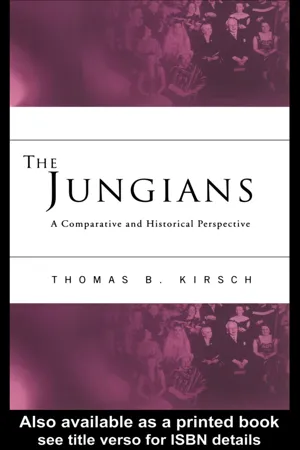
- 318 pages
- English
- ePUB (mobile friendly)
- Available on iOS & Android
eBook - ePub
About this book
Information
1 Analytical psychology in Zurich
ORIGINS
Analytical psychology had its origins in Zurich, Switzerland, and consequently this city holds center stage in the history of the Jungians. C.G. Jung was born on the Swiss side of the Lake of Constance on 26 July 1875, studied medicine in Basle, and moved to Zurich in 1900. From 1909 until his death on 6 June 1961 he lived and worked in the same house in Küsnacht on the Lake of Zurich. The tower he built at Bollingen, a small village on the Obersee, the continuation of the Lake of Zurich, was his refuge where he spent extended periods of introverted time. It is not the purpose of this book to give a detailed description of Jung’s life, as numerous biographies are available by authors such as Barbara Hannah, Sir Laurens van der Post, Vincent Brome, Gerhard Wehr, Paul Stern, Frank McLynn, Ronald Hayman, Deirdre Bair (in press), as well as Jung’s own autobiography, Memories, Dreams, Reflections. Instead, the beginnings of analytical psychology in Zurich will be described in the first part, and events subsequent to Jung’s death will make up the second part of this chapter.
Jung’s theory did not arise in a vacuum, and so it is important to locate Switzerland both geographically and culturally to understand the nature of this fertile soil on which his ideas developed. Switzerland’s history began over seven hundred years ago, when it consisted of rural and urban communities which desired to be independent from larger dynasties, such as the Habsburgs or the Italian dukes. No central authority existed until 1848 when a modern federal constitution was accepted, with German, French, and Italian recognized as the official languages. This constitution made Switzerland a democracy at a time when the rest of Europe was still more or less feudalistic. Switzerland was one of the spiritual centers of the Reformation, and since the sixteenth century its population has been fairly equally divided between Protestantism and Catholicism. Jung came from a long line of Protestant ministers, and his family traced its ancestry to Germany several centuries earlier. Switzerland, because of its location in the heart of Europe, its long history of neutrality, and its magnificent Alps, has always been an important commercial, industrial, tourist, and cultural center. Although sometimes seen as “conservative” and “quaint,” the Swiss have a long history of egalitarian tendencies, being among the first to free mental patients, and to admit women into medicine. Over the centuries the Swiss have been open to new ideas, and the country has been hospitable to “revolutionary” thinkers who found a temporary or permanent home there.
It is not surprising, therefore, that in the first decade of the twentieth century Zurich became the second most important center for the new science of psychoanalysis after Vienna. A collegial and personal friendship between Freud and Jung existed from 1907 to 1913. C.G. Jung was a principal figure in the institutional developments of psychoanalysis, and he became a prime architect of the international psychoanalytic movement. He was instrumental in organizing congresses, became the first president of the International Psychoanalytic Association (IPA), as well as editor of the first psychoanalytic journal, Das Jahrbuch. Jung introduced the rite of a training analysis, stipulating that any would-be analyst must first submit to his own analysis. This requirement has become a standard feature of all depth psychology schools. For many individuals from many countries, who later became well-known first-generation psychoanalysts, the path led through Zurich and the Burghölzli, where Jung was the Oberarzt, the chief physician under Eugen Bleuler.
Nineteen hundred thirteen was a decisive year: the Freud–Jung collaboration finally and irrevocably came to an end. Both men were profoundly wounded by the schism. Freud never developed another deep male friendship, as he had with Jung, while Jung was forced into a period of withdrawal, introversion, and self-analysis which lasted at least five years. In the same year Jung used the term “analytical psychology” for the first time to differentiate his psychology from psychoanalysis.
Early groups in analytical psychology
In recent years the founding of the first organizational structures relating to analytical psychology has been the subject of much discussion (Noll 1994, 1997; Shamdasani 1998a). The painstaking research of Sonu Shamdasani has reconstructed the history of analytical psychological groups in Zurich. The city was an early center for psychoanalysis, and by 1912 a well-functioning Psychoanalytical Association connected to the Burghölzli and the University of Zurich was in place. However, in 1912 the Zurich Psychoanalytical Association separated from the Burghölzli and became an independent organization, apart from any academic affiliation, which led psychoanalysis and analytical psychology to develop their own independent institutions.
A further separation took place on 10 July 1914 when Alphonse Maeder proposed that the group resign en masse, and the Zurich Psychoanalytic Association made an almost unanimous decision to separate from the IPA. This happened after Freud’s denunciation of Jung and the Zurich school in his “On the History of the Psychoanalytic Movement,” where Freud had established an orthodoxy which did not allow for free and unimpeded research (Freud 1914: 7).
On 30 October of the same year it was decided to rename the society the Association for Analytical Psychology on the suggestion of Professor Messmer (Muser 1984). This group, consisting mainly of medical doctors, met on a regular basis every other week until 1918, when it became absorbed into the newly formed Analytical Psychology Club. During the period between 1912 and 1918 Jung reformulated his major theories of the psyche, the collective unconscious, archetypes, individuation, and psychological types, and the meetings at the Club must have been significant.
Shamdasani’s recent research has shown that between 1916 and 1918 there were two separate Jungian groups: a professional one, the Verein, and a second one which was a lay group, the Analytical Psychology Club. The Analytical Psychology Club in Zurich became a model for similar clubs in other cities and countries. When the two groups merged in 1918, the Analytical Psychology Club was the place to meet for individuals interested in analytical psychology.
The early training of analysts
Following World War I Jung emerged from his “confrontation with the unconscious” (Jung 1963) and his fame spread, especially in the English-speaking countries and Europe. Individuals would write to Jung, asking to see him in analysis, and if accepted they would come to Zurich for varying lengths of time. In those days analyses were usually much shorter, for many reasons – not the least of which were financial considerations which prevented protracted stays.
In 1925 Jung began to give seminars in English in Zurich (Jung 1990), and from 1928 to 1939 he gave a seminar in English each academic semester. Originally the transcripts of these seminars were distributed only selectively; however, in recent years many of them have been edited and published. Individuals who were in analysis with Jung as well as Zurich analysts were invited to attend seminars. In his role as professor at the Eidgenössische Technische Hochschule (ETH), Jung gave a weekly lecture on basic aspects of analytical psychology to the general student body, and analysands who could understand German were invited to attend. These lectures were quickly translated into English by these analysands.
The Analytical Psychology Club meetings were taking place on a regular basis, and the lectures were always in German which excluded most of Jung’s American and British analysands.
The combination of analysis and seminars provided the training for the first generation of Jungian analysts. The analysis was usually done with Jung and Toni Wolff. The analysand would see Jung one day and Toni Wolff either later the same day or the following day. This type of analysis of seeing more than one analyst at a time has been called “multiple analyses” (Kirsch 1976) and has become an accepted and usual pattern in Zurich and in other countries following the Zurich model. It was sharply criticized by Michael Fordham in London (Fordham 1976), because he claimed that the transference/countertransference implications were not being analyzed and interpreted. This “multiple analyses” model allowed for too much acting out by both the patient and the analysts. When negative feelings between patient and analyst developed, the issues could be shunted to the other analyst. However, the input of two analysts of different psychological type and gender could be helpful to the patient. Jo Wheelwright, one of those who experienced multiple analyses in Zurich, stated that Jung was excellent for archetypal interpretations, while Toni Wolff was more experienced at working on personal issues, and overall he found her to be a better practical analyst than Jung (Wheelwright 1974). This pattern of multiple analyses has continued into subsequent generations of analysts in Zurich. Although still used today in Zurich and other places, the increasing importance of the transference has lessened its practice.
The relationship between Toni Wolff and C.G. and Emma Jung was controversial and remains so today. Toni Wolff came to see Jung as a patient in 1910, and he brought her to the Psychoanalytic Congress in Weimar in 1911, along with Emma Jung and Fräulein Moltzer. As the Jung–Freud relationship broke up, and Jung entered his “dark night of the soul” journey, he turned more and more to Toni Wolff. Around 1912–1913 they formed an erotic bond which lasted until the time of her death in 1953. His relationship with Toni Wolff was completely in the open, and Emma, the family, and Jung’s patients were aware of it. The two women worked together in the Analytical Psychology Club, attended Jung’s seminars together, and Toni Wolff often came to the family for Sunday lunch. Over the years they established a modus vivendi which worked for all three of them. Because of their relative comfort with the situation, others were not asked to unconsciously carry the burden. In many personal conversations with people who were in analysis with both Jung and Wolff during the 1930s, they all said how comfortable the situation was. As a result, no one had to speak about the triangle outside the analytical circle, and the complicated relationships only became public knowledge many years after they had all died. However, this left a legacy for future analysts. Some attempted to imitate Jung, and even though several instances are known, none of them appeared to have succeeded. Analysts involved in a powerful countertransference have invoked Jung’s behavior to justify their own. It is an inheritance that Jungian analysts have had to look at deeply. What seemed to work for Jung, Emma, and Toni, has not been possible for others. Today’s analysts are much more cognizant of the destructive aspects of acting out the transference/countertransference relationship.
In the early days the path to becoming a Jungian analyst was fluid. Jung would write a letter stating that the person had studied his methods and was ready to practice as a Jungian. However, seeing Jung was no guarantee that an individual would receive a letter of accreditation. Many people who expected such a letter never received one, whereas others who did not plan to become analysts received Jung’s blessing. In some instances Jung recommended further academic training to an analysand (e.g., Jo Wheelwright), while others were accepted with very little academic training (for instance Hilde Kirsch).
During the 1930s Jung did not seem very interested in forming his own school of psychology and psychotherapy. As president of the International General Medical Society for Psychotherapy, he was more interested in finding points of commonality among the different schools of psychotherapy. In 1938 he signed a statement produced by the International General Medical Society for Psychotherapy, which outlined points of agreement among the various psychotherapeutic schools. In Switzerland he became president of the Swiss Society for Practical Psychology, where he was again attempting to form a common, non-sectarian basis for psychotherapy. However, some of his closest associates during that period recognized the need to form an institute in Zurich where Jung’s psychology could be studied. However, because of World War II, the plan had to be put on hold until 1947.
Eranos
In 1933 the first yearly Eranos conference was held in Ascona, Switzerland, on the shores of Lago Maggiore, at the home of Mrs Olga Froebe-Kapteyn, a Dutch woman with a strong interest in symbolism, art, and Jung’s psychology. The initial inspiration for the Eranos conference was the encounter between Eastern and Western religions, philosophies, and psychology. Over the years Eranos developed far beyond its original boundaries and became a meeting place where ideas were exchanged on science, the humanities, mythology, and psychology. Jung attended Eranos conferences as one of the participants, but he was clearly the mediating link among all the speakers. Leading scholars from all over the world would come to this quiet, out-of-the-way place for a week of lectures, good discussions, and pleasant companionship. Jung spoke fourteen times at this conference, and the last paper he presented was “On Synchronicity” in 1951. The Eranos Tagung, as it was called, did not directly influence the practice of analytical psychology but reinforced the strong academic and cultural aspects of Jung’s personality and psychology. Many of Jung’s analysands who later became analysts attended the yearly conference. Some of the great minds of this century lectured at Eranos, including Martin Buber, Joseph Campbell, Gershom Sholem, D.T. Suzuki, Paul Tillich, among others. In recent years the conferences have continued, but the focus has changed to a more detailed study of the I-Ching. Erich Neumann, a disciple and friend of Jung, summed up the Eranos experience as follows: “Eranos, landscape on the lake, garden, and house. Modest and out of the way, and yet a navel to the world, a small link in the golden chain. As speakers and listeners, we always have to give thanks” (Jaffé 1997).
Two very practical links to the development of analytical psychology emerged from these annual gatherings. First, Olga Froebe-Kapteyn was encouraged by Jung to develop an archive of pictures portraying different archetypal symbols. She amassed a great number of pictures which eventually became the foundation for the Archive for Research in Archetypal Symbolism (ARAS), which is now housed in several American Jung Institutes, as well as in Zurich and at the Warburg Institute at the University of London. The pictures and the commentary are valuable resources for analysts and academicians interested in art history, culture, and symbolism.
A second practical outcome of the Eranos meetings was the fact that Paul and Mary Mellon attended them from 1937 through 1939. Paul Mellon was the son of Andrew Mellon, a prominent Pittsburgh banker and Secretary of the Treasury under President Coolidge. Paul’s wife, Mary, developed a strong transference to Jung and devoted the rest of her short life to the furthering of Jung’s work. She died in 1946, shortly before she was to return to Zurich for the first time after the war. The Mellons were captivated by the atmosphere of the conference and the collection of pictures Mrs Froebe-Kapteyn had assembled. They attended their first Eranos conference with the intention of meeting Jung, and they hoped that he would accept them for analysis. The Mellons did indeed meet Jung at Eranos, and both began analysis shortly thereafter. Later the Mellons formed the Bollingen Foundation, named after Jung’s tower in Bollingen, and they supported the translation and publication of Jung’s Collected Works in English, among other projects. For many years the publication of the volumes of the Collected Works was subsidized by the Bollingen Foundation so that the expense would not deter the ordinary person from reading Jung.
FIRST-GENERATION INDIVIDUALS AROUND JUNG
Emma Rauschenbach Jung (1882–1955)
Any discussion of important persons around Jung must begin with his wife of over fifty-two years, Emma. Emma Rauschenbach was born in the city of Schaffhausen near the German border. She came from a wealthy industrialist family who owned the International Watch Company (IWC), a famous name among Swiss watches. Emma and C.G. Jung were married on 14 February 1903 and moved into an apartment at the Burghölzli, where Jung was working at the time. With money from her family they were able to build a large house in Küsnacht on the Lake of Zurich, where both Emma and C.G. Jung lived for the rest of their lives. The Jungs had five children, four girls and one boy.
In 1910 Jung analyzed Emma for some months, with Freud’s approval and warning of the dangers to the personal relationship. When the conflicts between Freud and Jung arose in 1911, Emma personally and on her own wrote to Freud asking him to be forgiving of Jung, because he was going through difficult times. Her attempt to mediate between the two was not successful.
The next hurdle Emma had to face was the erotic relationship between Jung and Toni Wolff, which probably began in 1913; the exact date is not known. What kinds of discussions took place among the three of them is not known, but the result was that Jung stayed with Emma, and she accepted the relationship between Jung and Toni. Toni became a part of the extended family, and the three of them would be together at various professional and social functions. For approximately forty years, until the death of Toni Wolff in 1953, this triangular arrangement was to remain in place.
It is difficult to ascertain at what point Emma began to practice as an analyst. When the Analytical Psychology Club was formed in 1916, she was named the first president. She relinquished that position after one year, and later Toni was to be president for many years. Over the years many of Jung’s analysands also saw Emma. However, most of the foreign students who were in analysis with Jung up till the end of the 1930s saw Toni as the second analyst. Emma wrote a monograph on Anima and Animus, which was published in 1941. It became a classic within the early Jungian literature. Meanwhile she worked on her magnum opus, The Grail Legend, which she never finished, but which Marie-Louise von Franz completed after Emma’s death.
Emma Jung died on 27 November 1955 from stomach cancer, only weeks after it had first been diagnosed. In a discussion with Franz Jung, the only son, he stated that his mother held the family together, and it was only because of her that Jung was able to accomplish his life’s work. She took care of all aspects of family life and so many things, tangible and intangible, that Jung was free to do his creative work. Jung was absolutely devastated when Emma died, and many of his close intimates thought that he would never recover from her death. Fortunately, he did.
Toni Wolff (1888–1953)
Toni Wolff’s importance to Jung has long been recognized; her influence on him was profound. Toni Anna Wolff was born in Zurich on 18 September 1888 and was the oldest of three daughters born to Konrad Arnold Wolff and Anna Elisebetha Sutz. The Wolff family resided in Zurich since the 1300s and was one of its most distinguished. The father was a merchant and a businessman in Japan prior to his marriage. Although the marriage was arranged, it was described as a happy one. Toni was her father’s favorite. When he died in 1910, her mother sent her to Jung for treatment of what today would be diagnosed as depression. Jung immediately sensed her aptitude for analysis, because in 1911 he invited her along with his wife and Fräulein Moltzer to the Weimar Psychoanalytic Congress.
When Jung began his nekyia into the unconscious, Toni Wolff was the one he turne...
Table of contents
- Cover
- Halftitle
- Title
- Copyright
- Contents
- Preface
- Foreword by Peter Homans
- Acknowledgements
- Abbreviations
- Introduction by Thomas B. Kirsch
- 1. Analytical psychology in Zurich
- 2. The role of Analytical Psychology Clubs
- 3. Analytical psychology in the United Kingdom
- 4. Analytical psychology in New York
- 5. Analytical psychology in northern California
- 6. Analytical psychology in southern California
- 7. Developments in the United States and Canada after 1970
- 8. Analytical psychology in Germany
- 9. Analytical psychology in Italy
- 10. Analytical psychology in France
- 11. Analytical psychology in smaller European countries
- 12. Analytical psychology in Israel
- 13. Analytical psychology in Australia and New Zealand
- 14. Analytical psychology in Latin America
- 15. Analytical psychology in South Africa
- 16. Analytical psychology in Russia and Eastern European countries
- 17. Emerging groups in Asia
- 18. The International Association for Analytical Psychology
- 19. The history of Sandplay
- 20. Observations and conclusions
- Bibliography
- Index
Trusted by 375,005 students
Access to over 1.5 million titles for a fair monthly price.
Study more efficiently using our study tools.
Frequently asked questions
Yes, you can cancel anytime from the Subscription tab in your account settings on the Perlego website. Your subscription will stay active until the end of your current billing period. Learn how to cancel your subscription
No, books cannot be downloaded as external files, such as PDFs, for use outside of Perlego. However, you can download books within the Perlego app for offline reading on mobile or tablet. Learn how to download books offline
Perlego offers two plans: Essential and Complete
- Essential is ideal for learners and professionals who enjoy exploring a wide range of subjects. Access the Essential Library with 800,000+ trusted titles and best-sellers across business, personal growth, and the humanities. Includes unlimited reading time and Standard Read Aloud voice.
- Complete: Perfect for advanced learners and researchers needing full, unrestricted access. Unlock 1.5M+ books across hundreds of subjects, including academic and specialized titles. The Complete Plan also includes advanced features like Premium Read Aloud and Research Assistant.
We are an online textbook subscription service, where you can get access to an entire online library for less than the price of a single book per month. With over 1.5 million books across 990+ topics, we’ve got you covered! Learn about our mission
Look out for the read-aloud symbol on your next book to see if you can listen to it. The read-aloud tool reads text aloud for you, highlighting the text as it is being read. You can pause it, speed it up and slow it down. Learn more about Read Aloud
Yes! You can use the Perlego app on both iOS and Android devices to read anytime, anywhere — even offline. Perfect for commutes or when you’re on the go.
Please note we cannot support devices running on iOS 13 and Android 7 or earlier. Learn more about using the app
Please note we cannot support devices running on iOS 13 and Android 7 or earlier. Learn more about using the app
Yes, you can access The Jungians by Thomas B. Kirsch in PDF and/or ePUB format, as well as other popular books in Psychology & Mental Health in Psychology. We have over 1.5 million books available in our catalogue for you to explore.