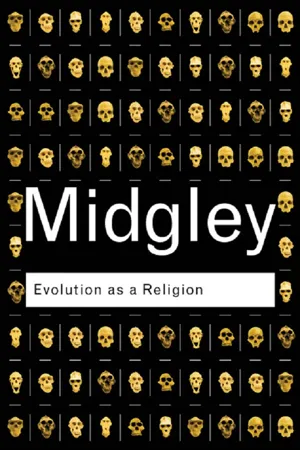
According to a profile in The Guardian, Mary Midgley is 'the foremost scourge of scientific pretensions in this country; someone whose wit is admired even by those who feel she sometimes oversteps the mark'. Considered one of Britain's finest philosophers, Midgley exposes the illogical logic of poor doctrines that shelter themselves behind the prestige of science. Always at home when taking on the high priests of evolutionary theory - Dawkins, Wilson and their acolytes - she has famously described evolution as 'the creation-myth of our age'. In Evolution as a Religion, she examines how science comes to be used as a substitute for religion and points out how badly that role distorts it. As ever, her argument is flawlessly insightful: a punchy, compelling, lively indictment of these misuses of science. Both the book and its author are true classics of our time.
- 224 pages
- English
- ePUB (mobile friendly)
- Available on iOS & Android
eBook - ePub
About this book
Information
1
Evolutionary Dramas
There is grandeur in this view of life.
Charles Darwin
Science and Symbolism
The theory of evolution is not just an inert piece of theoretical science. It is, and cannot help being, also a powerful folk-tale about human origins. Any such narrative must have symbolic force. We are probably the first culture not to make that its main function. Most stories about human origins must have been devised purely with a view to symbolic and poetic fittingness. Suggestions about how we were made and where we come from are bound to engage our imagination, to shape our views of what we now are, and so to affect our lives. Scientists, when they find themselves caught up in these webs of symbolism, sometimes complain, calling for a sanitary cordon to keep them away from science. But this seems to be both psychologically and logically impossible.
Our theoretical curiosity simply is not detached in this way from the rest of our life. Nor do scientists themselves always want it to be so. Some of the symbolic webs are ones which they approve of, and promote as part of the ideal of science itself. For instance, Jacques Monod, as an atheistical biochemist, does not just rejoice at getting rid of the theistic drama. He at once replaces it by another drama, just as vivid, emotive and relevant to life, in which Sartrian man appears as the lonely hero challenging an alien and meaningless universe:
It is perfectly true that science attacks values. Not directly, since science is no judge of them and must ignore them; but it subverts every one of the mythical or philosophical ontogenies upon which the animist tradition, from the Australian aborigines to the dialectical materialists, has based morality, values, duties, rights, prohibitions.
If he accepts this message in its full significance, man must at last wake out of his millenary dream and discover his total solitude, his fundamental isolation. He must realize that, like a gypsy, he lives on the boundary of an alien world; a world that is deaf to his music, and as indifferent to his hopes as it is to his sufferings or his crimes.1
But ‘discovering his total solitude’ is just adopting one imaginative stance among many possible ones. Other good scientists, very differently, have used the continuity of our species with the rest of the physical world to reprove human arrogance and to call for practical recognition of kinship with other creatures. Many, like Darwin and the great geneticist Theodosius Dobzhansky, have held that an attitude of awe and veneration for the wonders of the physical world is an essential condition for studying them properly. Others have talked in a more predatory way about the joys of the chase and the triumph of catching facts. Both motives, and many others, are evidently so habitual in science that they are only not mentioned because they are taken for granted.
It seems often to be assumed that they are therefore irrelevant, that Science itself is something so pure and impersonal that it ought to be thought of in complete abstraction from all the motives that might lead people to practise it. This, unfortunately, cannot work because of the importance of world-pictures. Facts are not gathered in a vacuum, but to fill gaps in a world-picture which already exists. And the shape of this world-picture – determining the matters allowed for it, the principles of selection, the possible range of emphases – depends deeply on the motives for forming it in the first place.
Imagination, which guides thought, is directed by our attitudes. For instance, predatory and competitive motives tend to produce a picture dominated by competition and predation – one in which these elements do not only play their part, as they did for Darwin, but are arbitrarily and dogmatically isolated as sole rulers. Thus, in a familiar distortion which will concern us repeatedly, the sociobiologist M. T. Ghiselin flatly declares:
The evolution of society fits the Darwinian paradigm in its most individualistic form. The economy of nature is competitive from beginning to end. Understand that economy, and how it works, and the underlying reasons for social phenomena are manifest. They are the means by which one organism gains some advantage to the detriment of another. No hint of genuine charity ameliorates our vision of society, once sentimentalism has been laid aside. What passes for cooperation turns out to be a mixture of opportunism and exploitation. The impulses that lead one animal to sacrifice himself for another turn out to have their ultimate rationale in gaining advantage over a third, and acts for the good of one ‘society’ turn out to be performed for the detriment of the rest. Where it is in his own interest, every organism may reasonably be expected to aid his fellows. Where he has no alternative, he submits to the yoke of servitude. Yet, given a full chance to act in his own interest, nothing but expediency will restrain him from brutalizing, from maiming, from murdering – his brother, his mate, his parent, or his child. Scratch an ‘altruist’ and watch a ‘hypocrite’ bleed.2
As we shall see, this claim is essentially pure fantasy, not only unsupported by the empirical facts which are supposed to be its grounds, but actually contrary to them, such as they are. Is this a quite exceptional aberration? Some will suspect that it must be, not only because the world-picture involved is a bad one, but because scientists ought to be so impartial that they either do not have anything so unprofessional as a world-picture at all, or, if they have one, do not let it affect their work.
But this is a mistaken ideal. An enquirer with no such general map would only be an obsessive – someone who had a special motive for collecting facts indiscriminately. He would not be a person without an attitude, or without special motives, but one with motives so odd as to inhibit the kind of organizing activity which normally shapes people’s ideas into some sort of coherent whole. Merely to pile up information indiscriminately is an idiot’s task.
Good scientists do not approximate to that ideal at all. They tend to have a very strong guiding imaginative system. Their world-picture is usually a positive and distinctive one, with its own special drama. They do not scrupulously avoid conveying any sense of dark and light, of what matters and what does not, of what is to be aimed at and what avoided at all costs. They use the lights and shadows to reveal the landscape. Like those who argue usefully on any other subject, they do their best work not by being neutral but by having strong preferences, being aware of them, criticizing them carefully, expressing them plainly and then leaving their readers to decide how far to share them.
Symbolism, then, is not just a nuisance to be got rid of. It is essential. Facts will never appear to us as brute and meaningless; they will always organize themselves into some sort of story, some drama. These dramas can indeed be dangerous. They can distort our theories, and they have distorted the theory of evolution perhaps more than any other. The only way in which we can control this kind of distortion is, I believe, to bring the dramas themselves out into the open, to give them our full attention, understand them better and see what part, if any, each of them ought to play both in theory and in life. It is no use merely to swipe at them from time to time, like troublesome insects, while officially attending only to the theoretical questions. This will not make them go away, because they are a serious feature of life.
Darwin’s Balance
The drama that attends a theory need not, then, be mere melodrama. When sensationalism is present it is either irrelevant or – if it really belongs to a theory – shows that that theory is bad. The drama that goes with a good theory is simply the expressive aspect of the theory itself. In order of time, it is often conceived in advance of much of the supporting evidence. But when further facts accumulate, it ought to respond to them by refining and subtilizing its cruder outlines.
This process usually makes it less extreme and one-sided, and so moves it away from the gratuitous sensationalism which marks melodrama. That does not make it less stirring or less important for life; it can make it more so. This imaginative and emotional deepening is part of the growth of a theory, not just a chance ornament. When the young Darwin immersed himself in the arguments about cosmic purpose in Paley’s theological textbook The Evidences of Christianity, and repeatedly read Paradise Lost on exploring trips from the Beagle,3 he was neither wasting his time nor distorting his scientific project. He was seriously working his way through a range of life-positions which lay on the route to the one he could finally use.
The result of this long preliminary pilgrimage was to make his own picture unusually balanced and inclusive. To keep it so is, however, terribly hard. He himself made clear that he felt this difficulty deeply, and was constantly dissatisfied with his efforts, constantly changing his books to do justice to some neglected angle. The vastness of the truth and the one-sidedness of formulae always haunted him.
This haunting by no means reduced his work to an undramatic neutrality. Instead, the tension of opposites makes the drama which he shows us comprehensive and Shakespearian, so that it includes every mood. Gillian Beer has lately pointed out how rich his style is in fertile metaphors and models, which he continually uses to supplement and correct each other.4 Centrally, he will not lose hold of either of the two emotional responses which belong most naturally to evolutionary speculation – on the one hand, optimistic, joyful wonder at the profusion of nature, and on the other, pessimistic, sombre alarm at its wasteful cruelty. Since he cannot qualify every sentence, selective quotation often makes him seem enslaved to one or other of these attitudes. And others who have made real efforts to come to terms with the conflict have been misrepresented in the same sort of way.
No malice is needed for this distortion. Even given goodwill, the difficulty is immense. What is needed is not just a set of rules for handling factual disputes, of the kind which is recognized as part of scientific training. Since this vast issue involves our whole view of our place in the world, discussion of it calls out and reflects the whole shape of the character. The way in which we treat it inevitably reveals our weaknesses and prejudices. Dozens of awkward truths about ourselves are relevant to this subject; our avoidance of any of them projects a distortion on to the screen of our theory. Obviously we shall never escape their influence. What is needed is the kind of effort which Darwin made to become aware of them, to separate them from the more narrowly factual issues, and to watch out for their dangers.
Am I exaggerating these dangers? Some physical scientists are likely to feel that the kind of thing I have been describing does indeed happen in other disciplines, notably in the humanities, but does not normally happen in their own, and cannot really have mattered to Darwin. I only wish that they were right.
The destructive message of this book is a somewhat dismal one. It concerns the sort of trouble which arises when, with writers less careful than Darwin, the dramas take over. About evolution, theory itself has again and again been distorted by biases flowing from over-simple, unbalanced world-pictures. The trouble does not, of course, lie in mere wish-fulfilment of the obvious kind which paints the world as we should like it to be. It involves being obsessed by a picture so colourful and striking that it numbs thought about the evidence required to support it. Standards of proof then fall headlong.
Half the trouble of course takes place out of sight, in the mere choice of problems, in taking some things for granted and being quite unpersuadable about others, in unconsciously placing the burden of proof on one’s opponents, and sometimes in pure tribal feeling which confines one’s attention to the fellow-specialists who already share one’s premisses. Of course it is true that the resulting mistakes are usually not as bad as the exaggerated forms in which they are reflected by outsiders, and also that they are ‘not part of science’. Mistakes never are. But since what is needed in order to correct them is not to avoid all world-pictures altogether, but to form better ones, this whole process is a matter for real scientific concern.
False Lights
There are two distortions in particular which will mainly concern us in this book, and they had better be indicated, however crudely, right away. Neither is new; both have often been denounced. But both persist, not just in the minds of outsiders ignorant of evolutionary theory, but also in those of many scientists who develop and expound it.
The first is the better known and the more obviously pernicious. It is the ‘Social Darwinist’ idea, expressed by Ghiselin, that life has been scientifically proved to be essentially competitive, in some sense which exposes all social feeling as somehow mere humbug and illusion. The phrase ‘survival of the fittest’ has been used, ever since Herbert Spencer first coined it, to describe an individualistic law showing such things as co-operation, love and altruism to be unreal, a law which (somewhat mysteriously) both demands and predicts that they should always give way to self-interest.
This has often been exposed as nonsense. Since many very successful species of social animals, including our own, have evolved these traits, have survived by them and continue to live by them, their unreality cannot be the message of evolutionary theory. But because of its strong dramatic force, as well as various political uses, this notion persists through repeated attempts to correct it, and often twists up the ideas even of those who think they are helping to get rid of it. It is especially troublesome in the American sociobiology debate, a topic to which I shall have to give a rather disproportionate amount of attention, simply because its wide publicity makes it, just now, the most prominent hotbed of noisy errors about evolution.
The second main distortion may be called Panglossism, or the Escalator Fallacy. It is the idea that evolution is a steady, linear upward movement, a single inexorable process of improvement, leading (as a disciple of Herbert Spencer’s put it) ‘from gas to genius’5 and beyond into some superhuman spiritual stratosphere. This idea, first put forward by Jean-Baptiste Lamarck at the beginning of the nineteenth century,6 convinced Spencer instantly and completely.
It did not convince Darwin at all. He thought it vacuous, pointed out the obscurity of the metaphor ‘higher’, and relied on no such paid-up cosmic insurance policy to bail out the human race. He developed his own view of selection on the humbler model of a bush – a rich radiation of varying forms, in which human qualities cannot, any more than any others, determine a general direction for the whole.
Here too, however, what he rejected has been kept by many people as a central feature of the idea of evolution and seen as a key part of ‘Darwinism’. Still unsupported by argument, it too continues to produce some extremely strange theorizing, and in its less obvious way also to do a great deal of damage. These two kinds of drama are, in fact, the shapes into which the two main strands of feeling about evolution naturally develop, if they are not held in balance and forced to correct each other. They are the hypertrophied forms of cosmic optimism and cosmic pessimism respectively. Since both these moods are common, theory-builders often oscillate between them rather casually, and produce views which owe something to both. Unluckily, this is not the same thing as the synthesis which Darwin attempted. It can merely give us the worst of both worlds.
The Fear of Biology
Melodramas like these, especially the ‘Social Darwinist’ or Spencerist one, account, I am sure, for the strong objection which many people still feel to seriously taking the theory of evolution on board at all. This objection is not confined to Biblical creationists. Certainly the persistence of creationism, leading to a recent expansion and even the conversion of a few physical scientists, itself indicates something beyond mere passive conservatism. But what is much more interesting and important is the subtler resistance still common among social scientists.
This is not a denial of evolutionary theory itself, which is usually conceded as correct in its own sphere, but a steady rejection of any attempt to use it in the interpretation of human affairs. A sanitary cordon is erected at the frontier between the physical and social sciences, at which biological explanations generally and evolutionary ones in particular still tend to be turned back, marked with an official stamp which may read ‘Fascist’, ‘Racist’, ‘Galtonist’, ‘Innatist’, ‘Biological Determinist’, or at times, most grimly of all, merely ‘Biological’.
This habit is fortunately on the way out, and a modest two-way traffic does now go on, to the general advantage. But a good deal of work is still needed to explain – as is always necessary in these cases – the distortions which gave rise to the prejudice in the first place, and just why they are not actually part of biological science. That is a main business of this book.
Tribally speaking, this debate is conceived as a border dispute between social scientists and biologists. It can appear to be one between their respective sciences themselves. Since, however, sciences cannot oppose each other in this way, there is plainly a need for rethinking and restatement when their representatives start doing so. It is helpful, I think, to begin by looking at the historical reasons why inter-science war at this point did not surprise or shock people as much as it ought to have done.
In the first place, wit...
Table of contents
- Cover
- Half Title
- Copyright
- Title Page
- Dedication
- Contents
- Acknowledgements
- Introduction to the Routledge Classics Edition
- 1. Evolutionary Dramas
- 2. Do Science and Religion Compete?
- 3. Demarcation Disputes
- 4. The Irresistible Escalator
- 5. Choosing a World
- 6. The Problem of Direction
- 7. Scientist and Superscientist
- 8. Dazzling Prospects
- 9. Black Holes: Jacques Monod and the Isolation of ‘Science’
- 10. Freedom and the Monte Carlo Drama
- 11. Scientific Education and Human Transience
- 12. Mixed Antitheses
- 13. Science, Scepticism and Awe
- 14. The Service of Self and the Service of Kali
- 15. Who or What is Selfish?
- 16. Dreaming and Waking
- 17. The Limits of Individualism
- 18. The Vulnerable World and Its Claims on Us
- Notes
- Index
Trusted by 375,005 students
Access to over 1.5 million titles for a fair monthly price.
Study more efficiently using our study tools.
Frequently asked questions
Yes, you can cancel anytime from the Subscription tab in your account settings on the Perlego website. Your subscription will stay active until the end of your current billing period. Learn how to cancel your subscription
No, books cannot be downloaded as external files, such as PDFs, for use outside of Perlego. However, you can download books within the Perlego app for offline reading on mobile or tablet. Learn how to download books offline
Perlego offers two plans: Essential and Complete
- Essential is ideal for learners and professionals who enjoy exploring a wide range of subjects. Access the Essential Library with 800,000+ trusted titles and best-sellers across business, personal growth, and the humanities. Includes unlimited reading time and Standard Read Aloud voice.
- Complete: Perfect for advanced learners and researchers needing full, unrestricted access. Unlock 1.5M+ books across hundreds of subjects, including academic and specialized titles. The Complete Plan also includes advanced features like Premium Read Aloud and Research Assistant.
We are an online textbook subscription service, where you can get access to an entire online library for less than the price of a single book per month. With over 1.5 million books across 990+ topics, we’ve got you covered! Learn about our mission
Look out for the read-aloud symbol on your next book to see if you can listen to it. The read-aloud tool reads text aloud for you, highlighting the text as it is being read. You can pause it, speed it up and slow it down. Learn more about Read Aloud
Yes! You can use the Perlego app on both iOS and Android devices to read anytime, anywhere — even offline. Perfect for commutes or when you’re on the go.
Please note we cannot support devices running on iOS 13 and Android 7 or earlier. Learn more about using the app
Please note we cannot support devices running on iOS 13 and Android 7 or earlier. Learn more about using the app
Yes, you can access Evolution as a Religion by Mary Midgley,Mary Midgley in PDF and/or ePUB format, as well as other popular books in Theology & Religion & Philosophy History & Theory. We have over 1.5 million books available in our catalogue for you to explore.