eBook - ePub
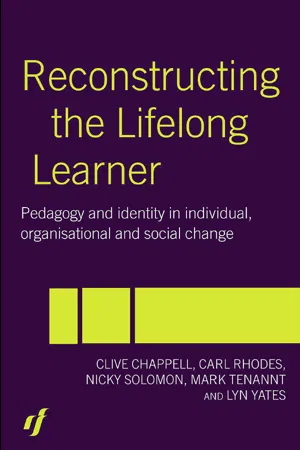
Reconstructing the Lifelong Learner
Pedagogy and Identity in Individual, Organisational and Social Change
- 208 pages
- English
- ePUB (mobile friendly)
- Available on iOS & Android
eBook - ePub
Reconstructing the Lifelong Learner
Pedagogy and Identity in Individual, Organisational and Social Change
About this book
How is adult learning used to produce personal, organisational and social change?
This interesting examination of adult learning for change illustrates through diverse case studies and theoretical perspectives that personal change is inextricably linked to broader organisational and social change. The authors explore how theorising education as a vehicle for self-change is relevant to the practices of educators, learning specialists and others concerned with promoting learning for change.
The book examines the relationship between pedagogy, identity and change, and illustrates this through a range of case studies focusing on the following:
* Self-help books
* Work-based learning
* Corporate culture training
* AIDS education
* Gender education
* Sex offender education.
A concluding chapter discusses how writing an academic text is itself a pedagogical practice contributing to the identities of authors. This unique text will be of interest to students of education, sociology, cultural studies and change management as well as teachers, educators and professionals involved in lifelong learning or change management in any way.
Information
Chapter 1
Education as a site for self-work
Introduction
Educators, and others with an educational dimension to their work, are frequently engaged in promoting learning for personal change. Sometimes this is made explicit – for example, in programmes which aim to improve self-esteem or self-concept, or which help people discover their ‘authentic’ self. Sometimes it is more implicit – for example, in programmes which address significant social issues such as gender stereotyping, racial discrimination, migration, domestic violence, environmental concerns and perhaps health issues: the idea being that personal change is inextricably linked to broader social change.
In the workplace too most changes imply a reorientation of people’s values or attitudes or the way they see themselves. Recent interest by organisations, for example, in promoting ‘cultural change’ programmes for personnel suggests that business now regards the personal change of employees as crucial to the achievement of increased efficiency and profitability. The idea here is that people who identify with the culture of an organisation are able to produce the sorts of meanings at work that encourage them to act in ways that contribute to the success of the organisation (see du Gay 1996a).
Irrespective of context, we argue here that all programmes designed to act as catalysts for personal or professional growth and change contain implicit theorisations concerning the nature of the self, its development or capacity for change, and the way the self relates to others or to society more generally. Such theorisations are a necessary part of our conception of the possibility of self-change and the associated pedagogies deployed for the purpose of change (e.g. Mezirow’s notion of perspective transformation – see Mezirow 1990, 1991; Weissner et al. 2000). When engaging with these conceptions a number of questions surface: Can we be the sole agents of our own change? If not, to what extent are we dependent on others to effect self-change? What kinds of activities and relationships promote self-change? What theoretical assumptions underpin contemporary understandings about the possibility of self-change? What is the role of the educator in identity work? How does pedagogical practice contribute to learner and teacher identity formation? What political and ethical issues emerge from using pedagogy to change identity? In what ways do pedagogy, identity and change work together? Different pedagogies offer, or at least imply, different responses to these questions and others like them. Other questions may also be asked, or the above questions reframed, to expose different ways of thinking about the issue of self-formation and change. In other words, different theoretical perspectives pose different questions and cast the problematic in different ways.
We suggest that by engaging with theorisations concerning the self and self-change, practitioners are better able to analyse their own assumptions, make explicit their theoretical position, and tailor their pedagogical practices accordingly. The purpose of this book then, is to theorise education as a vehicle for self-change and to explore how such theorising impacts on the practices of educators, ‘learning specialists’ and others concerned with promoting learning for change. The position adopted throughout is that the various educational and learning ‘programmes’ are best seen as technologies for constructing particular kinds of people or ‘subjects’.
The purpose of this chapter is twofold: first, to make the general case that education invariably involves an element of self-formation and change, and second, to review and analyse the practices and theories of different traditions in education with a view to identifying the key pedagogical and theoretical issues that hinge on the formation of self and self-change. We commence with a brief discussion of the dualism of ‘individual and society’ as a way of framing existing pedagogical approaches. We then look at perhaps the most pervasive strategy apparent when there is a deliberate focus on learning for self-change and self-work: reflection on experience as a pedagogical tool. We conclude with a brief discussion of teacher-learner relationships and identity work, and how both are implicated in any decision to adopt a particular pedagogical tool.
The dualism of ‘individual’ and ‘society’ in pedagogies of change
It is useful to consider various educational interventions for self-change as belonging to and extending the lineage of ‘technologies of the self’ as elaborated by Foucault. In his essay on ‘Technologies of the Self’ (Foucault 1988), Foucault traces the development of technologies of the self in Graeco-Roman philosophy and in early Christianity. Technologies of the self (which stand alongside and interact with technologies of production, sign systems and power)
permit individuals to effect by their own means or with the help of others a certain number of operations on their own bodies and souls, thoughts, conduct and way of being, so as to transform themselves in order to attain a certain state of happiness, purity, wisdom, perfection, or immortality.
(1988: 18)
Foucault is particularly concerned with the notion of ‘taking care of oneself’ as a precept or imperative which circulated among a number of different doctrines in the period 3 bc–ad 3. This is a theme developed more extensively in The Care of the Self: The History of Sexuality, Volume 3. In this text, Foucault refers to the time and effort expended in attending to oneself in antiquity:
Taking care of oneself is not a rest cure. There is the care of the body to consider, health regimens, physical exercises without overexertion, the carefully measured satisfaction of needs. There are the meditations, the readings, the notes one takes on books or on the conversations one has heard, notes that one reads again later, the recollection of truths that one knows already but that need to be more fully adapted to one’s life . . . there are also the talks one has with a confidant, with friends, with a guide or director. Add to this the correspondence in which one reveals the state of one’s soul, solicits advice, gives advice to anyone who needs it . . . Around the care of self there developed an entire activity of speaking and writing in which the work of oneself on oneself and communication with others were linked together.
(1986: 51)
Foucault analyses the techniques associated with different doctrines concerned with the care of self: from the practices of Stoic teachers such as the spiritual retreat, meditation, ritual purification and mentoring; to the Christian tradition of confession, disclosure and renunciation of the self. His interest in these techniques (and their contemporary equivalents such as counselling, guidance and education) is how they figure in the transformation of human beings into subjects, and how power can be exercised or resisted through the work of self on self. As Foucault argued earlier:
There are two meanings of the word subject: subject to someone else by control and dependence, and tied to his own identity by a conscience or self-knowledge. Both meanings suggest a form of power which subjugates and makes subject to . . . it can be said that there are three types of struggles: either against forms of domination (ethnic, social, religious); against forms of exploitation which separate individuals from what they produce; or against that which ties the individual to himself and submits him to others in this way (struggles against subjection, against forms of subjectivity and submission).
(1983: 212)
A similar analysis can be made of existing pedagogical technologies aimed at fostering certain kinds of self-change and transformation. In this regard, Boud (1989) provides a useful framework (also cited by Usher et al. 1997). He comments on four pedagogical traditions: the training and efficiency tradition (with its classical scientific self, a kind of self-contained mechanistic learning machine); the self-direction or andragogical tradition (where the self is conceived as individualistic and unitary, capable of rational reflection on experience, and conferring meaning on experience); the learner-centred or humanistic tradition (with the notion of an innate or authentic self which is in a process of ‘becoming’ in a holistic integration of thinking, feeling and acting); and the critical pedagogy and social action tradition (with its exploited self of ‘false consciousness’, an inauthentic self which is socially formed and distorted by ideology and oppressive social structures). The problem with the first three of the above is that they accept as given or neutral that which is highly problematic: for example, knowledge and skills are assumed to be neutral rather than socially and culturally constructed; or experience is seen as given, the source of authentic knowledge and not in any way problematic; or there is assumed to be a true self which exists independently of the social realm. In the andragogical and humanistic traditions in particular, the social is something which is cast as oppressive and to be overcome or transcended through technologies which promote self-control, self-direction, self-management, self-knowledge, autonomy, or self-realisation – technologies which are aimed at empowering the individual learner. The andragogical and humanistic traditions support the conventional view that education can lead to a greater awareness of self through cultivating a self which is independent, rational, autonomous, coherent and which has a sense of social responsibility. In this scenario social change is a matter of individuals acting authentically and autonomously: being truly themselves.
Now this view of the self, which is largely informed by humanistic psychology, has been criticised as being overly individualistic: of portraying social problems as largely individual problems with individual solutions, of accepting as given the social world in which the self resides. This version of self-empowerment through the fostering of personal autonomy is seen by critics as illusory: largely because social structures and forces remain unchallenged. At the very least the increasing pluralisation of society has challenged any pretence that universal social and normative frames of reference can provide unchanging anchoring points for identity. Indeed, increasing social and cultural mobility has begun to erode the possibility of developing a self built on any singular and stable socio-cultural community. Ultimately, and ironically, the technologies which enhance autonomy are said to serve the interests of existing social structures and forces. This view is well expressed by Usher et al. (1997: 98):
These traditions make much of empowering the individual learner, yet they have shown themselves to be wide open to hijacking by an individual and instrumental ethic. The psychologism and individualism of humanistic discourse presented as a concern for the ‘person’ can lead ultimately and paradoxically to a dehumanisation through the substitution of covert for overt regulation under the guise of ‘being human’, enabling learners to ‘open up’, and provide access to their ‘inner world’. This is an infiltration of power by subjectivity and a complementary infiltration of subjectivity by power.
Such a position is not new in social theory. Indeed, critical pedagogy, and its associated technologies, is based upon a view of the self as socially constituted. Now there are very different versions of how the social becomes a constitutive part of the self: how the ‘outside’ gets ‘inside’ so to speak, and how social processes interpenetrate the psyche. Nevertheless they all have in common the notion that the self participates in its own subjugation and domination, whether it is through ‘false consciousness’ produced by membership of a particular social group, or the internalisation of social ‘oppression’ through individual ‘repression’ (in the psychoanalytic sense). But Usher et al., from their postmodernist stance, regard critical pedagogy as reifying the social as a monolithic ‘other’ which serves to oppress and crush, and they warn that it is a mistake to adopt an over-socialised and over-determined view of the person:
There is a tendency in the critical tradition to end up with a conception of the self which is, on the one hand, oversocialised and overdetermined and on the other, patronising in so far as selves have to be seen as normally in a state of false consciousness. In stressing the negative and overwhelming effects of social relations and social structures, persons are made into social ‘victims’, dupes and puppets, manipulated by ideology and deprived of agency.
(1997: 99)
The technology of the self in critical pedagogy is one based on ideology critique, whereby the aim is to analyse and uncover one’s ideological positioning, to understand how this positioning operates in the interests of oppression, and through dialogue and action free oneself of ‘false consciousness’. The problem with this approach is that it theorises a self which is capable of moving from ‘false’ to ‘true’ consciousness: that is, a rational and unified self which is capable of freeing itself from its social situatedness. It is this which links critical pedagogy with the andragogical and humanistic traditions, traditions which it opposes for their individualistic approach.
Arguably in the social sciences, and the educational technologies they foster, the problematic of the social within the self is traditionally framed in terms of a binary opposition or dualism between the ‘individual’ and ‘society’. It is as if the two poles ‘individual’ and ‘society’ are antithetical, separate, and pull in opposite directions. Moreover, theoretical positions which pose an ongoing dialectical interaction between ‘individual’ and ‘society’ have hitherto been unable to escape the dualism and invariably privilege one term over the other. For example, there have been a number of attempts in psychology to theorise the social component of psychological functioning, particularly in social and developmental psychology. Concepts such as ‘internalisation’, ‘interaction’, ‘intersubjectivity’, ‘accommodation’, ‘shaping’, ‘role’ and ‘modelling’ are recognisable as part of the vernacular adopted by psychology to explain how the ‘outside’ gets ‘inside’. From a postmodern point of view, they all fail because they are based on an acceptance of the individual-society dualism. Theories which stress ‘shaping’ and ‘modelling’, for example, assume a totally passive individual who is moulded by external forces. Theories which employ the concepts of ‘interaction’, ‘internalisation’, ‘accommodation’, ‘role’ and ‘intersubjectivity’ ultimately rely on the existence of a unitary, rational, pre-given individual subject.
It is of course possible to develop a way of theorising subjectivity which is not reliant on this individual-society dualism. The concepts of individual and society can be recast as effects which are produced rather than as pre-given entities. For example, the idea of the unitary, coherent and rational subject as agent can be ‘deconstructed’ as being a historical product, best seen as a discourse embedded in everyday practices and as part of the productive work of, say, psychology and its associated educational technologies. Therefore, replacing this view of the individual is the idea of the subject as a position within a discourse. Moreover, because there are a number of discourses, a number of subject positions are produced, and because discourses are not necessarily coherent or devoid of contradiction, subjectivity is regarded as multiple, not purely rational, and potentially contradictory. This implies a decentring of the self away from the notion of a coherent ‘authentic’ self and towards the notion of ‘multiple subjectivities’, ‘multiple lifeworlds’ or ‘multiple layers’ to everyone’s identity.
To summarise, traditional theorisations of adult education practice invariably privilege one of the two poles of the individual-society dualism: the psychological/humanistic pole which stresses the agency of the subject, and the sociological/critical theory pole which stresses how the subject is wholly determined. The dilemma for the educator is that neither pole offers a satisfactory perspective on practice: the former seems too naive in failing to acknowledge the power of social forces, and the latter is too pessimistic and leaves no scope for education to have a meaningful role, and there is certainly no role for the autonomous learner. A way out of this dilemma is to deny the binary opposition on which it is built, and treat the ‘subject’ and the ‘social’ as jointly produced through discursive practices.
Reflection on experience as a pedagogical technology
By engaging with the above issues, educators can begin to pose questions about how they intervene to produce personal change and what their interventions reveal about their assumptions regarding the self. Do our interventions assume a false consciousness among learners? Do we assume that our interventions assist learners to overcome their social situatedness (personal history, experience of oppression etc.)? Are our interventions aimed at helping learners discover their ‘real’ selves? Do our interventions promote a stronger, more autonomous sense of self? Do we assume that an integrated, coherent, autonomous self is both desirable and possible? Or are our interventions aimed at exploring the multi-layered and multi-faceted nature of a purely relational self? Each one of these positions, if adopted, leads to the formulation of particular types of educational goals and the adoption of processes and ways of talking with learners which are quite different.
This can be illustrated with respect t...
Table of contents
- Cover Page
- Title Page
- Copyright Page
- Acknowledgements
- Introduction
- Chapter 1: Education As a Site for Self-Work
- Chapter 2: Theorising Identity
- Chapter 3: Understanding Identity As Narrative
- Chapter 4: Pedagogies for Personal Change In the ‘Self-Help’ Literature: Helping Oneself
- Chapter 5: Writing Portfolios In a Work-Based Learning Programme: Textually Producing Oneself
- Chapter 6: Pedagogy As a Tool for Corporate Culture: Working for Oneself
- Chapter 7: Games As a Pedagogy In HIV/AIDS Education: Protecting Oneself
- Chapter 8: Social Movements and Programmes of Gender Change: Interrupting Oneself
- Chapter 9: Educational Programmes for Sex Offenders: Correcting Oneself
- Chapter 10: Pedagogy, Identity, Reflexivity
- References
Trusted by 375,005 students
Access to over 1.5 million titles for a fair monthly price.
Study more efficiently using our study tools.
Frequently asked questions
Yes, you can cancel anytime from the Subscription tab in your account settings on the Perlego website. Your subscription will stay active until the end of your current billing period. Learn how to cancel your subscription
No, books cannot be downloaded as external files, such as PDFs, for use outside of Perlego. However, you can download books within the Perlego app for offline reading on mobile or tablet. Learn how to download books offline
Perlego offers two plans: Essential and Complete
- Essential is ideal for learners and professionals who enjoy exploring a wide range of subjects. Access the Essential Library with 800,000+ trusted titles and best-sellers across business, personal growth, and the humanities. Includes unlimited reading time and Standard Read Aloud voice.
- Complete: Perfect for advanced learners and researchers needing full, unrestricted access. Unlock 1.5M+ books across hundreds of subjects, including academic and specialized titles. The Complete Plan also includes advanced features like Premium Read Aloud and Research Assistant.
We are an online textbook subscription service, where you can get access to an entire online library for less than the price of a single book per month. With over 1.5 million books across 990+ topics, we’ve got you covered! Learn about our mission
Look out for the read-aloud symbol on your next book to see if you can listen to it. The read-aloud tool reads text aloud for you, highlighting the text as it is being read. You can pause it, speed it up and slow it down. Learn more about Read Aloud
Yes! You can use the Perlego app on both iOS and Android devices to read anytime, anywhere — even offline. Perfect for commutes or when you’re on the go.
Please note we cannot support devices running on iOS 13 and Android 7 or earlier. Learn more about using the app
Please note we cannot support devices running on iOS 13 and Android 7 or earlier. Learn more about using the app
Yes, you can access Reconstructing the Lifelong Learner by Clive Chappell,Carl Rhodes,Nicky Solomon,Mark Tennant,Lyn Yates in PDF and/or ePUB format, as well as other popular books in Education & Adult Education. We have over 1.5 million books available in our catalogue for you to explore.