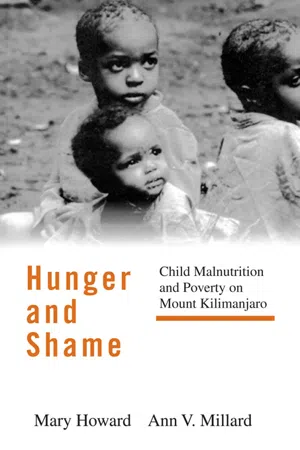
Hunger and Shame is a passionate account of child malnutrition in a relatively wealthy populace, the Chagga in Mt. Kilimanjaro, Tanzania. Views of family members, health workers and government officials provide insights into the complex of ideas, institutions and human fallibility that sustain the shame of malnutrition in the mountains.
Discussing the moral and practical dilemmas posed by the presence of malnourished children in the community, the authors explore the shame associated with child hunger in relation to social organization, colonial history and the global economy. Their discussions challenge the reader to ask fundamental questions concerning ethics, the politics of poverty and shame and social relations.
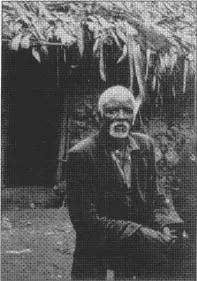
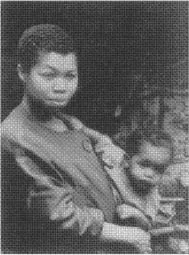
On the slopes of Mt. Kilimanjaro, Francis Lema struggled to contain his anger as he spoke about his two dead children and two living sons, both severely stunted by malnutrition. Only one of the five children, a daughter, was healthy. As he protested the tragedies of his life, tears welled in his eyes, while Bibiana, his wife, sat quietly with a pained look on her face. “Can you tell me why this had to happen?” he asked.
A man of dignity, Francis strove to maintain his composure while telling me about the loss of his children. He had gone to great lengths to save them but to no avail. At this point in our relationship, he was starting to question many of the principles by which he had lived his life; I had never before seen him so close to exhaustion and despair.
Francis's haunting question provoked the writing of this book.1 The story of his family is an account of hunger and shame. The multiple causes of his children's deaths included the family's poverty, a cause of shame that impedes efforts of parents to find adequate food and medical care for their children. While Francis and Bibiana's poverty was stigmatic, their children's malnutrition brought even more shame.
The experience of the Mt. Kilimanjaro people with hunger and the role of shame in shaping it has grown out of their social life, economy, and history. Their children's malnutrition is rooted in the rhythms of everyday life-farm work, life in the family compound, and local commerce, which ties them to the global market. In this everyday context, we explore the meaning of child hunger and the shame it causes.
In addition, we examine the biological and cultural aspects of child malnutrition to understand the systematic forces and misunderstandings that sustain them. Colonialism, Christianity, capitalism, and socialism have all played roles in the high rates of child malnutrition and in intensifying its stigma. Francis and Bibiana Lemas’ problems with child malnutrition result not from the backwardness ascribed to farming societies in less developed countries, we maintain, but from the relentless erosion of poor people's political power in the face of these institutions.
Figure 2 Francis Lema, in 1989
As we describe the Lemas'and other parents'struggles with their children's hunger, we analyze in depth the failure of a medical institution designed to prevent and treat child malnutrition. The Nutrition Rehabilitation Unit, NURU, was developed by experts who combined a biomedical approach with education in nutrition and agriculture, all based on an ideology of community participation. Although NURU saved llvess we examine its failure at malnutrition prevention to contribute to the growing work in institutional ethnography (Escobar 1995; Fiske 1989; Scott 1990). It is our hope that such a critique will contribute to the development of more culturally sensitive, inclusive, and sustainable approaches to the prevention of child malnutrition.
Figure 3 BibianaLema with her daughter Nuya in 1974
“These People”: Constructing Kin as Other
The Lemas belong to a group known as the Chagga, a relatively prosperous farming people whose homeland is Mt. Kilimanjaro, Tanzania (Figure 5). Many Chagga are successful entrepreneurs, farming the fertile volcanic soil on the mountain and growing fine ara-bica coffee to be exported all over the world. They established one of the first farming cooperatives on the African continent in 1925 (Iliffe 1979:276–79). Through Christian mission schools, the Chagga became the most highly educated people in the country (Kerner 1988; see also Samhoff 1979), and many have entered professional positions and government service as a response to the growth of the population and an acute shortage of land. In spite of their prosperity, however, the Chagga have at times over the last thirty years had the highest rate of child malnutrition in Tanzania (Hai Nutrition Campaign 1987; Kreysler 1973; Lindner 1972; Shayo 1981; Women and Children in Tanzania 1990).
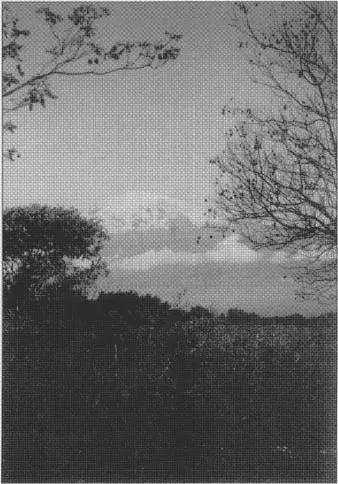
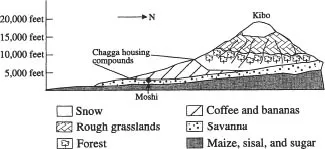
Figure 4 A View of Mt, Kilimanjaro. After moore 1986:16
Figure 5 Profile of MX, Kilimanjaro. After Moore 1986:16 Kimberly Nickols
I first came to know the Lemas in 1974 during home visits for an evaluation of NURU. A team of Chagga researchers and I carried out the study, which took place during the height of a severe famine that devastated agriculture in most of East Africa. Known locally as the time of njaa (hunger), the famine disrupted the lives of everyone on the mountain. It was triggered by a long period of drought; a crippling disease of the main cash crop, coffee; a drop in world coffee prices; and global inflation. At the height of the famine, as many as fifty thousand households-40 percent of those on the mountain-sought emergency food aid from the government (Swantz et al. 1975). People today still shudder as they recall the anguish of this period.
I went to Kilimanjaro in 1970 to do anthropological research on the causes of child malnutrition. It wasn't until the fourth year of my stay, during the NURU study, that I became fully aware of the impact of the shame and stigma associated with poverty and child malnutrition. One of my first insights into the social ostracism of impoverished families came from Gladys Kimario, a university-educated Chagga researcher whom I would replace on the study team. She decided that she had had enough of “these people.” Hawa watu (these people) was a common referent to the poor-sometimes used by their own kin to convey a sense of distance or otherness from themselves. Mrs. Kimario, as she preferred to be called, took me and the principal investigator, Dr. Marja-Liisa Swantz, to meet some of the families in the study.
1974
Mrs. Kimario seemed to be a knowledgeable and competent investigator, and she gave us a great deal of information on “the cases” I was about to inherit from her. She led us to a Roman Catholic mission in the upper reaches of one of the poorest districts on the mountain. We were introduced to some Church and government officials and then proceeded to the Lema family compound. We wanted to talk to Francis and Bibiana Lema about their son Hamisi, a six-year-old boy who had been treated at NURU.
As we approached their compound, Mrs. Kimario commented, “This family can't do anything right, and they don't seem to care. I'm tired of their backwardness and apathy! Come! I'll show you.” Neither Francis nor Bibiana was home at the time. She led us into their house-an unthinkable intrusion on Kilimanjaro under most circumstances but apparently excusable in Mrs. Kimario's mind that day.
We entered the Lema house, which was an untidy mud structure with a roof thatched with banana leaves and patched with flattened tin cans. The doorway provided the only light inside the one-room house. At first, we could barely make out Hamisi, but eventually we saw that he was still malnourished after returning from NURU. His four brothers and sisters also had symptoms of malnutrition. The children whimpered for lack of camouflage in their barren surroundings as they scurried to escape the glare of the strangers who had so rudely entered their home.
A stench of urine coming from the children's bedding began to overwhelm us. We put our hands over our noses and mouths and left quickly. “This is outrageous!” Dr. Swantz said after we got out of earshot. She was shocked by the contrast with her pleasant memories of Mt. Kilimanjaro from years earlier, when she had worked as a teacher in one of the better-off districts on the mountain. She added sorrowfully, “What in the world could have caused this?”
Equally disturbing to her was the attitude of Mrs. Kimario toward impoverished members of her own community. Dr. Swantz hoped that face-to-face contact with poor people would encourage empathy in the university students and inspire them to find solutions for their problems. The students were supposed to work alongside poor women as equals and help them form income-generating cooperatives; in this way, their research would be in accord with the ideals of the socialist government. Dr. Swantz's strategy worked in most cases, but not in Mrs. Kimario's. Addressing a group of poor women at NURU, Mrs. Kimario had declared, “You embarrass me! Why are your children without food? Your laziness and ignorance are causing them to be ill! You can go out and earn wages and prevent malnutrition. You're giving all of Kilimanjaro a bad name!”
I would hear poor people publicly reprimanded in this manner many times by professionals and other better-off members of their community on Mt. Kilimanjaro.
The Human Face of Poverty
We tell the stories of people whose children were starving to illustrate their struggles with hunger and strategies for dealing with it. Drawn from field notes, recollections, diaries, and visits to the area over a twenty-five-year period, the stories include dialogue, emotion, and sketches of living conditions to provide a sense of the social and psychological realities of child malnutrition. I include my own thoughts and feelings at times to illuminate the assumptions, motives, and actions of health planners, researchers, and medical staff as some of the many actors in this drama of human suffering.
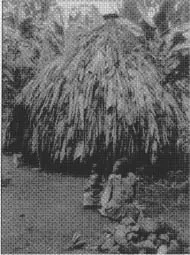
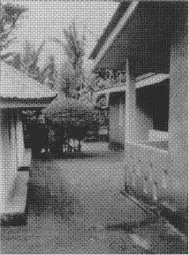
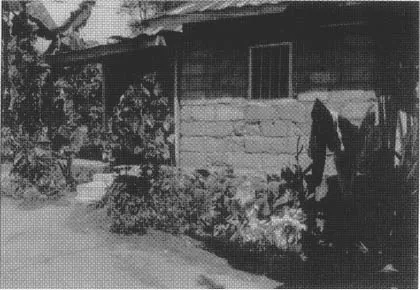
Figures 6, 7, and 8 Economic variation among neighboring Lema households
Figure 6 Paulo and Sylvia Lema and their seven surviving children lived in the thatched house.
Figure 7 Edwardi and Philippe Lema's compound with the cattle barn to the left (it was better built than most of the surrounding home's ofEdwardi's kin).
Figure 8 A typical modern house with cementblocks, tin roof, and glass windows. The Kilimanjaro people take pride in their flower and vegetable gardens.
Francis Lema's struggle takes center stage in several chapters—as the father in a patrilineal system in which the family wealth passes through males, Francis largely determined the fortunes of his household.2 His wife, Bibiana, who was both pitied and held in contempt for the condition of her children, had less time available to assist me in the research process. She was too busy caring for her children and cultivating the family's food crops.3 Francis worked as a day laborer at the Roman Catholic mission where I found lodging during the NURU study, and through proximity and personal compatibility, we became friends.
I saw that, in contrast to Mrs. Kimario's report, Francis and Bibiana were not apathetic about their children's health. The couple cared deeply for each other, their children, and neighbors who were also struggling with hunger and illness. Out of concern, they arranged meetings for me with families living in conditions they considered worse than their own.
They first took me to a clearing about a hundred yards from their house. There stood the small mud dwelling of Francis's first cousin, Nathaniel Lema, and his wife, Cecilia. I was stunned to learn that they had lost all five of their children.
The two couples later brought me to help their ailing cousin Paulo Lema, who lived next door. Paulo's wife, Sylvia, was pregnant with her thirteenth child, while the twelfth was malnourished and still unable to walk at two and a half years of age. Five of their children had died.
I accompanied all o...
Table of contents
Front Cover
Half Title
Title Page
Copyright
Contents
List of illustrations
List of tables
Foreword
Preface
Acknowledgments
1 The Shame of Hunger
2 To the Mountain and an Early Confrontation with Death
3 Poverty Amidst Plenty
4 On the Road to the Margins
5 “These People”: Institutional Discrimination and Resistance by the Poor
6 Sex and the Shame of Kwashiorkor
7 The Meaning of a Child
8 Conflict in Families
9 Child Favoritism and Malnutrition
10 The NURU Experience
Endnotes
Appendix A
Appendix B
Appendix C
Glossary
Bibliography
Index
Trusted by 375,005 students
Access to over 1.5 million titles for a fair monthly price.
Study more efficiently using our study tools.
Frequently asked questions
Yes, you can cancel anytime from the Subscription tab in your account settings on the Perlego website. Your subscription will stay active until the end of your current billing period. Learn how to cancel your subscription
No, books cannot be downloaded as external files, such as PDFs, for use outside of Perlego. However, you can download books within the Perlego app for offline reading on mobile or tablet. Learn how to download books offline
Perlego offers two plans: Essential and Complete
Essential is ideal for learners and professionals who enjoy exploring a wide range of subjects. Access the Essential Library with 800,000+ trusted titles and best-sellers across business, personal growth, and the humanities. Includes unlimited reading time and Standard Read Aloud voice.
Complete: Perfect for advanced learners and researchers needing full, unrestricted access. Unlock 1.5M+ books across hundreds of subjects, including academic and specialized titles. The Complete Plan also includes advanced features like Premium Read Aloud and Research Assistant.
Both plans are available with monthly, semester, or annual billing cycles.
We are an online textbook subscription service, where you can get access to an entire online library for less than the price of a single book per month. With over 1.5 million books across 990+ topics, we’ve got you covered! Learn about our mission
Look out for the read-aloud symbol on your next book to see if you can listen to it. The read-aloud tool reads text aloud for you, highlighting the text as it is being read. You can pause it, speed it up and slow it down. Learn more about Read Aloud
Yes! You can use the Perlego app on both iOS and Android devices to read anytime, anywhere — even offline. Perfect for commutes or when you’re on the go. Please note we cannot support devices running on iOS 13 and Android 7 or earlier. Learn more about using the app
Yes, you can access Hunger and Shame by Mary Howard,Ann V. Millard in PDF and/or ePUB format, as well as other popular books in Social Sciences & Anthropology. We have over 1.5 million books available in our catalogue for you to explore.