- 240 pages
- English
- ePUB (mobile friendly)
- Available on iOS & Android
eBook - ePub
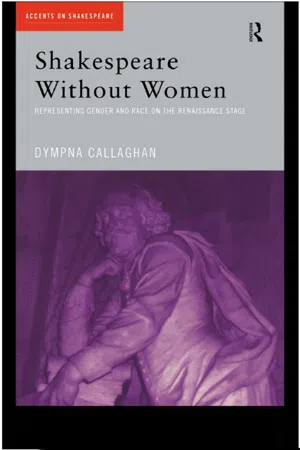
Shakespeare Without Women
About this book
Shakespeare Without Women is a controversial study of female impersonation, and the connections between dramatic and political representation in Shakespeare's plays. In this original and challenging book, Callaghan argues that Shakespeare did not include women, and that his transvestite actors did not represent women, and were not, furthermore, meant to do so. All Shakespeare's actors were, of historical necessity, (white) males which meant that the portrayal of women and racial others posed unique problems for his theatre. What is important, Shakespeare Without Women claims, is not to bemoan the absence of women, Africans, or the Irish, but to determine what such absences meant in their historical context and why they matter today. Callaghan focuses in the implications of absence and exclusion in several of Shakespeare's works: * the exclusion of the female body fromTwelfth Night * the impersonation of the female voice in the original performances of the plays * racial impersonation in Othello * echoes of removal of the Gaelic Irish in The Tempest * the absence of women on stage and in public life as shown in A Midsummer Night's Dream.
Information
1
“And all is semblative a
woman’s part”
Body politics and Twelfth Night
I
Once a marginalized object in traditional literary scholarship, the body has emerged as a crucial category of critical inquiry. In Renaissance studies it has become the focus of attention as the site of emergent notions of the modern subject and attendant concepts of privacy and intimacy hitherto viewed as natural and transhistorical. Transformations wrought by the Reformation and by the shift from feudalism to capitalism rendered the body subject to what Norbert Elias has called “the civilizing process” (Elias 1978–82 [1939]; Gent and Llewellyn 1990:1–10). More specifically, Renaissance theatre itself had a corporeal, sexual identity. It was a place where, to use Dekker’s redolent term, “stinkards” gathered, where patrons engaged in those sexual practises so often vilified by anti-theatricalists: arousal, prostitution, perhaps even copulation itself (Gurr 1987:38). The Renaissance body, then, especially in the arena of theatre, has been recognized as political, that is, as a site for the operation of power and the exercise of meaning, and one “fully social in its being and in its ideological valency” (Barker 1984:13).
That the Renaissance seems peculiarly concerned with the somatic might seem justification enough for a study of the body in Shakespeare. We might concur with Carroll Smith-Rosenberg, who argues: “During periods of social transformation, when social forms crack open…ideological conflict fractures discourse…sexuality and the physical body emerge as particularly evocative political symbols” (Smith-Rosenberg 1989:103). But the resurgence of the body in Renaissance studies (and elsewhere) is not a perennial, cyclical phenomenon. Rather, the intensity of focus on the body is related to very specific, historically situated developments in poststructuralist theory.
In The Ideology of the Aesthetic Terry Eagleton draws attention to the politics of current concern with the body:
[F]ew literary texts are likely to make it nowadays into the new historicist canon unless they contain at least one mutilated body. A recovery of the importance of the body has been one of the most precious achievements of recent radical thought…. At the same time, it is difficult to read the later Roland Barthes, or even the later Michel Foucault, without feeling that a certain style of meditation on the body, on pleasures and surfaces, zones and techniques, has acted among other things as a convenient displacement of a less immediately corporeal politics, and acted also as an ersatz kind of ethics. There is a privileged, privatized hedonism about such discourse, emerging as it does at just the historical point where certain less exotic forms of politics found themselves suffering a setback.
(Eagleton 1990:7)
The body is simultaneously situated here as de facto, “exotic,” a “precious achievement,” and a “displacement” of serious politics. The emancipatory potential projected onto the body (by feminist and Queer theorists as much as the doyens of poststructuralism) versus the political limitations of current fetishizations of the body seems to put the “undecidable” and the “dialectical” perilously close. Nevertheless, Eagleton draws our attention to the fact that the body becomes in much critical discourse the site of “micropolitics” (in centrist or “ludic” readings of the postmodern as opposed to resistance postmodernism),1 which is believed to have replaced the grand conceptual, liberatory narratives of political economy (see Zavarzadeh 1991). Ludic postmodernism produces a naive notion that social transformation can be articulated at the corporeal level. Foucault falls into this utopian vision of the body at the end of The History of Sexuality. The body, as a site of opacity almost exempt from meaning, becomes the privileged locus of resistance: “The rallying point for the counterattack against the deployment of sexuality ought not to be sex-desire, but bodies and pleasures” (Foucault 1981:157).2 While “bodies and pleasures” mark Foucault’s distance from Derridean and Lacanian desire, in the end the ideological effect is the same, namely one of privileged, privatized hedonism. Similarly Bakhtin, whose rhetoric is more that of mouth and anus than zone and surface, nonetheless deploys a populist, utopian view of the disruptiveness of the grotesque body (see Stallybrass and White 1986).
Paradoxically, too, micropolitical analyses are frequently presented as “materialist.” For example, both Foucault’s techniques of the subject and Bakhtin’s grotesque realism have been viewed as such, in what Eagleton dubs “the modish, purely gestural uses of that most euphoric of radical buzz-words” (Eagleton 1986:80). In some instances popular and politically specific uses of the term materialism are employed as if they were synonymous. Lucy Gent and Nigel Llewellyn, for example, in their fairly traditional, thematic approach to Renaissance Bodies, argue for the pure material reality of the body as opposed to “abstraction and distance”; that is, the discursivity of the “figure”: “‘Body,’ by contrast, suggests the solidly central unrepresented fact of existence, a materiality that is of itself inarticulate. It is the mute substance of which ‘figure’ is a more nervous and expressive shadow” (Gent and Llewellyn 1990:2). Yet this appearance of substance occurs only because this is how, within the transactions of discourse, the body is rendered intelligible in our culture. When Gent and Llewellyn refer to the body’s sheer physicality, the mute facticity of its materiality, they reduce the material to the elemental. This definition of the material as the density of things one can touch is classically humanist. Mas’ud Zavarzadeh explains:
In the discourses of ludic postmodernism, “politics” is an exemplary instance of totalitarian “conceptuality.” The micropolitics of the body, on the other hand, is politics without concepts: the local politics of material experience. However, material in these theories…means the immediate elements of the medium of the political, that is to say, the discourses that articulate subjectivities and thus produce the micro-political. It is, in other words, a materialist politics only in the sense that, for example, focusing on the “photochemical reality” of film makes the film maker a “materialist” film maker. An idealist materialism isolates single issues and their mode of enunciation from the global structures of the political economy.
(Zavarzadeh 1991:48)
Such critical discourses, then, invoke the body as substantive, ontologically grounded raw material devoid of any agenda for social transformation. Alternatively (and sometimes simultaneously) in its textualist rendition, the material is defined as discourse, as the material part of the sign to which the body contributes, as Barthes has proposed, through the phatic dimension of speech.3 Thus a characteristic deconstructionist maneuver places the opacity of both the signifier and the body as the “material” dimensions of the production of meaning. This depoliticized materialism conveniently coincides with both post-marxism and those reactionary elements of the (ludic) postmodern to which it is also causally related. In this way contemporary discourse on the body, as Eagleton argues, has become alienated from the “more traditional political topics of the state, class conflict and modes of production,” that is, from historical materialism as it has been previously and more rigorously understood (Eagleton 1990:7). The body, then, even when it is understood not as simple transhistorical fact but as “a relation in a system of liaisons which are material, discursive, psychic, sexual, but without stop or centre” (Barker 1984:12), may signal, nonetheless, the displacement of the political defined as the global, totalizing agendas relegated to obsolescence in much postmodern theory. Thus, while ludic postmodern discourses of the body offer accounts of the body substantially different from humanist understandings, their ideological effects are in the end disarmingly similar.
Materialism, as I have argued, cannot be reduced to raw physicality or to the so-called materiality of signs; both constitute “idealist materialism.” In terms of discourse on the body, this contention denies neither the “real” ontological existence of the body nor the materiality of discourse (see Barrett 1988:xxviii; Wolff 1990:133). However, the material should not be confined to the binarism brute-material/discursive, but rather considered as the way the social and cultural always exceed the discursive. For this is precisely what is at stake in the question of the material. An example may clarify the point: that certain classes of women were particularly marked out as rape victims in the Renaissance (servants, for example) and that women continue to be viewed as sexual terrain to be possessed, violated, and commodified constitute physical, social, and cultural aspects of rape as opposed to purely physical or “textual” ones (see Bashar 1983:24–46). (Women are thus no more vulnerable to rape as an inherent fact of biology than men are to castration.) Rape has, then, both a physicality and a politics that in a patriarchal culture expresses relations between men in which women are property, and as such it cannot be separated from issues of class and ownership. That is, the discursive construction of the gendered body is implicated in the materiality of the nondiscursive, and the latter is not simply raw materiality but also the social and cultural.
I have chosen an example pertinent to feminist struggle because the politics of the body are exacerbated and more urgent there: as the object of patriarchal subjugation, women are uniquely identified with their anatomy, which has been simultaneously and problematically marked as the ground of feminist resistance. The problem is whether the body intrinsically constitutes an appropriate and effective site of resistance to the increasingly dense, subtle, and comprehensive conceptual trap of late-capitalist patriarchy. The danger is that “its pre-existing meanings, as sex object, as object of the male gaze, can always prevail and reappropriate the body” (Wolff 1990:121). It is not clear that we reclaim women’s bodies—especially denigrated female genitals, which are culturally marked as the source of women’s oppression—without regressing into biological essentialism (the very rationale for women’s subordination), the phenomenology of lived experience, or the political evasions of poststructuralism.4 Nor can we reclaim past representations of female corporeality in any simple, celebratory way.
In what follows I want to use a more politically effective understanding of materialism than the one current in cultural criticism of the body in order to focus on the absent-presence of female genitals in Twelfth Night. My analysis of the play’s representations of the female body operates in terms of global rather than local structures and resists the characteristic poststructuralist notion that undecidability is liberating. Further, I want to resist the pervasive tendency in Shakespeare criticism, in both its humanist and poststructuralist manifestations, to conflate “matter” and materialism, a trivialization that blocks the emancipatory potential of this radical concept.5 For the female body, while not literally present on the Renaissance stage, was constantly and often scabrously constructed in masculine discourses in ways that reinforced larger patriarchal institutions and practises.6
II
In Shakespearean comedy the female body is most obviously a problem at the (secondary) level of the text’s fiction, where female characters such as Viola and Rosalind disguise themselves as eunuchs and lackeys. But the female body is also problematized at the primary level of Renaissance theatre practise, in which boys played “the woman’s part.” Lisa Jardine argues, “‘Playing the woman’s part’—male effeminacy—is an act for a male audience’s appreciation”; she asserts that that “these figures are sexually enticing qua transvestied boys, and that the plays encourage the audience to view them as such” (Jardine 1983:31, 29).7 As the complexity of this state of affairs has been emphasized, however, there has been something of a displacement of the initial feminist recognition that transvestism is an aspect of misogyny based on the material practise of excluding women from the Renaissance stage—the “boy actress” phenomenon.8 Thus, while Stephen Orgel in a now-famous contribution to South Atlantic Quarterly’s special issue on homosexuality contends, like Jardine, that homosexuality was the dominant form of eroticism in Renaissance culture, he also argues (and this is indeed a crucial recognition) that the homoeroticism of the Renaissance stage was not inevitably misogynist (Orgel 1989:17).9 Transvestism could not have had particularly insidious implications for women, he argues, because plays depended for their success on the large numbers of female playgoers. Nevertheless, the exclusion of women from the stage and their simultaneous inclusion as customers—the fundamental characteristic (contradiction) of the institution of theatre in early modern England— does not exculpate theatre from charges of misogyny. This should not lead us to conclude, of course, that women’s appearance on the stage at the Restoration should be read simply as “progress.” In those countries where female players were allowed on stage, women were no less oppressed than in England.10 Rather, the point here is to recognize the flexibility, the historically and geographically variable nature of patriarchy, while insisting on the exclusion of women from the Renaissance stage as the determinate material condition of the theatre’s production and representation of femininity.
Catherine Belsey’s essay, “Disrupting Sexual Difference: Meaning and Gender in the Comedies,” written in the 1980s performed the important task of bringing a feminist-deconstructionist reading to the comedies. This approach takes the destabilization of meaning to be in and of itself “political,” and urges separation of the positive play of transvestism from the systematic and structural oppression of women. From this perspective the endless play of meaning inherent in transvestism becomes inherently subversive—undecidable—and therefore, “for us to decide” (Belsey 1985:190). But since all meanings in language are inherently unstable, the limits of this approach are that transvestite destabilizations do not necessarily offer any especially liberating possibilities for feminism.11 Comic transvestism, particularly in Twelfth Night, may indeed take “the most remarkable risks with the identity of its central figure” and permit us “to glimpse alternative possibilit...
Table of contents
- Cover Page
- Title Page
- Copyright Page
- Dedication
- Plates
- General Editor’s Preface
- Acknowledgments
- Introduction Cleopatra Had a Way With Her
- 1. “And All Is Semblative a Woman’s Part” Body Politics and Twelfth Night
- 2. The Castrator’s Song Female Impersonation On the Early Modern Stage
- 3. “Othello Was a White Man” Properties of Race On Shakespeare’s Stage
- 4. Irish Memories In the Tempest
- 5. What Is an Audience?
- Notes
- Bibliography
Trusted by 375,005 students
Access to over 1.5 million titles for a fair monthly price.
Study more efficiently using our study tools.
Frequently asked questions
Yes, you can cancel anytime from the Subscription tab in your account settings on the Perlego website. Your subscription will stay active until the end of your current billing period. Learn how to cancel your subscription
No, books cannot be downloaded as external files, such as PDFs, for use outside of Perlego. However, you can download books within the Perlego app for offline reading on mobile or tablet. Learn how to download books offline
Perlego offers two plans: Essential and Complete
- Essential is ideal for learners and professionals who enjoy exploring a wide range of subjects. Access the Essential Library with 800,000+ trusted titles and best-sellers across business, personal growth, and the humanities. Includes unlimited reading time and Standard Read Aloud voice.
- Complete: Perfect for advanced learners and researchers needing full, unrestricted access. Unlock 1.5M+ books across hundreds of subjects, including academic and specialized titles. The Complete Plan also includes advanced features like Premium Read Aloud and Research Assistant.
We are an online textbook subscription service, where you can get access to an entire online library for less than the price of a single book per month. With over 1.5 million books across 990+ topics, we’ve got you covered! Learn about our mission
Look out for the read-aloud symbol on your next book to see if you can listen to it. The read-aloud tool reads text aloud for you, highlighting the text as it is being read. You can pause it, speed it up and slow it down. Learn more about Read Aloud
Yes! You can use the Perlego app on both iOS and Android devices to read anytime, anywhere — even offline. Perfect for commutes or when you’re on the go.
Please note we cannot support devices running on iOS 13 and Android 7 or earlier. Learn more about using the app
Please note we cannot support devices running on iOS 13 and Android 7 or earlier. Learn more about using the app
Yes, you can access Shakespeare Without Women by Dympna Callaghan in PDF and/or ePUB format, as well as other popular books in Literature & Literary Collections. We have over 1.5 million books available in our catalogue for you to explore.