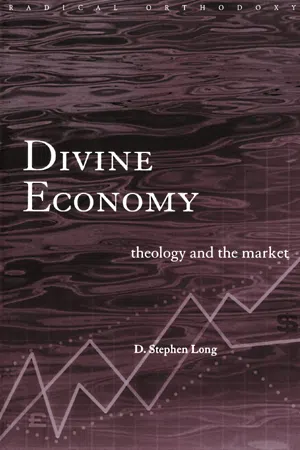
What has theology to do with economics? They are both sciences of human action, but have traditionally been treated as very separate disciplines. Divine Economy is the first book to address the need for an active dialogue between the two.
D. Stephen Long traces three strategies which have been used to bring theology to bear on economic questions: the dominant twentieth-century tradition, of Weber's fact-value distinction; an emergent tradition based on Marxist social analysis; and a residual tradition that draws on an ancient understanding of a functional economy. He concludes that the latter approach shows the greatest promise because it refuses to subordinate theological knowledge to autonomous social-scientific research.
Divine Economy will be welcomed by those with an interest in how theology can inform economic debate.
- 336 pages
- English
- ePUB (mobile friendly)
- Available on iOS & Android
eBook - ePub
About this book
Information
Part I
The dominant tradition
Market values
1 Introduction to Part I
What has theology to do with the economy? Given the standpoint of the average economics textbook, the answer from the economists’ perspective is obvious: nothing. Theology might have relevance for the cultural values that undergird the economic system, but actual economic practice is best served when theology keeps to its own proper sphere. Premodern theological efforts to speak a decisive word on economic practice are described by both economists and many theologians as misguided, irrational, and authoritarian.
What has the economy to do with theology? Despite the economists’ neglect of theology, a number of theologians work on the relationship between theology and economics. In so doing, they have maintained the ancient tradition that faith and economic matters are inextricably linked. This is a considerable achievement because it works against the historical development of modern economics. As a discipline, economics has increasingly developed an anti-humanistic mode. Political economists first freed economics from theology at the end of the eighteenth century with Adam Smith’s revolution. Economists then freed economics from political theory in the nineteenth century. In the twentieth century economics has become an increasingly abstract—mathematical—science. That theologians continue to make claims on it runs counter to long-standing trends. All of us who care about both faith and economics are in their debt because the gravest temptation we face is that the rending asunder between them will one day be complete. No one will remember to ask ‘What has Jerusalem to do with Wall Street?’ The ancient tradition will disappear.
The term ‘tradition’ is, as Raymond Williams noted, ‘a particularly difficult word.’1 Although it once designated ‘surrender or betrayal’ it now signifies the activity of passing something along in history. This is both active and passive.2 Without the passivity of reception, nothing can be handed down. At the same time, once this knowledge is received it will inevitably reflect the situation of the inheritor. Thus tradition results from human activity, an intentional (and unintentional) shaping of received knowledge. And this can be ‘radically selective.’ Certain things will be emphasized and others neglected.3
In twentieth-century Christian theology, a number of theologians find doctrines of creation, anthropology and original sin as particularly relevant in relating theology and economics. Part I examines the work of five such theologians. They represent different ecclesial traditions and political positions. They would not agree on public policy questions. Nevertheless, despite their differences on a number of issues, they answer the question of how we are to relate theology to economics by selecting similar, if not identical, theological themes. I have identified this group of theologians as ‘the dominant tradition.’
By ‘dominant tradition,’ is meant that human selection which ‘seizes the ruling definition of the social.’4 In other words, what counts as ‘social’ is self-referential. Members of those institutions, movements and formations that currently constitute the ‘social’ define it so that what counts as ‘social’ fits with those ruling definitions. Then, by definition, what doesn’t fit cannot be social. It can have only the status of the sectarian, utopian, irrational, personal or private. Max Weber demonstrated that with the rise of capitalism theological forays into economics were increasingly viewed as irrational remainders that described those things for which the mathematical facts could not account.5 If Weber was correct about the role of theology in the modern world then all theologians are reduced to the same status before the science of economics; we are all transgressors on the economists’ terrain. Nevertheless, some theologians transgress that landscape less than do others.
The theologians examined in Part I, Michael Novak, Max Stackhouse, Dennis McCann, Ronald Preston, and Philip Wogaman, do not represent a decisive transgression against capitalist orthodoxy. They differ in their economic prescriptions—ranging from a defense of the classic liberal economy (Michael Novak) to Keynesian models of welfare capitalism (Preston and Wogaman) to somewhere in between (Stackhouse and McCann)—but the theological themes they select, and the economic prescriptions they offer, fitted well with ruling social-economic ideas in the late twentieth century. None of these theologians represents a position that could be characterized as radical, counter-cultural, or revolutionary. They may suggest important reforms of capitalism and capitalist institutions but, on the whole, their work fits comfortably with the dominance of global capitalism and the culture that makes it possible and is produced by it.
That their theological selections occur within a framework that seeks relevance to the public order is not surprising: they do not find that public order—democratic capitalism—a threat to Christian theology. Therefore they can easily pose the question: How can we construct a Christian social ethic that will ‘bear on economic life in our increasingly global era?’6 What is of interest is the theology that takes shape once this becomes the central question theology answers. Novak draws primarily on an anthropology that emphasizes liberty. Stackhouse and McCann emphasize the need for capitalism to remain grounded in a religious metaphysical moral foundation that stresses the freedom of the person to transcend his or her historical particularity. Ronald Preston draws upon the contributions of the social sciences and theology’s need to be relevant to them. He likewise finds a theological entrance to the economists’ landscape through an anthropology of liberty, as does Philip Wogaman.
Consistent with this anthropological focus is the strong dependence of all five theologians on the doctrine of original sin. All five find Reinhold Niebuhr’s work to be the source for this understanding of the doctrine. However, they all neglect to note the similarity between Niebuhr’s account of original sin and the Stoic doctrine of unintended consequences, which so deeply influenced Adam Smith’s metaphysical moral vision. These theologians also develop a critical posture against the premodern theological tradition. Novak and Stackhouse work from a critical hermeneutics of suspicion that resonates well with Nietzsche’s understanding that modern morality arises from resentment. For instance, Novak once stated that ‘claims on the part of groups to represent “conscience,” “morality,” and “principle” must be exposed for what they are: disguises for naked power and raw interest.’7 Stackhouse likewise conceives of an adversarial culture of elites that cloak their powerlessness behind outmoded moral and theological principles. Such suspicion is also directed against the Christian tradition itself. That one finds this critical suspicion present in something described as ‘the dominant tradition’ may at first seem surprising. To modern ears the term ‘dominant tradition’ conjures up images of hierarchy, authoritarianism, and dogmatism. How can a dominant tradition be based on critical suspicion rather than on the very thing I am arguing for—a dogmatic orthodoxy? The answer is found in the particular anthropological vision of liberty that holds the dominant tradition together. As the market itself had to be ‘liberated’ from outside interference, so an anthropology relevant to it must also be based on freedom from undue interference, a freedom that promotes critical suspicion. Critical suspicion represents little if any threat to a tradition formed by the culture that makes the global capitalist market possible; less still when we recognize that this critical suspicion is related to the work of Max Weber as developed by the theologians in this tradition.
Weber is central not only for the development of the social sciences on which the dominant tradition draws, but for the specific fact-value distinction by which this tradition makes theology relevant to economics. Weber provides the basic strategy to relate theology to economics. This is accomplished by accepting the fact-value distinction and by arguing that theology’s role is to give the facts a meaningful critique through the value that theology offers.
Part I of this work examines this dominant tradition by developing the common theological themes that bind these theologians together. First I develop and consider critically their common strategy for relating theology to economics. Second I argue that the foundational theological theme they employ is an anthropology which assumes the human person is free to choose and through her or his choices gives value to things in the world. This does not deny the possibility of a metaphysical order to which those values must be subordinated, whether it is called natural law or common grace, but it does assume a metaphysical order that does not challenge the heart of this anthropology. In fact it is through this anthropology that we know God’s work in the world; an analogia libertatis is at the heart of the dominant tradition’s theology. This liberty is limited only by the constraints of original sin. Human freedom to intend the good does not guarantee the good because of the unintended consequences of our free human action. This anthropology of liberty does not aim toward a substantive good Christologically determined, but it functions best when in service to the useful. Third I show how the Weberian strategy and the dominance of the theological anthropology result in a subordination of Christology and ecclesiology to a doctrine of creation. It is this third point that renders the first two so problematic.
2 The Weberian strategy
Theology’s importance as value, ethos, or spirit
Michael Novak’s inheritance from Weber is obvious from the titles of his books—The Spirit of Democratic Capitalism and The Catholic Ethic and the Spirit of Capitalism.1 Although he critiques Weber for not recognizing that the Catholic rather than the Protestant ethic contributes to capitalism’s possibility, he finds Weber’s work indispensable for his identification of ‘spirit’ as the decisive element in understanding economics. Novak writes:
What needs to be explained is not private ownership or the means of production, the existence of markets, and profit or accumulation…. What Weber set out to explain is something quite different…. To put it simply, Weber detected something new, a novel Geist or spirit or cultural inspiration, some new complex of social attitudes and habits.2
For Novak, this spirit is Catholicism, rightly understood. Weber’s work allows theology to be relevant to economics because of the dialectical relationship between facts and values. The market is a semi-autonomous sphere that operates on the basis of its own facticity. However, it also operates within a cultural system that sustains it. Yet that cultural system is not produced by the market itself; the market needs cultural values that come from outside it. It needs the ‘spirit’ that Roman Catholic theology offers.3
Novak divides the democratic capitalist system into three distinct yet related systems. First is the market economy; second is political democracy; and third is the moral-cultural system that must be ‘pluralistic and liberal.’4 For Novak, these three systems work together. You cannot have one without the other. Both the political and economic system are ‘nourished’ by the cultural liberal-pluralist system. But how theology is supposed to contribute to the operation of these three systems is not clear: much of Novak’s work argues that the church has failed to understand its own congruity with the cultural system. He emphasizes that congruity by locating it in the ‘liberty’ at the heart of Christian theology. The essence of the spirit of democratic capitalism is the creation of ‘a non-coercive society as an arena of liberty within which individuals and peoples are called to realize through democratic methods the vocations to which they believe they are called.’5 And although other cultural systems can provide this, Catholicism, rightly understood, guarantees it. Thus the central theological connection with economics is for Novak an analogia libertatis. But this analogy functions univocally. Where the spirit of liberty is, there is the Lord. Theology and economics are related through an analogous underlying liberty, a liberty capitalism requires and one that Catholic theology, rightly understood, can provide.
I Novak’s Catholicism and capitalism, rightly understood
The key here is Catholicism rightly understood, for Novak acknowledges that the resistance to capitalism in some countries and cultures results from their Catholicism. Novak’s argument that Catholicism is both necessary for, and a detriment to, capitalism can be confusing. His appeal to Catholicism is to a re-formed Catholicism similar to that which he extolled in an early work praising Vatican II, The Open Church. Novak is a reformer. His purpose is to develop a social ethic that can preserve liberty and human dignity. What makes his work controversial is that he finds capitalist institutions necessary for political liberty, and political liberty necessary for capitalist institutions. The role of the church and of theology must then, a priori, fit with that ‘liberty.’
Catholicism, rightly understood, is consistent with the cultural system necessary for capitalism. But this cultural system is not merely the sum of individuals’ intentions. Novak shares with Weber (along with Stoic philosophy, Adam Smith and Reinhold Niebuhr) a doctrine of unintended consequences.6 For Novak this doctrine functions to show how a sound political economy will be concerned more with consequences than intentions and yet nevertheless produce the best form of political life.7 A ‘virtuous self-interest’ results in a maximization of liberty.
Although the doctrine of unintended consequences is indebted to Weber, he used this doctrine in a way radically different from Novak’s. For Weber, the virtues of abstinence and self-abnegation led to an ‘iron cage’: where ‘the Puritan wanted to work in a calling; we are forced to do so.’8 The unintended consequences for Weber were not increased liberty but constraint: ‘More and more the material fate of the masses depends upon the steady and correct functioning of the increasingly bureaucratic organization of private capitalism. The idea of eliminating these organizations becomes more and more utopian.’9 Novak does not refute Weber’s charge. He does not challenge Weber’s realism that finds capitalism inevitable despite human intentions. Novak agrees with Weber’s unintended consequences. He notes: ‘We are all capitalist now, even the pope. Both traditionalist and socialist methods have failed; for the whole world there is now only one form of economics.’10 This statement seems homologous to Weber’s iron cage, with one important difference: Novak denies that the all-encompassing power of the market is an iron cage resulting from bureaucratic rationality. Instead it is based on ‘insight and practical wisdom,’ and therefore he finds it liberating even though it is a spirit that arises despite substantive human intentions.11 Yet Novak then suggests that the market economy, political democracy, and the moralcultural system share ‘one fundamental reality: choice.’12 But if we are all now capitalists, even the Pope, despite our intentions, how can this be a matter of choice? I am not suggesting that Novak finds capitalism to be an inexorable historical necessity. His work argues that the political and cultural systems must preserve capitalism, for it cannot preserve itself. The contradiction in his strategy to relate theology to economics is the contradiction between a doctrine of unintended consequences and a morality of choice.
Novak’s use of Weber, coupled with his strategy for theology’s relevance, results in an irresolvable contradiction. On the one hand we are told that capitalism needs theology because of the anthropology it provides, where the person is free to act on the basis of his or her choices. And on the other hand we are told that we have no choice. We are all now capitalists. At this point in his argument, Novak’s ‘spirit’ contradicts itself, and we discover that the ‘new complex of social attitudes and habits’ Weber identified cannot be so easily appropriated for theological purposes. If these attitudes arise from the unintended consequences of our actions, then they cannot be based on our moral capacity for free, intentional, human action unless that free, intentional, human action is purely formal. In other words, the spirit that is produced from our choices is not the freedom for any particular good: it is not a freedom for that which is beautiful, true and holy. Instead, it is the freedom itself, the formal ability to choose, that produces this spirit. This spirit is the human creature’s ability to give ‘value’ to the world irrespective of any intrinsic beauty, goodness, or truth embodied in the objects chosen.
Novak does critique Weber for only acknowledging two systems—the cultural and the economic. Here he seeks to ‘go beyond’ Weber by connecting the two systems with a third—the system of political liberty. This is necessary because Weber failed to see that capitalism is destroyed when the state encroaches on the market.13 Here Novak appeals to Joseph Schumpeter as someone who helps us go beyond Weber by acknowledging the need for political liberty.14
Novak reads Schumpeter as showing us that the success of capitalism ‘in the political order and in the economic order undermine it in the cultural order.’15 Schumpeter certainly acknowledged that the social institutions that undergird capitalism are constantly threatened by it and will eventually be undermined. But how Novak uses this argument does not fit well with Schumpeter’s own use. For Novak, democratic capitalism is not a ...
Table of contents
- Cover Page
- Title Page
- Copyright Page
- Acknowledgments
- Introduction
- Part I: The dominant tradition
- Part II: The emergent tradition
- III: The residual tradition
- Notes
Trusted by 375,005 students
Access to over 1.5 million titles for a fair monthly price.
Study more efficiently using our study tools.
Frequently asked questions
Yes, you can cancel anytime from the Subscription tab in your account settings on the Perlego website. Your subscription will stay active until the end of your current billing period. Learn how to cancel your subscription
No, books cannot be downloaded as external files, such as PDFs, for use outside of Perlego. However, you can download books within the Perlego app for offline reading on mobile or tablet. Learn how to download books offline
Perlego offers two plans: Essential and Complete
- Essential is ideal for learners and professionals who enjoy exploring a wide range of subjects. Access the Essential Library with 800,000+ trusted titles and best-sellers across business, personal growth, and the humanities. Includes unlimited reading time and Standard Read Aloud voice.
- Complete: Perfect for advanced learners and researchers needing full, unrestricted access. Unlock 1.5M+ books across hundreds of subjects, including academic and specialized titles. The Complete Plan also includes advanced features like Premium Read Aloud and Research Assistant.
We are an online textbook subscription service, where you can get access to an entire online library for less than the price of a single book per month. With over 1.5 million books across 990+ topics, we’ve got you covered! Learn about our mission
Look out for the read-aloud symbol on your next book to see if you can listen to it. The read-aloud tool reads text aloud for you, highlighting the text as it is being read. You can pause it, speed it up and slow it down. Learn more about Read Aloud
Yes! You can use the Perlego app on both iOS and Android devices to read anytime, anywhere — even offline. Perfect for commutes or when you’re on the go.
Please note we cannot support devices running on iOS 13 and Android 7 or earlier. Learn more about using the app
Please note we cannot support devices running on iOS 13 and Android 7 or earlier. Learn more about using the app
Yes, you can access Divine Economy by D. Stephen Long in PDF and/or ePUB format, as well as other popular books in Theology & Religion & Economic Theory. We have over 1.5 million books available in our catalogue for you to explore.