This accessible textbook offers students the opportunity to explore for themselves a wide range of sociolinguistic issues relating to the Spanish language and its role in societies around the world. It is written for undergraduate students who have a sound practical knowledge of Spanish but who have little or no knowledge of linguistics or sociolinguistics. It combines text with practical exercises and discussion questions to stimulate readers to think for themselves and to tackle specific problems.
In Part One Clare Mar-Molinero discusses the position of Spanish as a world language, giving an historical account of its development and dominance. Part Two examines social and regional variation in Spanish, and investigates dialects, language attitudes, and style and register, particulaly in the media. The author also questions the relationship between gender and language. Part Three focuses on current issues, particularly those arising from language policies and legislation, especially in the education system, in Spain, Latin America and the USA.
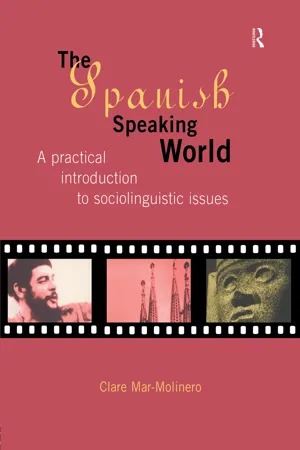
eBook - ePub
The Spanish-Speaking World
A Practical Introduction to Sociolinguistic Issues
- 200 pages
- English
- ePUB (mobile friendly)
- Available on iOS & Android
eBook - ePub
About this book
Information
Part one
The position
of Spanish
in the world
Chapter 1
The origins of Spanish
The historical context of a dominant language
| Introduction | |||||||
| From Latin to Castilian | |||||||
| The establishment of a ‘national’ language | |||||||
| Language in twentieth-century Spain | |||||||
| Further reading | |||||||
Introduction
Spanish is spoken today by over 350 million people. For the vast majority of these people Spanish is their mother tongue. From the Iberian Peninsula, where Spanish first developed, the language has been exported across many continents and established as the national language of many countries. Colonisation and imperialism, however, were the reasons for this dramatic spread, and the legacy of this enforced dominance can still be seen in many of the places where Spanish is spoken. Even in the Iberian Peninsula itself the status of Spanish is not unproblematic as it continues to coexist, sometimes uneasily, with those minority languages that still survive on the peripheries of the Peninsula. The history up to the present day of these minority languages will be specifically examined in Chapters 3 and In Latin America, too, Spanish is often in conflict with the precolonial indigenous languages, as will be seen in Chapter 2.
Part one will trace the history of the development and expansion of Spanish, or Castilian as it is now interchangeably known, showing how and where its relationship with other languages leads to tensions. This chapter will look at the origins of Spanish, and how it emerged in the Iberian Peninsula and developed as the dominant language of that region.
•• Before continuing any further, think about the development of Western European countries in general, and how far they have emerged as unified states from fragmented communities and medieval kingdoms. Waves of conquests, particularly significant being the Roman one, have influenced the development of linguistic varieties. How typical do you think this pattern was in the evolution of language in Spain?
What makes Spain’s linguistic history different from many of its neighbours’, is the conquest and long occupation of large parts of the Peninsula by the Arabic-speaking Moors. The bringing together of potentially hostile groups across the Peninsula during the Reconquista against this common enemy helped create a unity and establish a pecking order which was to prove very important to Spain’s early nation-building.
From Latin to Castilian
Except for Basque, all the languages we associate today with the Iberian Peninsula are derived from Latin and form part of the Romance languages continuum.
•• What other languages are part of this continuum? Deciding how to demarcate these different languages presents important questions of definitions: what is a dialect and what is a language? Fasold (1984) and Edwards (1985) will help you in your answers. Can you think of ways of defining these terms which make sense of how we now divide up the various Romance languages?
•• Nowadays we usually talk of the existence of five discrete languages in the Iberian Peninsula: Castilian, Portuguese, Catalan, Galician and Basque. Discuss the concept of a ‘discrete’ language. What, in your view, characterises separate languages in this sense? As you read the rest of this chapter, decide what have been the principal factors which have allowed these five to survive as languages, and not others, such as, for example, Aragonese or Asturian?
During the Roman occupation, the cultured language of writing and political power was still Classical Latin. However, the spoken language was what is normally called Vulgar Latin. Over time the various local populations created new forms of this which we could call separate vernaculars. These developed from a mixture of the previous local languages and Vulgar Latin and reflected their diverse geographical and environmental contexts. The fragmentation of the declining Roman Empire saw a corresponding fragmentation in the various forms of Latin-based languages being used. By around the eighth century, five distinct language groups all derived from Latin had emerged on the Peninsula: Galaico-Portuguese, Asturian-Leonese, Castilian, Aragonese and Catalan. At first Castilian was the least evolved of the post-Roman Empire forms of Vulgar Latin. It retained, therefore, marked differences from spoken Latin.
In 711 the Moors invaded the Iberian Peninsula and although they remained for very little time in the more northern and western parts, their final expulsion only took place seven centuries later. Castile was particularly prominent in the opposition to the Moorish invaders, which, in turn, led Castilians to a new, and never-to-be-lost, position of importance during the centuries of the Reconquista. Castile came to dominate the Peninsula, culminating with the marriage of the Catholic Monarchs, Ferdinand and Isabella, in 1469 and the final ousting of the Moors with the fall of Granada in 1492. This dominance inevitably gave status to the Castilian language, which was increasingly used, even in non-Castilian territories, as the language of culture and administration. A standard form of Castilian had emerged, in particular as the result of efforts by the Castilian king Alfonso X in the mid-thirteenth century to standardise the written language.
•• The concept of standard language will be referred to throughout this book. Try to find out a little more about what this concept refers to (see, for example, Edwards 1985, Wardaugh 1992 or Romaine 1994).
Coinciding with the Catholic Monarchs’ and Castile’s political domination, the first standard Spanish (i.e. Castilian) grammar was produced by Antonio de Nebrija in 1492.
• Yet another highly significant event around this same date, 1492, was the birth of Spain’s American empire. Consider why this event might also have favoured the rise of Castile’s dominant role in Spain, especially given the fact that the Catalans and Galicians were forbidden from trading with the New World colonies.
The end of the fifteenth century, then, for most commentators marks the birth of modern Spain. This period heralds the beginning of the creation of a Castilian hegemony, a hegemony born out of solidarity in the face of the common Moorish enemy, throughout the newly formed state, and, with it, the repression of the minority communities along the peripheries.
•• Define and discuss the concept of hegemony.
Spanish nation-building and Castilian linguistic supremacy go hand-in-hand, but, nonetheless, they do not succeed in entirely eliminating non-Castilian communities.
•• Consider the importance of language as a marker of national identity. To do this you will need to discuss terms such as ‘nation’ and ‘state’ and decide how far communities are grouped naturally through shared characteristics and how far they are forced into being by political and/or military organisations (see Edwards 1985 and Wardaugh 1987).
Through wars and the politics of royal marriages the various kingdoms of the Peninsula were brought together, albeit still very loosely. However, attempts to include Portugal in this were not successful. Portugal was established as a separate kingdom in 1134, and only briefly reverted to Castilian dominance under Philip II from 1580–1640, thereafter remaining a separate state from Spain.
Initially the so-called ‘unification’ of Spain created first by the Catholic Monarchs’ marriage and finally by the annexation in 1512 of Navarra, was a very loose concept, hardly akin to our present notion of ‘nation-state’. This is reflected too in the range of languages still in use across the Peninsula, despite the dominance of Castilian. Its political superiority, as the language of the court and government and the expanding empire, was mirrored too during this period by a flourishing literary output in Castilian which became known as Spain’s Golden Age, and was marked by the work of authors such as Cervantes, Lope de Vega, Calderón, Góngora and Quevedo.
The establishment of a ‘national’ language
It is really not until the seventeenth century, as Spain began to abandon her more ambitious empire-building and started to look more inwards on herself, that moves to consolidate Spanish national identity took shape which directly influenced language policies.
• Consider why the following secret memorandum written by Conde Duque de Olivares in 1624 to the King is so important in this process:
The most important thing in Your Majesty’s Monarchy is for you to become king of Spain, by this I mean, Sir, that Your Majesty should not be content with being king of Portugal, of Aragon, of Valencia, and count of Barcelona, but should secretly plan and work to reduce these kingdoms of which Spain is composed to the style and laws of Castile, with no difference whatsoever.
(quoted in Linz 1973: 43)
Clearly a major obstacle to any such centralising policy, and to a sense of Spanish, not merely Castilian, identity, would be the existence of different vernaculars (linked with their diverse regional identities) thus bringing the need for one ‘national’ language onto the agenda.
•• What do you think is the significance of calling the language ‘Spanish’ (español) or ‘Castilian’ (castellano)? Discuss this issue in the context of all the areas where the language is spoken (see, for example, Alvar 1986: Chapter 3). Do these terms have a different meaning when used by English speakers?
On the death of Charles II in 1700 there ensued a bloody conflict over the succession. The losing pretender (Archduke Charles) was backed by, amongst others, many of the communities where non-Castilian languages were still widely spoken, such as Aragon, Catalonia, Valencia and Mallorca. Partly, then, as a result of their defence of the defeated Archduke, a heightened repression of non-Castilian languages followed, with moves to impose Castilian throughout Spain in administration and the law. The successful claimant, Philip V, was the first of the Spanish Bourbon kings, who further extended a tight centralised political system, along the lines of the model being developed then in France, from where he came. As a result of their and their pretender’s defeat the Catalans and others had their last residual local laws and privileges revoked. This accelerated a programme of massive Castilianisation of their institutions and public life.
During the eighteenth century two issues in particular play a significant role in furthering the position of Castilian throughout Spain. These are the increasing use of Castilian by the Catholic Church, and the use of Castilian in the education system. To this also can be added the effect of universal male conscription into a Castilian-speaking army. As power became centralised in Madrid, so too did the appointment of bishops, with the result that Castilian-speaking bishops were now commonplace in the non-Castilian speaking areas. While the lower clergy often resisted this loss of the use of the mother tongue, the Church had an important influence in extending the use of Castilian, both in its ecclesiastic duties and its education services. In 1768 Charles III decreed that ‘throughout the kingdom the Castilian language be used in administration and in education’ (quoted by Siguan 1993: 25).
•• In what ways is education so important in helping to create national identity (see, also, Chapter 11)? In particular remember that with the arrival of the printed word, written educational materials became more widespread. What are these materials and how can they reflect national issues?
In the eighteenth and nineteenth centuries education became increasingly accessible and, eventually, compulsory. The claims that it was necessary to learn Castilian in order to have access to the political administration or to the language of culture were, in reality, secondary to the basic desire by the monarchy and government to give children a particular Spanish way of being which was essentially that of a Castilian identity.
A further factor contributing to the consolidation of the prestige of Castilian as the national language was the establishment of the Royal Academy of the Spanish language in 1713.
•• What does the Academy’s motto ‘limpia, fija, y da esplendor’ tell us about its role in promoting the Spanish language? Compare this to other language academies in such places as France or Italy (see, for example, Edwards 1985). Does the absence of such language academies in Britain and the USA demonstrate a different role for language in their nation-building?
In 1808 Spain, like so much of Europe, was invaded by Napoleon. As had occurred previously during the Reconquista, this had the effect of uniting even those who had previously been in conflict with the central government with a sense of solidarity against the common enemy. It seemed that, for the first time, a sense of Spanish (rather than Castilian, Catalan, Galician, etc.) patriotism was experienced. However this was followed by a century of deep divisions and internal conflict, which failed to build on that moment of national patriotism. During this period, language issues seemed to take something of a back seat at national level. On the one hand, the Liberals, the Federalists and, much later, the left-wing supporters of working class groups, all viewed the ‘national’ language as an enabling vehicle to empower people in political decision-making, and thus feared the divisive nature of promoting regional languages over Castilian. On the other hand, and surprisingly, the traditionalist Carlists, based in rural and often non-Castilian speaking regions of northern Spain, did not appear to pay any attention to issues of local languages.
•• Try to find out more about nineteenth-century Spain and its crisis in nation-building in order to answer why the different sides in constant conflict paid so little attention to the role of regional languages. (You will find useful information on this in Mar-Molinero and Smith 1996.)
Despite this lack of interest from the main political actors in the centre, however, the latter half of the nineteenth century saw the resurgence of cultural activities in languages other than Castilian in various parts of the Peninsula, notably in Catalonia, Galicia and the Basque Country (see Chapter 3). These cultural movements signalled new or increased literary outputs, which led to a focus on the written language for the first time in many centuries. This period, then, also saw significant work in the standardisation of the language in the areas of codification and elaboration of the non-Castilian languages, that is to say, with the production of dictionaries, grammars and standard orthographies. ( discusses further the role of this kind of activity as part of language planning.)
It needs stressing that whilst Castilian had by now dominated all walks of public life in Spain and was clearly the national language, the other languages were still spoken, to a greater or lesser extent, by their communities. Although they had not disappeared altogether, in many areas they were in a classic diglossic situation vis-à-vis Castilian.
•• The concept of diglossia is widely used to discuss sociolinguistic situations, and many commentators use it when talking about the different linguistic varieties of Spain. Diglossic situations are said to occur when two linguistic varieti...
Table of contents
- Cover Page
- Half-Title Page
- Title Page
- Copyright Page
- Table of Contents
- Illustrations
- Acknowledgements
- Introduction
- Part one THE POSITION OF SPANISH IN THE WORLD
- Part two EXPLORING LINGUISTIC VARIATION
- Part three CURRENT ISSUES:LANGUAGE AS NATIONAL IDENTITY MARKER
- Bibliography
- Index of terms
Trusted by 375,005 students
Access to over 1.5 million titles for a fair monthly price.
Study more efficiently using our study tools.
Frequently asked questions
Yes, you can cancel anytime from the Subscription tab in your account settings on the Perlego website. Your subscription will stay active until the end of your current billing period. Learn how to cancel your subscription
No, books cannot be downloaded as external files, such as PDFs, for use outside of Perlego. However, you can download books within the Perlego app for offline reading on mobile or tablet. Learn how to download books offline
Perlego offers two plans: Essential and Complete
- Essential is ideal for learners and professionals who enjoy exploring a wide range of subjects. Access the Essential Library with 800,000+ trusted titles and best-sellers across business, personal growth, and the humanities. Includes unlimited reading time and Standard Read Aloud voice.
- Complete: Perfect for advanced learners and researchers needing full, unrestricted access. Unlock 1.5M+ books across hundreds of subjects, including academic and specialized titles. The Complete Plan also includes advanced features like Premium Read Aloud and Research Assistant.
We are an online textbook subscription service, where you can get access to an entire online library for less than the price of a single book per month. With over 1.5 million books across 990+ topics, we’ve got you covered! Learn about our mission
Look out for the read-aloud symbol on your next book to see if you can listen to it. The read-aloud tool reads text aloud for you, highlighting the text as it is being read. You can pause it, speed it up and slow it down. Learn more about Read Aloud
Yes! You can use the Perlego app on both iOS and Android devices to read anytime, anywhere — even offline. Perfect for commutes or when you’re on the go.
Please note we cannot support devices running on iOS 13 and Android 7 or earlier. Learn more about using the app
Please note we cannot support devices running on iOS 13 and Android 7 or earlier. Learn more about using the app
Yes, you can access The Spanish-Speaking World by Clare Mar-Molinero in PDF and/or ePUB format, as well as other popular books in Languages & Linguistics & Linguistics. We have over 1.5 million books available in our catalogue for you to explore.