eBook - ePub
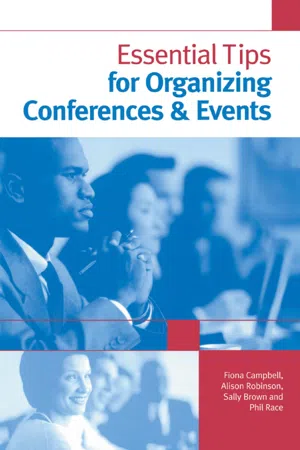
Essential Tips for Organizing Conferences & Events
- 160 pages
- English
- ePUB (mobile friendly)
- Available on iOS & Android
eBook - ePub
Essential Tips for Organizing Conferences & Events
About this book
Many conferences and training events are organised by individuals who have little experience of doing so. Some have had the task thrust upon them without being offered adequate training, and have little idea of the time, experience and care needed to plan and manage events effectively. Each conference is different, and each can present a new problem to the unprepared, even to the most experienced conference organiser.
This book provides immediate, accessible advice on how to run an effective event, featuring a wealth of practical tips, guidelines, case studies, action checklists, and useful sample material and templates. All areas of organisation are covered, including: managing, planning, contingency planning, targeting, costing and budgeting, housekeeping, administering, assuring the quality of content, evaluating, disseminating and ensuring continuity.
Information
1
Initiating the event: early decisions
Whether you are putting together your plans for a full-scale residential conference, or for a much shorter, sharper event, there is a lot of work involved! To keep you going when the going gets tough, you need good reasons to bother.
In this brief section, we have started with the overall question ‘Why?’ The remaining two elements of this section address the question ‘What?’, in the respective contexts of what will the event be about, and what will delegates get out it.
Our comments and suggestions in this section are of course expanded on considerably throughout much of the rest of this book, but we thought it best to start you thinking first about the global ‘Why?’ and ‘What?’ questions at the outset.
Why are you planning a conference or event?
Whether you are planning a residential conference running for several days, or a half-day training event, it takes a lot more time and energy to plan it all than just the time taken for it to run. It is not unusual for planning and organizing a big conference to take up several months of several people’s time. Nor is it unusual for them to be busy people with all sorts of other things to attend to all through this time. It is therefore worth stepping back from the overall idea of planning a conference, and making sure that this is really what you want to do. The following questions and suggestions may help you to clear your mind, and decide why you’re going to go ahead and organize a conference—or indeed not!
- What are your objectives for the event? What purposes will it serve you? In other words, what’s in it for you if it goes really well? Promotion? Making an impact? Getting better known in your field? Public acclaim? Pleasing your boss? Just the satisfaction of having done it all and made it work? Some combination of several of these?
- What’s the risk for you? What would be the worst-case scenario for you personally if the conference didn’t work? Would any blame come firmly back to you?
- Who will benefit from the conference? Will it be the institution or venue at which the conference will take place, the organizing association, the participants themselves, the organizing team, sponsors if you happen to use them, or some combination of several of these possible beneficiaries? It is important to identify how each stakeholder is likely to benefit from the event.
- What’s in it for the host institution or the conference venue? Is it likely that there will be a profit from the event? Will this be substantial? If the event is being hosted by an institution such as a university or college, is a profit expected by the host institution? Are other benefits more important to the institution, perhaps for example publicity? Would a loss be accepted if the event did not really take off?
- What’s in it for the members of the organizing team? Will it bring them fame and fortune? Will it be a really useful professional development experience for them? Will it bring them job satisfaction and security? Will it open up new avenues? Will it bring them new important contacts and networking opportunities?
- What’s in it for the key presenters? Will this be an important and timely opportunity for them to share their expertise? Will the conference open up to them important new channels of communication with others in their field? Will it allow them to gain recognition of their work? Will it lead to the successful publication of their work in reputable and esteemed formats?
- What’s in it for the delegates themselves? What difference will the conference make to those who attend? What are they going to take away with them, in terms of knowledge, experience, skills and changed attitudes?
- Does it really need to be a conference to meet the various needs of the various stakeholders? In other words, do people need to be physically in the one place at the same time to achieve the objectives? Could your objectives be better served with an alternative mechanism? Perhaps a series of two-hour workshops, a team-building course, an on-line discussion forum, a selfinstructional guide in printed or electronic form might be more appropriate?
Choosing themes
Getting the right people to a conference or training event depends substantially on making the event seem relevant, interesting and attractive for them. The following set of questions and suggestions should help you to make the crucial decisions about what exactly your conference will be seen to be about.
- Will your topic remain topical? Look at what is topical at the present time. Although some topics may have gone out of fashion only months later, most topical themes remain of interest for at least some time. Besides, even if perceptions about the theme may have changed by the time you actually run the conference, you will need to be attracting participants some time earlier than this. In any case, it is not difficult to continue to fine-tune exactly how the conference will address the themes all the way along the line to the event itself, and respond to emerging or changing views about the theme.
- Are you and the planning team equipped with knowledge regarding national, institutional or local priorities? Do you keep up to date by attending relevant events and following any national debate around the topic? If not, you should, and you should definitely make sure your team does include individuals who do.
- Do you know your competition? While you certainly won’t want to run an identical event, it is likely that there will be similarities in the content and themes of corresponding events, if they relate to current priorities. Ensure that your event is complimentary rather than in competition. The number of potential delegates is finite, and you will both end up with low participation rates if events are too similar.
- If it’s a short, sharp event, don’t make the theme too broad. Your main aim should be to plan the advertising of the agenda for the event so that everyone who turns up for it will get at least some of what they are looking for from it.
- Are there current hot issues or topical topics which you want to address? Perhaps these have arisen as a result of changes in market forces, developments on the international scene or the creation of a new initiative or product?
- What are the pressing interests and concerns of your target group? What is it your people really want to do? Can this be turned into a conference theme?
- Have there been national developments in the field? Is there an obvious national agenda to be addressed? For example, has new legislation been issued which people will need to find out about and discuss? Are there funding body imperatives? Have new government initiatives been unveiled?
- Is it likely to be something peculiar to your own organization? Are there organizational priorities to agree on? Is an organization-based perspective required? Do the staff need upskilling in a particular area? Is there a new concept or initiative of relevance to your local group? Are there partnerships that require forging or opportunities to be created to facilitate the sharing of good practice?
- Have more than one theme for a major event. Often the most valuable products of a conference arise from different constituencies of delegates interacting with each other. If the agenda is too narrow, you may only attract people whose particular interest coincides exactly with this agenda.
- Don’t have too many themes. If the conference themes appear to be too broad and varied, members of your target audiences are likely to think, ‘Well, parts of this look relevant to me, but there’s an awful lot that isn’t directly useful to me,’ and decide not to attend.
- Don’t expect to attract everyone in your target audiences. Any conference will only attract a proportion of the target audience. Sometimes some of the most relevant potential delegates will simply not be able to attend through prior commitments, or for all sorts of other reasons.
- Think ahead to strands. For a major conference, it is normal to have parallel sessions, and to arrange these so that parallel strands follow through particular themes through the conference. These strands can be developed from the original advertised themes.
- Don’t expect all envisaged strands to become a reality. When conference publicity identifies a number of intended strands, it is normal for one or two of these to attract the greatest interest and large numbers of contributions, and for what seemed to be equally viable strands to turn out to be non-starters. It is also normal for some better ways of dividing the conference into strands to become apparent when the nature and direction of most of the contributions become clearer, near to the event.
Intended conference outcomes
In education and training, it is normal to describe the curriculum in terms of what is intended to be achieved. This is often done in terms of ‘objectives’, or ‘intended learning outcomes’ or ‘intended training outcomes’. One way or another, these boil down to spelling out in advance what people who participate should achieve by the end of the event. It can be really useful to spell out the agenda of a conference or training event in similar ways, so that people making up their minds about whether to take part can get a better idea of what’s in it for them if they attend—or indeed what they may miss out on if they don’t attend.
- Think of what people are likely to want to get out of the event. What will get them to sign up for the event in the first place? How will participation in the event match their interests and aspirations?
- Think of what people may need to get out of the event. What are their problems? What may they gain at the event to address these problems? What kinds of solutions to these problems may the event help them to identify?
- Don’t set out too many intended conference outcomes. For a big event, the intended outcomes could run into pages. Pick out only the intended outcomes that are likely to be highest on intended participants’ shopping lists.
- Beware of stating things that intended participants may already have achieved. If the event looks as though it won’t take them any further, they are unlikely to enrol for it. Build in to the wording of each of the intended outcomes some feeling of how they will take their existing achievements further or deeper.
- Aim to make the intended outcomes tangible and achievable. Avoid bland wording such as ‘understand’, ‘know’ or ‘appreciate’. Focus instead on what participants will be able to do with their increased understanding, knowledge or appreciation by the end of the event.
- Link the intended outcomes demonstrably to the themes of the event. For example, have one or two intended outcomes linked to each theme.
- Use the intended outcomes to spell out exactly what the themes are likely to mean in practice for those who participate in the event. The wording of a theme may only tell intending delegates something about the content of the event; the intended outcomes can add vital detail about what exactly intending delegates may hope to achieve in relation to each theme.
- Make the intended outcomes link well to being present and participating at the event. This can be done quite explicitly, for example by phrasing them along the lines, ‘After participating in this conference, and taking part in the discussions, brainstorming sessions, and workshop tasks, you should be better able to:
- put into practice…
- develop workable tactics to…
- work towards achieving…
- Test out your ideas of intended conference outcomes with typical intended participants. For example, ask them to jot down their thoughts in answer to ‘What three things would you particularly like the planned conference to do for you?’ and see what the most common threads turn out to be. This can also help you to identify further themes—or indeed to find out which of the current themes in your draft planning don’t actually lead directly enough into any intended outcomes for delegates.
2
Choosing the right type of event
What is the right type of event? This depends mainly on the purpose of your event, as well as the size, duration, history, and other circumstances surrounding your planning and implementation of the event.
We start this section with a table illustrating some of the similarities and differences between a range of different kinds of event. However, these are not mutually exclusive, as for example it is quite common to have a ‘launch’ event within a residential conference, and even more common to have a formal dinner and after-dinner speech. But launch events and dinners with speakers can be freestanding events in their own right too.
We therefore continue this section with the question, ‘What sort of event are you planning?’ and some comments and suggestions to help you to think deeper into your overall rationale. We continue by posing the question, ‘When is a conference the best choice?’ to help you think through the basis on which you may choose a conference as the most suitable format for your event.
We complete this section of the book by looking individually at one-day events, half-day events, awards ceremonies and launch events. There are of course similarities and differences between all of these possibilities, and it is often the case that a longer event such as a conference may also include one or more of these.
What sort of event are you planning?
The suggestions and discussions in this book extend to several kinds of event, for example international conferences, national and internal conferences, launch and dissemination events, and so on. Different kinds of event serve different purposes. It’s important to choose the right kind of event for the purposes you are aiming to achieve. Some things lend themselves to full-scale international conferences; other purposes are best served by shorter, sharper local gatherings. It is useful to make wise and informed choices regarding the sort of event that will best meet your particular requirements and contexts. The following questions and suggestions may help you to decide which kind of event will be most suitable for your purposes.
Table 2.1 Choosing your event format
- Do you intend to bring together an international group to discuss and take forward a particular theme? In this case, you are probably working towards organizing a fully-fledged international residential conference.
- Is the conference part of a series? In this case, you will need to take due account of how recent conferences in the series have developed over the last few years. In such cases it is well worthwhile for you, and other key members of your organizing team, to have attended the last two or three in the series. If it’s a big conference, it will be even better if your team can attend the conference before yours en masse, and shadow the team that is running it in the venue concerned.
- Is the target audience well defined? Do you want to bring together a group of staff from different agencies, organizations and institutions to address particular themes? If so, a national residential conference may be suitable. This is the most usual format of annual conferences organized by professional associations.
- Is the need or purpose more localized? For example, does the purpose relate principally to a particular group of staff within a particular region? Purposes could include reaching a set of decisions or action planning to tackle a certain issue. If so, your event is most likely to be a one-day regional conference or training event.
- Are you planning to launch something? Perhaps a new association, a new funding stream, a new national or local initiative, or a new concept? If so, a national one-day event could be suitable, with most or many people travelling some distance to attend.
- Do you wish to disseminate information and ideas from a funded project or a new initiative? Again a one-day national or regional event may be the best way to meet your needs. There may well be at least some dissemination funding already built into the project, some of which could go towards the costs of planning and running a conference or event.
- Is your event focused on one institution or organization? If so a one-day in-house event may be the most useful format (although you may choose not to hold the event on-site). Events of this kind could include a conference run for staff of a particular organization (usually with external inputs), which aims to agree an organizational perspective on a particular issue, or to enhance staff awareness and abilities in a specific area.
- How big will your event be? How many participants do you anticipate? Be realistic and use as a guide numbers who have attended similar events—although be aware that location, timing, and factors about the timeliness of the topic may all affect expected numbers. Many of these factors are covered in other parts of this book.
When is a conference the best choice?
Why would you want to choose to have a conference? When deciding what kind of an event to have, you are likely to want to think through the pros and cons of having a conference, rather than a different kind of event. The following sets of tips are designed to help you make this decision. Here we are using the term ‘conference’ to mean a substantial event at which delegates can hear a range of keynote and other speakers, participate in discussions and workshops, and review exhibitions and displays.
Conferences can be suitable for:
- Enablin...
Table of contents
- Cover Page
- Title Page
- Copyright Page
- Preface
- Acknowledgements
- 1 Initiating the Event: Early Decisions
- 2 Choosing the Right Type of Event
- 3 Choosing the Right Inputs for Your Event
- 4 Early Planning
- 5 Detailed Planning
- 6 Managing the Event
- 7 Following Up an Event
- 8 Resources
- 9 Templates
Trusted by 375,005 students
Access to over 1.5 million titles for a fair monthly price.
Study more efficiently using our study tools.
Frequently asked questions
Yes, you can cancel anytime from the Subscription tab in your account settings on the Perlego website. Your subscription will stay active until the end of your current billing period. Learn how to cancel your subscription
No, books cannot be downloaded as external files, such as PDFs, for use outside of Perlego. However, you can download books within the Perlego app for offline reading on mobile or tablet. Learn how to download books offline
Perlego offers two plans: Essential and Complete
- Essential is ideal for learners and professionals who enjoy exploring a wide range of subjects. Access the Essential Library with 800,000+ trusted titles and best-sellers across business, personal growth, and the humanities. Includes unlimited reading time and Standard Read Aloud voice.
- Complete: Perfect for advanced learners and researchers needing full, unrestricted access. Unlock 1.5M+ books across hundreds of subjects, including academic and specialized titles. The Complete Plan also includes advanced features like Premium Read Aloud and Research Assistant.
We are an online textbook subscription service, where you can get access to an entire online library for less than the price of a single book per month. With over 1.5 million books across 990+ topics, we’ve got you covered! Learn about our mission
Look out for the read-aloud symbol on your next book to see if you can listen to it. The read-aloud tool reads text aloud for you, highlighting the text as it is being read. You can pause it, speed it up and slow it down. Learn more about Read Aloud
Yes! You can use the Perlego app on both iOS and Android devices to read anytime, anywhere — even offline. Perfect for commutes or when you’re on the go.
Please note we cannot support devices running on iOS 13 and Android 7 or earlier. Learn more about using the app
Please note we cannot support devices running on iOS 13 and Android 7 or earlier. Learn more about using the app
Yes, you can access Essential Tips for Organizing Conferences & Events by Sally Brown,Fiona Campbell,Phil Race,Alison Robinson in PDF and/or ePUB format, as well as other popular books in Education & Education General. We have over 1.5 million books available in our catalogue for you to explore.