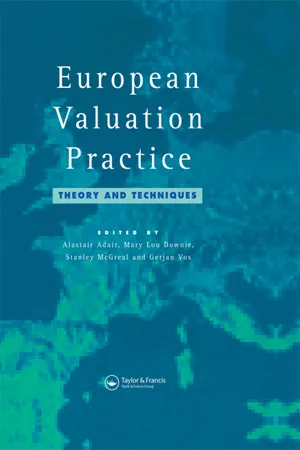
- 353 pages
- English
- ePUB (mobile friendly)
- Available on iOS & Android
eBook - ePub
About this book
The variability of valuation practice within Europe is perceived as a problem within the globalization of property. This edited textbook examines the practice of real estate valuation in selected countries in Europe. The focus is on countries with well developed real estate markets in which both international and indigenous investors are active. The book is aimed at real estate professionals, financiers, institutional advisers, property researchers and students who require a greater understanding of comparative property appraisal techniques applied across Europe.
Information
Publisher
Taylor & FrancisYear
2013Print ISBN
9780415512114
9780419200406
Edition
1eBook ISBN
9781135821180
1
The context of valuation practice in Europe
Stories of valuation eccentricities within Europe abound, their bizarre nature betraying ignorance of each other’s valuation objectives, theory and practice. This unfortunate situation has been brought to the fore by the internationalization of property activity, stimulated by the inception of the Single European market for goods and services. Developers seek to expand their activities from their home base in pursuit of fresh profit opportunities while investors look for the potential of diversifying between economies and locations. Financial services organizations seek market share in other countries, while manufacturing companies relocate and expand their presence in strategically chosen locations to serve their new international markets. The result is that consultancies which service and feed off all these groups have to grapple with property values in unfamiliar locations, encompassing foreign business and legal systems, if they wish to retain their clients’ instructions. This text, through examining valuation techniques in several European countries, seeks to highlight variations and, indeed, similarities, where these exist, in terms of practice and methodology.
1.1 INTRODUCTION
The response of property consultants to the challenges of cross-border opportunities and international expansion has been to cooperate or merge with an indigenous partner to overcome the disadvantage of lack of local knowledge, expertise and contacts. Most such international links have flourished on an agency basis, earning fees through letting, selling and buying property for clients, or on a brokerage basis. A period of active expansion in Europe in the years prior to the inception of the Single Market is now being followed by consolidation, dictated to some extent by economic recession and oversupply, particularly in office markets (Berry and McGreal, 1995). It remains to be seen whether the market for these services is now saturated.
The well-established international property consultants, having established their presence with agency business, are likely to expand by introducing, among other services, commercial property valuation. This raises the question whether such operators will employ the methods and value concepts of the international property industry or adopt local methods. Despite much anecdotal evidence that the valuation process varies from place to place, very little research has been carried out to establish the nature or extent of such differences (Bell and Hobbs, 1993; Downie, 1993; RICS, 1993). In deciding whether to use indigenous valuation methods consultancies must identify whether they are equipped and qualified to value locally by local methodology, whether the fee potential of a country warrants the necessary investment in personnel and training, and whether restrictive local practices effectively close the market in valuation services to outsiders. The crucial issue however is likely to be their clients’ requirements. They may opt for familiarity, the valuation formats they know and understand, or alternatively for a system which provides better for their particular needs than the one they have hitherto used. Many users of valuations are now expanding their business across their traditional borders and in so doing are exposed to the valuation culture of their new markets. As a consequence they find themselves using appraisals produced in the valuation cultures of several different countries and will undoubtedly evolve preferences for those which best serve their needs.
Business expansion across borders prompts the need for consistent valuation systems for accounting and stock market valuation purposes. This is already happening through the introduction of unified accounting rules in certain financial service sectors enabling meaningful cross-border comparison of values and performance. For example, the European Union Directive governing the reporting of Insurance Company Performance.
Several international associations of valuers have been formed with various objectives, including lobbying the European Commission, standardizing concepts and definitions of value, setting international practice standards and improving communication across borders. The overall agenda is to increase valuation business by offering an enhanced quality of service to clients on a wider geographical basis than before. The effectiveness of these organizations is not guaranteed, depending in part on their acceptance by national professional bodies, and there is potential for disagreement when cherished national systems of practice and theory have to be reconciled in creating an internationally accepted standard or definition. Examples are The International Asset Valuation Standards Committee (TIAVSC), The European Group of Valuers of Fixed Assets (TEGOVOFA) and The European Valuers Association (Euroval).
In addition to the proliferation of such associations, the Royal Institution of Chartered Surveyors (RICS) has extended its influence into mainland Europe by accrediting selected higher education courses and setting up national organizations. This is significant, since chartered surveyors have to apply the bases of valuation and follow the requirements of the ‘Red Book’ (RICS, 1990) in carrying out valuations for specified purposes and are subject to the institution’s Code Of Practice. Such courses exist in Ireland, Germany and the Netherlands as well as the UK.
International consultants already carry out many valuations for their clients, often in connection with investment transactions and predominantly in the major investment locations: the large cities and localized growth regions. Many of these consultants have UK connections and therefore use UK-based growth–implicit valuation methods or the internationally accepted growth–explicit discounted cash flow method. Indeed, it is possible to foresee a situation where two tiers of valuation methods are applied by two distinct sets of valuers: international/UK methods applied by international consultants dominating the larger investment markets and indigenous valuers operating in the more provincial markets and for specialized functions such as providing court evidence.
This book attempts to clear some of the confusion by providing a framework within which different national valuation processes can be compared across 12 western European countries.
1.2 INVESTMENT VALUATION: PRICING AND APPRAISAL OF WORTH
It is of crucial interest to investors to be able to compare the worth of investments in different countries with their prices, i.e. the exchange value in the market. Research in this area tends not to be published, primarily because of its commercial sensitivity. The range, complexity and subjectivity of the issues to be incorporated in such a study are considerable. Quantifiable estimates must be made of the risk and return characteristics of investments, including the effectiveness of land registration guarantees, tenure norms, income certainty and growth potential, tenant and business risk, differences between the national and local economies, and many more. In addition to appraising investment worth, investors need to understand local pricing methods.
It is possible to conjecture that in markets as yet unexploited by international investors, price is dictated by the interaction of local users’ and investors’ perceptions of worth, and local valuers’ pricing mechanisms. In some markets owner-occupation of commercial property is more usual than separation into occupation for use and ownership for investment purposes. In such circumstances local users’ perceptions of worth will dominate (Coakley, 1994) with price expressed as:
price = f (local valuation practice, local user worth)
If the scenario is developed to envisage newly-arrived international investors appraising and acquiring property in a subset of such markets, for instance major cities, then prices are likely to be influenced by their perceptions of worth and their pricing methods. Coakley characterizes this as the predominance of international views of property’s exchange value (Coakley, 1994) with international price expressed as:
international price = f (international valuation practice, international investment worth)
The price at which properties are exchanged will depend on which of the functions gives the higher value. Prima facie, it would appear that pressure from outside investors may well increase demand and thereby push up values. Therefore, in internationally attractive investment locations, international methods may replace indigenous methods of valuation and of pricing. Conversely, in the markets not favoured by such investors, indigenous methods may persist.
There is anecdotal evidence that international investors are cautious about entering territory as yet unbroken by their peers. For example, investment in Dusseldorf is acceptable but Dortmund, despite possible high returns, is not. Therefore, international investment is restricted to a limited group of cities and as competition for investments there intensifies, prices rise and returns diminish. Concurrently, the advantages of widening the investment net also increase: product is more readily available elsewhere, it offers higher potential returns and it may offer returns disproportionate to the added risk since these may be relatively inefficient markets with prices unrelated to intrinsic worth.
It is the business of investors, but outside the scope of this book, to investigate relative levels of price and of worth. This study is confined to one aspect of the scenario: the different indigenous valuation processes. By elucidating this subject it is hoped to make a contribution to the overall picture of varying methods of appraisal and pricing, and spheres of influence of valuers, users and investors. However, a great deal more work will need to be carried out before investors have a secure understanding of the relationship of appraisal of worth and pricing to inform their acquisition and disposal decisions.
1.3 THE CULTURAL PROBLEM AND THE VALUATION PROCESS
Most valuation texts concentrate on the construction and manipulation of mathematical models designed to express chosen value concepts such as likely sale price or investment worth. These models have usually been evolved by practitioners and are constantly being criticized, refined, supplemented or replaced by new models proposed by practitioners and, increasingly, academics. Some may have been enshrined in law, or alternatively adopted by client or other professional bodies and explanation in the literature is invariably aimed at readers familiar with the national context in which they are used. This book, by examining valuation processes within and across national spheres of influence, addresses a more heterogeneous practice base and target audience. As a result, valuation processes rather than valuation methods alone are discussed.
The essential problem is the cultural nature of valuation. It is often said that valuation is an art rather than a science and, like all art, valuation cannot be fully appreciated without an understanding of its cultural context. This means the business or economic culture of the country, a concept of great complexity and subtlety. There are national expectations (low inflation in a stable economy in Germany, higher inflation and a severely cyclical economy in Italy and the UK), national laws on land registration, property ownership and occupation (rent indexation in Germany and France, upwards-only rent review in the UK), fiscal regimes, company law and norms (frequent take-over and merger of mainly quoted companies in the UK, a large privately-owned industrial base in Germany, with few take-overs) and, of course, different dynamics of politics and society, manufacturing and service industries and the property they use.
A practitioner or researcher operating in one country may misinterpret the valuation process in another through ignorance of this complex scenario of economic interactions and their social, legal and political backdrop. Therefore, this book does not confine itself to the technical aspects of valuation, as do many other national references, rather it supplements the details of law, mathematics and valuation concepts or definitions with an overview of clients, valuers’ education and employment, tenure norms, data sources and philosophy. Unfortunately it is difficult for those steeped in their own national system to identify the cultural aspects which may be unique, and therefore interest the reader from another country, and few valuers are well educated in comparative economics or business studies. The book makes an attempt to address the question of the cultural context of valuation, but knowledge of this area is so underdeveloped at present that it can only be a tentative first step.
These cultural aspects can have profound repercussions for the practice of valuation. The accounting culture of many countries avoids revaluation of property for accounting purposes; assets are carried in the accounts at their cost to the business. By contrast, in the UK, which has a large publicly quoted equity market, property is regularly revalued for annual accounts, providing a substantial workload for valuers and wide-ranging debates about the appropriate methods of valuation for this purpose (RICS, 1994). Not only does UK accounting culture enhance the size of the valuation profession, but also its deg...
Table of contents
- Cover
- Halftitle
- Title
- Copyright
- Contents
- List of Contributors
- Foreword
- 1 The context of valuation practice in Europe
- Part One: Theoretical basis of valuation
- Part Two: Valuation practice in Europe
- Part Three: European valuation perspective
- Index
Trusted by 375,005 students
Access to over 1.5 million titles for a fair monthly price.
Study more efficiently using our study tools.
Frequently asked questions
Yes, you can cancel anytime from the Subscription tab in your account settings on the Perlego website. Your subscription will stay active until the end of your current billing period. Learn how to cancel your subscription
No, books cannot be downloaded as external files, such as PDFs, for use outside of Perlego. However, you can download books within the Perlego app for offline reading on mobile or tablet. Learn how to download books offline
Perlego offers two plans: Essential and Complete
- Essential is ideal for learners and professionals who enjoy exploring a wide range of subjects. Access the Essential Library with 800,000+ trusted titles and best-sellers across business, personal growth, and the humanities. Includes unlimited reading time and Standard Read Aloud voice.
- Complete: Perfect for advanced learners and researchers needing full, unrestricted access. Unlock 1.5M+ books across hundreds of subjects, including academic and specialized titles. The Complete Plan also includes advanced features like Premium Read Aloud and Research Assistant.
We are an online textbook subscription service, where you can get access to an entire online library for less than the price of a single book per month. With over 1.5 million books across 990+ topics, we’ve got you covered! Learn about our mission
Look out for the read-aloud symbol on your next book to see if you can listen to it. The read-aloud tool reads text aloud for you, highlighting the text as it is being read. You can pause it, speed it up and slow it down. Learn more about Read Aloud
Yes! You can use the Perlego app on both iOS and Android devices to read anytime, anywhere — even offline. Perfect for commutes or when you’re on the go.
Please note we cannot support devices running on iOS 13 and Android 7 or earlier. Learn more about using the app
Please note we cannot support devices running on iOS 13 and Android 7 or earlier. Learn more about using the app
Yes, you can access European Valuation Practice by A. Adair,M.L. Downie,S. McGreal,G. Vos in PDF and/or ePUB format, as well as other popular books in Business & Urban Planning & Landscaping. We have over 1.5 million books available in our catalogue for you to explore.