eBook - ePub
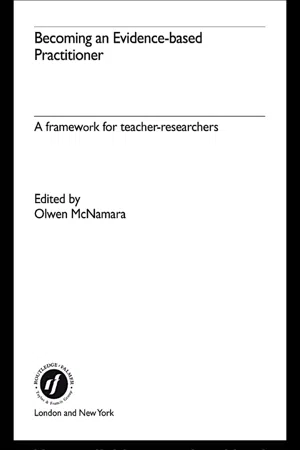
Becoming an Evidence-based Practitioner
A Framework for Teacher-researchers
- 208 pages
- English
- ePUB (mobile friendly)
- Available on iOS & Android
eBook - ePub
Becoming an Evidence-based Practitioner
A Framework for Teacher-researchers
About this book
The world of teacher research is rapidly changing following the introduction of Best Practice Research Scholarships. This was announced by the DfEE as part of a new Professional Development Plan in which teachers are to be allocated up to £3000 to do their own research (non-award bearing) with the support of an HE mentor. The TTA also believes that teachers should play a more active role in conceiving, implementing, evaluating and disseminating research.
This book is for teachers who are looking, or being encouraged, to undertake research in their schools. Written by teachers and their HE research mentors, the book provides case studies which show teachers how to 'do' and 'use' research and how to 'do' effective pedagogy. Olwen MacNamara shows how a group of teachers set out to observe, describe, analyse and intervene in areas of primary education. The book can be raided for insights into research methods as well detailing professional issues about teaching and learning, and will be essential reading for teachers undertaking Best Practice Research Scholarships.
Information
Part 1
Emerging issues in teacher research
Chapter 1
Evidence-based practice through practice-based evidence
Olwen McNamara
Introduction
The last few years have seen a sea change in the opportunities available for teachers to engage both in doing teacher research projects and in using existing findings from the wider research and evidence base. A number of recent initiatives have signposted the Government’s intention to support a form of evidence-based practice ( EBP) which incorporates both of these elements. Performance Threshold Assessments, for example, require the evidencing of systematic engagement in professional development which could include research and evidence-based activities with a principal focus on teaching in the classroom ( DfEE, 2000). In addition, the DfEE announced a new Professional Development Programme for 2000/01, now extended for a further three years, to improve classroom practice by funding Best Practice Research Scholarships which will support teachers in undertaking research and development work and becoming more informed by existing research ( DfEE, 2001). The TTA itself, of course, has a relatively long history of supporting teachers’ engagement in and with research. The TTA’s Teacher Research Grants scheme has, since 1996, supported about thirty teachers a year, and in 1997 our own School-based Research Consortia initiative was launched. Finally, the DfEE has established the Evidence for Policy and Practice Information and Coordinating Centre ( EPPI Centre) to commission and maintain systematic reviews of, in the first instance, school-based education research, in order to build resource databases and help practitioners and policy makers to locate and access relevant research.
Against this broad backdrop of recent initiatives the relative absence of a research-informed culture in schools is marked. A range of approaches has been advocated since the ‘teachers-as-researchers’ movement began in the 1970s (e.g. Stenhouse, 1975; Carr and Kemmis, 1986; Elliott, 1991); however, a number of weaknesses have been evident. First, the issue of teachers engaging with using research and evidence, as opposed to engaging in doing research, has been widely neglected. Only in recent years has the former been facilitated by the publication of a number of accessible and brief research summaries in hard and electronic copy from the TTA, DfEE, SCRE (Scottish Council for Research in Education), NFER (National Foundation for Educational Research), etc. Second, research-based practice over the last three decades has been a temporary and voluntary activity for the majority of its practitioners. Initial opportunities for teachers to engage in research were through funded projects in the 1970s and 1980s but involved limited numbers of, often specially selected, individuals. Continued support for practitioner research in the late 1980s was mainly resourced from HEI lecturers’ own research time, often in collaboration with LEAs (Elliott and Sarland, 1995). The effects of changes in funding bases for LEA and HEI have made such collaboration less likely in the last decade and teachers’ experience of research has mainly involved award-bearing Continuing Professional Development courses, and, to a more limited degree because of pressures of time, Initial Teacher Training. A potential failing of this HEI accreditation model of ‘teacher research’ is that research methodology and theory can easily become decontextualised from practice.
Attitudes to research
When we first embarked upon this project we were interested in exploring teachers’ attitudes to research. So, as mentioned briefly in the Introduction, we conducted a baseline questionnaire survey in the consortium schools. The same questionnaire was subsequently repeated, on a smaller scale, towards the end of the project. One of our first corporate activities then was to devise the questionnaire. We were interested to ascertain teachers’ perceptions and experiences of, and beliefs and attitudes towards, doing and using research. The reason for this was fourfold. First, it was an exercise in constructing a questionnaire, even worse an exercise in constructing a questionnaire collaboratively! (You can see the end result in Toolkit 1). It was our intention to collect both descriptive and explanatory data so we devised a mixture of open and closed questions. [ Munn and Driver (1995) is a useful sourcebook, which gives a practical guide to using questionnaires in small-scale research]. There are a number of other reasons why it can be useful to conduct a questionnaire, apart from the obvious one of wanting to collect information and elicit views. A second, and for us important, reason was that we hoped that the arrival of the questionnaire would raise the profile of the project within the schools and, on a more general level, get staff to begin thinking and talking about the value of doing and using research. Third, we wanted to collect data that could be used in the research training sessions in order that data analysis would be relevant and illuminating and not simply an academic exercise. Finally, there was always the option to repeat the questionnaire, at a later date, to detect whether any shifts in attitudes had occurred within the schools as a result of the project. We had 100 questionnaire returns (about 80 per cent), which was a very high response rate; characteristically 30 per cent is not uncommon in the teaching profession.
Images of research
Perhaps the question that overall gave us the richest data was ‘What image does educational research hold for you?’ These images, we discovered, varied enormously, and responses to this very open question included insights on the nature of the data, the findings, the research processes and indeed quite a lot upon researchers themselves. Two prominent, and largely negative, themes that emerged were that research was seen as ‘academic work’ and that data were often imagined to be ‘statistical’ in nature. Academic work involving ‘Professors undertaking tests and surveys and making reports’ was berated because ‘people in universities’ were ‘out of touch with real classrooms’. ‘Academia’ was depicted as a ‘utopia irrelevant to actual classroom situations’. Research was characterised as ‘dry facts’ that ‘failed to influence practice’. Statistics were mistrusted because ‘statistics can prove anything’ and can be manipulated. One respondent in particular displayed a very negative image of educational research: ‘statistics/research carried out in isolation resulted in misinterpretation/sometimes manipulation of findings. Depending on who is using the statistics/research useful findings can be ignored for political reasons or because they are not in fashion’. Statistical data were seen as a stick with which to beat teachers, ‘telling us how bad we are with no ideas of how to improve’, and were thus ‘very demoralising’. ‘Raising confidence’ and ‘self-esteem’ were currently felt to be the highest priority in teaching! The processes involved in research were often depicted as technical:
- ‘controlling variables’
- ‘questionnaires’
- ‘graphs, surveys and videos’
- ‘making observations, asking questions, testing hypothesis’
- ‘jargon’.
Such technical processes were not always viewed negatively; they were sometimes seen as ‘exciting’, ‘positive’ or ‘interesting’ when they involved ‘analysing data and processing to workable suggestions’.
Research was perhaps viewed most positively when it was linked directly to practice: ‘Action research is most useful, teacher-based and school-based.’ It could be a source of new ideas, an instrument of change mostly as a means to better performance, and was thought to involve:
- ‘assessment of current practice’
- ‘justification for good practice’
- ‘looking in detail at teaching’
- ‘finding out about how children learn a subject’.
Occasionally, however, implementation of research findings was thought to bring about ‘change in curricula content and teaching methods which [was] not always in the best interest of children’ or was ‘impractical on a day-to-day basis’. Linked to this was a concern about the practical use to which the findings were generally put. The perception was that involvement with others in research involved ‘hard work and very little feedback’; and concern was expressed that sometimes ‘not much was done with the findings’. Again this was linked to ‘the wrong people coming up with the wrong suggestions, poorly researched and then left to teachers on the ground to implement’.
Doing research
Surprisingly, 35 per cent of teachers responding to the questionnaire claimed some experience of carrying out research. This was almost entirely related to either Initial Teacher Training, just under half, or Continuing Professional Developments/Masters level work, just over half. Overall, 40 per cent of teachers found the thought of being involved in educational research was ‘very valuable’ and 30 per cent found the thought of being involved ‘very interesting’. On the whole, although such activity was viewed positively in principle, on a practical level pressures of time and workload meant that only 4 per cent of teachers who responded felt that being involved in educational research would be ‘very manageable’. The pressure of time necessary to engage in the research process was an ever-present theme in most responses: ‘lots of books’ and ‘paperwork’ but ‘teachers don’t have time to read’. Even a number of the individual positive responses involved a ‘yes but’, and the ‘but’ was usually the time that research was seen to involve, ‘important, necessary – but yet another addition to workload’.
Information about teaching
Teachers felt that currently their most valuable sources of information about teaching were:
- ‘colleagues’, a substantial 85 per cent;
- ‘books’ were cited by 80 per cent ;
- ‘LEAs’, ‘professional journals’, ‘press and media’ and ‘ DfEE’ between 60 and 70per cent;
- ‘conferences’ and ‘ OFSTED’ were perceived to be slightly less informative;
- ‘ TTA’ and ‘universities’ were at the bottom of the heap with only 30 per cent, partly perhaps reflecting disenchantment with academia and teachers’ perceived current use of research findings and literature.
Using research
Despite teachers’ apparent current lack of use of research, it appeared that they perceived the potential impact of educational research on teaching as quite substantial and also beneficial. Some 50 per cent of teachers claimed that research increased ‘teacher effectiveness’ and ‘teacher knowledge’. On the down side, 60 per cent of those who responded felt that research did not increase the public’s esteem of teachers ‘at all’. The vast majority of respondents felt that teaching would improve considerably if teachers knew more about using research. There was the perception that ‘Single class teaching can result in the teacher’s approach becoming insular – the more we know of education in other areas, the better’; ‘Sometimes I think you can get stuck into a routine of doing things a certain way, finding out about research findings will help teachers, give them fresh ideas and different view points’. Research was not viewed so much as a ‘stick with which to beat teachers’ but as an aid: it would show teachers where they were ‘barking up the wrong trees’, reduce ‘unproductive work’, and stop them ‘reinventing the wheel’. Research, it was felt, could improve:
- ‘quality of teaching’;
- ‘pupil learning’;
- ‘teacher confidence’; ‘ownership’ of developments
- ‘ownership’ of developments in educatio; n
- understanding of the ‘rationale of change’;
- underpinning of ‘decision-making, planning and organising’.
Only one respondent rejected outright the advantages of research in terms of professional development: ‘If you have been teaching for a long time I think you have a pretty good idea what works’. Another teacher thought such dated knowledge unsafe as ‘teaching is not static; it needs to use all support available to meet the needs of an ever-changing society’.
There were some clear messages for researchers about current practice and the importance of ‘relevance’, ‘accessibility’, ‘transferability’, ‘validity’ and ‘applicability’. Research, it was felt:
- must offer ‘practical advice/ways forward’;
- should ‘summarise [findings or] they will not, in reality, be accessible’;
- should not produce just ‘long reports’ full of ‘educational jargon’ and ‘unexplained
- should ensure ‘outsiders’ ‘listen to/take note of what teachers have to say’;
- should bridge the gap between theory and practice - ‘useful research’ was ‘disregarded in practice’ because ‘putting into practice research findings in the classroom can be very difficult’.
How attitudes changed
Towards the end of the project we chose to canvass opinion regarding attitudes to research again. We repeated certain of the questions used in the baseline questionnaire survey and added additional ones (see Toolkit 2) designed to provide some evaluative information (although the project was, of course, subject to a major external evaluation and other internal assessments). The survey was conducted on a smaller scale than previously, with only five rather than eight schools taking part (two schools had dropped out over the course, and by dint of circumstances another school was unable to complete the questionnaire at the time). In addition, the response rate fell to about 50 per cent; our strategic timing of the survey during the last 2 weeks of the summer term was necessary but far from ideal!
Images of research
Taking into account that the responses may well have come from the most positive and supportive teachers there was still a noticeable shift in attitude in response to the question ‘What image does educational research conjure up now?’. ‘Statistics’ was only cited once and ‘professors in ivory towers’ did not feature at all. About 60 per cent of the responses were positive; the themes that could be seen to be emerging were practical relevance and partnership:
- ‘far more positive with practical implications in the classroom’;
- ‘can practically impact on teaching practice/perceptions’;
- ‘a way forward for educational progress, which is central to teachers’ own interests’;
- ‘progress and development’;
- ‘working in liaison with other educational bodies to coordinate research based on informed opinion’;
- ‘working as a team to further the development of education with...
Table of contents
- Cover Page
- Title Page
- Copyright Page
- Tables and boxes
- Contributors
- Acknowledgements
- Introduction
- Part 1
- Part 2 Insights into teacher research
- Part 3 Reflections upon collaborative research
Trusted by 375,005 students
Access to over 1.5 million titles for a fair monthly price.
Study more efficiently using our study tools.
Frequently asked questions
Yes, you can cancel anytime from the Subscription tab in your account settings on the Perlego website. Your subscription will stay active until the end of your current billing period. Learn how to cancel your subscription
No, books cannot be downloaded as external files, such as PDFs, for use outside of Perlego. However, you can download books within the Perlego app for offline reading on mobile or tablet. Learn how to download books offline
Perlego offers two plans: Essential and Complete
- Essential is ideal for learners and professionals who enjoy exploring a wide range of subjects. Access the Essential Library with 800,000+ trusted titles and best-sellers across business, personal growth, and the humanities. Includes unlimited reading time and Standard Read Aloud voice.
- Complete: Perfect for advanced learners and researchers needing full, unrestricted access. Unlock 1.5M+ books across hundreds of subjects, including academic and specialized titles. The Complete Plan also includes advanced features like Premium Read Aloud and Research Assistant.
We are an online textbook subscription service, where you can get access to an entire online library for less than the price of a single book per month. With over 1.5 million books across 990+ topics, we’ve got you covered! Learn about our mission
Look out for the read-aloud symbol on your next book to see if you can listen to it. The read-aloud tool reads text aloud for you, highlighting the text as it is being read. You can pause it, speed it up and slow it down. Learn more about Read Aloud
Yes! You can use the Perlego app on both iOS and Android devices to read anytime, anywhere — even offline. Perfect for commutes or when you’re on the go.
Please note we cannot support devices running on iOS 13 and Android 7 or earlier. Learn more about using the app
Please note we cannot support devices running on iOS 13 and Android 7 or earlier. Learn more about using the app
Yes, you can access Becoming an Evidence-based Practitioner by Olwen McNamara, Olwen Mcnamara, Olwen McNamara,Olwen Mcnamara in PDF and/or ePUB format, as well as other popular books in Education & Education General. We have over 1.5 million books available in our catalogue for you to explore.