eBook - ePub
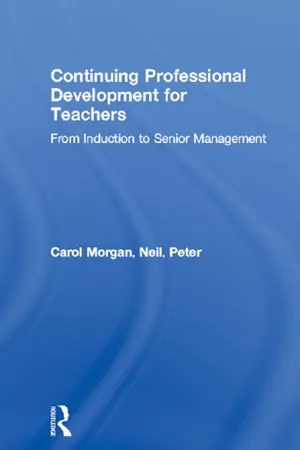
Continuing Professional Development for Teachers
From Induction to Senior Management
- 254 pages
- English
- ePUB (mobile friendly)
- Available on iOS & Android
eBook - ePub
Continuing Professional Development for Teachers
From Induction to Senior Management
About this book
This volume is designed for teachers, whether just setting out or climbing the ladder. It examines the complex set of options and requirements facing teachers, from qualifying as a teacher to developing skills through middle and senior roles, and continually improving teaching skills.
Information
Part I
Getting established
1
The new post and induction
Having come through the training process, the trainee will have some idea as to what to expect in the classroom. The experiences of the classroom received during school experience in partner schools during training will have prepared the student exiting the PGCE course (referred to in different parts of the UK as the newly qualified teacher (NQT) (England and Wales), beginning teacher (BT) (Northern Ireland) or probationary teacher (Scotland), for some of the demands of the teaching job, but taking up full-time, or even part-time employment in a school context, will bring with it some unexpected surprises. We shall use the term NQT throughout except where reference is made to official documents from Scotland or Northern Ireland.
The role of the General Teaching Councils
Each of the four main jurisdictions in the UK has a General Teaching Council, the oldest of which is the GTC in Scotland (GTCS), which was founded in 1965. The GTC in England (GTCE) was established in 2000 and the GTC Wales (GTCW) in 2001. In Northern Ireland the GTC will come into existence in 2003; the developmental work on teacher education has hitherto been undertaken by the Northern Ireland Teacher Education Committee (NITEC), which will hand over this responsibility to the GTC(NI) when it opens. The GTC acts as the gatekeeper to the prof proffession; it is the body responsible for registration of new teachers and its overarching function is to advise on all aspects of the profession, particularly maintaining and raising standards. The GTC is an independent body, answerable to its registered teachers (GTCE, 2001a). It was established following the Teaching and Higher Education Act 1998 with the following remit:
- to contribute to improving the standards of teaching and the quality of learning;
- to maintain and improve standards of professional conduct among teachers; (both of these in the public interest) to advise the Secretary of State on the following:– standards of teaching;–standards of conduct for teachers;–the role of the teaching profession;–the training, career development and performance management of teachers;–recruitment to the teaching profession;–medical fitness to teach;
- to establish and maintain a register of teachers (GTCE, 2001a: 24).
The GTCs are responsible for raising the status of teachers and either have produced, in consultation with the profession, a Professional Code for Teachers, or they have distributed a Code for consultation. The Councils will also have a role in matters relating to disciplinary functions.
The role of the GTC in Scotland differs from that of its counterparts. It has responsibility for accrediting courses of initial teacher education (unlike the situation in England where this responsibility rests with the Teacher Training Agency) and the GTCS has generally more legislative powers than the other GTCs.
The main involvement of the NQT with the respective GTC will be seeking registration to teach. The easiest way to consult the regulations at the time of application is to search on the relevant Web site:
GTC (England): www.gtce.org.uk
GTC (Scotland): www.gtcs.org.uk
GTC (Wales): www.gtcw.org.uk
In order to obtain registration it will be necessary for the NQT to pay a fee. If the NQT fails the statutory induction period he or she will be removed from the register. There will be requirements on the school to ensure that a suitable induction programme is provided and the school will have responsibility to confirm that the NQT has successfully completed the statutory induction period. Each Council will have specific regulations for those who have qualified outside the area and leaflets setting out how to apply for registration can be obtained from the relevant GTC. In certain subject areas there are specific requirements which have to be met in addition to the standards before full registration can be granted; it is necessary therefore to check the specific requirements relevant to your subject area and with the relevant GTC as conditions for specific subjects may change. For example, the GTC in Scotland requires teachers of modern languages to have spent at least six months in the country of the languages before they can qualify to teach; this is not a requirement, however, in Northern Ireland at present. In addition to setting out regulations and to maintaining the register, the GTCs are actively involved in promoting teacher development from induction onwards by providing publications and documents to support the process. Some of their policies, recommendations and working papers will be highlighted in later sections of this chapter.
The GTCE has recently launched its second Corporate Plan (GTCE, 2002), in which it sets out its key commitments in relation to each of its corporate objectives:
- providing a professional voice on teaching;
- supporting standards;
- raising teacher status;
- listening to teachers.
The Corporate Plan also details the changes in the GTC's powers following the Education Act 2002. Full details of both the second corporate plan and the Education Act 2002 can be accessed on the GTCE Web site.
Government regulations and recommendations
In all parts of UK education since the late 1990s, professional development of teachers, from initial teacher education and induction through to headship, has undergone unprecedented change. A feature of this development, as a result of devolution, is the diversity of provision in the different parts of the country. The work of the GTC is inextricably linked to the development in the various jurisdictions and each will present its own particular emphases. There are, however, similarities to the process as teachers progress through the system. The general framework which appears to be consistent across the country is as follows:
- initial training;
- induction (first year in post);
- early professional development (EPD) (usually lasting two further years);
- CPD (career long);
- subject leadership/Advanced Skills teacher/Key Stage co-ordinator/SENCO;
- headship, including the National Professional Qualification for Headship (NPQH).
The emphasis at each stage is on the on-going development of the teacher's professional skills and knowledge and certification of competence at particular stages, such as the key stages of head of department or headteacher. What may differ across the UK systems is the terminology. Where there are significant differences in the use of terms, these will be explained.
This section gives a brief overview of some of the important regulations for teacher education in the different parts of the UK. In setting out these according to the various jurisdictions, it is intended to highlight aspects which may be of interest to the wider teaching community. The regulations in one part of the UK may be more prescribed than in others. Where examples from specific areas appear to illustrate good practice, these will be included in the relevant sections.
England
In England, various statutory bodies have a role in teacher education and development. The Secretary of State has responsibility for setting standards of qualified teacher status (QTS) and requirements of programmes leading to the award of QTS. The Teacher Training Agency (http://www.canteach.gov.uk) focuses on initial teacher training but it also provides guidance for induction. The Department of Education and Skills (http://www.dfes.gov.uk/iateach/) has overall responsibility for legislation relating to all aspects of teaching. In particular it sets out guidance on the regulations for induction (DfES, 2001b), which can be found on the Department's Web site in the professional development section. Additional guidance on registering with the GTC in England is available on its Web site.
The Teaching and Higher Education Act 1998 introduced regulations to provide a bridge from the initial teacher education phase to EPD. Precise details of the induction period for NQTs are presented in the DfES Circular 582/2001 (DfES, 2001b) and it sets out the ways in which NQTs should be supported and monitored in their first year of teaching. The induction should take place over three school terms. During the induction year, it is recommended that NQTs have a reduction of 10 per cent of a normal teaching load in order to give them time to devote to induction activities. The Induction Standards which have to be met by the NQT build on those required in the training year. These are listed under the following headings:
- Professional values and practice.
- Knowledge and understanding.
- Teaching.
- Planning, expectations and targets.
- Monitoring and assessment.
- Teaching and class management.
- National test in numeracy.
These standards are currently out for consultation (TTA, 2002). During the process an induction tutor will support the NQT. At the end of the induction year, the NQTs performance will be judged against the criteria and it will be determined whether or not he or she meets the required standard to be fully passed as a teacher. Normally the period of induction will be one full year, but induction can be completed within a period of up to five years. It is the responsibility of the headteacher, in conjunction with the so-called Appropriate Body to ensure that induction arrangements are in place and that the NQT has met the Induction Standards. The Appropriate Body is in most cases the Local Education Authority (for those in maintained schools). At the end of the induction period the Appropriate Body will inform the GTCE of the outcome of the induction.
In England, the period following induction is simply referred to as CPD. Whereas the arrangements governing induction are mandatory, there are at present in England no formal requirements governing the years following induction. CPD in England is influenced by the DfEE circular 0071/2001 (DfEE, 2001b), which sets out the Government's CPD strategy. Further details of the CPD strategy can be found at the Web site www.teachernet.gov.uk. The GTCE emphasizes the fact that teachers are encouraged to develop their professional practice, but that such development must take account of local contexts and professional and personal priorities. It has produced a draft document, the Professional Learning Framework (GTCE, 2001b), which is currently out for consultation. This document sets out ways in which teachers can continue to improve their own practice, be involved in learning networks and develop their expertise beyond the school. Many of the aspects highlighted in this document will be dealt with in later sections of the book.
Northern Ireland
The Department of Education in Northern Ireland some years ago developed a three-phase integrated approach to the education and training of teachers. Details of this are found in the Teacher Education Handbook (DENI, 1998a). Originally conceived of as the 3 ‘I's —that is, initial teacher education, induction and in-service, this has evolved into initial teacher education (ITE), induction and EPD. The unifying strand, which permeates all phases, is the list of competences and core criteria to be acquired by the beginning teacher (BT). The competences are categorized in five broad domains:
- Understanding of the curriculum and professional knowledge.
- Subject knowledge and subject application.
- Teachin...
Table of contents
- Cover
- Half Title
- Full Title
- Copyright
- Contents
- Acknowledgements
- Other contributors
- Acronyms
- Introduction
- Part I Getting established
- Part II Preparing for advancement
- Part III Preparing for leadership
- Appendix
- References
- Index
Trusted by 375,005 students
Access to over 1.5 million titles for a fair monthly price.
Study more efficiently using our study tools.
Frequently asked questions
Yes, you can cancel anytime from the Subscription tab in your account settings on the Perlego website. Your subscription will stay active until the end of your current billing period. Learn how to cancel your subscription
No, books cannot be downloaded as external files, such as PDFs, for use outside of Perlego. However, you can download books within the Perlego app for offline reading on mobile or tablet. Learn how to download books offline
Perlego offers two plans: Essential and Complete
- Essential is ideal for learners and professionals who enjoy exploring a wide range of subjects. Access the Essential Library with 800,000+ trusted titles and best-sellers across business, personal growth, and the humanities. Includes unlimited reading time and Standard Read Aloud voice.
- Complete: Perfect for advanced learners and researchers needing full, unrestricted access. Unlock 1.5M+ books across hundreds of subjects, including academic and specialized titles. The Complete Plan also includes advanced features like Premium Read Aloud and Research Assistant.
We are an online textbook subscription service, where you can get access to an entire online library for less than the price of a single book per month. With over 1.5 million books across 990+ topics, we’ve got you covered! Learn about our mission
Look out for the read-aloud symbol on your next book to see if you can listen to it. The read-aloud tool reads text aloud for you, highlighting the text as it is being read. You can pause it, speed it up and slow it down. Learn more about Read Aloud
Yes! You can use the Perlego app on both iOS and Android devices to read anytime, anywhere — even offline. Perfect for commutes or when you’re on the go.
Please note we cannot support devices running on iOS 13 and Android 7 or earlier. Learn more about using the app
Please note we cannot support devices running on iOS 13 and Android 7 or earlier. Learn more about using the app
Yes, you can access Continuing Professional Development for Teachers by Carol Morgan,Peter Neil in PDF and/or ePUB format, as well as other popular books in Education & Education General. We have over 1.5 million books available in our catalogue for you to explore.