- 272 pages
- English
- ePUB (mobile friendly)
- Available on iOS & Android
eBook - ePub
About this book
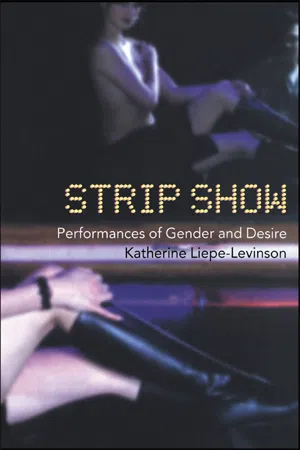
This book offers an account of an unprecedented North American study of contemporary female and male strip shows. It particularly focuses on the contradictory sex roles, cultural positions, and performance practices of 'straight' strip shows during their second heyday in the early 1990s.
Katherine Liepe-Levinson's research took her to over seventy different strip bars, clubs, theatres and sex emporiums ranging from elaborate lap-dancing and couch-dancing 'gentlemen's' clubs in New York, Houston, and San Francisco; to Peoria's onetime duplex cabaret where women strip for men downstairs, and men for women upstairs; to the nightclubs of Montreal where female and male performers displayed the 'Full Monty'.
Liepe-Levinson's intriguing, comprehensive study concentrates on the cultural and theatrical elements of the strip shows themselves including the geographic locations and interior designs of the clubs, the choreography and costumes of the dancers and the all-important participation of the audience. She draws upon a variety of methodologies as well as interviews with performers to explore how the strip show's cultural and theatrical aspects simultaneously uphold and break traditional sex roles. Her findings readily complicate several of the most prominent and prevalent theories about sexual representation, gender and desire.
Information
1
URBAN LOCATIONS OF DESIRE
A tale of five cities
I need to understand how a place on a map is also a place in history.
(Adrienne Rich)1
Between 1987 and 1992, the number of strip clubs in major cities across the United States roughly doubled, suggesting that voyeurism was indeed the commercial sexual pursuit of choice in the age of AIDS.2 As Eric Scigliano observed in the early 1990s, “the emerging battleground in the eternal war between prudery and prurience” was none other than the “ancient, quaint, and innocent-sounding art of the striptease.”3 At the time, New York City Mayor Rudolph Giuliani was just beginning to contemplate a political career on the national scene. It would be to his advantage to conclude his mayoral career by “purging” New York City in ways that reflected the values and policies of his conservative party.
Giuliani’s crusade against the legal sex trades for straight and gay patrons alike began in earnest in 1994 with the development of a new zoning code (approved by the City Council and Planning Commission in 1995) that was aimed at forever changing the Big Apple’s infamous map of sexual desire.4 The trials and tribulations surrounding the enforcement of this ordinance, from 1995 through to the year 2001, made his anti-porn campaign the most widely publicized version of the “secure cities” plan. As noted in the previous chapter, the secure cities plan was devised by Charles Keating and Edwin Meese, among others, for the National Family Legal Foundation. The goal of the foundation was to train 1,000 lawyers to “secure” 1,000 cities by creating and implementing zoning codes that would eventually eliminate all dedicated, and hitherto legal, sexually oriented businesses in the United States (e.g., strip clubs, X-rated book stores, pom and video shops, etc.).5
The earlier anti-sex trade campaigns launched against the Burlesquers of the 1930s and 1940s targeted performers for indecent and immoral behavior. The rationale behind the secure cities plan, however, focuses on the illicit exhibitions of the spectators. It is based on the premise that sexually oriented businesses invariably provoke male consumers to all kinds of indecent and violent acts that degrade the entire city (e.g., engaging in prostitution, trafficking in drugs, participating in other mob-related activities—or engaging in vandalism, street brawls, and sexual assaults on women and children).
To protect the citizens of New York City from such hazards, Giuliani’s zoning code banned any sex trade business larger than 10,000 square feet, and all sex trades from operating less than 500 feet from residences, churches, day-care centers, schools, and one another. The ordinance also gave the city the right to regulate all visible urban markers of the sex trades—that is, the right to remove any marquee or sign that did not meet with the approval of the zoning board. Because of the population density and the overlaps between commercial and residential zoning in New York, the implementation of the ordinance guaranteed the rapid demise of all such businesses. In order to avoid being accused of violating freedom of speech, Giuliani repeatedly announced that all legal sex trades in the city would be allowed to relocate to the wetlands of Staten Island or to the west-side piers of Manhattan. However, since the wetlands had no roads or infrastructure, and since both locations were remote and inconvenient to the rest of city life, such a move would probably lead to their speedy dissolution as well.
Throughout his anti-sex trade campaign, Giuliani insisted that his goal was not to ban the selling of sexually explicit material per se, but rather to close any establishment exclusively dedicated to the marketing of such goods. In other words, the city would still permit newspaper stands and stores to sell sex videos and magazines—provided that these materials did not comprise more than 40 percent of their overall inventory. Technically, this edict would allow the strip clubs and porn shops to operate in their current locations if they limited their sexually oriented goods and performances to 40 percent of their stock and space. Thus, outwardly at least, Giuliani appeared less interested in actually forbidding the sale of erotic or pornographic goods than in eliminating any explicit signs of sexual desire (along with any signs of “social trouble” in all senses of the phrase) from the official map of his city.
Community leaders rallied to the mayor’s cause. Chief executive counsel for New York City, Leonard Koerner, averred that in urban areas where adult stores flourished, non-sex trade businesses routinely went out of business leading to municipal “dead zones.” Queens city council member Karen Koslowitz lauded the campaign as “a fight to maintain a decent quality of life for our constituents and their families.” Dennis Saffran, director of the Center for the Community Interest (CCI), insisted that, far from being repressive, the new zoning code was “a sign of a new common sense of balance between individual and community rights that rejects the extreme positions of both the Civil Liberties Union and the censors.”6
Nevertheless, a coalition of over 100 adult video stores, peep shows, and topless bars, along with the New York Civil Liberties Union representing the industry’s customers, took the city’s new ordinance to federal court for violating the First Amendment. Harold Fahringer, head of the legal team for the coalition of strip clubs, maintained that the Mayor was in fact trying to legislate his own morality. “I do not think he’ll get away with it. It has nothing to do with these places causing crime or other social harms. What’s at the heart of this is he wants to ban this kind of entertainment.” Fahringer asserted that the zoning code would destroy what makes New York City “the greatest city in the world”—its high “tolerance for unorthodox views in every field, whether it be entertainment or political.”7
After months of waiting for the Federal Court of Appeals to decide whether his anti-sex trade ordinance was in fact constitutional, Giuliani attempted to get rid of strip clubs and porn shops by other means. During one of his weekly radio broadcasts, the mayor urged all like-minded and concerned citizens to photograph or videotape men going into and out of these establishments to deter business. Giuliani explained to his listening audience that it was legal for citizens to take pictures of people on city streets. He reassured “caller Dan” from Forest Hills, Queens, that this strategy would really “cut down on business… You know who goes into those shops anyway, right? You know the kind of people who would go in there. They probably wouldn’t want [other] people to know [about] that.” Norman Segal of the New York ACLU immediately took the mayor to task. Segal pointed out that while all citizens are free to use their cameras on the streets, it is illegal for an elected official to rally people to oppose any legal activity—be it the right to obtain an abortion, attend a political gathering, or visit a porn shop. Fahringer called the mayor’s photo shoot strategy “absolute insanity.” “What frightens me is enlisting citizens to engage in that kind of Big Brother activity in a free society. I just find it intolerable.”8
Giuliani, once again, defended his actions by insisting that places of adult entertainment posed a real and present danger to all New Yorkers. Anti-porn activists flocked to his defense, adding to the list of charges against the clubs the assertion not only that their entertainments degraded women by categorically depicting them as passive sex objects dominated by men, but that they triggered actual male violence against women. This formulation of gender, sexual desire, and representation is best summed up by the now famous anti-porn slogan coined by Robin Morgan: “Pornography is the theory, rape is the practice.”9 The harmful-secondary-effects argument and the secure cities plan of Keating and Meese rest on this analogy as well. They too propose that places of entertainment dedicated to sexually explicit representations inevitably lead to rape—the rape of our neighborhoods and cities.
The balance of this chapter explores the substance and legitimacy of all such arguments. To this end, it examines the locations, exterior designs, and advertisements of strip bars, clubs, and theatres (and the street scenes they produced) in five North American cities at the height of the striptease boom in the early 1990s. It was the omnipresence of these places of performance, and their spectacles of desire, that led directly to the instigation of the secure cities plan. Strip shows for white, middle-class, heterosexual males are discussed first. Their physical and social sites are then compared to similar shows for gay men, bisexuals, lesbians, and mixed audiences as a way of situating dominant heterosexual strip events and displays of desire as a part of a much larger socio-sexual discourse. Finally, the geographies of strip shows for straight men are compared to the shows for straight, similarly classed women—events that were all but ignored by the anti-porn and zoning campaigns of the last decade.
Strip clubs for straight men: City “street scenes” in Montreal, New York, San Francisco, Houston, and Washington DC
The sleazy nudie bar, hidden away in a municipal district of ill-repute, epitomizes for many both the cultural and the geographic location of the strip show for men. However, since the end of the Burlesque era, strip events have found their way into public forums as diverse as neighborhood bars, converted movie houses, theatres, restaurants, discotheques, luxurious nightclubs, and upscale sex emporiums. These places of performance are not only located in the danger zones of our cities, but in traditional business, entertainment, and shopping sectors as well. Marvin Carlson, Leslie Wade, and others interested in urban semiotics have pointed out that the locations of all places of performance—along with their exterior decorations, names, and general upkeep—not only structure the meanings of the show for the patrons within, but provide stories and narratives about both the city and the performance to the passer-by. In the words of Wade, erotic entertainments are “grounded in the cultural and mythic connotations of the street, the quarter, and the city itself.”10
The urban zoning code for strip clubs in Montreal, Quebec, stands in stark contrast to New York City’s latest anti-sex trade ordinance. Most of the well-known clubs and cabarets for straight men are situated in the relatively upscale, stylish downtown district along Saint Catherine Street, where they share the boulevard with conventional movie houses, theatres, department stores, four-star hotels, and boutiques.11 Despite this gentrified and otherwise mainstream location, strip clubs and sex shops blatantly advertise their presence with prominent marquees; neat, tuxedoed door-persons posted in their entranceways; and names that often refer expressly to the sex trades (e.g., La Cave du Sexe, Chateau du Sexe, Club Super Sexe, etc.). On Saint Catherine Street in Montreal, sexual entertainments are then rendered not only readily accessible—but, apparently, fashionable.
As part of the sexual gestalt of this city and district, some of the clubs for men exhibit giant exterior murals, neon signs, and posters of nude or semi-nude females and female body parts. Cabaret Penthouse features a doorway flanked by a huge pair of disembodied legs. Club Super Sexe sports a marquee offering a triumvirate of comic book-style “supersexy” heroines flying across the sky, decked out in minuscule bikinis and traditional superhero capes and boots. Chateau du Sexe and Club Le Scandale display enormous posters of pinups and nudes who stare down at the traffic and parking lots from second-story windows.
Some critics and passers-by may find these street exhibitions degrading for the ways they “objectify” women—and for the ways they make what is culturally understood as private so very public. Such sizable marquees and posters were obviously designed to stop traffic. However, their towering depictions of overtly sexual women also suggest something of the dominatrix—and with the dominatrix, the transgressive male desire to be sexually overwhelmed or enslaved by a woman. In the street scene created by the exterior design of Cabaret Penthouse, comparatively tiny male customers even must enter the club by going between the disembodied legs of a man-consuming giantess.
As almost any classified, personal ad section in newspapers across North America will attest, male fantasies about female sexual control and power are far from uncommon. From San Francisco to Syracuse, men of all socio-economic backgrounds and ethnicities advertise their desires for the sexually expert dominatrix. Sex trade researchers and feminist critics Anne McClintock, Laura Kipnis, and Pat Califia also note separately that within S/M communities and S/ M entertainments, the majority of straight men participate not as dominants, but as submissives.12 Nancy Friday’s anthology of male sexual fantasies, Men in Love: Men’s Sexual Fantasies, suggests that most men at least occasionally fantasize about being seduced by sexually aggressive women or about participating in scenes where erotic control oscillates between partners, rather than imagining themselves to be the sole dominators of the action.13
Signs of immense erotically demanding women affixed to the facade of a strip club may also reassure potential customers that once inside, the pressures of sexual performance they endure in “real life” are transferred to a brigade of women now responsible for the whole show. On the marquee of Club Super Sexe, where half-dressed “supersexy” action heroines patrol the skies, sexual heroics (rather than sexual passivity or moral depravity) are clearly fastened to the figures of females. Fred Small has proposed that such spectacles break gender norms because they offer males “a dream vacation” from their expected roles as the pursuers or initiators of sex.14
The logos and advertisements of Cabaret Penthouse and Club Super Sexe are arguably among the most unusual in the sex trades. But Berkeley Kaite contends that even stereotypical Playboy-like pictorials, such as those adorning the windows of Club Le Scandale, can suggest scenarios of female sexual control. Far from portraying women as powerless passive objects, Kaite argues that these representations also impose sexual demands or controls on their viewers, because even the most macho of spectators is still likely to imagine what he must do to prove his manhood—and, by extension, what the subject(s) of his desire may think about him or want from him. Kipnis discusses a similar scenario in her analysis of Hustler magazine. She insists that while this genre of porn plays to the standard male fantasy of the always accessible, always horny and willing bimbette, such material can include visions of the “haughty, superior, rejecting, upper-class bitch-goddess.” The attractiveness, and hence the “class,” of the “bitch-goddess” give her the po...
Table of contents
- Cover Page
- Title Page
- Copyright Page
- Gender in Performance
- Illustrations
- Acknowledgements
- Introduction: Strip Show: Performances of Gender and Desire
- 1: Urban Locations of Desire A Tale of Five Cities
- 2: Interiors
- 3: Costume Dramas and Sexual Subjectivity
- 4: Choreography I The Basic Moves
- 5: Choreography II Structure, Pleasure, and “Confessional” Narratives of the Body
- 6: Performing Spectators the Pleasure of Mimetic Jeopardy
- 7: Epilogue As Intermezzo The Saga of the Strip Show, or the Battles Over Sexual Representation Rage On…
- Appendix
- Notes
- Select Bibliography
Trusted by 375,005 students
Access to over 1.5 million titles for a fair monthly price.
Study more efficiently using our study tools.
Frequently asked questions
Yes, you can cancel anytime from the Subscription tab in your account settings on the Perlego website. Your subscription will stay active until the end of your current billing period. Learn how to cancel your subscription
No, books cannot be downloaded as external files, such as PDFs, for use outside of Perlego. However, you can download books within the Perlego app for offline reading on mobile or tablet. Learn how to download books offline
Perlego offers two plans: Essential and Complete
- Essential is ideal for learners and professionals who enjoy exploring a wide range of subjects. Access the Essential Library with 800,000+ trusted titles and best-sellers across business, personal growth, and the humanities. Includes unlimited reading time and Standard Read Aloud voice.
- Complete: Perfect for advanced learners and researchers needing full, unrestricted access. Unlock 1.5M+ books across hundreds of subjects, including academic and specialized titles. The Complete Plan also includes advanced features like Premium Read Aloud and Research Assistant.
We are an online textbook subscription service, where you can get access to an entire online library for less than the price of a single book per month. With over 1.5 million books across 990+ topics, we’ve got you covered! Learn about our mission
Look out for the read-aloud symbol on your next book to see if you can listen to it. The read-aloud tool reads text aloud for you, highlighting the text as it is being read. You can pause it, speed it up and slow it down. Learn more about Read Aloud
Yes! You can use the Perlego app on both iOS and Android devices to read anytime, anywhere — even offline. Perfect for commutes or when you’re on the go.
Please note we cannot support devices running on iOS 13 and Android 7 or earlier. Learn more about using the app
Please note we cannot support devices running on iOS 13 and Android 7 or earlier. Learn more about using the app
Yes, you can access Strip Show by Katherine Liepe-Levinson in PDF and/or ePUB format, as well as other popular books in Media & Performing Arts & Performing Arts. We have over 1.5 million books available in our catalogue for you to explore.