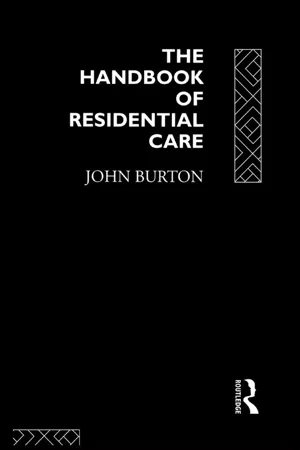
Designed as a practical guide, The Handbook of Residential Care presents a unique combination of real examples and case studies, analysis, guidance and reflective discussion. It brings together all areas of residential work and all levels of involvement in it, with an emphasis of direct personal work and everyday experiences. With checklists and action plans, the Handbook will promote effectiveness among residential workers - through self-management, building relationships, creating helpful organisation, and resisting bureaucratic and impersonal organisation. Invaluable to all practitioners, team leaders and managers in residential care, the Handbook provides a wealth of new ideas and many challenges to established policy and practice.
The five scenes from residential work described in this chapter are drawn from my own experience. I have chosen these particular events and situations because they cover a wide area and exemplify the complex and pressing demands that the work makes on us. They relate directly to all the subsequent chapters, in which the issues raised by the stories are discussed in detail.
I have ordered the stories, not chronologically, but in the same way as the book is structured, exploring first the feelings, thoughts and actions of individual workers engaged with assisting an individual resident. I then consider the building of relationships, the worker as part of a team, the resident as part of a group, questions of leadership and management, the way a whole establishment functions. The scenes broaden further to illustrate the wider political and organisational encompassments that so crucially affect residential care, ostensibly sustaining, but all too often hindering, the accomplishment of the primary task.
STRUGGLING TO CARE
Below I describe about twenty minutes of an evening’s work of two staff in a large, traditionally run, old people’s home. Inglewood, in the London Borough of Lambeth was reorganised over the five years since the time of this account to become a much more attractive and useful institution, with many different supportive functions, operating in smaller units, staffed by integrated teams of workers, and existing as part of a neighbourhood network of services for pensioners.
Viola and I went into room 13 where there were four beds. It was occupied by four old women who were all incontinent, two doubly. They were in their late eighties and nineties and all were what was known as ‘confused’, or, because of their multiple physical and mental frailties, they were often called ‘the babies’. The whole of this passage (the ‘babies’ passage’) on the ground floor smelled very strongly of urine. It had soaked into the floor coverings and the mattresses; the smell permeated the curtains, wallpaper and furniture. Sheets, blankets and clothing, although washed, were stained and had an unpleasant odour even after cleaning.
Mrs Pollard was sitting propped up in her bed. She had a strong growth of dark hair on her face and the slate-grey hair on her head lay straggly and dirty against the pillows. She had ceased to communicate with words; instead she grunted and when in obvious pain, but sometimes inexplicably, she let out a high-pitched shout or yelp. We were used to this sound from many residents as they got near to dying; nevertheless it was inhuman and frightening.
It was 7 p.m. Mrs Pollard needed changing, which had probably been done at about 2.30 p.m. before the early shift had gone off duty. We both knew what lay under the bedclothes. Mrs Pollard was wet and soiled. We needed to wash her, change her nightie, change all the sheets and possibly some blankets. But much worse than that, since she had been in bed for some weeks now, the deep and spreading sores on her body had deteriorated terribly.
She was a very heavy woman, sixteen stones, and difficult to move. She had large but superficial sore patches beneath her breasts. On her buttocks were two deep sores nearly exposing the bone (bone was visible here on another resident) and beneath the bandages on her feet, her heels were rotting sponges of stinking, dead flesh.
Under such an attack of deteriorating, poisoning sores and the respiratory infection which had confined her to bed, it was extraordinary that a very aged human being could survive. In such pain, with no visiting relatives or friends, with no diversion and nothing to look forward to, forced to exist in such utter degradation, what kept Mrs Pollard fighting to live?
As staff, I think, we all hoped she would die soon, for her sake and for ours, but she was holding on remarkably. A few of the staff loved Polly, as she had been affectionately nicknamed, and believed that they could tell her so by their actions, by sitting with her for a few seconds, holding her hand, giving her a drink from a feeding cup, stroking her face. Ellen, a domestic worker, was actually sitting with her when she eventually died.
But Mrs Pollard represented work that could never be done, a huge burden of disgust, resentment and guilt, a terrifying chasm of compassion that could not be filled and could not be crossed. Staff were left struggling with it, without help, respect or understanding, and equally undignified, reviled for being who they were in the job they had been given but could not do.
After more or less successfully washing Mrs Pollard from head to shin, changing the sheets and the pillow cases, putting cream on the sores under her breasts, trying to clean and dress the deep sores on her buttocks (we had no training or direction in how or what to use), Viola and I looked at each other.
The operation so far had taken us about twenty minutes. Viola was working fast and efficiently. I was her apprentice. She had led the way in washing, turning, the hard-learned techniques of taking off and putting on clothes, of changing bedding with someone in the bed, of removing heavily soiled sheets, of lifting a large, inert body. In between assisting in the room, I had run off searching for sheets, a nightdress, the cream, all in very short supply and from common stock. Viola carried a wash bag with her, provided by herself, without which there would not have been a flannel or soap, and which included talcum powder and a bottle of shampoo. The few residents who owned such personal items were the strong (in mind or body) who had managed to protect territory and possessions and had their own rooms, or those who had strong advocates in relatives or visiting friends. This was a small minority.
We had done everything except Mrs Pollard’s heels. Two days ago a district nurse had dressed them. We knew that they needed to be dressed now; the bandages were soaked with urine and the smell of putrefaction overrode the other smells in the room even through the bandages. Two washed bandages hung on the rail of the bedside locker. When we got the old ones off we would face damage for which we had no treatment. We would do our best to clean the heels but the flesh would come away as we did it. We had nothing to put on them apart from some gauze, if we could find it in the medical room, and the washed, cleanish bandages.
There were more than a hundred residents in the home, at least half of whom would have to be helped to bed, and given some of the attention we had given to Mrs Pollard. There were three others in this room alone and altogether there were four staff working on the late shift.
Wordlessly, shamefully, Viola and I decided to do no more. We repo-sitioned the metal cradle over Mrs Pollard’s feet to stop the weight of the bedding pressing down on her heels, and carefully pulled up the sheets and blankets, tucking them in neatly around her, and after touching her hand or patting her cheek, wished her goodnight before hurrying on to the next job. The night staff would change her and perhaps dress her heels later.
Mrs Pollard died about a week after this evening, poisoned by her sores.
COMPLICATED, EXHAUSTING WORK
This story is about work with children and teenagers (and one in particular) at Frogmore, a local authority Community Home for up to thirty residents.
It is summer 1974. There is a group of children and adults in Richmond Park in southwest London. I am there, the most senior and experienced of the grown-ups (but still relatively young and inexperienced); the children and teenagers, ranging from eight to fifteen, are scrambling around and playing a game which involves being, or sighting and chasing imaginary creatures like elves – bonkazoolas, I think we called them. The game has no rules or form; you don’t have to say you are playing and you can talk and walk along at the same time. This was a game that just sprang up that sunny evening, was played once or twice more in similar circumstances and faded away. Bonkazoolas were mostly friendly, interesting, shy and charming, but also very unpredictable because we never knew who was who -was I a bonkazoola or was I chasing a bonkazoola? – or whether there even were such creatures in the long grass, trees and undergrowth.
Throughout this game Lorna stayed close to me. She would jump on my back, have a piggy-back for a few yards, run off, hide, but most of the time she was having another conversation which wended its way in and out of the running and tumbling game. It was only possible to have this conversation at this stage because of the game.
She was telling me about her past. She had been born and brought up in Jamaica by her granny who had died, and then she had joined her mother on a huge and soulless old council estate in west London. There are very few children in this predicament now but in the 1960s and early 1970s this was a common situation and one I was used to (as a childcare worker). Many women of Lorna’s age now are bringing up their own Black British children. Although I was familiar with the situation and I had tried to imagine what it would be like, I could never get very close to a deep understanding of the effects of such a huge separation, loss and the shock of arriving in a White, racist society to a new mother.
This had all happened in the previous year for Lorna. She was thirteen. This precarious mother/daughter relationship fell apart very quickly under the pressure of school, friends, being out and about in this empty, unwholesome, urban environment. Her mother couldn’t control her; Lorna didn’t respond to the chastisement and her mother began to be frightened of her, convinced at one time that her daughter was trying to poison her.
The situation came to such a head that she came very willingly in to local authority care a few days before the evening I am describing. At that time all of the staff at Frogmore, the children’s home she first came to, were White, and probably slightly more than half the children were Black, mostly Afro-Caribbean, though that wasn’t a phrase in common usage.
The term Afro-Caribbean is now itself beginning to be dropped, as a much larger proportion of this population of the United Kingdom were born or have spent most of their lives in Britain. A Black (African) person with a Caribbean heritage may in a few years time be more likely to describe her or himself as African British (or English, Irish, Scots or Welsh), a British person of African descent, or an African person of British nationality and citizenship. However, such progress is a long struggle and will require a pride and appreciation from British people (particularly White) in living in a multiracial society. This issue has a strong influence on the effectiveness and quality of all residential care.
Officially, even in this comparatively progressive local authority, there was no substantial recognition that the needs of Black children in care were essentially any different from those of White children, nor was there any great concern that an all-White staff group was unsuitable to do a good job for Black children.
So there was Lorna establishing what can be seen as a therapeutic relationship with a White male worker and at the same time telling him in the most influential way that he had yet heard about the experience of loss, separation, rejection, cultural and racial disconnection and the severance of family ties − and many other things besides. And all this in the middle of a complicated and engaging game being played on and off by about a dozen people at one corner of Richmond Park.
The development of, what I call here, a therapeutic relationship is in many ways chancey and haphazard. There may be a fortunate context which just happens to be right, as on that particular evening. Mistakes are frequent but often become significant parts of the relationship; their destructive threat can be overcome, made constructive and integrated. The frightening but so productive content of transference and counter-transference (see Chapter 3) are used most often quite unwittingly. (Sometimes, if you knew what was happening, you would run a mile!) What parent/child link and communication was going on? Who was initiating it? Was there a sexual meaning to this horseplay? Was this closeness and touch legitimate? Was this girl—this man—safe?
There is no time to debate, even mentally question, your actions and attitudes. You think about them afterwards and if you are lucky in residential work, you have someone to talk to about them (through supervision, support, staff meetings and staff groupwork). But, working well, there are mechanisms of test and control and awareness, which are taking stock, guiding and keeping one tiny important element of your consciousness on the outside looking in. The mistakes are made when these mechanisms (part of you) cannot keep up or are confused by the multiplicity of events and emotions.
It was a beautiful, sunny evening and that rambling, tumbling group of children and adults were happy and unusually collected in their behaviour. (This was demonstrated by their capacity to enjoy and tolerate such a loose and anarchic game.) There was a rare lack of aggression and I was more relaxed than I often was in such situations. More usually I would be sharply aware of and anxious about the potential chaos in which many of the children we worked with found their most self-destructive, frightened but habitual behaviour.
To go back to the previous and very different evening: we are still with Lorna although this story involves many other people. The following is the exact diary account I wrote at the time; it is therefore not necessarily expressed precisely as I would like to write it now.
Before tea Allan and Django were caught on top of a lorry belonging to the packing yard which gives us wood. A tarpaulin has been torn and other damage done to crates. It is not certain whether or not Allan and Django actually caused this damage. I saw Allan first and took him to the office where I questioned him and ‘told him off.
Soon after tea as we were just going to cricket, I saw Allan outside the gates, called to him, but he ran off and although I gave chase he eluded me.
Cricket When we eventually turned up at the park, we started reasonably promptly but Terry was not picked on my side. He was now ‘in a mood’. This was made ten times worse when he was out first ball! for which he seemed to blame me although I had no hand in his dismissal. He then stalked around for a while before, towards the end of his side’s innings, picking up the ball and hiding it so that we could not continue with the game. We finally got the ball back from him only to be again frustrated by Fred’s getting it and holding up the game once more. I asked him to return it several times without results. 1 got angry with bred (mistake), grabbed him and took the ball. Fred said I’d hurt him and ‘made him angry now’ and began to head for home. I went after him and said he couldn’t go, but would have to field or sit and watch. (His side was now fielding.) I held on to him and he struggled and shouted and threatened until it was my turn to bat and I had to leave him in order not to completely wreck the game. He went back to Frogmore. (See Mike’s notes about the evening.)
11- and 12-year-olds’ meeting We started this as soon as we returned from the cricket in order not to lose the conversation which was already taking place, i.e. whether I was right or wrong to physically hold Fred. There was a strong feeling that I was bullying and unfair, that I had no right to ‘order’ children around – Ύou can’t tell us what to do.’ We went on about staff, violence, and violence between children for a long time. Terry was still furious and resentful to me even at the end of the meeting. Karl made some penetrating and mature comments. Geoff was his usual benign, foggy self.
Pauline and Lorna persistently interrupted the meeting for about twenty minutes.
13-, 14- and 15-year-olds’ meeting At first it seemed that no-one would come to the meeting. Dan, Chrissie and Kate turned up. Then Desmond and Shirley came in and just hung on. We began falteringly but quite amicably. We had coffee.
Pauline and Lorna stormed in, all wet from paddling in puddles and raving in the rain. They were full of ‘going to a club’ earlier on; they weren’ t coming to the meeting. Pauline was changing her mind all the time; she’d never asked for a meeting etc. But they stayed. Both in a very high mood. Shouting, anti Chrissie and Kate. Eventually we got onto childhood – first memories. This became quite fruitful and Lorna pretended she was a baby, and much to everyone’s amusement and intense interest, cried and kicked on the floor. Most of the children were a little apprehensive of the idea of searching back to their childhoods and were reticent, perhaps using Lorna’s outrageous and forthright exhibition as a substitute for their own memories. It provoked great outbursts of laughter.
Julie’s visit (Steve’s mother) Towards the end of the adolescents’ meeting, Pauline had gone out and returned with the news that there was a mad, drunk woman outside. Lorna was out of the door in a flash followed by some others. Reluctant to leave the meeting on any pretext, but sensing some serious situation, I followed them and left Pete [staff] to finish off the meeting. On the front lawn stood a swaying, bellowing, blaspheming woman with a crowd of children from the flats leaning over the wall jeering and goading her. Immediately she saw me she came at me and grabbed me by the arms, and started to shout threats at me. I soothed her and told her I would protect her, and she was safe (great stuff!), and she gradually quietened. Anne ([resident] brought a cigarette for her and she began to move where I was pushing her gently away from the children at the wall. All this time Lorna was darting in and out very like a little dog, yelping hysterically, and the children at the wall were hurling abuse and shouting out ‘Steve hanged himself!’ (which he apparently tried to do). Julie (the woman, who lives in the next block of flats) wanted to telephone Steve, her son, so I took her first to the front house and tried to make the call for her but could not get the 2p in! (Steve is at the moment in a Classifying School which Julie refers to kindly as a ‘mental home’.) My original aim had been to try to just get her home but the children outside wouldn’t move away and I couldn’t get her through them.
Befor...
Table of contents
Cover Page
Title Page
Copyright Page
Figures
Examples
Checklists
Preface
Acknowledgements
Introduction
Chapter 1: Scenes from residential work
Chapter 2: Understanding and managing: Making a start
Chapter 3: Giving and receiving
Chapter 4: Leading and influencing: Creating and using vision
Chapter 5: Creating helpful organisation
Chapter 6: Resisting hindering organisation
Chapter 7: Outside assistance
Chapter 8: A good place to live?
Chapter 9: Liberating institutions: A future for residential care
Appendix 1: The learning basket
Appendix 2: Change
Appendix 3: Models,images and cultures of organisations, establishments,units, homes and teams
Bibliography
Trusted by 375,005 students
Access to over 1.5 million titles for a fair monthly price.
Study more efficiently using our study tools.
Frequently asked questions
Yes, you can cancel anytime from the Subscription tab in your account settings on the Perlego website. Your subscription will stay active until the end of your current billing period. Learn how to cancel your subscription
No, books cannot be downloaded as external files, such as PDFs, for use outside of Perlego. However, you can download books within the Perlego app for offline reading on mobile or tablet. Learn how to download books offline
Perlego offers two plans: Essential and Complete
Essential is ideal for learners and professionals who enjoy exploring a wide range of subjects. Access the Essential Library with 800,000+ trusted titles and best-sellers across business, personal growth, and the humanities. Includes unlimited reading time and Standard Read Aloud voice.
Complete: Perfect for advanced learners and researchers needing full, unrestricted access. Unlock 1.5M+ books across hundreds of subjects, including academic and specialized titles. The Complete Plan also includes advanced features like Premium Read Aloud and Research Assistant.
Both plans are available with monthly, semester, or annual billing cycles.
We are an online textbook subscription service, where you can get access to an entire online library for less than the price of a single book per month. With over 1.5 million books across 990+ topics, we’ve got you covered! Learn about our mission
Look out for the read-aloud symbol on your next book to see if you can listen to it. The read-aloud tool reads text aloud for you, highlighting the text as it is being read. You can pause it, speed it up and slow it down. Learn more about Read Aloud
Yes! You can use the Perlego app on both iOS and Android devices to read anytime, anywhere — even offline. Perfect for commutes or when you’re on the go. Please note we cannot support devices running on iOS 13 and Android 7 or earlier. Learn more about using the app
Yes, you can access The Handbook of Residential Care by John Burton in PDF and/or ePUB format, as well as other popular books in Social Sciences & Organisational Development. We have over 1.5 million books available in our catalogue for you to explore.