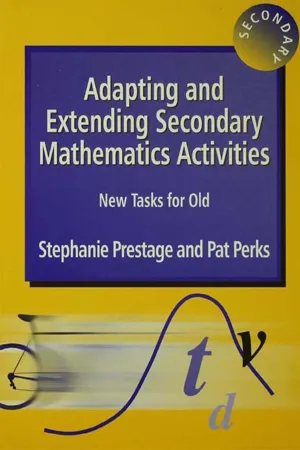
eBook - ePub
Adapting and Extending Secondary Mathematics Activities
New Tasks FOr Old
- 160 pages
- English
- ePUB (mobile friendly)
- Available on iOS & Android
eBook - ePub
Adapting and Extending Secondary Mathematics Activities
New Tasks FOr Old
About this book
This book is designed to assist teachers to get the most out of the textbooks or mathematics schemes used in their schools, providing methods of extending the activities offered to learners.
Information
CHAPTER 1
Putting mathematics at the heart
Where we introduce why we work in this way
Why this book?
As we work in classrooms or with our students we often design different tasks, or help others to do so. We have much experience of designing tasks and we are often asked where we get our ideas from. Well, like everyone else, we borrow them from others. We then adapt them to the needs of our pupils. Our sources are other teachers, textbooks, journals like Mathematics in School, Mathematics Teaching and Micromaths and plenty of discussion! Only by talking about mathematics do we refine our ideas. By trying to make our ways of working explicit to our students we have begun to realise that ideas for adapting do not ‘just happen’ but are based on various strategies. This book explains the techniques we use for creating different tasks for use in the mathematics classroom.
Why do we need different tasks? You will be familiar with the reasons.
- Learners learn in different ways: some need to work from simple to hard cases; some need a challenge before they want to look at simpler ideas; some need more practice than others; some need pictures; and some like the abstract. We cannot cater for this by only working in one way.
- Different environments call for different tasks. For example, you will be aware of the dangers of using scissors with a rowdy Year 7 on a wet Friday afternoon; you cannot move around in a classroom designed for 20 if you have 35 pupils in the group; and just before examinations your focus is bound to be on practice.
- Children work at different rates. The fast ones deserve something more mathematically satisfying than racing ahead in the book or more practice of the same. Children who are mathematically able ought to expand their thinking more widely.
- Some children need more challenging work. Giving a pupil 20 more questions is no reward for getting the first 50 correct.
- Topics need revisiting. We need to find ways of practising familiar ideas in the context of current work.
- ‘Variety is the spice of life.’
Textbooks are one of the major resources in mathematics classrooms. They tend, however, to offer one style of working: step-by-step, working from simpler tasks to harder tasks. The books are usually organised to keep much of the content separate, with the idea that this will make the learning and the accounting for delivering the curriculum easier. Most questions, or parts of questions, have only one answer. Contexts are provided, and the formats of the questions often seem very different as you work through an exercise. However, the questions have been well thought through. The ideas are based on the type of work on which your pupils will be assessed. There will be many diagrams and contexts, pictures and facts that you can use to interest your pupils. Textbooks contain lots of practice in a particular style. All of this is very useful, but if we believe that learners need different experiences, textbooks need to be supplemented.
Some pupils find the examples in textbooks far too easy and become bored. Extending activities to include generalisation and proof may provide just the challenge needed to keep their enthusiasm for mathematics. Some pupils do not understand the questions in the book. If they work on the mathematics using an adapted task they can often approach the questions on a later occasion with a greater confidence and competence. For example, the fishing competition task in Chapter 3 was devised as a result of pupils having difficulty understanding the questions on decimals in their textbook; they knew neither what to do nor how to do it. The time spent playing the game in a lesson resulted in most of the children tackling a homework sheet with success and remembering their work on decimals with enthusiasm.
By creating different tasks we can begin to work on the ideas outlined earlier. We design tasks which match our beliefs about what should go on in mathematics classrooms.
- We want the mathematics in any task to be explicit. Our pupils are learning mathematics; they need to know what it is.
- Separating different aspects of the curriculum can cause confusion for some pupils. Pupils can often confuse perimeter and area of rectangles unless we work, at some point, on these two attributes together and look at the relationship between them or lack of one. Is it true that area and perimeter are connected for regular polygons? How able a mathematician do you need to be to work on such questions?
- By connecting the curriculum, the number of topics we have to teach becomes less daunting.
- If we practise some content in the context of other content, we are keeping the ideas fresh in pupils' minds and giving ourselves more time.
- Practice needs to be purposeful. There needs to be a reason for doing the mathematics that is not just about getting the right answer.
- When each question has only one right answer, the emotional investment in that answer is huge. If questions have more than one answer the emotional commitment lessens, but the opportunity for helping pupils increases, without killing the question. How many times have you found yourself solving a problem for a pupil? It is fascinating to watch how pupils manipulate our students into doing their work for them.
- One of our responsibilities is to ensure that our pupils get the best examination results they can. We believe that the best way to do this is to challenge pupils to answer questions which go wider than the ones they will meet in such examinations.
- To get better (and more) mathematicians, we do not need to race through the curriculum, but should offer our pupils challenging tasks based on the content everyone is doing.
- The first attainment target (Ma1), ‘Using and Applying Mathematics’, should be integrated into the mathematics curriculum as much as possible. It is not an add on: it describes a way of working mathematically.
The new National Curriculum (Department for Education and Employment (DfEE) 1999) has been written so that the integration of Mai with the other attainment targets is explicit in the programmes of study. One of the ways of increasing coverage of Mai in lessons is to expect pupils to make choices, so that decision-making becomes one of the skills worked on in mathematics lessons. This also links with purpose. If a pupil is asked to find the value of 2a + b when a = 3 and b = −1, the pupil has no choices to make. If the question is given a purpose, and becomes ‘When is 2a + b smaller than a − b?’, the practice of substitution is subsumed into the finding of the relationship; pupils have to choose the numbers to substitute and there is plenty of practice because there are many answers. There is also differentiation because some pupils will solve an equation and offer a justification for the results (probably because they do not need to practice substitution).
The desire to offer all pupils a rich mathematical experience and to enhance their learning and enjoyment of the subject is at the heart of the way in which we work. If we offer appropriate challenges the brightest can be encouraged to develop their mathematics more widely and we can help the low achiever to learn better – and we can enjoy mathematics. As teachers we need to use all the sources available to us to help improve our pupils' learning.
The purpose of this book
This book is intended to accompany all your current sources, your scheme and your textbooks and worksheets. The techniques are intended to offer you another way of looking at any of these materials to create more diversity of tasks. The other major resource in schools, other than textbooks and worksheets, is the computer. Technology has become a major player in the field of mathematics. We need to question its role and the implications of the subject and not forget the humbler incarnations of Information and Communications Technology (ICT): calculators. Using existing ideas and adapting them to suit particular needs can provide a multitude of new problems. Adapting your own tasks creates a versatility in the teacher which can make you more responsive to the needs of the classroom.
In Chapter 2 we introduce you to ways we begin to think more carefully about the mathematics in tasks, and Chapter 3 offers initial examples of taking tasks and adapting them in ways that are explored in more detail in later chapters. The first structured technique we offer is in Chapter 4. We change tasks by adding or removing parts of the task, changing the givens or constraints. Changing resources can be a major way of adapting tasks, whether the resources are varied (Chapter 6) or focus around technology (Chapter 7), or depending on what the learner brings to the task (Chapters 8 and 9). Chapter 10 looks more explicitly at linking the syllabus together and Chapter 11 uses these ideas together with the length of time given to a task to define the many aspects the teacher has to choose when planning for pupils' learning.
We hope you find the techniques useful. Remember, we want our pupils to learn mathematics, so put mathematics at the heart of any task.
CHAPTER 2
A splurge of ideas
In which we offer ways to connect subject knowledge across the mathematics curriculum and meet existing techniques for opening up questions
This chapter is in two sections. The first section looks at two existing approaches which we have found useful for changing and adapting questions. We thought that you should know where our ideas are rooted. The second section considers a technique that we use throughout the book to capture ideas at any particular time. We will create diagrams that we call ‘splurge’ diagrams (hence ‘a splurge of ideas’), although elsewhere in the literature they are referred to as brainstorming, topic webs or concept maps. When analysing the mathematics within a particular topic, much of our knowledge comes from years of experience with different texts, questions and discussions. Trying to access this knowledge can be rather hit and miss, so a splurge of ideas related to the topic can be useful: we use whatever emerges on the day. The lack of linearity is crucial (there is no right route) and encourages the jotting down of any ideas which might indicate the breadth of choices within a topic. Later in this chapter we will ‘splurge’ ideas about resources, mathematical content and mathematical processes. Every time we draw such a diagram it may have different connections and different words, often with new links in whatever area of the curriculum we are working in. We are sure many of the ideas will be familiar to you, but we hope you enjoy our interpretation.
Technique 1: ‘What-if-not’
One of the most interesting techniques for analysing alternative approaches to finding new questions, as well as analysing the mathematics, is that described by Stephen Brown and Marion Walter in their articles in Mathematics Teaching and their book The Art of Problem Posing (Brown and Walter 1990). With apologies to them we will attempt to give you a brief flavour of the technique, but we recommend that you go and read the book itself.
Take a familiar question:
Complete the sequence 4, 9, 14, 19, 24, _, _.
Most of us know how to respond. The answer is 29 and 34. The question is routine, but we are about to play with this question to give some alternatives.
The first thing that Brown and Walter suggest is that you list all the attributes of the question (we sometimes use the word ‘givens’):
- the first five numbers in the sequence are given;
- we need to find two more;
- we need to find the sixth and the seventh numbers;
- the first number is 4;
- the second is 9;
- the first two numbers are square;
- the fourth number is prime;
- the pattern in the units digits goes 4, 9, 4, 9, …;
- the numbers are even, odd, even, odd, even, …;
- each number is a multiple of 5, subtract 1;
- each number is a multiple of 5, add 4;
- and so on.
Who would have thought there was so much to say? The first time we tried this our list was much shorter, but like many things finding the attributes in a question gets easier with practice.
Secondly (say Brown and Walter), take one of the attributes from the list and ask the question ‘What if it is not … [the attribute], but ...
Table of contents
- Cover
- Full Title
- Copyright
- Contents
- Dedication
- Introduction
- 1 Putting mathematics at the heart
- 2 A splurge of ideas
- 3 New questions for old
- 4 Removing and adding constraints
- 5 The consequences of changing a task
- 6 Changing resources
- 7 Changing resources: using technology
- 8 Changing resources: the learner
- 9 Context, reality and ambiguity
- 10 Connecting the syllabus
- 11 And so to choose
- References
- Index
Trusted by 375,005 students
Access to over 1.5 million titles for a fair monthly price.
Study more efficiently using our study tools.
Frequently asked questions
Yes, you can cancel anytime from the Subscription tab in your account settings on the Perlego website. Your subscription will stay active until the end of your current billing period. Learn how to cancel your subscription
No, books cannot be downloaded as external files, such as PDFs, for use outside of Perlego. However, you can download books within the Perlego app for offline reading on mobile or tablet. Learn how to download books offline
Perlego offers two plans: Essential and Complete
- Essential is ideal for learners and professionals who enjoy exploring a wide range of subjects. Access the Essential Library with 800,000+ trusted titles and best-sellers across business, personal growth, and the humanities. Includes unlimited reading time and Standard Read Aloud voice.
- Complete: Perfect for advanced learners and researchers needing full, unrestricted access. Unlock 1.5M+ books across hundreds of subjects, including academic and specialized titles. The Complete Plan also includes advanced features like Premium Read Aloud and Research Assistant.
We are an online textbook subscription service, where you can get access to an entire online library for less than the price of a single book per month. With over 1.5 million books across 990+ topics, we’ve got you covered! Learn about our mission
Look out for the read-aloud symbol on your next book to see if you can listen to it. The read-aloud tool reads text aloud for you, highlighting the text as it is being read. You can pause it, speed it up and slow it down. Learn more about Read Aloud
Yes! You can use the Perlego app on both iOS and Android devices to read anytime, anywhere — even offline. Perfect for commutes or when you’re on the go.
Please note we cannot support devices running on iOS 13 and Android 7 or earlier. Learn more about using the app
Please note we cannot support devices running on iOS 13 and Android 7 or earlier. Learn more about using the app
Yes, you can access Adapting and Extending Secondary Mathematics Activities by Stephanie Prestage,Pat Perks in PDF and/or ePUB format, as well as other popular books in Education & Education General. We have over 1.5 million books available in our catalogue for you to explore.