- 504 pages
- English
- ePUB (mobile friendly)
- Available on iOS & Android
eBook - ePub
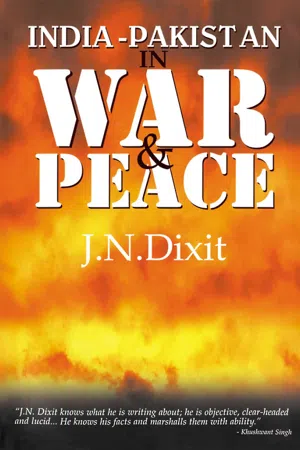
India-Pakistan in War and Peace
About this book
As the Kashmir dispute brings India and Pakistan ominously close to nuclear war this book provides a compelling account of the history and politics of these two great South Asian rivals. Like the Israel-Palestine struggle, the Indian-Pakistan rivalry is a legacy of history. The two countries went to war within months of becoming independent and, over the following half-century, they have fought three other wars and clashed at the United Nations and every other global forum. It is a complex conflict, over religion and territory with two diametrically opposed views of nationhood and national imagination. J.N. Dixit, former Foreign Secretary of India, and one of the world's leading authorities on the region, has written a balanced and very readable account of the most tempestuous and potentially dangerous flashpoint in international politics.
Information
Annexures
Annexure 1
Pakistan—Birth and Objectives
Pakistan grew out of the two-nation theory of the Muslim, which for the last twenty years or more has been synonymous with its permanent president, the late Mohammed Ali Jinnah, called by the Muslims Qaid-i-Azam or the Supreme. Leader. The career of Qaid-i-Azam Jinnah indicates a curious and ironic development from being ‘the apostle of Hindu-Muslim Unity’, as he was called by admiring Congressmen, to being the chief exponent, advocate and creator of Pakistan—a state based upon the thesis that the Muslims of India are a separate nation, and as such need a homeland and state for themselves, separate from Hindu-land. Pakistan is now a predominantly Muslim state, so predominantly Muslim in its population that its western and more important portion has in the course of a few months of its establishment, been almost completely rid of its Hindu, Sikh and to a great extent of its Christian and untouchable populations. By what processes this development has been brought about is what this booklet is designed to relate. The present overlords of Pakistan have declared frequently that Pakistan is in character a Muslim State—the largest Muslim State in the world. This description of its character, when placed side by side with the declared character of India as a secular state, has unnerved the Hindu population of faraway East Bengal, let alone in Pakistan where Hindus in appreciable numbers are found. Since last October a deliberate policy on the part of the Muslim majority in East Bengal, with the connivance of the East Bengal Muslim League Government, forced the Hindus out of that province. This exodus of Hindus became such a vast movement of emigration, that in October 1948 official estimates put the number of Hindu immigrants from Eastern Pakistan into India at 15 lakhs. More and more were following over the border into Assam and West Bengal everyday, and the refugee problem for the Indian Government already preoccupied with the rehabilitation of about a crore of people from Western Pakistan and Kashmir, began to assume a desperate look. That is what made Sardar Patel declare that if the Pakistan Government did not take effective steps to stop the exodus of Hindus from East Bengal the India Government would claim proportionate territory from East Bengal for the resettlement of the Hindu immigrants. This exodus is only an illustration of the fact that the driving out of minorities and non-Muslim population is something inherent in the very nature, conception and scope of the kind of state which the Muslims have achieved through the good offices of the British in the shape of Pakistan. No amount of reasonableness and accommodation, no attempts at friendship and understanding on the part of India could avert what occurred in West Punjab, in the North Western Frontier Province, in Sindh, in Bahawalpur, in raider-occupied Kashmir and is at present occurring in East Bengal. The thing is inevitable and inherent in the nature of the State of Pakistan and the entire attitude and mentality of which this State is the result. It is a significant fact that while in India, the Government discourages communal groups and parties, in Pakistan no group or parties other than communal are encouraged. A Pakistan Peoples’ Congress is inconceivable. When the Hindu leaders of Sindh planned the establishment of a political party which might draw its membership from people belonging to various communities the reply of the Pakistan Government was characteristic. The Hindus of Sindh, (such of them as are still there) might have a Hindu Party, but not one which Muslims also might join. In the Muslim State of Pakistan, no Muslim may join any organisation other than a purely Muslim one. It is such an attitude which bred the riots of 1946 and 1947-Calcutta, Noakhali, NWFP, the Punjab, Sindh and Bahawalpur.
The very name of the State which the Muslim League envisaged— and achieved—is, in the context in which it was adopted, a standing insult to other non-Muslims living in India. This name, Pakistan, means literally “the Land of the Pure” or of Purity. This implies clearly that Hindus and all that belongs to them credally and materially is impure, defiled and unholy. In a communally-charged atmosphere to have broadcast such an offensive name and concept among the Muslims was to extend an open invitation to racial and communal arrogance, contempt of others, challenges and counter-challenges.
The origin of the Pakistan idea is briefly this:
Dr Mohammad Iqbal in his presidential address at the Annual Muslim League Session held at Allhabhad in 1930, advocated the establishment of a separate Muslim State or Federation in India on the basis of the Muslim’s separate political identity, in these words: “The Muslim demand for the creation of Muslim India within India is, therefore, perfectly justified…. I would like to see the Punjab, North West Frontier Province, Sindh and Baluchistan amalgamated into a single state. Self-Government within the British Empire, or without the British Empire, the formation of a consolidated North-West Indian Muslim State appears to me to be the final destiny of the Muslims at least of North-West India.
This was the first hint thrown into the atmosphere of Indian politics of a separate Muslim State or Federation. But the thing at this stage was a vague aspiration, the desire towards a separate state was formed in anybody’s mind as a concrete programme—symptomatic nevertheless of a dangerous way of thinking and an explosive kind of mentality.
Dr Mohammad Iqbal’s thesis did not immediately find much support with the Indian Muslims. At the Round Table Conference which was held in London soon after, the Muslim delegates talked in terms only of safeguards and the proportions of seats the Muslims might get in the various legislatures of India in addition to pleas for the creation of a new Muslim-majority province, namely Sindh. The official policy of the Muslim League in these years continued to be very much the same— any thought of setting up a separate state being regarded as the vision of an idealist, a poet, but in no way practical politics.
But Dr Mohammad Iqbal was by no means the only Muslim who thought in terms of a separate Muslim State in India. In January 1933 there appeared, on behalf of certain Indian Muslim students at Cambridge, headed by Chaudhari Rehmat Ali, a pamphlet entitled Now or Never, This pamphlet advocated a complete breakaway of the Muslims of North-Western zones of India from the rest of the Indian nation. “India,” it said, “is not the name of single country, nor the home of one single nation. It is in fact, the, the designation of a state created for the first time in history by the British.” The Muslims are shown in this pamphlet to be altogether separate in their way of life from the other people of India, and hence the unmistakable conclusion is suggested that they must have a separate state of their own. Says the pamphlet, “We do not inter-dine, we do not intermarry. Our national customs and calendars, even our diet and dress, are different. Hence the Muslims demand the recognition of a separate national status.”
It is necessary here to point out that the essence of this last argument given above has been repeated ever since 1940 by all Muslim Leaguers, down from Mr Jinnah. Differences and cleavages have been emphasised and the doctrine of hate and animosity has been preached. Muslim separatism has been bolstered up; all attempts made in the past—both remote and recent—by far-sighted Hindus and Muslims, kings, poets, founders of faiths and others, have been sought to be written off. This exaggerated account of the cleavage between the Muslims and the Hindu (and Sikh) way of life led, when factors favourable to such a consummation had developed fully, to the orgy of rioting in Bengal, the NWFP, the Punjab and Sindh. As a matter of fact, it would have been a surprising thing if after the gospel of hate which the Muslim League had been preaching to the Indian Muslims for so many years, these riots and their accompanying horrors and devastation had not occurred.
The word “Pakistan”, which so powerfully caught the imagination of the Muslims of India, and which pinned the vague, floating idealism of savants like Dr Mohammad Iqbal to a concrete objective and programme, is a coinage of Chaudhari Rehmat Ali, who has been mentioned above. He has been hailed among the Muslims as the founder of the Pakistan National Movement. The coinage is said to have been formed from the initial letters of the names of the Provinces designed to compose the original Pakistan. These provinces were: Punjab, Afghania (NW Frontier Province), Kashmir and Baluchistan (which contributed the end letters to the name). Apart from this genesis of the name, which perhaps was an afterthought, the name is a Persian compound formation, and an offensive challenge to the non-Muslims. Pakistan means the Land of the Pure, in this case the Muslims.
Pakistan, as has been told above, was originally conceived to comprise only the northwestern areas of the Punjab, Sindh, Kashmir, the N.W.Frontier Province and Baluchistan. But in a later concept of the thing, issued in the form of a revised version of the original scheme, it was devised to comprise, besides the areas originally earmarked for it, also Assam and Bengal in the east, and Hyderabad and Malabar in the south. In addition to these extensive strongholds of Muslim power in the north west, east and south beleaguering non-Muslim India from all strategic points, there were also to be several smaller though by no means small, Muslim pockets, studded all over the country—one in the United Provinces, one in the heart of Rajputana and another still in Bihar. Thus, the Muslims of all India, and not only those of the Muslim majority areas, were to have independent countries of their own, parcelling out India into so many new Muslim-dominated States.
This process in its conception carried with itself certain very far-reaching, and in the light of the communal developments of 1946 and 1947, very significant and pregnant corollaries. Rehmat Ali, whatever else he might be, has been quite fertile in the...
Table of contents
- Cover Page
- Title Page
- Copyright Page
- Introduction
- One: IC-814 to Kandahar
- Two: Implications of the Kargil War
- Three: Tunnel Visionaries
- Four: Wellsprings of Antagonism
- Five: From Democracy to Dictatorship and War
- Six: The Break-up of Pakistan: Mujibnagar to Simla—The Advent of Zia-ul-Haq
- Seven: Coup to Coup: Pakistan, 1972–1999
- Eight: Kashmir: The Intractable Bone of Contention
- Nine: India and Pakistan—Nuclear Weapons States
- Ten: Retrospect and Prospects
- Eleven: The Agra Summit and After
- Twelve: Uncertainties or Opportunities
- Annexures
Trusted by 375,005 students
Access to over 1.5 million titles for a fair monthly price.
Study more efficiently using our study tools.
Frequently asked questions
Yes, you can cancel anytime from the Subscription tab in your account settings on the Perlego website. Your subscription will stay active until the end of your current billing period. Learn how to cancel your subscription
No, books cannot be downloaded as external files, such as PDFs, for use outside of Perlego. However, you can download books within the Perlego app for offline reading on mobile or tablet. Learn how to download books offline
Perlego offers two plans: Essential and Complete
- Essential is ideal for learners and professionals who enjoy exploring a wide range of subjects. Access the Essential Library with 800,000+ trusted titles and best-sellers across business, personal growth, and the humanities. Includes unlimited reading time and Standard Read Aloud voice.
- Complete: Perfect for advanced learners and researchers needing full, unrestricted access. Unlock 1.5M+ books across hundreds of subjects, including academic and specialized titles. The Complete Plan also includes advanced features like Premium Read Aloud and Research Assistant.
We are an online textbook subscription service, where you can get access to an entire online library for less than the price of a single book per month. With over 1.5 million books across 990+ topics, we’ve got you covered! Learn about our mission
Look out for the read-aloud symbol on your next book to see if you can listen to it. The read-aloud tool reads text aloud for you, highlighting the text as it is being read. You can pause it, speed it up and slow it down. Learn more about Read Aloud
Yes! You can use the Perlego app on both iOS and Android devices to read anytime, anywhere — even offline. Perfect for commutes or when you’re on the go.
Please note we cannot support devices running on iOS 13 and Android 7 or earlier. Learn more about using the app
Please note we cannot support devices running on iOS 13 and Android 7 or earlier. Learn more about using the app
Yes, you can access India-Pakistan in War and Peace by J. N. Dixit in PDF and/or ePUB format, as well as other popular books in Politics & International Relations & Asian Politics. We have over 1.5 million books available in our catalogue for you to explore.