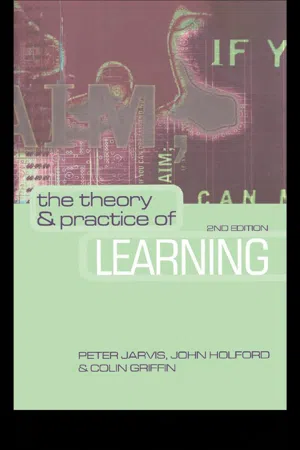
Learning is among the most basic of human activities. The study of learning, and research into learning is becoming a central part of educational studies. This is a comprehensive introduction to contemporary theories and modern practices of learning. Updated and expanded, this second edition should be of interest to teachers, facilitators, human resource developers and students of education. The contents cover: lifelong learning; the social background to learning; cognitivist theory; types of learning; learning using ICT; and philosophical reflections on learning.
eBook - ePub
The Theory and Practice of Learning
- 212 pages
- English
- ePUB (mobile friendly)
- Available on iOS & Android
eBook - ePub
The Theory and Practice of Learning
About this book
Information
Chapter 1
The emergence of lifelong learning
Like every other social institution, education has undergone many changes over the past few years: globalization, the emergence of the knowledge economy and lifelong learning have been among them. Significantly, people often now talk about lifelong learning rather than lifelong education, or continuing education, and so on. Understanding these changes and some of the forces that have generated them is important to everyone involved in education and human resource development. So in this first chapter we show what changes have occurred, while Chapter 2 provides an introductory analysis illustrating what forces in society have produced them.
We shall discuss 13 shifts in emphasis that have occurred in education in the past few years, all of which will be familiar to most providers of learning opportunities. These are not, of course, all the changes which have occurred, and readers may well be able to list others. As we progress through this chapter, we shall also see that there is considerable overlap between them. Each of these 13 listed below takes the form of continuum along which the change has taken place, so that it does not mean that those on the left-hand side of the continuum have ceased to exist, merely that education has spread along each of them with the new developments being placed on the right-hand side. They are listed below in the order that they are going to be discussed, and readers will recognize that while there is a certain logic in this order it does not indicate any causal connotations. The changes are from:
- childhood to adult to lifelong;
- the few to the many;
- education and training to learning;
- learning as a process to learning as an institutional phenomenon;
- teacher-centred to student-centred;
- liberal to vocational and human resource development;
- theoretical to practical;
- single discipline knowledge to multidisciplinary knowledge to integrated knowledge;
- knowledge as truth to knowledge as relative/information/ narrative/ discourse;
- rote learning to reflective learning;
- welfare provision (needs) to market demand (wants);
- classical curriculum to romantic curriculum to programme;
- face-to-face to distance to e-learning.
Few of these will come as a surprise to experienced educators, who will be familiar with all of them. Even so, we will discuss each briefly in the remainder of this chapter, which lays the foundations for the remainder of this book.
From childhood to adult to lifelong
In a strange way education has never really been exclusively a childhood phenomenon, although it has been much more widely recognized in this form. In the United Kingdom, compulsory schooling really only began in 1870 and yet the history of adult education stretches back long before this period (Kelly, 1970). Nevertheless, after 1870, school education grew by virtue of its compulsory nature and education came to be seen by many people as preparing children for adulthood. The history of adult education in the United States reveals many similarities, as Kett (1994) has shown.
Even so, during the 20th century considerable efforts were made in Britain to emphasize the place of adult education (see, for example, the 1919 Ministry of Reconstruction Report). By the 1960s, adult education had become accepted in the United Kingdom, and in that decade there was considerable expansion. The 1944 Education Act had placed various responsibilities on local Education Authorities to ensure the provision of further education within their areas.
Yeaxlee wrote about lifelong education as early as 1929, even though adult education was not then really firmly established in the United Kingdom. But only after the Second World War did signs of adult education’s demise as a form of provision appear on the horizon, when UNESCO adopted the idea of lifelong education (Lengrand, 1975).
However, there was not a simple transition from adult education to lifelong education in the United Kingdom. Two other concepts intervened. In the 1960s an idea became popular that people should have an educational entitlement after they left school—this gained ground as recurrent education. Adding to the confusion, the Organization for Economic Cooperation and Development (OECD) subtitled some of its publications in this period (OECD, 1973) as recurrent education—a strategy for lifelong education. The other term that gained popularity was continuing education, that is, education which continued after schooling. This concept carried no implications of educational entitlements and, not surprisingly, it gained ground in the United Kingdom in the 1980s. Continuing education has no end point and so the transition to lifelong education was a simple move which happened in the late 1980s and early 1990s. With the ageing of society, we are now beginning to see an increase in education for the elderly, through the growth of Universities of the Third Age, Institutions for Learning in Retirement, Elderhostel and other such organizations. By the middle 1990s, it was generally accepted that education is a lifelong process and the European Commission started publishing policy documents arguing about the need to have lifelong learning throughout the Community (European Commission, 1995).
From the few to the many
Unlike the American system of mass education, the British system of education has traditionally been rather elitist, training the few to assume responsible positions in government, the professions and the Church. Hence, the school curriculum was narrow and selective. A great proportion of children were condemned to non-white-collar occupations early in their educational careers. Comprehensive reforms tried to overcome this, but they have not succeeded.
By the 1980s, there was still only a small percentage of young people going on to higher education, which was regarded as a waste of the remainder’s potential and insufficient to fill all the knowledge-based jobs in society. Reich (1991), for instance, suggested that about 30 per cent of the United States’ workforce would be working in knowledge-based industries by the end of the 20th century. Consequently, the education reforms of the late 1980s and early 1990s in the United Kingdom expanded higher education in the 1990s to a mass system, with the hope that 50 per cent of young people would eventually be able to attend higher education. In Korea, this figure is already 70 per cent. Significantly, however, Livingstone (1999) suggests that there is considerable underemployment in North America which politicians are not taking into account.
From learning as process to learning as an institutional phenomenon
The process of learning has generally been understood to be the process through which individuals go in acquiring their knowledge, skills, attitudes, values, beliefs, emotions and senses. Either learning has been regarded as the process of transforming these experiences into human attributes, or—as behaviourists have suggested—learning is seen as the behaviour exhibited as a result of the learning. Both ideas still prevail.
However, more recently, there has been another change in emphasis. Learning has acquired a social institutional meaning in terms such as the learning society, the learning organization and even in lifelong learning itself. This has resulted in considerable confusion since the human process tends to get subsumed into the institutional phenomenon. It is becoming increasingly difficult, for instance, to distinguish between lifelong learning as a human process of learning throughout the whole of an individual’s life and lifelong learning as a governmental strategy achievable mainly through institutional processes.
From education and training to learning
It will be seen throughout this chapter that there has been a gradual move away from the traditional views of education as the means through which the older generation passes on to the next generation the knowledge which it regards as worthwhile and valuable. That previous function of education has not disappeared in initial education, although education has become more geared to labour market needs.
Traditionally, however, educationalists (Peters, 1967 inter alia) argued that education is fundamentally cognitive whilst training is skills based. Such arguments, which were convincing to many at the time, failed to recognize the integrated nature of knowledge and action. Now, perhaps, the pendulum has swung a little too much away from the cognitive. Even so, as it became necessary to combine these phenomena, a new term had to be discovered—and this became learning. This has, however, produced an ambiguous position since learning has traditionally been viewed as an individual process and education and training were both institutional ones. Consequently, we now see a separation being made between formal, non-formal and informal situations within which learning occurs, as later chapters in this book will show.
We have also seen different providers emerging which can provide learning materials for potential learners in the market. Education, therefore, is now but one provider among many potential sources of learning material. No longer does it have unique functions highly regarded by society. Now the focus is upon learning—and providers of learning materials no longer have to be educators, or even know about ways of facilitating learning effectively.
From teacher-centred to student-centred education
In the 1960s some of the more progressive ideas of the American philosopher, John Dewey (1916, 1938), were incorporated in school education. Amongst these was his concentration on the child and the way that the child developed. During this period, work by cognitive psychologists, such as Piaget, became quite central to theories about the nature of teaching and learning, and ideas about the developmental stages of growth became central to a great deal of thinking about how children learn.
Significantly, it was during the same period that Malcolm Knowles (1980, inter alia), in the United States, popularized his idea of andragogy, which was a student-centred approach to adult education. Some adult educators rightly claimed that this was no new discovery, since adult education had always been student centred. Be that as it may, Knowles’ ideas became extremely popular and his own intellectual pedigree can be traced back to John Dewey through Eduard Lindeman—Knowles’ first educational employer and a person who had a great influence on his work. In addition, Knowles’ work was published in the 1960s, and was in many ways characteristic of that period.
When the expressive period ended in the mid-1970s, the values of student-centred learning had become much more widely recognized, and were often taken for granted in education, as a whole. However, the extent to which this approach was practised, rather than being merely rhetoric, is open to question. Nevertheless, the rhetoric of learner-centred education is still very strong, not only in adult education, but also in human resource development and school education.
Additionally, as it is becomingly increasingly recognized that more learning occurs outside of the formal educational institution, and also that there is now a learning market, the learner is being seen as central to the process and the nature of teaching is changing considerably, as we have discussed elsewhere (Jarvis, 2001).
Liberal to vocational and human resource development
The knowledge economy in Western Europe demanded that people became employable and continued to be employable throughout their working lives. Lifelong learning was regarded as the instrument through which this would be achieved. The way that the emphasis in education changed during this period can be seen in the changes in the British Open University, which began as a ‘liberal arts university’ but which has subsequently become much more vocationally oriented. This actually reflected a great deal of the debate which had gone on in school education in the 1960s and early 1970s. Peters (1977), for instance, had argued that the aims of education were to produce a rounded person (an ‘educated man’) rather than one who was orientated just to work. A similar change has actually occurred in European policy about lifelong learning. The Memorandum of Lifelong Learning (EC, 2000) regarded employability as one of the two aims of lifelong learning, the other being citizenship. But by the new policy document in 2001 (EC, 2001), employability was seen as only one of four aims, the others being citizenship, social inclusion and fulfilment of human potential.
However, as institutionalized education has become more market orientated, so more of its courses have become more vocationally orientated, especially the new degree courses, including postgraduate degree work, which can be regarded as vocational and even as human resource development.
What has become of liberal education? This has become increasingly categorized as a leisure pursuit. One new trend is toward a new emphasis on Third Age education, in the rapidly growing force of non-formal adult educational institutions known in the United Kingdom and elsewhere as Universities of the Third Age.
From theoretical to practical
Until very recently, education in one form or another had a monopoly in teaching all forms of theory. It was generally thought, for instance, that theory had to be taught before new recruits to a profession could go into practice. The idea that practitioners applied theory to practice was widely accepted. It was also widely thought that research was conducted to build up the body of knowledge—the theory that could be taught to the next generation of recruits. By the 1970s, this view was being questioned in a number of ways. Stenhouse (1975), for instance, suggested that teachers should research their own practice—after all, they were implementing the curriculum. At the same time, Lyotard (1974) was suggesting that all knowledge in the future would be legitimized through its performativity (he later modified the ‘all’).
Practice became a more central situation in teaching and learning and, with the development of experiential learning theories, it is hardly surprising that problem-based education, and then work-based learning, became more significant. Naturally, this was also in accord with industry’s own aims to educate its own workforce. Increasingly, for instance, we see continuing education courses, leading to Masters’ degrees, being totally work-based. Today, we are also beginning to see practitioner doctorates emerge—and with this, there is an increasing emphasis on practical knowledge. Even more significantly, the relationship between theory and practice is changing, and with the decline of the idea of grand theory we are now beginning to see arguments about theory coming from practice rather than the other way around (Jarvis, 1999). However, this creates a number of difficulties in assessment for traditional educational institutions used to assessing cognitive knowledge through the traditional examination system. Now new ways of assessing learning have to be devised, even assessing learning that has occurred outside of the educational institution.
From single discipline to multidisciplinary to integrated knowledge
As a result of the Enlightenment and the Industrial Revolution, individual disciplines of study emerged and knowledge about society began to be categorized by discipline (philosophy, sociology, psychology and so forth). Each of the disciplines developed its own array of sub-disciplines, and these sometimes overlapped with each other—social psychology etc.
By the 1960s, however, this division by disciplines was beginning to be recognized as somewhat artificial and so ideas of multidisciplinary study emerged. Consequently, it was possible to study the social sciences—and look at each of the social sciences and even at their different interpretations of the same phenomenon, so that we could have a philosophy of education, a sociology of education and even a socialphilosophy of education. Britain’s new universities, especially Keele in the 1960s and the Open University in the 1970s, introduced multidisciplinary foundation courses. The Open University still retained them as compulsory until the mid-1990s, although pressures to drop multidisciplinary foundation courses have been quite strong in some quarters.
However, as the orientation to research and study became more practice based, it was recognized that practice is not multidisciplinary but integrated knowledge. Knowledge is now widely recognized to be a ‘seamless robe’. Heller (1984) showed how obvious this is for everyday knowledge and since then the ideas of ‘practical knowledge’ have emerged. Practical knowledge—such as nursing or teaching knowledge— is integrated and it is knowledge about doi...
Table of contents
- Cover Page
- Title Page
- Copyright Page
- The Authors
- Preface to the First Edition
- Preface to the Second Edition
- Chapter 1: The Emergence of Lifelong Learning
- Chapter 2: The Social Background of Lifelong Learning
- Chapter 3: Behaviourist Approaches to Learning
- Chapter 4: Cognitivist Theories
- Chapter 5: Social Learning
- Chapter 6: Experiential Learning
- Chapter 7: Types of Learning
- Chapter 8: Culture and Learning
- Chapter 9: Self-Directed Learning
- Chapter 10: Contracts and Learning
- Chapter 11: Open and Distance Learning
- Chapter 12: Work-Based and Problem-Based Learning
- Chapter 13: The Learning Organization
- Chapter 14: Assessing Learning
- References
- Further Reading
Trusted by 375,005 students
Access to over 1.5 million titles for a fair monthly price.
Study more efficiently using our study tools.
Frequently asked questions
Yes, you can cancel anytime from the Subscription tab in your account settings on the Perlego website. Your subscription will stay active until the end of your current billing period. Learn how to cancel your subscription
No, books cannot be downloaded as external files, such as PDFs, for use outside of Perlego. However, you can download books within the Perlego app for offline reading on mobile or tablet. Learn how to download books offline
Perlego offers two plans: Essential and Complete
- Essential is ideal for learners and professionals who enjoy exploring a wide range of subjects. Access the Essential Library with 800,000+ trusted titles and best-sellers across business, personal growth, and the humanities. Includes unlimited reading time and Standard Read Aloud voice.
- Complete: Perfect for advanced learners and researchers needing full, unrestricted access. Unlock 1.5M+ books across hundreds of subjects, including academic and specialized titles. The Complete Plan also includes advanced features like Premium Read Aloud and Research Assistant.
We are an online textbook subscription service, where you can get access to an entire online library for less than the price of a single book per month. With over 1.5 million books across 990+ topics, we’ve got you covered! Learn about our mission
Look out for the read-aloud symbol on your next book to see if you can listen to it. The read-aloud tool reads text aloud for you, highlighting the text as it is being read. You can pause it, speed it up and slow it down. Learn more about Read Aloud
Yes! You can use the Perlego app on both iOS and Android devices to read anytime, anywhere — even offline. Perfect for commutes or when you’re on the go.
Please note we cannot support devices running on iOS 13 and Android 7 or earlier. Learn more about using the app
Please note we cannot support devices running on iOS 13 and Android 7 or earlier. Learn more about using the app
Yes, you can access The Theory and Practice of Learning by Peter Jarvis, John Holford, Colin Griffin, Peter Jarvis,John Holford,Colin Griffin in PDF and/or ePUB format, as well as other popular books in Education & Adult Education. We have over 1.5 million books available in our catalogue for you to explore.