The Anthropology of Love and Anger questions the very foundations of western sociological thought. In their examination of indigenous peoples from across the South American continent, the contributors to this volume have come to realise that western thought does not possess the vocabulary to define even the fundamentals of indigenous thought and practice. The dualisms of public and private, political and domestic, individual and collective, even male and female, in which western anthropology was founded cannot legitimately be applied to peoples whose 'sociality' is based on an 'aesthetics of community'.
For indigenous people success is measured by the extent to which conviviality, (all that is peaceful, harmonious and sociable) has been attained. Yet conviviality is not just reliant on love and good but instead on an even balance between all that is constructive, love, and all that is destructive, anger.
With case studies from across the South American region, ranging from the (so-called) fierce Yanomami of Venezuela and Brazil to the Enxet of Paraguay, and with discussions on topics from the efficacy of laughter, the role of language, anger as a marker of love and even homesickness, The Anthropology of Love and Anger is a seminal, fascinating work which should be read by all students and academics in the post-colonial world.
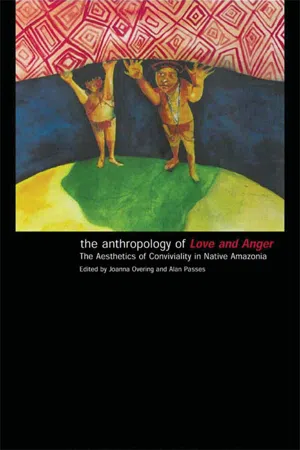
eBook - ePub
The Anthropology of Love and Anger
The Aesthetics of Conviviality in Native Amazonia
- 320 pages
- English
- ePUB (mobile friendly)
- Available on iOS & Android
eBook - ePub
The Anthropology of Love and Anger
The Aesthetics of Conviviality in Native Amazonia
About this book
Information
Part I
Conviviality as a creative process
The aesthetics of the passions and embodiments of community
Chapter 1
The first love of a young man
Salt and sexual education among the Uitoto Indians of Lowland Colombia
Juan Aívaro Echeverri
Men must eat many a peck of salt together before the claims of friendship are fulfilled
Dialogus de Amicitia: Laelius,X.l’K, 67, in Latham 1982: 57)
The Uitoto and other neighbouring groups from the Colombo-Peruvian Amazon used not to consume mineral salt - sodium salt, NaCl. They have learned to eat it since the middle of the twentieth century following their incorporation into market relations through the rubber industry and, latterly, Catholic Mission education and permanent contact with non-Indians. Formerly, they extracted salts from plants, mainly palms, and they continue doing so today. To obtain these vegetable salts, the plant matter (buds, flowers, bark) is burned, water is filtered through the ashes to leach out the minerals, and the resulting brine is boiled down until the salts are desiccated. These vegetable salts are potassium salts very rich in microelements. Indians use them mostly as an alkaline mixture for tobacco paste (Yera),1 as well as for healing and some limited culinary consumption.
Vegetable salts have been extracted by many peoples throughout the world, e.g. the Azande of Central Africa (Prinz 1993: 344–5) and the Anga-speaking groups of Papua New Guinea, mainly the Baruya, for whom salt serves as a kind of money (Godelier 1969; Lemmonier 1984). In the American continent there have been numerous reports since the earliest times of European occupation of the use of vegetable salts.2 Most are just anecdotal, but they seem to point to its widespread utilisation, which is not a mere substitute for sodium or mineral salt (many of these groups having easy access to natural sources), and which in most cases seems to be closely associated with ritual purposes. The production and consumption of vegetable salts no longer exist among many of the groups that formerly used them. In Northwest Amazonia they are still to be found mainly among the Eastern Tukano-speaking, Uitoto-speaking, Bora Miraña-speaking and Andoque-speaking groups, who occupy a continuous area on the borders of the Colombian, Peruvian and Brazilian Amazon, where they continue to be actively produced and circulated, mostly for everyday and ritual consumption of tobacco, ritual exchange, initiation rites and healing.
Ethnographic reports of these groups refer but summarily to the production, consumption and circulation of vegetable salts, let alone to the meanings associated with them in indigenous thought.3 Much attention has been paid to other ritual substances, such as tobacco, coca, hallucinogenic plants and medicinal plants, but salt seems to have gone unnoticed. For the Vaupés region, at least two anthropologists have, in passing, hinted at the potential meaning of the substance. Reichel-Dolmatoff writes that according to the Tukano, ‘the main energy in the cosmos is generated by the sun and is called bogá, a fundamental vital force of an essentially spermatic character’ (1996: 32). And he adds in a note: The root of bogǻ {bo, bu,po,pu, mo, mu) can be found in a number of words that refer, literally or metaphorically, to a conceptual field that has to do with procreation, insemination and impregnation’ (ibid., p. 190). Among the words he lists as derived from that radical (manioc starch, phallus, to inseminate, cultivated field, etc.), he cites ‘moá¡ salt, metaphorically sperm’ (ibid.). The spermatic character of salt among the Vaupés Indians is confirmed by Christine Hugh-Jones in her reference to the process of the preparation of meat among the Eastern Tukano-speaking Barasana, in which she states that ‘salt and pepper added during the boiling could be made comparable to semen and blood. Not only are their colours white and red appropriate for semen and blood, but also the Barasana terms for them relate them to the sexual roles in conception. Salt is moa, “activating substance” (moa-, to move, to work)’ (1979: 195).
This seminal sense of salt, only intimated at by these authors, is shared by the Uitoto and other neighbouring groups. This has become clear to me after a number of years of research on the meaning of vegetable salts for the Uitoto, with the elder Enókakuiodo. Our inquiry arose from a common interest in understanding the interplay of desire in human relations, which can evolve into love, hate, miscommunication, or life. This has led to a compilation of oral narratives about salt, which are the subject matter of this chapter. I have done research and collaborative work with the Indian groups of the Caquetá-Putumayo region in the Colombian Amazon, in the context of their growing political awareness, the legal recognition of lands, and their re-creation of collective identities in the aftermath of their violent insertion into market relations which has taken place since the first decades of the twentieth century. I became involved in institutional work to support ‘grassroots initiatives’, concerning indigenous research on territory, alternative market products, indigenous education, indigenous political organisations and legal advice. After a number of years I, and others who worked with me, grew increasingly disappointed with the results of such well-intentioned attempts: delays, failures, mutual misunderstandings, problems with financial resources were constant and recurring. My concern with these issues of
‘intercultural communication’ was shared by Enókakuiodo, who, as a sort of privileged outsider (he was not involved in any project), used to employ sexual jokes to comment on the everyday trials and tribulations of relations between institutions and Indians (cf. Overing on the potency of bawdy humour, this volume). Enókakuiodo would refer to communities as ‘women who arejealous’, to a project as a process of seduction and to the barrenness of such polygamous marriages.
In particular I remember one very potent image which he constructed to express his understanding of the relationships between non-Indians and Indians, in that context and in general. He likened the situation to that of a woman showing her vagina to a man: non-Indians showed the Indians ‘that woman’s vagina’, that is, money, alcohol, merchandise, technology, and, in a perfectly symbolic and literal sense, ‘their salt’. Formerly, when baptised, Indians were given a taste of (chloride) salt, which, for many elders today, was their first-ever experience of mineral salt.4 ‘As they gave it once, now they have to keep giving it to us’, is something I have heard from several older Indians. This baptismal salt is a metonym of ‘white people’s stuff’ and carries a sexual sense of sharing body fluids: semen, milk. It creates bonds and desire.5 So, ‘we had a glimpse of that woman’s vagina, and we want more’, Enókakuiodo asserts: ‘we don’t know where to stop’. That is why institutions, so to speak, feel so uncomfortable and disappointed in their dealings with Indians, as the latter lose their heads when handling money and alcohol, and normal relations get strained or broken.
But, conversely, Indians have also shown non-Indians their own ‘vagina’, that is, their ritual substances, their sorcery, their knowledge about the forest and nature, and their shamanic power and skills. Because we glimpsed that vagina without preparation, we then want more: we want to taste, we want to touch. We do not know how to deal with the Indians’ ‘salt’. Indians consequently feel that non-Indians do not relate to them on fair terms, and that they want to inquire into matters that are very private and esoteric, while seemingly failing to understand the most obvious.
For Enókakuiodo, the whole matter is thus a question of sexual education: of how to regulate desire, how to know the limits. This sexual education may help to turn barren relations into productive ones, allowing for mutual nurturing and feeding; it may open up what he calls ‘a playground’, where such exchanges are regulated and maintained. Thus, ‘salt’ became our research subject. We began a long work, carrying out a full empirical investigation of the vegetable salts utilised by the Uitoto, extracting, processing and analysing a total of sixty types from different vegetable species. In the process we recorded in the Uitoto language, then transcribed and translated many hours of Enókauiodo’s explanation about the meaning of salt, addressed to one of his sons. He stressed the subject’s importance by stating repeatedly that this work was actually a way of bequeathing a ‘heritage’ to his children and grandchildren. At the same time, according to him, our project was a sort of ‘laboratory’ in which to probe and test the regulation and management of such a sexually charged ‘playground’: space of meeting, space of attraction, space of exchange, feeding space, breathing space, space of creation - surrounded by dangers, illness, fatigue, distrust, anger; space of processing and transformation.
Enókakuiodo’s initial aim was to reach a better understanding of the relations between persons and groups, modelled on those between husband and wife or, rather, between ritual allies, contending parties who keep growing in their ceremonial careers by exchanging work, songs, knowledge - and modelled also on the exchange of coca or of tobacco in the ritual place of coca, and on the rules for mambe-ing6 coca (cf. Londoño-Sulkin, this volume), for men sitting together in dialogue, ‘cool’ and ‘sweet’. His perspective then became an open-ended consideration of the processes of insemination, fecundation, conception, birth and development of life: the constitution of a ‘ground’: i.e. consciousness, society, the world - the ongoing agonistic process of battling, suffering, transforming, processing.
Thus, from these two contrasting portrayals of the circulation of ‘salt’ - salt as semen that impregnates a ground and salt as circulation of substances in a ‘playground’ - I have chosen a sort of intermediate image to start with: a young man in love, at the end of this process of formation and full of salt for exchange.
A young man’s basket
Let us focus our attention on a young Uitoto man beginning to weave a basket. Crouching in front of a bunch of vines, he tries to figure out how to start, where to place the first knot, which fibre to insert next, so as to give form to the entangled ensemble. His body shifts this way and that, his face bends toward the floor, he keeps attempting to start. ‘This is the first moving around’, says the discourse on salt, ‘this is the first looking around; this is, truly, the first tasting’. And it continues:
- For this reason a young man
- does not
- at once pick up rafue.
- Out of weariness, out of suffering
- he understands rafue, he picks up rafue.
- But then, when he becomes dextrous, he shows it in work,
- he teaches [it]
- to another,
- he shows it:
- ‘Here, this is my work,
- I have baskets, I have firewood.’
- This is the origin
- of the first love
- of a young man.
- Formerly, the Father Buinaima
- settled
- this
- strength,
- this
- woman’s desire.
- This is woman, this is the wooing basket..
- Who can turn his face away
- from that basket?
- Who can say T can’? No one can say that.
- In that basket,
- many former generations lost their faces,
- many spirits lost their faces.
- There is nowhere else to go,
- there is no other track,
- there is no other path.,
- The path we tread is the only one.,
- It is the path of our birth,
- it is the path through which we came forth.
Thus we are observing the moment of trying to start, to give form, to bring order to the tangled set of vines. What is referred to may in effect be a material basket, or an attempt to instil life in a woman’s womb, or the work of the Creator to give form to the world. Similarly, one could also understand that what is being described are the efforts to make sense of a situation, to open up a path of knowledge - ‘knowledge’, a first attempt to translate the Uitoto word rafue.
In ordinary language, rafue means ‘news, matter, affair’. In the above excerpt, it signifies knowledge, but it is a knowledge that has to be made to act upon the world and produce tangible results: baskets, firewood, the first love of a young man. Rafue refers neither to words nor things, but to the activity through which words are turned into things, the movement from the named to the tangible through time. The two roots that compose the term rafue (raa, ‘a thing’, and ιfue, ‘something spoken’) synthesise this movement. Most crucially, for Enókakuiodo, his discourse on salt is also rafue. Rather than an explanation of a system of meanings, it is a process of instruction, whose result is the realisation of a vital reappropriation by the listener-apprentice. It is meant to bring about the latter’s own interpretation based on lived experiences: ‘Out of weariness, out of suffering/he understands rafue, he picks up rafue:
Rather than on a system of thinking, my focus here is on the process of instruction that lays out a discourse that produces multiple images each of which may be interpreted in several ways. The discourse extends like a net that defies any attempt to structure a coherent narrative out of it. I feel like that young man set before many strands (images, concepts), trying to weave them into a basket. Another listener, one of Enókakuiodo’s sons, say, may be able to construct it as a discourse on the process of formation of life inside a woman’s womb, given his own worries concerning his wife’s fertility. The key to the matter is the vital experience that the listener can bring into his/ her reflection upon the rafue of salt: human reproduction, good intercultural communication, understanding of a system and so forth.
That reflective capacity of rafue is obtained through a ‘poetic’ use of language: ‘poetic’ understood as linguistic artefacts that slide along paradigms of meaning. ‘Basket’, for instance, can be taken as referring to the womb, a person, knowledge, power, ceremonial career. These poetic artefacts transform into others - ‘basket’ is also a path, the birth path. The images flow and subside in the rafue of salt along the drama of creation, of battling, suffering, succeeding, never arriving at an ultimate conclusion. I try to represent this poetic imagery and flow through a transcription of the discourse in versified form, as shown in the excerpts quoted.
A full demonstration of this mode of narration requires a rendition of longer sections. Here, however, I will focus on two guiding principles or notions that allow a view of this process of transmission of knowledge through poetic artefacts: the notions of ‘ground’ and of rafue itself. My first approach to the two notions is the image of a young man weaving a basket, articulated by vital experience: sexual impulse - jtruιfue, which I translate as ‘love’. ‘Ground’ is the object of that sexual impulse, in this case named as a basket, which can be understood as woman, food plot, etc. The exercise of that impulse upon that ground is the path of rafue.
This ground-raƒue system of construction of knowledge contains a statement about proper social behaviour, implicit in the control of that sexual impulse through what is the ultimate goal of rafue: to ensure good human life, expressed in knowledge, wisdom, human fertility, regeneration, love, speaking and food. This is most clearly depicted in the following excerpt of the rafue of salt in respect of the basket of humanity:
- This is the basket of mambe-ing coca,
- this is the basket of knowledge,
- this is the basket of endurance,
- this basket,
- is the basket of advising,
- basket of wisdom;,
- this basket,
- is the basket of holding the phallus,
- basket of humanisation;
- this basket
- is the basket of love,
- basket of the Word;
- this is the basket of our life.
The rafue on rafue and the ‘ground’: the path of life
The image of a young man beginning to weave a basket is but one transformation of the master story of the creation of the world. The Creation is indeed a myth, but in the rαfue of salt it is never narrated as a separate story. Myths derive their power from always being susceptible to multiple interpretations, transformations, displacements, lack of closure. One would prefer to ‘understand’ the narration of a myth in some kind of chronological order -what comes first, what follows next, which character is different from which other character, who is the son, wife or brother-in-law of whom and so forth. Fixing the myth destroys its power. The rαfue of salt is full of mythic references that are never fully revealed, never transparent. The myths are always half-concealed, their apparent narrative structure perpetually being modified. Once told, they are promptly devalued as ‘just stories’. I will try to ‘detain’ for a moment the story of creation, inasmuch as it contributes ...
Table of contents
- Cover page
- Title page
- Copyright page
- The anthropology of love and anger
- List of contributors
- Preface
- Introduction: Conviviality and the opening up of Amazonian anthropology
- Part I: Conviviality as a creative process the aesthetics of the passions and embodiments of community
- Part II: Conquest and contact The historical failure of convivial relations
- Part III: The delicacy of Amazonian sociality
Trusted by 375,005 students
Access to over 1.5 million titles for a fair monthly price.
Study more efficiently using our study tools.
Frequently asked questions
Yes, you can cancel anytime from the Subscription tab in your account settings on the Perlego website. Your subscription will stay active until the end of your current billing period. Learn how to cancel your subscription
No, books cannot be downloaded as external files, such as PDFs, for use outside of Perlego. However, you can download books within the Perlego app for offline reading on mobile or tablet. Learn how to download books offline
Perlego offers two plans: Essential and Complete
- Essential is ideal for learners and professionals who enjoy exploring a wide range of subjects. Access the Essential Library with 800,000+ trusted titles and best-sellers across business, personal growth, and the humanities. Includes unlimited reading time and Standard Read Aloud voice.
- Complete: Perfect for advanced learners and researchers needing full, unrestricted access. Unlock 1.5M+ books across hundreds of subjects, including academic and specialized titles. The Complete Plan also includes advanced features like Premium Read Aloud and Research Assistant.
We are an online textbook subscription service, where you can get access to an entire online library for less than the price of a single book per month. With over 1.5 million books across 990+ topics, we’ve got you covered! Learn about our mission
Look out for the read-aloud symbol on your next book to see if you can listen to it. The read-aloud tool reads text aloud for you, highlighting the text as it is being read. You can pause it, speed it up and slow it down. Learn more about Read Aloud
Yes! You can use the Perlego app on both iOS and Android devices to read anytime, anywhere — even offline. Perfect for commutes or when you’re on the go.
Please note we cannot support devices running on iOS 13 and Android 7 or earlier. Learn more about using the app
Please note we cannot support devices running on iOS 13 and Android 7 or earlier. Learn more about using the app
Yes, you can access The Anthropology of Love and Anger by Joanna Overing, Alan Passes, Joanna Overing,Alan Passes in PDF and/or ePUB format, as well as other popular books in Scienze sociali & Antropologia. We have over 1.5 million books available in our catalogue for you to explore.