- 224 pages
- English
- ePUB (mobile friendly)
- Available on iOS & Android
eBook - ePub
About this book
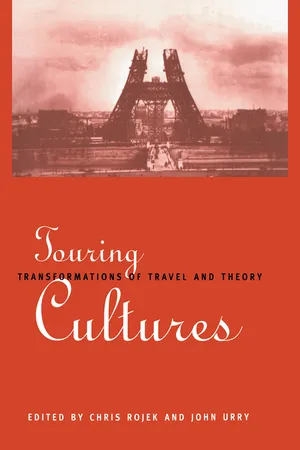
It is becoming ever clearer that while people tour cultures, cultures and objects themselves are in a constant state of migration. This collection brings together some of the most influential writers in the field to examine the complex connections between tourism and cultural change and the relevance of tourist experience to current theoretical debates on space, time and identity.
Information
1
TRANSFORMATIONS OF TRAVEL AND THEORY
Chris Rojek and John Urry
TOURISM AND CULTURE
Peoples, cultures and objects migrate.This book draws on the expansion of social science interest in mobility, in the mobility of peoples, cultures and objects.It is now clear that people tour cultures; and that cultures and objects themselves travel. It is this two-fold aspect that will be jointly addressed in the chapters that follow. We begin this chapter with an analysis of the complex connections between tourism and cultural change, inspired by Said’s and Clifford’s notions of ‘travelling cultures’ (Said 1983; Clifford 1992).
We will begin by interrogating the very category of ‘tourism’. Is there such an entity? Does the term serve to demarcate a usefully distinct sphere of social practice? Where does tourism end and leisure or culture or hobbying and strolling begin? This book is based on the view that tourism is a term waiting to be deconstructed.Or as Marx might have said it is a chaotic conception, including within it too wide a range of disparate phenomena (Marx 1973).It embraces so many different notions that it is hardly useful as a term of social science, although this is paradoxical since Tourism Studies is currently being rapidly institutionalised within much of the academy.
One significant reason for the problematic status of tourism is that its meaning stems from its ‘other’, from the other term or terms with which it is contrasted.There are many of these, including travel, day-tripping, culture, excursion, voyaging and exploration. Its meaning constantly slides as its ‘other’ changes.This is shown in Buzard’s (1993) analysis of the tourist-traveller distinction.He brings out that in the case of many different literary and academic writers during the nineteenth century the meaning of each term continuously slides under that of its other.Indeed more generally the very critiques of the role of the ‘tourist’, as found within many discourses surrounding ‘travel’, are in a sense part of the very nature of tourism as a complex set of social discourses and practices.
And yet at the same time it is believed by both the academy and the wider public that tourism does in fact possess a self-evident essence.People still want to ‘get away from it all’.Yet interestingly this desire for contrast and escape is increasingly freighted with worries that the impetus for tourism is itself destroying the possibility of tourism. For example, it seems obvious to the public and to academic commentators that in the past three decades Majorca, to take but one instance, has been more or less destroyed by a engulfing process which can be unambiguously identified as tourism or mass tourism; or that the retreat to Miami Beach has developed threatening, crimogenic aspects which threaten the very safety of tourists. Lying therefore behind many claims in this field is a fairly simple-minded realism: that there are clear and identifiable processes ‘out there’ and these can be straightforwardly described by terms such as ‘tourism’ and ‘travel’. Moreover, once they are so described they can then be explained through the use of conventional social science methodology, especially survey-type analysis (Krippendorf 1984).
It may be that this belief in the real essence of tourism is related to what can be described as a ‘realist’ search undertaken by tourists themselves for evidence that they really were in some particular place. This ‘realism’ of popular representation is associated with the role of photography. Crawshaw and Urry discuss how this produces a definite narrative and interpellation of the individual subject as a tourist in a particular place, engaging in apparently touristic activities (see Chapter 9).
One response to those who point to the problematic nature of tourism as a theoretical category is to seek to operationalise it. For example, tourism is often defined as involving stays of more than four nights and less than one year. But the problem with this is that it ignores whether these stays have in any sense the same significance to visitors. If they do not, then the investigator is placing together in one operational category quite different social practices, some of which might be merely that of weekly commuting. In what follows we shall presume that the variety of meanings is part of what we are seeking to identify and to explain. So while the collecting and analysis of the flows of visitors within and between countries, including the number of nights that they stay and so on, is crucially important data, we will not seek to reduce the tourism phenomenon to such an operational definition. Rather we will be concerned with unpacking the orientations that people bring with them when they engage in tourist activity and also with tracing some of the mythologies of escape involved when people go touring or dream of touring.
Another response to the problematic character of tourism is deliberately to abstract most of the important issues of social and cultural practice and only consider tourism as a set of economic activities. Questions of taste, fashion and identity would thus be viewed as exogenous to the system. Tourism on this account is treated as a set of economic factors, and individuals are viewed as bundles of given preferences. This is the standard treatment of tourism in the main textbooks (although less so in Shaw and Williams 1994).Again, the economic analysis of tourism provides crucial information for understanding the phenomenon. But it is limited. The number of hotels built in Berlin since the destruction of the Wall, or the average tourist expenditure by British tourists in Greece, tell us very little about the diverse qualities of tourist experience. In addition they carry the danger of reifying tourist experience so that thinking about tourism and developing tourist policy simply become a matter of reading and seeking to manipulate economic indicators.
Touring Cultures, by contrast, is premised upon the rejection of both positivist operationalisation and the strategy of economic abstraction. We will examine a wide range of phenomena which are characteristically viewed as ‘touristic’.And we will engage with the diverse meanings actors attribute, intentionally or otherwise, to the activities which are conventionally deemed to be part of tourism. But this identification of ‘tourism’ is now particularly problematic because of recent discursive and social transformations. Until the past two to three decades there were a series of temporary frontiers erected between what we can loosely term tourism and culture (since the demise of the Grand Tour which, for the sons of the wealthy, combined the two; see Craik in Chapter 6). As we have argued elsewhere, during organised capitalism, tourism and culture were relatively distinct social practices in both time and space (Rojek 1993; Urry 1994a), so it was a reasonable tactical move to presume that they could be analysed separately from each other. There was differentiation of social practices, each presupposing their own modes of judgement, hierarchy and authority. Tourism as practice and discourse involved clear specification in time (the week and the fortnight) and space (the specialised resorts and spas). It particularly involved the centrality of clock-time to its organisation. This was seen not only in the week being the key time-period but also the significance of fixed mealtimes, high levels of time-space synchronisation, and a remarkable degree of time surveillance (see Urry 1994b). All of this presumed a clear boundary between tourism and culture; a grid-like distinction between the two. Indeed Ritzer and Liska in Chapter 5 argue that tourist sites had been increasingly ‘McDisneyized’, becoming places in which people seek tourist experiences which are predictable, efficient, calculable and controlled.
This grid-like construction of life was not without criticism and resistance. Elsewhere one of us has used the collective term ‘Modernity 2’ to refer to such categories of resistance (Rojek 1995). If Modernity 1 set down certain rules to live by and attempted to install a universal, binding ‘order of things’, as Ritzer and Liska show in Chapter 5, Modernity 2 sought to express the ‘disorderliness’ of life. Modernity 1 tended to emphasise that life could be organised around consistent and comprehensive rational principles, whereas Modernity 2 stresses the irrational consequence of rational actions and, more generally, the impossibility of ‘planning’ or ‘managing’ social life. The ‘antinomian’ tradition described by Thompson (1994) shows the deep roots of Modernity 2 in various traditions of religious dissent. Criticism and dissent were often expressed in political forms. Socialism, feminism and the civil rights movement can all be seen as examples of Modernity 2’s rejection of the rigidities imposed under Modernity 1. But these movements rejected the existing order of things in order to achieve a qualitatively superior state of affairs. It was left to the poet Rimbaud at the end of the nineteenth century to express the anarchic kernel in Modernity 2 with his remark that life should seek to attain ‘the complete derangement of the senses’. But despite the erosive effect of Modernity 2 on the dominant order of things, Modernity 1 proved remarkably resilient. In spite of the breaching of various boundaries, until very recently the rules of division (public and private life; work and leisure; home and abroad; male and female roles; popular pleasure and high culture) were regarded, in the final analysis, to be clearly drawn and understood by most in ‘Western’ societies.
It is these rules and the notion of the ‘final analysis’ which has now been shattered. Tourism and culture now plainly overlap and there is no clear frontier between the two. They cannot be kept apart. First, this is because there is a ‘culturalisation of society’, a de-differentiation between all sorts of social and cultural spheres which were previously distinct, as Craik shows in Chapter 6. Even the apparently separate economy has partly turned into an economy of signs; while the development of a post-modern cultural paradigm involves the breaking down of conventional distinctions, such as high/low culture, art/life, culture/street life, home/abroad, that had kept different social practices within different social/spatial locations (Baudrillard 1981; Harvey 1989; Lash 1990; Lash and Urry 1994).
Further, many border-maintaining distinctions and discriminations have been overwhelmed by cultural innovations which have swept across frontiers, including those historically exerted around and by the nation-state. Migration has brought many ‘exotic’, ‘foreign’ cultures into the cities of Europe, the Americas and Australia. The old colonial metropolis is having to come to terms with post-colonial conditions. As Lury demonstrates, both objects and people are increasingly mobile, and such mobilities are culturally encoded (see Chapter 4 below; Clifford 1992; as well as the literature on post-colonialism).The diffusion of peoples between cultures can no longer be understood through the employment of conventional notions of control and resistance. Instead, the notion of hybridity which brings to mind the organic binding of different cultural conventions and symbols is more appropriate. For example, the Irish Americans in the US have evolved a hybrid culture which is neither purely American nor Irish, yet is clearly indebted to both; the same is true of British Afro-Caribbeans and British Asians. Hybridity moreover exposes the conventional division between home and abroad as over-simplistic. From a ‘Western’ standpoint, living-in and travelling-in cultures must be seen as occurring in the context of unparalleled cultural diffusion and hybridity (see Gilroy 1993). There is no simple sense of the spatially and temporally distinct ‘home’ and ‘away’.
Third, more specifically there has been the increasing culturalisation of tourist practices themselves and their profound impact on the range of ‘toured’ communities (see Morris 1995). Crang points to this in his discussion of what he calls ‘the mediation of co-presence’ (see Chapter 7). This culturalisation is most obviously seen in the growth of so-called ‘cultural tourism’. For example, educational tourism and keep-fit/adventure tourism are explicitly marketed as improving the ‘culture’ of the tourist. One does not simply see more of the world by engaging in these forms of tourist activities, one also accepts the invitation to become a better person. Culturisation can also be seen in the increasing significance of signs to the design and marketing of tourism sites. Various commentators have demonstrated that tourist practices do not simply entail the purchase of specific goods and services but involve the consumption of signs. Tourists are semioticians (see Culler 1988; MacCannell 1989). Indeed it is sometimes claimed that the sign or marker is constitutive of the sight which, in a sense, cannot be ‘seen’ without the marker. And with the extraordinary proliferation of images and signs in the last few decades, this economy of signs has swept across and overwhelmed the signs typically consumed by the traveller while away, as Rojek discusses through the concepts of indexing and dragging (Chapter 3). And the signs derived from travel are routinely produced and circulated by all sorts of other culture industries. Indeed, as Rojek discusses, people are beginning to discuss the whole idea of virtual travel or cyber-tourism. The result is that the distinctions made under Modernity 1 between ‘home and abroad’, ‘work and travel’ and ‘the authentic and the contrived’ are further drained of popular authority (see MacCannell 1989; Frow 1991; Morris 1995).
Most tourism research has not sufficiently recognised these developments—although it has of course noticed the marketing and economic opportunities of cultural tourism (see Taylor 1994; Morris 1995; and Craik in Chapter 6, for recent exceptions to this criticism). Crang partly attempts to redress the balance by demonstrating the performative character of many kinds of tourism employment; and thus to show how the labour undertaken involves the mobilisation of culturally meaningful selves. He shows that much tourism employment involves ‘cultural performance’ (see Chapter 7 below; Kershaw 1993). However, he also demonstrates that this is very varied in its impact, depending upon the social definition of the settings; the spatial and temporal structuring and uses of those settings; the materials through which product provision is organised; and the identity politics played out through the interactions between employees and tourists ( Chapter 7 below; Crang 1996).
In a number of ways then, this book aims to go beyond existing studies by demonstrating the following: that tourism is a cultural practice; that tourism and culture hugely overlap; that tourism as a cultural practice and set of objects is highly significant or emblematic within contemporary ‘Western’ societies organised around mass mobility; that tourism has largely to be examined through the topics, theories and concepts of cultural analysis, especially the current foci upon issues of time and space; that there should not be a specifically social science of tourism; that particularly significant in the analysis of culture will be the examination of the human senses, and especially the relative importance of the sense of sight; and that none of the supposed essences of tourism, such as the notion of ‘escape’, provides the kind of desired conceptual unity.
In the rest of this chapter we will consider some recent debates and theories relating certain of these claims, to tourism and the variety of human senses involved in the appreciation of place; to how cultures and objects and not just people travel or tour; and to the gendered nature of cultures and tourism practices and metaphors. There is a brief conclusion.
TOURISM AND THE SENSES
Issues of time and space are central to contemporary cultural analysis. But such a claim about the timed and spaced character of social phenomena forces us to confront how and in what ways we sense such phenomena. What senses are involved in the perception, interpretation, appreciation and denigration of other spaces? How do we sense what other places are like? How do senses work across space? How are other times remembered? Which senses predominate in different historical periods? Are there hierarchies of value between the different senses? (see Rodaway 1994 for his advocacy of a ‘sensuous geography’).
These are immensely complex issues relating to the history of Western philosophy and its particular fascination with the eye as the mirror of nature (Rorty 1980). Our initial claim is simply that the cultural analysis of ‘tourist’ social practices also necessitates analysis of these different senses, and in particular the privileging of the visual which appears to parallel the ocularcentrism of Western philosophy (Jay 1993). Crawshaw and Urry note that it is rather paradoxical that what Levin terms the ‘hegemony of vision’ appears to characterise the heights of Western philosophy and the depths of the Western holiday industry (see Chapter 9 below; Urry 1992b; Levin 1993; Gregory 1994:404). In the history of the West, sight has been typically taken as the noblest of the senses. Arendt, for example, argues that ‘from the very outset, in formal philosophy, thinking has been thought of in terms of seeing’ (Arendt 1978:110– 11). Observation came to be regarded as the only sure basis of scientific legitimacy.
But in the twentieth century the denigration of the central role of the visual has developed, especially within French social thought. The dark side of sight has come to be particularly emphasised. Jay (1993) brings this out in his interrogations of Sartre, Derrida, Irigaray, Debord and especially Foucault. In Foucault’s analysis there is the demonstration of how sight shifts from the primacy of the individual knowing eye, to its spatial positioning through especially the panopticon, and of the relationship of that social vision to the operation of power (1979). Such writers particularly bring out the complicitous role of vision in the mundane operations of power and control—it is no longer simply the source of enlightenment and science.
To some extent these debates parallel discussions in the 1920s and 1930s. Jokinen and Veijola note how Benjamin used the metaphor of the metropolis as a ‘labyrinth’ (Chapter 2 below; Benjamin 1973). Flânerie was the act not merely of intelligent wandering, but also of peeling away the blasé indifference to everyday life and the opening up of the senses. Kracauer (1995:65–74) presented tourism as the organised bombardment of the senses. He argued that the commercialisation of tourism no longer enables people to savour the sensation of foreign places. Tourism no longer involves capturing a long-imagined sight.
This is in stark contrast with when Goethe travelled to Italy, which he viewed as a country he ‘sought with his soul’ (Kracauer 1995:65). Indeed, reading Goethe’s memento of his journey to Rome in 1786 one is struck by the extraordinary richness of his preparation (Goethe 1962). He read voraciously on all things Roman; he pored over the history and street plans of the city; he studied engravings of the significant buildings, and he collected woodcuts, plaster casts, etchings and cork models. Goethe’s imagination immersed itself in the city, so that upon arrival he remarks t...
Table of contents
- COVER PAGE
- TITLE PAGE
- COPYRIGHT PAGE
- ILLUSTRATIONS
- CONTRIBUTORS
- ACKNOWLEDGEMENTS
- 1: TRANSFORMATIONS OF TRAVEL AND THEORY
- PART 1: THEORIES
- PART 2: CONTEXTS
- BIBLIOGRAPHY
Trusted by 375,005 students
Access to over 1.5 million titles for a fair monthly price.
Study more efficiently using our study tools.
Frequently asked questions
Yes, you can cancel anytime from the Subscription tab in your account settings on the Perlego website. Your subscription will stay active until the end of your current billing period. Learn how to cancel your subscription
No, books cannot be downloaded as external files, such as PDFs, for use outside of Perlego. However, you can download books within the Perlego app for offline reading on mobile or tablet. Learn how to download books offline
Perlego offers two plans: Essential and Complete
- Essential is ideal for learners and professionals who enjoy exploring a wide range of subjects. Access the Essential Library with 800,000+ trusted titles and best-sellers across business, personal growth, and the humanities. Includes unlimited reading time and Standard Read Aloud voice.
- Complete: Perfect for advanced learners and researchers needing full, unrestricted access. Unlock 1.5M+ books across hundreds of subjects, including academic and specialized titles. The Complete Plan also includes advanced features like Premium Read Aloud and Research Assistant.
We are an online textbook subscription service, where you can get access to an entire online library for less than the price of a single book per month. With over 1.5 million books across 990+ topics, we’ve got you covered! Learn about our mission
Look out for the read-aloud symbol on your next book to see if you can listen to it. The read-aloud tool reads text aloud for you, highlighting the text as it is being read. You can pause it, speed it up and slow it down. Learn more about Read Aloud
Yes! You can use the Perlego app on both iOS and Android devices to read anytime, anywhere — even offline. Perfect for commutes or when you’re on the go.
Please note we cannot support devices running on iOS 13 and Android 7 or earlier. Learn more about using the app
Please note we cannot support devices running on iOS 13 and Android 7 or earlier. Learn more about using the app
Yes, you can access Touring Cultures by Chris Rojek,John Urry in PDF and/or ePUB format, as well as other popular books in Social Sciences & Cultural & Social Anthropology. We have over 1.5 million books available in our catalogue for you to explore.