- 216 pages
- English
- ePUB (mobile friendly)
- Available on iOS & Android
eBook - ePub
Public and Performance in the Greek Theatre
About this book
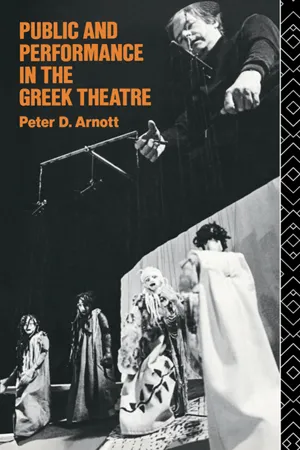
Peter Arnott discusses Greek drama not as an antiquarian study but as a living art form. He removes the plays from the library and places them firmly in the theatre that gave them being. Invoking the practical realities of stagecraft, he illuminates the literary patterns of the plays, the performance disciplines, and the audience responses.
Each component of the productions - audience, chorus, actors, costume, speech - is examined in the context of its own society and of theatre practice in general, with examples from other cultures. Professor Arnott places great emphasis on the practical staging of Greek plays, and how the buildings themselves imposed particular constraints on actors and writers alike. Above all, he sets out to make practical sense of the construction of Greek plays, and their organic relationship to their original setting.
Trusted by 375,005 students
Access to over 1.5 million titles for a fair monthly price.
Study more efficiently using our study tools.
Information
Subtopic
Ancient HistoryIndex
History1
THE AUDIENCE AND THE CHORUS
Periodically during the late winter and early spring the Athenians assembled to celebrate their festivals of drama. The dates were associated with religious celebrations that had been in existence long before plays were invented. But one practical reason for holding them so early in the year may have been protection for the performers: Greek acting, which involved strenuous physical and vocal effort in mask and costume, was hot work at the best of times. It helped, too, that in the Theatre of Dionysus where the plays were given, the auditorium was south-facing, while the actors had some benefit from the shade. But in the early months the weather was past the worst of winter, and not yet oppressive; though some festivals, we know, were virtually closed events, because the seas were not yet navigable and outsiders could not travel.
There are many things we do not know about the Athenian audience. It is still not certain, for example, whether or not women were admitted (though it is a reasonable surmise that they were). There are important things we do know, however, or about which we can make logical assumptions. The audience was massive in size; the consequences of this, for both playwright and actor, will be considered in a later chapter. It was talkative and unruly. Although drama, for the Greeks, was part of a religious festival, we should not make the mistake of equating this with our own church-going, or the Greek audience with a modern religious congregation, or Sophocles, as H. D. F. Kitto once said, with ‘an enlightened bishop’. For us, religious worship tends to be passive. For the Greeks it was participatory, and took many forms. The gods were honoured by human achievement: by athletic meets and boxing matches, by singing songs and acting plays.
We have ample testimony that the Greek audience was hardly a church-going congregation, in our sense of the word. In the early days of the theatre, when the seats were still of wood and not yet of stone, a favourite way of showing disapproval was for the audience to drum their heels against the benches. The effect of this, in a theatre with a huge audience and excellent acoustics, can be imagined. There are numerous stories of audiences disrupting performances by shouting, jeering, throwing fruit, and worse. Aeschylus was once in danger of his life because of some offence he had unwittingly committed; Euripides’ tragedy Ixion was halted by a crowd outraged by its blasphemy, until the poet had explained that, if the audience was patient, it would see the protagonist’s transgressions punished in the end.
The temperament and habits of the audience helped to shape the plays. This is most obvious in comedy, where it is clear that Aristophanes had to work hard, and carefully, to catch his public’s attention. Part of the problem arises from the use of an open, naturally illuminated playing area. In a modern theatre we are given ample warning that a play is starting. We are plunged into darkness, the curtain rises, and our attention is focused on one small, brightly lit space. Aristophanes has only his performers to work with. They must enter, small dots in a huge theatre, and secure attention by their own unaided efforts.
In modern open-air theatres, it is possible to quiet the audience with a fanfare or announcement. Whether this happened in Athens we do not know. It is doubtful whether it would have been enough. We see Greek plays in isolation, out of their festival context. For the Athenians the plays were simply one element, though an important one, in a mixed programme. The festival day must have been full of fanfares and announcements. For special attention Aristophanes needs other devices.
Obviously a strong beginning is indicated. Equally obviously it is as well not to proceed too quickly with the main theme of the play, or important exposition may be lost while the audience is settling down. It is safe to assume that the audience for comedy would be more relaxed and jocular than for tragedy. In the Aristophanic prologues a pattern is discernible which appears to be dictated by these factors.
The openings take two main forms. Several of the comedies begin with broad horseplay, fast and noisy to catch the audience’s attention. Thus The Knights opens with two slaves – caricatures of well-known contemporary generals – running on, complaining that they have been beaten, and weeping loudly together. This familiar low-comedy motif (Aristophanes complained when other playwrights used it, but did so happily himself) offers slapstick opportunities to which the audience would readily respond. Peace opens with a similar scene, in which slaves run back and forth with shovels of dung to feed the giant beetle on which Trygaios plans to ride to heaven. Lavatory humour amused the Greeks no less than it does the mass modern audience. The Birds opens with two old men staggering over the rocks, tripping, tumbling, and misled by their bird guides.
Alternatively, the comedy begins with a string of topical references and irrelevant jokes. The Acharnians opens in such a way. Dikaiopolis, alone, soliloquizes on the miseries of his life. We have jokes about the mob-orator Kleon, feuding with Aristophanes at the time – as the audience would have been well aware – and that ‘cold fish’ the tragedian Theognis, the composers Moschos and Dexitheos, and the flute-player Chaeris. All this is gossip-column stuff, and has nothing to do with the play. We do not get an inkling of the plot until line forty.
The Wasps opens in the same manner. Again we have two slaves, Xanthias and Sosias. They talk about their dreams, which happen to be about well-known people: Kleon again, the notorious coward Kleonymus, Theoros, one of Kleon’s political lackeys, and Alcibiades, the golden boy of fifth-century Athens. All this is funny but irrelevant. When it is over, the play proceeds. In The Frogs Dionysus and his slave Xanthias perform what is virtually a vaudeville dialogue, full of familiar patter, vulgarity, and innuendo.
The function of these openings is obvious. They serve to quiet a restless audience, to focus attention on the stage, and to establish a happy actor–spectator relationship. Modern comedians would call them a ‘warm-up’. It does not matter if the jokes are not properly heard. All the essential information comes later. Mazon aptly compares these introductions to a barker’s patter at a sideshow in a fair.1 They attract attention, and give a hint of the entertainment to come.
Tragic prologues are more immediately informative. We may surmise, perhaps, that the audience for this portion of the festival was better mannered, and more receptive. Some things, however, may still have been lost. When Aristophanes makes Euripides, in The Frogs, complain of Aeschylus’ habit of ‘raving haphazardly, and rushing into the thick of things’,2 he may have touched upon a genuine flaw in the senior dramatist’s method.
There are other generalizations we may make about this audience. Once again, the evidence comes principally from comedy. Athens, by modern standards, was a small town, and the small-town mentality was in many ways no different from what we are familiar with today. In such enclosed communities privacy is limited, difference is suspect, and tastes become parochial. Aristophanes makes many jokes about contemporary individuals. The notables of the state are satirized, as we would expect. Men of the stature of Kleon in the world of politics, Socrates in philosophy, and Euripides in the arts, are developed into major characters. In addition, there are the lesser figures who would still, by modern standards, be considered newsworthy – the personnel of the tragic theatre, for example, actors and playwrights alike, the politicians of the second rank, and even Orestes, the highwayman.
But this by no means exhausts the list. The little men are represented also, and the jokes about them tend to be of the same kind. A man is a fit subject for humour if he is in any way unusual. The smallest departure from the norm is potentially risible. A man may be mocked because he is too fat (Kleonymos) or because he is too thin (Kinesias, Kleocritos); because he tells tall stories (Proxenides, Theagenes) or because of his unpleasant sexual habits (Kallias, Kleisthenes, Lysistratos); for his lack of self-control (Patrocleides) or for his haircut (Kratinos); because he grows his beard (Agyrrhios) or because he has difficulty with his hatplume on parade (Pantakles). The fact that these apparently trivial characters and incidents are considered fit material for humour tells us much about the nature of Athenian society and the popular mode in comedy. It is evident that, at least so far as these personal references are concerned, we are dealing with a limited society whose tastes are essentially parochial. As in small-town humour of all countries and of all ages, any departure from the norm is funny. Most significant of all are the various allusions to foreigners and to resident aliens, such are Exekestides, Sakas, and Spintharos; Aristophanes derides them and expects his audience to do the same. To this group we may add the various personages, sometimes real, sometimes fictitious, who are mocked because they are unable to speak Greek – Kleophon, the Persian ambassador, the Triballian, and others. The comic foreigner of Aristophanic comedy is the comic Frenchman of English farce, and the comic Swede or Italian of American vaudeville. This type of joke is the surest index of middle-class tastes, and of an audience which dislikes, or distrusts, the unfamiliar.
Tragedy lacks this kind of topical reference, but the xenophobia remains. It appears in the subject matter of tragedy, which tends to take its stories from the lurid mythic and legendary past of other cities – principally Thebes and Argos, both long-standing rivals of Athens. It is in those places that men marry their mothers, and wives murder their husbands; it is there that incest and cannibalism thrive. Out of the whole surviving canon of Greek tragedy, there is really only one play which shows Athenian worthies in an unflattering light: Euripides’ Hippolytus, where Theseus, King of Athens, misled by false evidence, curses his own son in a fit of savage rage, and destroys him.
This exception is all the more conspicuous because Theseus is normally the shining hero of Athenian tragedy, as he was of Athenian legend. In Sophocles’ Oedipus at Colonus, when the old, blind, and beggared Oedipus seeks sanctuary from his oppressors, it is Theseus who takes him in. In Euripides’ The Madness of Heracles, when the hero cannot face life amid the consequences of his own insanity, it is Theseus who comforts him, reasons with him and persuades him to rejoin the living world. In Medea, when the heroine, deprived of home and husband, seeks a refuge, it is Aigeus, father of Theseus, who offers one.
Appeals to Athenian chauvinism resound within the plays. Sometimes they have only the barest connection to the plot. Medea, besides the character of Aigeus, offers a striking example of this. The Corinthian women of the chorus try to dissuade Medea from murdering her children, because such behaviour will be unacceptable to the city that has offered her shelter:
Happy of old were the sons of Erechtheus,
Sprung from the blessed gods, and dwelling
In Athens’ holy and untroubled land.
Their food is glorious wisdom, they walk
With springing step in the balmy air.
Here, so they say, golden Harmony first
Saw the light, the child of the Muses nine.
And here, too, they say, Aphrodite drank
Of Kephisos’ fair-running streams, with garlands
Of scented roses entwined in her hair
And gave Love a seat on the throne of Wisdom
To work all manner of arts together.
How will this city of sacred waters,
This guide and protector of friends, take you
Your childrens’ slayer, whose touch will pollute
All others you meet?3
This tribute to the city of the playwright and his audience is all the more poignant because, a few months later, the Peloponnesian War broke out; the glory of Athens was tarnished, and its image would never be the same again.
If Athenian heroes are the champions of the oppressed, Spartan characters – particularly during the war years – are portrayed as weak or villainous. Menelaus, in Sophocles’ Ajax, argues that the hero has no right to burial; in Euripides’ The Trojan Women, he enters to accuse his errant wife, and leaves the stage once more Helen’s willing prisoner. Such xenophobia is even more evident in the case of those who are not even Greek. ...
Table of contents
- Cover Page
- Halftitle Page
- Title Page
- Copyright Page
- Table of Contents
- A note on sources
- Introduction
- 1 THE AUDIENCE AND THE CHORUS
- 2 THE ACTOR SEEN
- 3 THE ACTOR HEARD
- 4 DEBATE AND DRAMA
- 5 PLACE AND TIME
- 6 CHARACTER AND CONTINUITY
- Notes
- Select bibliography
- Index
Frequently asked questions
Yes, you can cancel anytime from the Subscription tab in your account settings on the Perlego website. Your subscription will stay active until the end of your current billing period. Learn how to cancel your subscription
No, books cannot be downloaded as external files, such as PDFs, for use outside of Perlego. However, you can download books within the Perlego app for offline reading on mobile or tablet. Learn how to download books offline
Perlego offers two plans: Essential and Complete
- Essential is ideal for learners and professionals who enjoy exploring a wide range of subjects. Access the Essential Library with 800,000+ trusted titles and best-sellers across business, personal growth, and the humanities. Includes unlimited reading time and Standard Read Aloud voice.
- Complete: Perfect for advanced learners and researchers needing full, unrestricted access. Unlock 1.5M+ books across hundreds of subjects, including academic and specialized titles. The Complete Plan also includes advanced features like Premium Read Aloud and Research Assistant.
We are an online textbook subscription service, where you can get access to an entire online library for less than the price of a single book per month. With over 1.5 million books across 990+ topics, we’ve got you covered! Learn about our mission
Look out for the read-aloud symbol on your next book to see if you can listen to it. The read-aloud tool reads text aloud for you, highlighting the text as it is being read. You can pause it, speed it up and slow it down. Learn more about Read Aloud
Yes! You can use the Perlego app on both iOS and Android devices to read anytime, anywhere — even offline. Perfect for commutes or when you’re on the go.
Please note we cannot support devices running on iOS 13 and Android 7 or earlier. Learn more about using the app
Please note we cannot support devices running on iOS 13 and Android 7 or earlier. Learn more about using the app
Yes, you can access Public and Performance in the Greek Theatre by Peter D. Arnott in PDF and/or ePUB format, as well as other popular books in History & Ancient History. We have over 1.5 million books available in our catalogue for you to explore.