- 250 pages
- English
- ePUB (mobile friendly)
- Available on iOS & Android
eBook - ePub
Quality Assurance In Higher Education
About this book
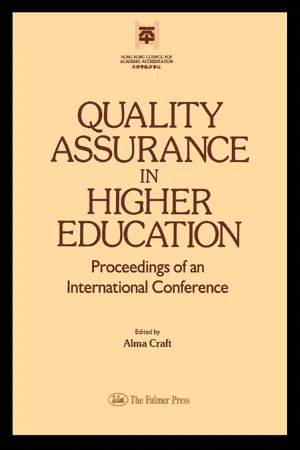
First Published in 1992. This is a collection of the Proceedings of an International Conference Hong Kong, July 1991. The Hong Kong Council for Academic Accreditation (HKCAA) hosted an invitation conference on Quality Assurance in Higher Education. Over 100 senior representatives from accreditation bodies and from higher education attended and spent three days in discussion of quality assurance issues. Delegates came from Australia, Belgium, Canada, China, France, Germany, Hong Kong, India, Indonesia, Ireland, Kenya, Korea, the Netherlands, New Zealand, Nigeria, Puerto Rico, Philippines, Singapore, South Africa, Sweden, Taiwan, the United Kingdom, and the United States of America. Edited versions of the formal presentations appear in this publication; together they offer a review of international developments in quality assurance in higher education.
Information
Part 1
Context
1
Quality Assurance in Higher Education
Malcolm Frazer
This chapter reviews current approaches to quality assurance in higher education. The author explores why there is concern for quality, what is meant by quality and how quality can be assured; he draws on the arrangements for dealing with quality in higher education in a variety of countries, and refers to some key publications. He offers some definitions and explanations of some of the terminology used in the literature. The final section considers the potential contribution of an international network of the various types of national agencies concerned with quality in higher education.
Introduction
The 1990s may become known as ‘the decade of quality’, in the same way that efficiency was a major theme during the 1980s. In industry, in commerce, in government circles and now in higher education the word ‘quality’ is on everyone’s lips: ‘quality control’, ‘quality circles’, ‘total quality management’, ‘quality assurance’, and so on. The maintenance and enhancement of quality, and attempts to define and measure quality, are now major issues for higher education in many countries.
Explanations of Some Key Terms
University
For convenience, ‘university’ is used throughout this paper to include all types of institution (colleges, polytechnics, technical and vocational institutes, universities, etc.) providing higher education. Many countries (e.g. Germany, Hong Kong, Netherlands, New Zealand, Republic of South Africa, United Kingdom) have a non-university sector of higher education. Institutions in these sectors will nevertheless be described here as universities. It is worth noting that often the better developed approaches to quality assurance are to be found in the non-university sectors.
Quality Control
Clearly every enterprise needs to have a system to check whether the raw materials it uses, the product it makes, or the service it provides reach minimum pre-defined (threshold) standards, so that the sub-standard can be rejected. Often this can only be done on a sampling basis. Typically there is a group of controllers or inspectors, who are independent from the main workforce, and who have powers to reject sub-standard products or services. Years ago industry learnt that this form of quality control was not enough. Most employees felt that the quality of the product or service was not their responsibility, that it did not matter if a sub-standard product was passed to the controllers, and that improving quality was not their concern. Industry therefore introduced the concept of quality assurance. This does not mean that quality control (i.e. passing or rejecting at pre-defined standards) is not needed. Quality control is necessary but not sufficient for any enterprise to be successful. The word 'enterprise' in this paragraph is to be interpreted as widely as possible. It includes manufacturing industry, service industry (e.g. banking) and public utilities (e.g. hospitals and universities). It is worth re-reading this paragraph and substituting the word 'university' for the word 'enterprise'. Many questions come to mind. Are the raw materials of the university its students, its teachers and researchers or its curriculum? Is the service the university provides its teaching, its pastoral care of students or the learning facilities such as libraries, and computer facilities? Is the product of the university its graduates and the competences they have acquired (examination results or employment destinations) or the new knowledge generated by research? Clearly all these aspects of a university's activities contribute to its overall quality; but they are interrelated. No university could, or should, employ groups of controllers or inspectors to examine each of these aspects in isolation. The overall quality of a university must be the concern of everyone who works there. This leads us to quality assurance.
Quality Assurance
As defined here, and by many in industry, quality assurance has four components. These are that:
- everyone in the enterprise has a responsibility for maintaining the quality of the product or service (i.e. the sub-standard rarely reaches the quality controllers because it has been rejected at source);
- everyone in the enterprise has a responsibility for enhancing the qual-ity of the product or service;
- everyone in the enterprise understands, uses and feels ownership of the systems which are in place for maintaining and enhancing quality; and
- management (and sometimes the customer or client) regularly checks the validity and viability of the systems for checking quality.
If the word ‘university’ replaces ‘enterprise’ throughout this paragraph, then a university which takes quality assurance seriously emerges as a self-critical community of students, teachers, support staff and senior managers each contributing to and striving for continued improvement. This chapter is mainly about quality assurance in higher education. This phrase has been overused and possibly even misused, and so in addition to describing the why, what and how of quality assurance, an attempt is made in this section to differentiate it from other aspects of quality in higher education. Readers may also wish to refer to a recent overview of quality assurance and accountability in higher education (Loder, 1990).
Quality Audit
A scrutiny by a group external to the university to check that the quality assurance and quality control processes are appropriate and working properly has been described as ‘quality audit’. The concept of quality audit has been developed in the United Kingdom, where in 1990 the Committee of Vice-Chancellors and Principals established a small Academic Audit Unit using experienced academics on temporary secondment from universities (see Chapter 10). Recent proposals from the UK Government (Department of Education and Science, 1991) include the establishment of a Quality Audit Unit with a somewhat similar role. Quality audit is neither concerned with a university’s mission or objectives (inputs) nor with how successfully these objectives have been attained (outputs), but solely with the processes by which the university checks on the relations between its inputs and outputs. Sometimes quality audit is confused with accreditation.
Accreditation
This term has different meanings in various parts of the world. In the North American sense it can apply either to institutions or to programmes (subject or professional areas).
Accreditation assures the educational community, the general public, and other agencies or organizations that an institution or programme (a) has clearly defined and educationally appropriate objectives, (b) maintains conditions under which their achievement can reasonably be expected, (c) is in fact accomplishing them substantially, and (d) can be expected to continue to do so. (Chernay, 1990)
It is noteworthy that in this definition of accreditation there is no requirement to judge whether the objectives (mission, aims) of an institution or programme are to meet any specified, or threshold standard. (For a description of the accreditation system in the United States seen through British eyes, see Adelman and Silver, 1990.) In many other countries, accreditation would imply that at least a threshold standard was intended and being achieved. For example, in the United Kingdom professional bodies accredit courses of study (programmes) meaning that graduates will be granted professional recognition.
The Council for National Academic Awards (CNAA) in the United Kingdom uses accreditation in a different sense. CNAA is an awarding body and has therefore a responsibility to ensure that its graduates have achieved at least a threshold standard. In the past it has validated (see below) each course or programme, but recognizing that real and enduring quality is best assured by the institutions themselves, CNAA has delegated authority, subject to certain safeguards, to validate and approve programmes to about forty institutions with a proven track record of quality assurance. In this sense accreditation means ‘self-validation’ which is different from quality audit (restricted to verifying processes) on the one hand and from ‘accreditation’ in the United States sense as described above on the other. (For a full description of the CNAA approach to accreditation, see Harris, 1990.)
Validation
The process of approving a new programme, or allowing an existing programme to continue, is described as validation. It is a check that pre-defined, minimum standards will be (new programme), or are (existing programme) reached. Most higher education institutions take responsibility for approving their own programmes and do not involve external agencies or even external individual peer reviewers. Exceptions are the ‘non-university’ institutions in some countries (e.g. Hong Kong, Republic of South Africa, United Kingdom).
Peer Review
The involvement of people as active university teachers, as researchers or as practising professionals to offer advice and to make judgments and/or deci sions about proposals for new programmes, the continuation or modification of existing programmes, the quality of research programmes or the quality of institutions is described as peer review.
Quality Measurement
For most products or services it is clearly possible to define, nationally or internationally, a minimum acceptable or threshold standard (e.g. percentage of vitamin C in orange juice, fuel consumption of a car, the number of trains arriving within x minutes of the scheduled time). If there is a single parameter defining the standard, then quality control is simple. Furthermore, if there are a number of similar products or services, applying the measurement enables them to be compared and even put in rank order. For example, orange juice from a number of manufacturers could be put in rank order based on the percentage of vitamin C, with some perhaps falling below the threshold. However, there would be little point in comparing, and then placing in rank order samples of orange juice and mineral water because mineral water is not purchased for its vitamin C. Furthermore, vitamin C content is not the only quality parameter for orange juice. Others might be the percentage of sugar, of other sweeteners, of ‘orange flavouring’, etc., to say nothing of more subjective factors such as taste. Quality in higher education is like quality in orange juice— it is multifaceted. ...
Table of contents
- Cover Page
- Title Page
- Copyright Page
- Foreword
- Editor’s Introduction
- Part 1: Context
- Part 2: International Developments
- Part 3: Quality Assurance In Hong Kong
- Part 4: Conclusion
- Appendix: Abstracts of Additional Papers
- Notes On Contributors
Trusted by 375,005 students
Access to over 1.5 million titles for a fair monthly price.
Study more efficiently using our study tools.
Frequently asked questions
Yes, you can cancel anytime from the Subscription tab in your account settings on the Perlego website. Your subscription will stay active until the end of your current billing period. Learn how to cancel your subscription
No, books cannot be downloaded as external files, such as PDFs, for use outside of Perlego. However, you can download books within the Perlego app for offline reading on mobile or tablet. Learn how to download books offline
Perlego offers two plans: Essential and Complete
- Essential is ideal for learners and professionals who enjoy exploring a wide range of subjects. Access the Essential Library with 800,000+ trusted titles and best-sellers across business, personal growth, and the humanities. Includes unlimited reading time and Standard Read Aloud voice.
- Complete: Perfect for advanced learners and researchers needing full, unrestricted access. Unlock 1.5M+ books across hundreds of subjects, including academic and specialized titles. The Complete Plan also includes advanced features like Premium Read Aloud and Research Assistant.
We are an online textbook subscription service, where you can get access to an entire online library for less than the price of a single book per month. With over 1.5 million books across 990+ topics, we’ve got you covered! Learn about our mission
Look out for the read-aloud symbol on your next book to see if you can listen to it. The read-aloud tool reads text aloud for you, highlighting the text as it is being read. You can pause it, speed it up and slow it down. Learn more about Read Aloud
Yes! You can use the Perlego app on both iOS and Android devices to read anytime, anywhere — even offline. Perfect for commutes or when you’re on the go.
Please note we cannot support devices running on iOS 13 and Android 7 or earlier. Learn more about using the app
Please note we cannot support devices running on iOS 13 and Android 7 or earlier. Learn more about using the app
Yes, you can access Quality Assurance In Higher Education by Alma Craft in PDF and/or ePUB format, as well as other popular books in Education & Education General. We have over 1.5 million books available in our catalogue for you to explore.