![]() Part 1
Part 1
Introduction, scope and context![]()
Chapter 1
Introduction
| Chapter overview |
| • | About this guidance |
| • | When is LVIA carried out? |
| • | Impacts, effects and significance |
| • | Who is this guidance for? |
| • | Organisation and structure of the guidance |
About this guidance
1.1
Landscape and Visual Impact Assessment (LVIA) is a tool used to identify and assess the significance of and the effects of change resulting from development on both the landscape as an environmental resource in its own right and on people's views and visual amenity. The Landscape Institute and the Institute of Environmental Management & Assessment (and its predecessor the Institute of Environmental Assessment) have worked together since 1995 to publish guidance on LVIA. Two previous editions of these guidelines, published in 1995 and 2002, have been important in encouraging higher standards in the conduct of LVIA projects.
1.2
This is the third edition of the guidance and replaces the earlier editions. The new version takes account of changes that have taken place since 2002, in particular:
- changes in the context in which LVIA takes place, including in the legal and regulatory regimes and in associated areas of practice;
- the much greater range of experience of applying LVIA and testing it through Public Inquiries and related legal processes, which has revealed the need for some issues to be clarified and for the guidance to be revised to take account of changing circumstances.
When is LVIA carried out?
1.3
LVIA may be carried out either formally, as part of an Environmental Impact Assessment (EIA), or informally, as a contribution to the 'appraisal' of development proposals and planning applications. Both are important and the broad principles and the core of the approach is similar in each case.
LVIA as part of EIA
1.4
LVIA applies to all projects that could require a formal EIA but also includes projects that may be assessed informally. EIA has been formally required in the UK, for certain types of project and/or in certain circumstances, since 1985. It applies not only to projects that require planning permission but also to those subject to other consent procedures like use of agricultural land for intensive agricultural purposes, irrigation and land drainage requirements or reclamation of land from the sea The various European Union Directives underpinning this requirement have now been consolidated in Directive 2011/92/EU The assessment of the effects of certain public and private projects on the environment. The objective of the Directive is to ensure that Member States
adopt all measures necessary to ensure that, before consent is given, projects likely to have significant effects on the environment by virtue, inter alia, of their nature, size or location are made subject to a requirement for development consent and an assessment with regard to their effects.
(European Commission, 2011)
The Directive and the Regulations that implement it in different countries of the UK specify the types of project and the circumstances in which EIA may be required. In summary, EIA is a way of ensuring that significant environmental effects are taken into account in decision making.
1.5
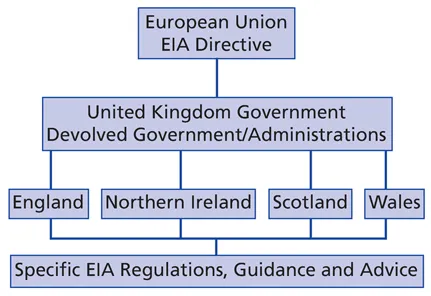
Devolution in the United Kingdom has meant growing emphasis on the individuality of approaches in devolved administrations and their related organisations. The framework within which EIA is carried out therefore consists of:
- the European Union Directive;
- UK Country Regulations which interpret and implement the Directive individually for England, Northern Ireland, Scotland and Wales;
- guidance documents produced by government departments to assist in implementation, including planning policy guidance and other forms of more specific EIA guidance, including guidance on specific types of change or development;
- specialised guidance produced by government agencies, or professional bodies (such as the Landscape Institute and IEMA), dealing with specific aspects of implementation.
This means, depending on project location, that the landscape professional must be aware of the relevant devolved government/administration's requirements with respect to EIA so far as it is pertinent to Landscape and Visual Impact Assessment.
1.6
The EU Directive covering EIA and related matters applies equally to all countries of the UK but is implemented through country Regulations that may be different in each and may also change periodically as they are updated. Each country also has a number of specific Regulations that cover a range of named activities, some of them outside the planning system. Such specific Regulations cover (among other things) electricity supply, transport, fish farming, energy production and transmission, gas and petroleum extraction, water abstraction, forestry, land drainage, agricultural improvements on uncultivated land or semi-natural areas and restructuring of rural land holdings.
Figure 1.1 The EIA hierarchy
1.7
Planning policy guidance also differs across the four countries, as does the specialised guidance that has been issued by government departments and their agencies. The variety of specialist guidance from agencies and others also changes from time to time. Scottish Natural Heritage has been particularly active in producing advice and guidance both on EIA in general and on issues relating to the effects of wind farms in particular.
1.8
EIA procedures require a wide range of environmental topics to be investigated. The European Union Directive, the Regulations that apply in the UK and the guidance documents that support them all list these, albeit with slight variations in the wording. The topics can be summarised as:
- human beings, population;
- flora and fauna;
- soil, water, air, climate;
- landscape;
- cultural heritage (including architectural and archaeological heritage);
- material assets.
1.9
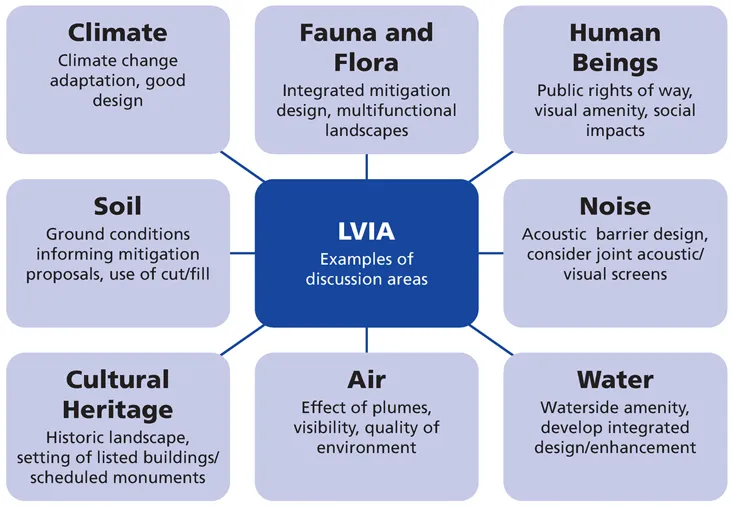
As well as specifically identifying landscape as a topic to be considered, the Directive and the Regulations also make clear the need to deal with the interrelationship between topics. This raises the issue of how landscape interrelates with matters such as, for example, population, flora and fauna, and cultural heritage. Consequently in the context of EIA, LVIA deals with both effects on the landscape itself and effects on the visual amenity of people, as well as with possible interrelationships of these with other related topics.
1.10
This guidance intentionally does not set out to identify or summarise the complex regulatory framework of legislation, Regulations and policy for EIA in general or for more specific aspects of it. To do so would immediately date it as the regulatory framework changes. The websites of relevant government departments and agencies provide the starting point for finding up-to-date information and will usually contain links to other relevant material. Anyone who may be involved in carrying out an LVIA as part of an EIA must ensure that they are fully familiar with the current legislation, Regulations and guidance documents that may be relevant to the specific project or location they are dealing with.
Figure 1.2 Examples of LVIA's relationship with other topics
LVIA in the 'appraisal' of development proposals
1.11
The principles and processes of LVIA can also be used to assist in the 'appraisal' of forms of land use change or development that fall outside the requirements of the EIA Directive and Regulations. Applying such an approach in these circumstances can be useful in helping to develop the design of different forms of development or other projects that may bring about change in the landscape and in visual amenity. Reference is sometimes made to the 'appraisal' of landscape and visual effects when such work is carried out outside the requirements of the EIA Directive and Regulations, and Local Planning Authorities may ask for such 'appraisals' where planning applications raise concerns about effects on the landscape and/or visual amenity. While much of this guidance is concerned with formal requirements for EIA and with the role LVIA plays in that process, the methods described will also be useful in such situations.
LVIA in Strategic Environmental Assessment
1.12
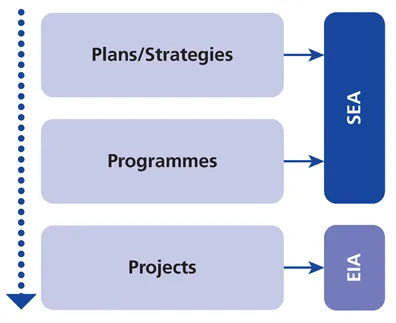
It has been widely recognised that project-level EIA alone cannot lead to comprehensive environmental protection or sustainable development. The European Strategic Environmental Assessment (SEA) Directive 2001/42/EC The assessment of the effects of certain plans and programmes on the environment (European Commission, 2001) is intended to address this and ensure that environmental consequences are addressed at strategic as well as project levels. It applies to certain plans and programmes that are developed by the public sector and by private companies that undertake functions of a public nature under the control or direction of government. This Directive is again transposed into UK law by a series of country-specific Government Regulations.
Figure 1.3 Relationship between SEA and EIA
1.13
Government and UK country agency guidance on implementing the SEA Directive and Regulations includes a similar list of environmental topics to the EIA Directive and Regulations, and so includes landscape. The principles of LVIA set out in this guidance are therefore equally applicable to SEA. There is a degree of overlap between the two processes and landscape and visual amenity issues may arise in both. However, as there is no clearly specified project to be assessed in SEA, the approach is more strategic and generic. The SEA process allows the cumulative effects of potential developments to be taken into account at an early stage of planning and alternative strategic approaches to be considered before decisions are taken, all in a way which is transparent. In England there are close relationships between SEA and sustainability appraisals of development plans, which have been carried out in various form...