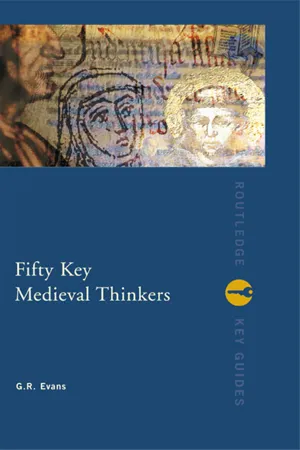
Focussing on individuals whose ideas shaped intellectual life between 400 and 1500, Fifty Key Medieval Thinkers is an accessible introduction to those religious, philosophical and political concepts central to the medieval worldview. Including such diverse figures as Bede and Wyclif, each entry presents a biographical outline, a list of works and a summary of their main theories, alongside suggestions for further reading. Chronologically arranged, and with an introductory essay which presents important themes in context, this volume is an invaluable reference tool for all students of Medieval Europe.
- 224 pages
- English
- ePUB (mobile friendly)
- Available on iOS & Android
eBook - ePub
Fifty Key Medieval Thinkers
About this book
Information
IVO OF CHARTRES c. 1040–1115
Life and times
Ivo of Chartres was probably born near Beauvais, or possibly in the region of Chartres. He was sent to Bec, where he was a pupil of Lanfranc and a fellow pupil of Anselm of Canterbury. He was thus ‘formed’ by the Benedictines. He was Bishop of Chartres from 1090 until his death. As a bishop, from 1092–4 he was much occupied with the remarriage of King Philip I of France and from 1100–04, he was involved in difficulties about the succession to the see of Beauvais. These events brought him into opposition to Philip I and Louis VI. He died in 1115.
Work and ideas
Ivo lived in a period when there was growing awareness of a need for a more coherent system of academic law to underpin and provide guidance in the handling of practical legal problems, of the sort he encountered, like any other bishop, but perhaps with better intellectual and scholarly equipment for dealing with them than most. For Ivo was an interventionist bishop, with an active mind, in an age when many other bishops appear to have been less certain about their duties in canon law. Pressing legal issues arose out of the contemporary debates on simony, clerical celibacy and lay investiture. Gregory VII (d. 1085) had heightened the general contemporary awareness during his active and reforming pontificate. He had been fond of sending papal legates to excommunicate recalcitrant bishops and even to depose metropolitans.
In his legal writing, Ivo was well aware that there was a difficulty about sources. There was no defined corpus for canon law. Would-be canon lawyers could point only to such uncertain collections as the Pseudo-Isidorian Decretals, in which forged texts of fictional popes were brazenly assembled as ‘authentic canon law’ to make up for the deficit of real material. Ivo was the author of the Panormia, the Tripartita, and the Decretum. The last is dependent on the Decretum of Burchard of Worms for much of the content but it is still a pioneering work of its time in the theory of the study of canon law. In the Prologue (it is not certain which work this belongs to) Ivo explains that he has tried to bring together in his immense collection materials from the letters of Popes, the acta of Councils, the Christian authorities and secular legislation. He has arranged everything under topic headings or titles.
Ivo warns the user that he will find things which appear to be contradictory. He should ask himself whether they really are, or whether he should be taking some to be intended to evince severity, others mercy.1 He looked from a lawyer’s point of view (with a glance sideways at the parallel Scriptural problem) at the internal economy of the problem of contradiction. He suggested a new way forward, which was to regard texts as not adversi but diversi.2
He also explores the law on ‘dispensation’, clarifying some laws as immobiles (from which there can be no dispensation), while others are mobiles, and some flexibility can be allowed. There can be occasions when they may be dispensed from, without the law being changed when this happens. For Ivo, the utilitas of the Church and the rule that love is the fulfilment of the law are the guidelines in deciding when this should be done.
Ivo was also the author of a large corpus of letters, more than three hundred, almost all letters of ecclesiastical business, and full of clues to the development of canon law in practice.
Influence
Ivo’s Prologue seems to have had an influence on Alger of Liege, who took up the theme in his Liber de misericordia et iusticia. On Gratian, the author of the definitive Decretum of the twelfth century, too, he had an influence, though Gratian read for himself and independently the component parts of the Corpus iuris civilis of Justinian in his years of preparation for the completion of his book in about 1140. The complete text of the old body of Roman law was only now coming back into academic and practical use and interest in it was running high, at just the time when interest in the study of logic was also mounting. Gratian took such work into account too. And indeed his work went on developing during the second half of the twelfth century, as it moved into the schools and commentaries began to be written on it. Ivo stands at the head of this process for the twelfth century.
Notes
1 A Scholastic Miscellany: Anselm to Ockham, trans. Eugene R. Fair-weather (London, 1956).
2 Cf. PL 162.226–7, Letter 222.
Bibliography
Ivo of Chartres, Panormia and Prologue, PL 161; Prologue, ed. J. Werckmeister, Sources canoniques (Paris, 1997); Correspondance (1090–8), ed. J. Leclercq (Paris, 1949); Ivo of Chartres, Le Prologue, trans. J. Werckmeister (Paris, 1997).
Further reading
M. Grandjean, Laics dans I’ église (Paris, 1994).
MAIMONIDES 1138–1204
Life and times
Moses Maimonides was born at Cordoba where he was taught by his father, who was an expert in the Talmud, the compilation of oral Jewish teaching known as the Mishnah and of authoritative early commentary upon it. He was therefore brought up as a child in Moorish Spain at the period of the maximum intellectual interchange between Christian scholars and those of Judaism and Islam. Under the Abbasids it was an important centre of classical Greek and medieval Arabic learning. At the end of the 1140s Maimonides fled anti-Jewish persecution and settled in Fez in Morocco and then, after a short period, in Cairo, where he became a physician, the family breadwinner and something of a leader of the Jewish community. The rest of his education was thus obtained in a wandering way.
Work and ideas
Maimonides’s first book seems to have been a treatise on logic which he wrote when he was still a boy, but he was not drawn to Aristotelianism in his mature writings except as an ingredient in his interpretative mix. His chief love was Jewish thought. Maimonides’s commentary on the Mishnah, which he finished in early adulthood, was called the Siraj (Book of Illumination). His code on the Talmud appeared in about 1180, setting out in an orderly way the religious beliefs of Jews and the standard interpretations, with further ethical and philosophical commentary. It served something of the purpose of Peter Lombard’s Sentences in contemporary Christian theology, and met some of the same needs of contemporary students for summary and explanatory materials which would help them get their bearings in an increasingly complex mass of knowledge. Of his work on the Jewish law the most noted were perhaps the Book of Commandments and The Book of Knowledge.
The Guide for the Perplexed (c. 1190), an extensive work of philosophy for the educated Jew who found himself in religious difficulties, is perhaps the most significant of his works in Arabic. It assumes that the reader has a good deal of previous knowledge of Greek science and philosophy, or provides clues to such necessary knowledge. The contemporary respect of the Latin West for demonstrative method is visible in Maimonides too. His Guide covers the classic philosophical question: proofs for the existence of God; the nature of theological language; divine attributes; the purpose of the law in human life; the purpose of human life itself.
It is an important lesson of the work of Maimonides that medieval thought in its characteristic preoccupations is a product of the Judaic as well as the Roman and Greco-Christian traditions of late antiquity. There are differences of course. Maimonides as philosopher-theologian is concerned to assist his Jewish readers in their observance of the Old Testament Law, and as a consequence his speculative philosophical writing has a practical air not to be found in the Latin thinkers of his day in quite the same way. Where the Christian author tends to struggle with the relationship between faith and reason, that is, between things which can be ‘known’ only through revelation and by trust in God, and things which can be arrived at by reasoning alone, for Maimonides the division or tension is between these same rational matters and things held because they are beneficial to society (Guide III.27–8).
In Book III.51–4 of the Guide Maimonides brings to an end a general discussion of Law, and the Torah in particular, in which he has been explaining the reasons why the Ten Commandments should be obeyed. He then turns to the practicalities of fixing the mind on God and living in obedience to his Law. He gives the famous ‘parable of the palace’. The Ruler is in his palace, and his subjects are distributed, some within the city, some outside it. Some are trying to reach the place where the Ruler is; others are outside the gates and looking for the way in. To persevere in this quest until one is in his presence requires a new kind of effort, Maimonides suggests.
Influence
Maimonides had a considerable influence on Albert the Great and Thomas Aquinas.
Bibliography
The Book of Commandments, trans. Charles B. Chaval (London, 1967); The Book of Knowledge, trans. Moses Hyamson (New York, 1974); Ethical Writings of Maimonides, ed. Raymond L. Weiss and Charles Butterworth (New York, 1983); Guide of the Perplexed, trans. Schlomo Pines (Chicago, 1963).
Further reading
J. Haberman, Maimonides and Aquinas: A Contemporary Appraisal (New York, 1979); M. Kellner, Maimonides on Human Perfection (New York, 1990); I. Dobs-Weinstein, Maimonides and St. Thomas on the Limits of Reason (New York, 1995); Maimonides: a Collection of Critical Essays, ed. J.A. Buijs (Notre Dame, 1988); B.Z. Bokser, The Legacy of Maimonides (New York, 1950).
RUPERT OF DEUTZ c. 1075–1129/30
Life and times
Rupert of Deutz was born in Liège in about 1075. He became an oblate at St Laurence, Liege and was professed there in 1091. In about 1100–05 the monastery became a Cluniac house. Rupert did not seek ordination and when he reached the proper age, in about 1105–08, he refused it. It seems that he simply wanted to be a monk, and indeed that is how he spent his life.
But he was not a quiet figure, and he enjoyed a dispute. In the period 1113–15 he was engaged in debate on the Eucharist in Liege with Alger of Liege. The controversy with Alger of Liege is touched on Book XII of De sancta Trinitate (On the Holy Trinity) which he wrote about this time (c. 1113–14). In 1114–16 there was more debate, this time at Liege, on predestination, and again, over a period of time, Rupert became involved. The years 1116–17 Rupert spent in exile at Siegburg, still writing. In 1117 he produced De omnipotentia dei. There followed in the same year debates with the Laon masters and bishop William of Châlon-sur-Marne.
There was already a degree of ‘theatre’ in academic disputation. Alger had been secretary to the bishop of Liege for a decade when he made his criticisms. When he attacked Rupert of Deutz for his views on the Eucharist, Rupert responded with vigour, and there were plenty keen to watch the contest, or even to join in. At this date it could be dangerous to a writer’s reputation for orthodoxy to engage in scholarly argument. In his remarks on part of the Rule of St Benedict, In quaedam capitula Regulae Sancti Benedicti, Rupert describes an actual incident in which he was called a heretic: ‘They began to defame me as a heretic who had said that the blessed Augustine was not in the canon.’ Rupert comments that others began to destroy his reputation too: Illi me ex hoc diffamare coeperunt.1
Rupert’s description of this episode hints at more than one encounter, and it is possible to identify a plausible audience of students among the local clergy who seem to have contributed material for Alger’s De sacramentis.
Rupert’s polemic provoked a ‘show-down’. The trigger may have been the point when he pitted his opinions against Anselm of Laon in De voluntate Dei (V.2). That brought him to trial for heresy in September 1116. There is some evidence that the accusations against him were quite wide-ranging, not confined to the eucharistic or predestination issues alone, though those were serious enough. Rupert was accused of being an impanationist, holding that the body and blood of Christ are present in the consecrated bread and wine by being somehow ‘inside’ it, and not by transforming it. He would have been condemned, it has been suggested, but for the surprise intervention of Abbot Cuno of Siegberg.
There remain questions about ‘who started it’ (did Alger initiate offensives against Rupert or Rupert against Anselm of Laon?), as well as uncertainties over what it was about. But what seems fairly certain is that not only Rupert but his supporters and detractors enjoyed it and saw it as legitimate debate, and the affair turned ‘nasty’ only when it began to appear that Rupert might find himself condemned for heresy.
There was then, in these events, a slippage between the academic and the ecclesiastical worlds, in which a lively exchange of views could become a dangerous game. Rupert escaped partly by making shrewd moves, allying himself with ‘the Church’ against those who challenged it, and identifying those challengers with his enemies.2
Rupert was not cured of disputatiousness by the experience of his trial. Later in life he was arguing with the canons regular and the Jews. Rupert was engaged in debate with the Jew Hermannus in Munster in 1128. Hermannus gave his own account of this in De conversione sua, and something of their talk appears to be reflected in Rupert’s Commentary on the Minor Prophets. Hermannus describes how he first encountered and began to talk to Christians while staying in the royal household of Lothar at Mainz on business. Lothar had in his entourage Ekbert, to whom Hermannus talked. (This is perhaps a glimpse of a continuation of the royal or imperial household as the forum of exchange of ideas it had often been in the Carolingian period.)
With the zeal of a convert, ...
Table of contents
- Cover Page
- Title Page
- Copyright Page
- Contents
- Preface
- Introduction
- Augustine of Hippo
- Ambrose of Milan
- Jerome
- PS-Dionysius c.500
- Cassiodorus
- Boethius
- Gregory the Great
- Isidore of Seville
- Bede
- Paschasius Radbertus
- Johannes Scotus Eriugena
- Hincmar of Rheims
- Remigius of Auxerre
- Gerbert of Aurillac
- Berengar of Tours
- Peter Damian
- Anselm of Canterbury
- Hugh of St Victor
- Adelard of Bath early twelfth century
- Ivo of Chartres
- Maimonides
- Rupert of Deutz
- Peter Abelard
- William of Conches
- Bernard of Clairvaux
- Anselm of Havelberg
- Averroes (Ibn Rushd)
- Peter Lombard
- John of Salisbury
- Hildegard of Bingen
- Joachim of Fiore
- Francis of Assisi
- Robert Grosseteste
- Roger Bacon
- Bonaventure
- Albertus Magnus
- Thomas Aquinas
- Siger of Brabant
- Johannes Duns Scotus
- Dante Alighieri
- Ramon Llull
- Meister Eckhart
- Thomas Bradwardine
- William of Ockham
- Baldus of Ubaldis
- John Wyclif
- Pierre D'Ailly
- Jean Gerson
- Nicholas of CUSA
- Gabriel Biel
- Index
Trusted by 375,005 students
Access to over 1.5 million titles for a fair monthly price.
Study more efficiently using our study tools.
Frequently asked questions
Yes, you can cancel anytime from the Subscription tab in your account settings on the Perlego website. Your subscription will stay active until the end of your current billing period. Learn how to cancel your subscription
No, books cannot be downloaded as external files, such as PDFs, for use outside of Perlego. However, you can download books within the Perlego app for offline reading on mobile or tablet. Learn how to download books offline
Perlego offers two plans: Essential and Complete
- Essential is ideal for learners and professionals who enjoy exploring a wide range of subjects. Access the Essential Library with 800,000+ trusted titles and best-sellers across business, personal growth, and the humanities. Includes unlimited reading time and Standard Read Aloud voice.
- Complete: Perfect for advanced learners and researchers needing full, unrestricted access. Unlock 1.5M+ books across hundreds of subjects, including academic and specialized titles. The Complete Plan also includes advanced features like Premium Read Aloud and Research Assistant.
We are an online textbook subscription service, where you can get access to an entire online library for less than the price of a single book per month. With over 1.5 million books across 990+ topics, we’ve got you covered! Learn about our mission
Look out for the read-aloud symbol on your next book to see if you can listen to it. The read-aloud tool reads text aloud for you, highlighting the text as it is being read. You can pause it, speed it up and slow it down. Learn more about Read Aloud
Yes! You can use the Perlego app on both iOS and Android devices to read anytime, anywhere — even offline. Perfect for commutes or when you’re on the go.
Please note we cannot support devices running on iOS 13 and Android 7 or earlier. Learn more about using the app
Please note we cannot support devices running on iOS 13 and Android 7 or earlier. Learn more about using the app
Yes, you can access Fifty Key Medieval Thinkers by G.R. Evans in PDF and/or ePUB format, as well as other popular books in Philosophy & European Medieval History. We have over 1.5 million books available in our catalogue for you to explore.