Chapter 1
Being there
This book is about being there: about the nature of past lives at a time remote from the present. It tries to capture something not only of the central concerns but also of the many-sidedness and frequent messiness of existence. It seeks to show how we can avoid reducing social existence, and the people who constituted that, to a single dimension. It is about different ways of looking at scales of action and thought, which resist the common tactics of choosing one scale over another or of lapsing into unhelpful abstraction. In taking this theme, I hope also to open fresh ways of looking at the recurrent tensions between the individual and the collective, diversity and uniformity, and change and stability.
Two examples
Two initial examples, from my own recent research, help to set out the nature of the questions at stake. The causewayed enclosure at Windmill Hill, Wiltshire, in southern England, was constructed around or perhaps a little before 3500 BC, some centuries after the beginning of a different way of life in its region (Whittle et al. 1999). At a general level, this construction can be seen as a powerful statement of identity and central values. Its very form, concentric rings of interrupted ditches, may recall, whether consciously or unconsciously, that of much earlier constructions on the European mainland, which date back over 1,500 years (Figure 1.1). As such, it could be seen as an idealisation of a notion of ancestral settlement, a mythical form from a distant past (Bradley 1998a), all the more startling because this was not the first kind of construction to be attempted; in our jargon, other ‘monuments’ such as long cairns and long barrows had already been built in this region. More down to earth, the form of the enclosure might also draw on the shape of either contemporary camps or natural clearings and man-made clearances in woodland, and the placing of the vast construction in probably little altered woodland must raise the question of how people regarded their surroundings. These are the first of a series of probable metaphors, the defined space of this carefully constructed arena and the many things deposited within it standing for a string of ideas and concepts. As often commented, the segmented ditches may symbolise the disparate groups involved in construction and perhaps use of the site. In the ditches, the placed deposits, principally of animal bone, may evoke the importance of animals and their ambiguous relationship withpeople, and the central place of gathering and feasting in contemporary social existence. Animal bone deposits may also stand for the deposits of human bone encountered in larger quantities in other constructions, shrines, ossuaries or tombs housed in long barrows and cairns; the necessity to kill animals, as well as the social imperative of valuing them alive, may also be bound up with fear of killing people and the uncomfortable facts of inter-personal violence. Other things deposited, such as potsherds and stone artefacts, may stand for social interaction and relations with neighbours and allies, on the one hand, and the very fact of contemporary domestic existence on the other. At another level of abstraction, the dominant metaphors worked and re-worked at this site may present ideas of transition, transformation and renewal: a further set of attitudes to time and consciousness of self.
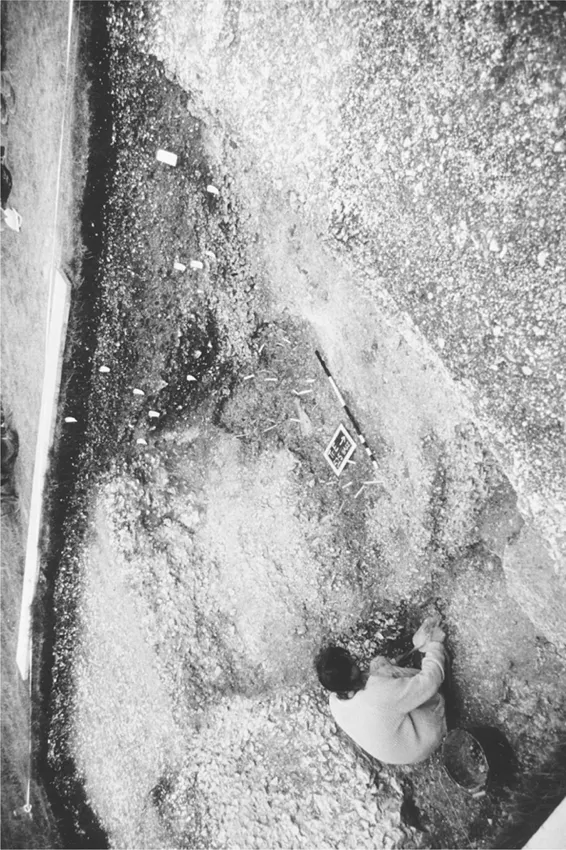
Figure 1.1 Excavation in 1988 of the middle ditch (Trench E) on the north side of the Windmill Hill enclosure, southern England. Abundant but small bone deposits were contained in a complex stratigraphy, close to the terminal of the ditch segment in question. Photo: author.
With so much to say about this one arena, and with so many other enclosures, barrows and cairns from the same period and area to consider, should we be content with this evidence and these kinds of interpretation? There are at least three problems. Research over the last two decades has shown that no one enclosure is quite like any other. Even regional groupings by form and layout may have been much exaggerated (Barclay 2000). From site to site, people might be seen as having drawn on a repertoire of common ways of doing things, but as having used these according to local circumstance and choice. We hardly yet understand this diversity, though it has often been described. Was it the product of deliberate statements about difference and otherness, or the accidental result of relative isolation and rituals infrequently performed? Did people come from far and wide to participate, or were these exclusively local affairs?
The second problem is how to relate these enclosures to their local contexts. The now over eighty or so enclosures of southern England (Oswald et al. 2001) are found in a considerable range of settings, none of which we yet comprehend very well. Around Windmill Hill, for example, other evidence, apart from that of barrows and cairns, is frustratingly limited to occasional pits, lithic scatters and fragments of old occupation surfaces preserved under earthworks. Much can be done with these, especially in areas where a density of monuments provides close sampling spots, as in Cranborne Chase (M.J. Allen 2000), but there is little getting round the fact that the dominant metaphors explored above tend to float above their local contexts. Whether or not this matters may depend on the view one has of ritual. Some ritual, like myths (J.F. Weiner 1988, 16), may simply operate in different domains from other aspects of life and thought. In that case, discussion of causewayed enclosures could legitimately be self-contained, and their dominant metaphors be taken as those of a realm of special consciousness. In other views, ritual is not to be so easily disconnected from other activity. Ritual, or better, rituals, may be a formalisation of other activities (Bell 1992), and part of their role at least may be to transform for people their understanding of what is understood in other contexts (Bloch and Parry 1982, 19). In this case, we badly need to know more about other contexts. Around Windmill Hill, this kind of evidence is meagre. What is principally suggested is a series of rather simple depositions in pits and other contexts, as part of what may have been quite transient and short-lived occupations, such as outside the enclosure on Windmill Hill itself (Whittle et al. 2000) or at Cherhill (Evans and Smith 1983). People may have been routinely accustomed to small-scale gatherings and attendant depositions.
This brings us to the third problem. The emphasis given in our discussion of the dominant metaphors of the Windmill causewayed enclosure sits uneasily with more detailed consideration of the deposits in question themselves. We analysed these carefully, Caroline Grigson giving especial attention to species, body parts, fragmentation and weathering, and Joshua Pollard to the wider evidence from earlier excavations at the site for combinations of finds (Grigson 1999; Pollard 1999a). We suggested some recurrent kinds of deposit, based on form, composition and possible history before final deposition (Whittle et al. 1999). In the end, a stark contrast remains between, on the one hand, the big ideas possibly represented by the totality of the site and the big-scale event that its original conception and construction must surely have marked, and on the other, the generally small-scale and perhaps often rather mundane nature of what was placed in the ditch segments of the site once active: the partial remains of an animal or two, sherds of broken pottery, some stone implements, sometimes charcoal, ash and blackened soil. How then were the supposed dominant metaphors of the site actually conceptualised, and what was really different in the use of the arena compared to ‘out there’ in the landscape? Was it in the end the power of memory, the recognition of a special setting, and perhaps the monumentality of the construction itself that mattered, rather than the ensuing commemorative acts of deposition?
Until we have better models of individual action and its relationship to collective practice, and of how people think in and across different domains of their existence, the interpretation of this kind of situation, intriguing and evocative though it is, will remain problematic. More or less the same difficulties recur in the quite different setting of my second example, and this recurrence indicates the general problem with which I am concerned.
We know very little about settlement of the river systems of the Carpathian basin before the late seventh and the very first part of the sixth millennia BC. We know something of quite concentrated forager populations in the Danube Gorges (Radovanović 1996), whose diet seems to have been based firmly on the resources of the Danube (Bonsall et al. 1997; 2000), and a little about forager populations in the hills to the west and north of the Carpathian basin. Some of these latter may have been quite mobile, while in the Gorges there may have been both periodic (or longer) aggregations of people, and connections to much wider regions seen in movements of raw materials (Chapman 1993). We may therefore have to think of systems operating at a regional scale. This may have included people making forays into the Carpathian basin itself, though the evidence is very sparse, apart from newly discovered but still imprecisely dated occupations on the northern edge of the Great Hungarian Plain, north of the Tisza valley near Szolnok (Kertész 1996). This is the necessary preamble to what happens next, before 6000 BC in the southern part of the basin (in the northern part of former Yugoslavia), and after 6000 BC in its central part (on the southern half of the Great Hungarian Plain).
From these dates, a series of changes ensue. People living off sheep, goats and other domesticates, as well as a wide range of wild game, fish, birds, cultivated cereals and probably other wild plants, came gradually into the Carpathian basin, probably from south to north (Figure 1.2). Their occupations can now be found plentifully along the watercourses of the basin, as far north as approximately half way up the Great Hungarian Plain (e.g. Kosse 1979; Jankovich et al. 1989). These consist of pits dug into the subsoil, and where they are preserved, thin occupation levels; some surface structures, perhaps shelters or small houses, are known. Finds of animal bone, pottery and other artefacts are abundant, for example at the small occupation of Endrőd 119 in the Körös valley (Makkay 1992).
Research on this phenomenon has concentrated for decades on big questions of the identity of this population (generally favouring the idea of some kind of colonisation by people coming up from further south in the Balkans), its choice of settlement location (strongly waterside as we have seen), its main means of subsistence and the general character of existence (generally seen as sedentary and agriculturally based). These remain important questions. The problem of identity can be seen in fresh light as continued research has shown how indigenous people in the Gorges were directly involved in these changes, and how, although new forms of settlement spread at first only so far across the Hungarian Plain, there were contemporary changes involving the use of very simple pottery and the building of houses on the west side of the Danube at least as far north as Vienna (Whittle et al. 2002). It is possible that local or regional populations were involved in or were part of these processes of change. One study of lithics has suggested that although obsidian raw material was procured from sources well to the north, in the hills of southern Slovakia and northern Hungary, well beyond the limits of the new phenomena on the southern half of the Great Hungarian Plain, the style of flint working and use owed little to indigenous traditions (Starnini 2000). In other cases, however, the details of lithic reduction and point technology may suggest some such continuity, as at Brunn outside Vienna and Ecsegfalva 23 in the central part of the Great Hungarian Plain (Peter Stadler, pers. comm.; Mateiciucová 2001). The very broad spectrum of resources used in the waterside environments of the Great Hungarian Plain, including plentiful fish, small game, freshwater shells and birds (e.g. Bökönyi 1992; Takács 1992), could speak for the continuation of forager subsistence traditions, even though it is likely that sheep, goats and cattle provided more food than all these other resources put together. Though no ancient DNA has yet been obtained from samples of this early date on the Great Hungarian Plain, study of mitochond-rial DNA in modern populations has suggested a general European picture of only about one-fifth of the population being of non-European descent (Sykes 1999). It may therefore be appropriate to begin to model a complex process of limited, gradual and perhaps targeted northward colonisation by population from the south, combined with adaptation and change among local or regional indigenous populations.
These are important questions, and if one is optimistic, the ‘impenetrable whodunnit’ of identities (Halstead 1989, 24) could be seen as now a little closer to resolution. They remain, however, questions set at a very general level. Rather less attention has been given to variation or individuals in these situations. On the Great Hungarian Plain, people clearly lived in varying settings. The overwhelming majority of these were waterside, but while some occupations were on the edges of active river systems, others were strung out along older alluvial deltas, and some, as at Ecsegfalva and Szarvas, on large still-water meanders. We do not yet understand the significance of such variation, though it might be to do with seasonal preferences. The occupation of place may have been significant in the construction and maintenance of identity. This is particularly so around the Ecsegfalva meander, where occupations appear relatively small but concentrated on particular points in the landscape, which were avoided at later dates.
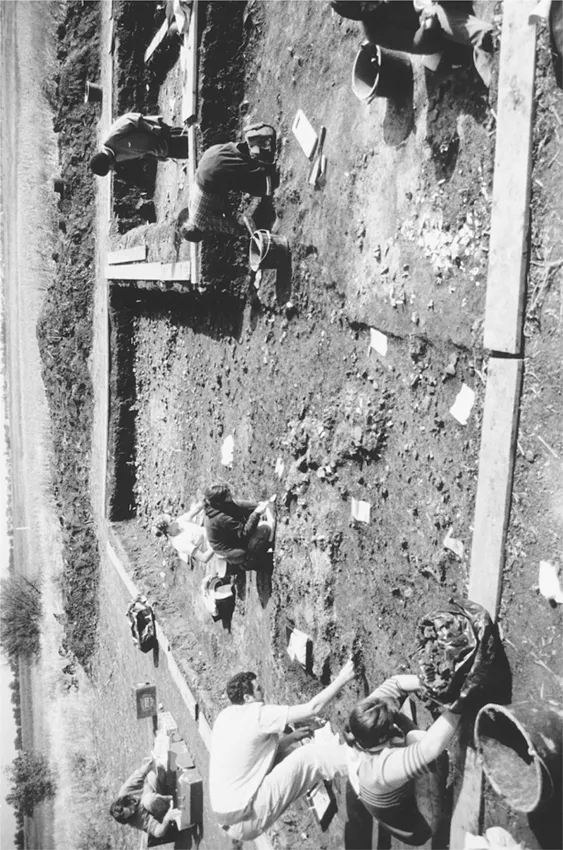
Figure 1.2 Excavation in 2001 of the occupation at Ecsegfalva 23, one of a series of sites near the northern limits of the Körös culture on the Great Hungarian Plain, showing remains of a burnt structure. Photo: author.
We also know rather little of the day-to-day conditions of existence. One or two small structures or houses are known (e.g. Raczky 1983) but the evidence is often elusive, as at Endrőd 119, where burnt daub was concentrated at the top of large infilled pits (Makkay 1992). Likewise at Ecsegfalva 23, careful recovery has so far shown considerable quantities of burnt daub, but few signs of postholes or stake-holes. It is possible that light, reed- and daub-covered structures are in question. One possibility is that the quantities of daub observed would only be produced by deliberate firing of these structures (Ammerman et al. 1988). A series of excavations has shown the existence of large and small pits, and both Endrőd 119 and Ecsegfalva 23 suggest that light structures could have been accompanied by at least one large pit complex and accompanying space around it. Most pits were deliberately rather than naturally filled. A complex cycle of comings and goings may be likely, the taking of places being marked by digging into the ground, and abandonment being marked by deliberate re-filling, as well as by the burning of small houses. It may be that the pollution of death was regarded as one good reason to shift from place to place (Chapman 1994).
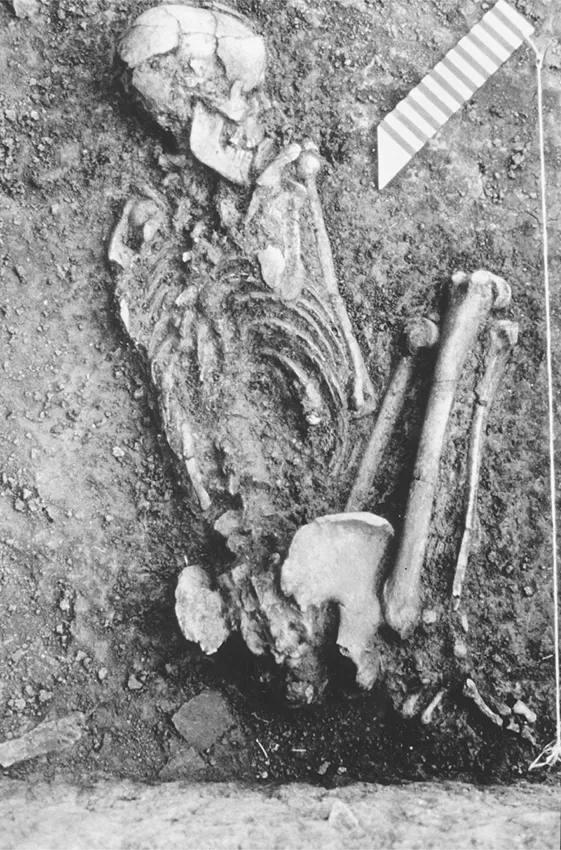
The evidence of one such burial puts the question of scales of analysis into sharp relief. Excavation at Ecsegfalva 23 in 1999 found the skeleton of one adult woman (Figure 1.3) (Whittle 2000a). The skeleton was crouched and the body had presumably been tightly bound, before being placed on the ground, not in a grave, above filled up shallow features at the edge of the occupation; it is hard to envisage contemporary occupation close by while the body decomposed. In itself, there is little unusual in this, as burials of mainly women and children have been found on many Körös culture occupations, in varying body positions and degrees of completeness (Trogmayer 1969; Chapman 1994). Intriguingly, the woman at Ecsegfalva had bad teeth. There were large cavities in the sides of her molars, and her front teeth, like the others, were worn well down. Across the ground surface of her upper two front teeth, there was a narrow groove, worn into the surface of the teeth, presumably by some repetitive action such as the working of sinew (Ildikó Pap and Rick Schulting, pers. comm.).1
We are confronted with a series of questions at different scales and it is hard to bring these together. At one level, we can investigate a general transformation in identity, choice of settlement areas and the use of new subsistence resources. At another we can investigate regional variation in such transformation. We can examine not only preferred locations for occupation, but also the use of place as a means of creating local identity. There is the problem of what occupations looked like, how long they were maintained and the circumstances in which they were abandoned. Or we can concentrate on individuals. The evidence of the Ecsegfalva woman suggests rather different perspectives on the wider phenomena. Perhaps her diet did not particularly suit her, giving problems with her teeth, unless she was predisposed to such difficulties. In either case, the experience of her adult life was presumably strongly coloured by pain. The particular use of her front teeth as a ‘third hand’ might suggest not only repetitive and unglamorous but also boring activity. How conscious would such a person have been of the wider histories of which she was part? The radiocarbon dates from the site so far may allow for memory of beginnings a few generations earlier. The woman presumably understood and probably took part in a range of subsistence activities. The facts of domestication may have been partly taken for granted, though people may have also been very conscious of the difference between wild and tame. On the other hand, the provision of food and drink in social gatherings, symbolised perhaps by the pottery so abundantly found in all these occupations, may have been much more important than the source of such food in itself. The cycle of occupations, and the significance of local place, may have been at least as important in the consciousness of people as the means of subsistence which have dominated the literature for so long. Place was hand-made, the walls of structures being framed by bundles or mats of reeds, and covered with clay which still bears finger impressions.
Figure 1.3 A woman of the Körös culture (or the succeeding AVK) from Ecsegfalva 23, notable for her delicate skeleton and bad teeth. Photo: author.
In both examples, we need much better integration of routines and daily activity with what went on at special times and places, of individualism with the ties that bind, of the present with the past and memory, and of people with their animals. In both cases, there are competing possibilities for what was thought significant, and what was remembered. We need a far better sense not only of how people acted, but also of how they thought, as both individuals and collectivities.
Structure and agency
The starting point of this book is that while a lot of research has been concentrated on particular aspects or scales of the kinds sketched so far, rather little has been offered by way of integration. It is an appropriate time to try, as these sorts of issue have begun to be widely debated. Ian Hodder has drawn attention to the need in studies of the British Neolithic to take account of individual action (1999, 132–7; cf. Hodder 1986), and Mark Edmonds has written an unusually empathetic account of the southern British Neolithic (1999). The relationship between what have come to be called structure and agency has begun to be widely debated in archaeology (e.g. Hodder 1999; Dobres and Robb 2000a; cf. Layton 2000), typically some time after the initial debates in the field of social theory and social anthropology. The principal sources have been Bourdieu and Giddens, each in turn influenced by a number of earlier and contemporary writers, including Mauss in the case of Bo...