eBook - ePub
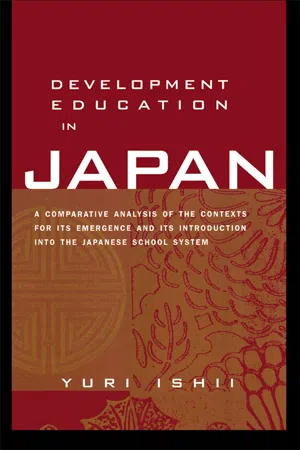
Development Education in Japan
A Comparative Analysis of the Contexts for Its Emergence, and Its Introduction into the Japanese School System
- 224 pages
- English
- ePUB (mobile friendly)
- Available on iOS & Android
eBook - ePub
Development Education in Japan
A Comparative Analysis of the Contexts for Its Emergence, and Its Introduction into the Japanese School System
About this book
This book aims to provide an explanation for the slow introduction of Development Education in Japan.
Information
Topic
EducationSubtopic
Education GeneralPart One
1
Development Education: The Term and the Concept
INTRODUCTION
Meanings of development education have been constructed over time by a variety of agencies and actors, and these meanings have also varied from one place to another. This chapter explores the range of meanings attached to the concept of development education and arrives at a definition that is operationally useful for the discussion in this book. In particular, a clear distinction is made between development education as a general concept and the activity of teaching development education in schools. The complexity of the genesis of development education and its controversial nature will be shown through the discussion on its historical background and the investigation of definitions. The final section provides the definition for the term development education as used in this book.
AN OVERVIEW OF THE HISTORY OF DEVELOPMENT EDUCATION
The term development education appeared around the mid-1960s. Although that is now more than thirty years ago, there is still confusion about what development education is. A number of people have attempted to clarify its meaning and have reached a conclusion that there is no one established definition.1 According to Robin Burns, the variety of definitions is due different interpretations of the two words, “development” and “education.”2 Indeed, discussions about their meanings are still going on, as evidenced by the evolution of development theories and disputes over educational policies that occur every where in the world.
Despite this confusion, development education still exists as a type of education. Its historical background shows why and what kind of different interpretations of development education arose.
The 1960s: Eve of the Genesis of Development Education
According to some European nongovernmental organizations (NGOs), the creation of development education by NGOs can be divided into three phases, depending on the concept promoted by activities and the form of the activities at that time.3 The first phase goes up to the end of the 1960s, the second phase takes place during the 1970s, and the third, from 1980 onward.4 Since the United Nations, which contributed to the creation of development education, also divides its campaign for development by these decades, this chapter follows these divisions for the analysis of the genesis of development education.
NGOs, including church-related organizations in countries such as the Netherlands, Canada, the United Kingdom, France, and Sweden, activated overseas aid to newly independent developing countries in the 1960s.5 In the late 1950s and the 1960s, these organizations started public information activities to let people in their own countries know about developing countries.6 This is the first phase of the genesis of development education.
During this period, the NGOs’ overseas aid was considered as charity rather than cooperation between partners. The purpose of the information activities was fund raising rather than raising awareness of their own people about developing countries.7 In order to move people to donate money, problems such as poverty and hunger in developing countries, and how the organizations were fighting against these problems, were emphasized.8 Thus, the recipients of the information were considered mainly as a source of funding and remained uninvolved.
The issue of developing countries also emerged as an important political theme in the United Nations in the 1960s because of the increasing number of developing countries in the organization.9 The United Nations launched the First Development Decade in order to respond to the needs of developing countries.10 During that period, the Food and Agriculture Organization (FAO) promoted the Freedom From Hunger Campaign, which, like information activities by NGOs, aimed at raising the awareness of people in member countries about hunger and poverty in developing nations.11 Thus, both NGOs and the United Nations recognized that problems in developing countries should be known to people in other countries, but public information activities had not yet developed into a definition of something to be taught in schools.
Behind this was a limitation of understanding about problems in developing countries in the 1960s. Since modernization theory was influential, the economics of developing countries were theoretically expected to follow the examples of economic growth in the western industrialized countries once advanced technology and skills were transplanted from those countries.12 The link between the problems andthe world economic system had not yet been noticed. As a consequence, the problems were considered irrelevant to the lives of people in industrialized countries and did not yet constitute part of school education.
After the 1970s: The Legitimation and Diversification of Development Education
Modernization theories faced criticism by the end of the 1960s.13 The trickle down of wealth from the rich to the rest of society in developing countries did not occur. Dependency theories asserted that the cause of the inability of developing countries to catch up with industrialized countries existed in the structure of the world economic system.14 Thus, problems relating to hunger and poverty started to be understood as a product of the world economic system, which was generating economic disparity, rather than as something relevant solely to developing countries. In 1970 the United Nations adopted the Second Development Decade and suggested in its strategy that governments of industrialized countries, as well as developing countries, should make efforts to inform people in their respective countries of problems in developing countries.15
Around this time, NGOs recognized the importance of getting to know more about the local contexts of developing countries.16 At the same time, the problems of developing countries were reinterpreted as a problem of the structure of societies in industrialized countries.17 The necessity of teaching about the link between the problems and industrialized countries in formal education was recognized by NGOs and governments in some industrialized countries.
The Swedish government promoted in its educational reform of 1969 such teaching in the formal educational system.18 Furthermore, in 1970 the Swedish International Development Authority (SIDA) and the National Board of Education held a European Development Education Workshop with FAO and UNESCO. The report Development Education: The Schools Open to the Third World was published after the workshop.19 In this workshop, not only did the term development education appear in an official document, but also development education was used to mean a form of education in schools.
In Canada, as well, the term development education was used for teaching about developing countries and their problems. Several NGOs started focusing on school education as a means of promoting understanding about developing countries. For example, in 1968 the London Cross Cultural Learner Centre was established, and in 1970 the Development Education Centre was started by OXFAM–Canada.20 In 1969 CUSO (Canadian University Service Overseas) adopted as its policy the promotion of the Canadian peoples’ understanding about developingcountries and started a mobile education center and school education program in 1972. 21
Public information activities for fundraising by NGOs in some industrialized countries changed their nature toward a more educational form so that it could be introduced to schools as content that young people should learn. For example, in Belgium, there was a shift from fundraising activities for charity to “effective Development Education programs aimed at promoting awareness raising activities.”22 In France, “help to developing countries accompanied by a better knowledge of the causes and mechanisms of this under-development” was suggested.23 Thus, the 1970s started with the movement toward the creation of development education as something to be taught in schools as well as social education. Attempts to give a definition and a name to this new form of education accompanied the movement.
As Burns suggested, definitions given to development education were diverse. This diversity is linked with the expansion of development education. Tim Brodhead, who worked for a Canadian NGO, suggests that there was progress on at least five points during the 1970s. The five points can be summarized as:
- The need to inform people about development issues was recognized and the expansion to organized education through, for example, labor unions, mass media, school systems, and other social systems occurred.
- The recognition of the interdependence between industrialized countries and developing countries changed the charity mentality to an understanding of the need for equal distribution of global resources.
- The need for solidarity between oppressed people in industrialized countries and developing countries was recognized.
- The start of international networking of the NGOs was a common theme.
- The emergence of an understanding of development education as a strategy for collective survival and for changing the life styles in industrialized countries.24
This expansion and diversification of doers in development education generated conflicts among them.25 For example, there were development education as part of school education, development education as advocacy by NGOs, and also development education as propaganda for promoting support of the United Nations or governmental aid policy. Development education in schools has an emphasis on educating pupils to develop a critical way of thinking, while development education, as NGOs’ advocacy, tends to be oriented to action for social change.26 UN agencies tend to include the interpretation that development education is also used for education in developing countries.
This diversification, which occurred in the 1970s, basically remained until the 1990s. Or rather, diversification has become more complicated as a result of some more recent interpretations.27 On the one hand, the interpretation of development changed in the 1980s toward placing more emphasis on the balance between economic development and the ecosystem because of “the disenchantment with material growth” and increasing ecological crisis.28 Subsequently, a new variation was added to development education. On the other hand, development education expanded, in Pradervand’s words, to “the extent one might describe it… [as]… ‘Nothing pertaining to the human condition is alien to me,’”and among NGOs, “some groups originally concerned solely with the Third World, now devote themselves entirely to national issues.”29 With these new topics, borders between development education and other types of education such as environmental education and human rights education became blurred.
Thus, in historical terms, definitions of development education have become more diverse since the term was created because of more doers being involved, the evolution of the concept of development, and attempts to exp...
Table of contents
- COVER PAGE
- TITLE PAGE
- COPYRIGHT PAGE
- SERIES PREFACE
- ACKNOWLEDGEMENTS
- INTRODUCTION
- LIST OF ACRONYMS
- PART ONE
- PART TWO
- APPENDIX 1 THE NATIONAL CURRICULUM FOR GEOGRAPHY A
- APPENDIX 2 THE THEMES OF EXHIBITIONS BY CLASSES IN THE SCHOOL FESTIVAL AT HEIWA THAT ARE RELEVANT TO DEVELOPMENT EDUCATION
- NOTES
- BIBLIOGRAPHY
Trusted by 375,005 students
Access to over 1.5 million titles for a fair monthly price.
Study more efficiently using our study tools.
Frequently asked questions
Yes, you can cancel anytime from the Subscription tab in your account settings on the Perlego website. Your subscription will stay active until the end of your current billing period. Learn how to cancel your subscription
No, books cannot be downloaded as external files, such as PDFs, for use outside of Perlego. However, you can download books within the Perlego app for offline reading on mobile or tablet. Learn how to download books offline
Perlego offers two plans: Essential and Complete
- Essential is ideal for learners and professionals who enjoy exploring a wide range of subjects. Access the Essential Library with 800,000+ trusted titles and best-sellers across business, personal growth, and the humanities. Includes unlimited reading time and Standard Read Aloud voice.
- Complete: Perfect for advanced learners and researchers needing full, unrestricted access. Unlock 1.5M+ books across hundreds of subjects, including academic and specialized titles. The Complete Plan also includes advanced features like Premium Read Aloud and Research Assistant.
We are an online textbook subscription service, where you can get access to an entire online library for less than the price of a single book per month. With over 1.5 million books across 990+ topics, we’ve got you covered! Learn about our mission
Look out for the read-aloud symbol on your next book to see if you can listen to it. The read-aloud tool reads text aloud for you, highlighting the text as it is being read. You can pause it, speed it up and slow it down. Learn more about Read Aloud
Yes! You can use the Perlego app on both iOS and Android devices to read anytime, anywhere — even offline. Perfect for commutes or when you’re on the go.
Please note we cannot support devices running on iOS 13 and Android 7 or earlier. Learn more about using the app
Please note we cannot support devices running on iOS 13 and Android 7 or earlier. Learn more about using the app
Yes, you can access Development Education in Japan by Yuri Ishii in PDF and/or ePUB format, as well as other popular books in Education & Education General. We have over 1.5 million books available in our catalogue for you to explore.