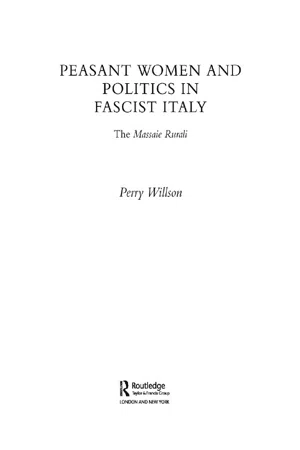
Peasant women were the largest female occupational group in Italy between the wars. They led lives characterised by great poverty and heavy workloads, but Fascist propaganda extolled them as the mothers of the nation and the guardians of the rural worlds, the most praiseworthy of Italian women.
This study is the first published history of the Massaie Rurali, the Fascist Party's section for peasant women, which, with three million members by 1943, became one of the largest of the regime's mass mobilizing organizations. The section played a key role in such core fascist campaigns as nation-building and ruralization. Perry Willson draws on a wide range of archival and contemporary press sources to investigate the nature of the Massaie Rurali and the dynamics of class and gender that lay at its heart. She explores the organization's political message, its propaganda and the reasons why so many women joined it.
- 240 pages
- English
- ePUB (mobile friendly)
- Available on iOS & Android
eBook - ePub
About this book
Information
Subtopic
20th Century HistoryIndex
History1
PEASANT WOMEN, THE RURAL WORLD AND THE FASCI FEMMINILI
The pattern of agricultural production and women’s place in this system helped determine how the fascists attempted to mobilize them politically. Agriculture was still Italy’s largest single economic sector in this period. Despite rapid economic growth around the turn of the century, which had created pockets of modern industry, mainly in the ‘industrial triangle’ of the North, millions still worked on the land. Numbers of those occupied by this sector remained high during the first half of the twentieth century and by 1936 were still roughly the same as in 1901. According to the 1931 census 41.5 per cent of Italian families (3,800,000 families) had a ‘head of family’ engaged in farming. The rural world, however, was far from static. Since Unification a series of forces, including the increased role of the market, the agricultural crisis of the 1880s, the rise of socialism, emigration and technological innovation had led to much change.1 In some rural areas, moreover, industry had an increasing impact on traditional lifestyles.2 Rural industry varied greatly including both factories (mainly textiles and food processing) and various types of cottage industry. Large numbers of Tuscan peasant women, for example, made straw hats for export until the 1929 crash destroyed their markets.3 The First World War only served to accelerate processes of change when over two and a half million peasants went to the front.
Rural Italy was a mosaic of different types of farming and such changes interacted with local situations in diverse ways. Not just crops and methods of cultivation but the size of holdings, modernity of farming techniques and forms of land tenure varied greatly from region to region, and even within close geographical areas.4 It is, of course, beyond the scope of this chapter to properly investigate this complex panorama, one which has been the focus of a considerable volume of historical research. I will limit myself to a consideration of the main types of peasant figure, a brief overview of fascist agricultural policy and a look at women’s role in agriculture. Finally I will discuss the founding of the fascist women’s sections and their attitude to rural questions.
During the rise of fascism, peasants were to be found in a variety of positions on the political spectrum. Italy, of course, was unusual in Western Europe in that socialism had spread in some rural areas at the end of the nineteenth century. Just after the First World War, large numbers of peasants, particularly landless farmworkers but also sharecroppers, belonged to socialist organizations. Others, including many smallholders, joined Catholic ‘white’ leagues. These had previously been tiny but now grew with, by 1920, nearly a million members.5 Yet others rallied to the blackshirts. There were still, however, many peasants little affected by organized politics. Italy’s formidable geography meant that many had little interaction with the world beyond their farm and local community.
The lives of many Italian peasants were characterized by great hardship, poverty, insufficient diet and poor health. Insanitary and overcrowded housing was widespread. It was even possible to find peasants who lived in dwellings made of earth and foliage, or in caves or cellars. These were the most extreme cases but a survey of 1933 classified the housing of a third of the rural population as either ‘uninhabitable’ or ‘almost uninhabitable’.6 Very few had running water or electricity.
Only hard labour could wrest a living from Italy’s difficult terrain, 35.5 per cent of which was classified as ‘mountainous’, 53.5 per cent as ‘hilly’ and only about 12 per cent as ‘plain’. Much farmland was the product of earlier reclamation efforts, mainly terracing, irrigation and drainage. Not all human interventions had improved things: some areas suffered from deforestation and soil erosion. Mechanization was introduced only slowly, held back by the abundant labour supply, fragmented landholding and steep slopes. In 1936, for example, Italy had only 32,500 tractors and 30,000 threshing machines.7 Rural unemployment and underemployment were endemic, problems greatly exacerbated by the reduction in emigration.
The peasantry was still the largest occupational group in interwar Italy. Behind the single term ‘peasant’ hid a complex range of different figures. Most belonged to one of three major categories: landless farmworkers, smallholders (tenants or owners) and sharecroppers. There were also various kinds of ‘mixed’ figures, such as smallholders who also did seasonal day labouring. Other peasant figures were essentially variations of the three main categories.8 All figures were found all over Italy although some broad generalizations are possible. Landless labourers were most numerous on the modern farms of the Po Valley, although even here there were also many other types of peasant. ‘Pure’ sharecropping (mezzadria classica) was most common in the Centre. In the South pockets of commercial farming producing things like olive oil and citrus fruits coexisted with huge estates of little improved land – the latifundia – run by tenant farmers.9
Many of the politically ‘red’ peasants were landless labourers. Various subcategories of such farm labourers existed. The braccianti avventizi, day labourers without security of employment, usually lived in towns and villages, with whole families (often nuclear) in one or two rented rooms whilst ‘salariati fissi’, who had annual contracts, were usually housed on the farm with their families and often paid in both kind and money. They sometimes also sharecropped small plots of land. It was particularly among the braccianti avventizi, especially in the Po Valley and on the great estates of Apulia, that socialist politics had taken hold before fascism. The Po Valley had many large, modern capitalist farms, mainly run by improving tenant farmers on long leases, who worked the rich soils of the alluvial plain on land drained or watered by modern irrigation systems. Here the proletarianized peasantry10 had become organized from the late nineteenth century and unions had been extremely effective. In some areas they had achieved control of the labour market, introducing the imponibile di manod-opera (which stipulated how many workers should be employed per hectare of land according to crop and season) and the collocamento di classe (a list of union members who did this work in turn).11 Both were highly unpopular with employers.
Another area with huge numbers of braccianti was Apulia in the ‘heel’ of Italy where vast capitalist estates, devoted almost exclusively to growing wheat, had been established after Unification by ploughing up sheep pastures. Owned mostly by absentee landlords and run by tenants on short leases with little incentive to invest in improvements, profitability was maintained largely by paying near starvation wages to a mass of proletarianized labourers who lived in slum conditions in agro-towns. Such expansive monoculture with low rates of mechanization meant high rates of seasonal unemployment. The Apulian social divide was stark and class hatred bitter. No paternalistic tradition softened landlord– peasant relations. Violence characterized class conflict and, from the turn of the century, revolutionary syndicalism spread.12
Landless day labourers were common in other parts of the South too but elsewhere they were frequently mixed figures, who might, for example, also farm tiny smallholdings. Although there was much unrest in the rural South before fascism, Apulia was the only place where socialism took root so strongly. In the turmoil following the First World War most Southern peasants hungered not for bolshevism but for land.13
The second category, smallholders, embraced both small tenant farmers and peasant proprietors who tilled their own land. Many owned only tiny unviable plots of poor land and despite having what was many peasants’ most heartfelt dream – landownership – they were often extremely poor. By the end of the Second World War, 83.1 per cent of private landowners had less than two hectares. In this situation many could not survive by farming alone and pluri-activity was widespread, including, for example, industrial or agricultural waged work, handicrafts, wetnursing, remittances from migrants and so on. Nonetheless, these peasants’ land-owning status was one that they clung to, toiling endlessly to retain it. Traditionally most smallholdings were in mountain areas but many more recently created small farms were established in hilly or flatland areas. Although some smallholdings were essentially subsistence farming, many (particularly in parts of the South such as Campania and Sicily) produced specialized crops like fruit and vegetables, often for export.14
The third major category was sharecropping, a land tenure form much praised by the regime. There were broad categories – classic sharecropping (mezzadria) and variants which came generally under the umbrella term of compartecipazione. The latter forms, common in the South but found elsewhere too,15 were usually not very different from waged labour except that the worker was paid with a share of the crop rather than a flat rate. Intermediate categories existed too, such as ‘fitto misto’ (‘mixed renting’), widespread in, for example, the Veneto, a system somewhere between sharecropping and tenant farming.16 It was in Tuscany (particularly the provinces of Arezzo, Pisa, Florence and Siena) that ‘classic sharecropping’ predominated but it was also common in Emilia Romagna, the Marches and Umbria.17 In this system landowners provided tools and a house on the land for the sharecroppers (mezzadri or coloni), who worked the land (the podere) in return for roughly half the annual crop. The costs of cultivation were divided with the landowner and contracts included various other obligations. An annual tithe of products (the ‘regalie’) such as eggs, poultry and hams, days of work on the landlord’s other fields which were unpaid or paid below market rates and regular laundering of clothes for the landlord were typical examples. Contracts also contained innumerable detailed clauses regulating things like which crops to grow, which livestock to raise, whether croppers were allowed to hire additional labour and could even give owners the right to veto marriages.18 Sometimes croppers were obliged to buy certain goods such as olive oil from the landlord, thereby increasing their dependency.
Sharecropping traditionally had offered peasants a reasonable standard of living, relative security of employment and a paternalist relationship with landowners who assisted in difficult times such as illness. In traditional contracts, nonetheless, landlords always had the upper hand because of the power to evict when annual contracts expired. Although many sharecroppers did remain on the same podere for generations, this could only be achieved by maintaining a deferential attitude. Some sharecroppers dealt directly with landowners, in other cases farms were run by a fattore (steward). There was sometimes also a fattoressa who would look after the female side of the farm’s activities. She would supervise the work of the women sharecroppers, arranging, for example, for the ‘regalie’ to be brought to the central farm buildings (fattoria).19 The fattoria included not just the fattore’s home but also barns, an oil press, machinery and so on. Many farms of this type were mixed with some land tilled by farmhands and some sharecropped.
Classic sharecropping was traditionally associated with social stability, high birth rates, extreme self-exploitation by all household members and low rates of innovation. By the interwar period, however, sharecropping had begun to change due to various factors. Landlords, wishing to take advantage of increased markets for agricultural produce, had begun to attempt to squeeze more and more work from sharecroppers by, for example, reducing the size of poderi. This, and rising taxation, increased peasant indebtedness. Gradually this eroded the paternalistic, deferential landlord–cropper relationship and led, in some areas, to socialist politics. During this period of militancy improved contracts were won but fascist squadristi violence soon enabled landowners to largely reverse the gains.20 After this terms of contracts generally worsened for croppers, and many of these were codified in 1933 with the ...
Table of contents
- COVER PAGE
- TITLE PAGE
- COPYRIGHT PAGE
- PLATES
- ACKNOWLEDGEMENTS
- ABBREVIATIONS
- GLOSSARY OF ITALIAN TERMS AND ORGANIZATIONS
- INTRODUCTION
- 1: PEASANT WOMEN, THE RURAL WORLD AND THE FASCI FEMMINILI
- 2: LADIES IN THE FIELD
- 3: ‘AN EXTRAORDINARY THING’
- 4: ‘GOING TO THE PEOPLE’
- 5: ‘INTO EVERY FARMHOUSE AND COTTAGE’
- 6: ‘WOMEN WITH A HUNDRED ARMS’
- 7: ‘AT THE GATES OF ROME’
- 8: A DOPOLAVORO FOR RURAL WOMEN?
- 9: RECRUITING FOR THE NATION
- EPILOGUE
Trusted by 375,005 students
Access to over 1.5 million titles for a fair monthly price.
Study more efficiently using our study tools.
Frequently asked questions
Yes, you can cancel anytime from the Subscription tab in your account settings on the Perlego website. Your subscription will stay active until the end of your current billing period. Learn how to cancel your subscription
No, books cannot be downloaded as external files, such as PDFs, for use outside of Perlego. However, you can download books within the Perlego app for offline reading on mobile or tablet. Learn how to download books offline
Perlego offers two plans: Essential and Complete
- Essential is ideal for learners and professionals who enjoy exploring a wide range of subjects. Access the Essential Library with 800,000+ trusted titles and best-sellers across business, personal growth, and the humanities. Includes unlimited reading time and Standard Read Aloud voice.
- Complete: Perfect for advanced learners and researchers needing full, unrestricted access. Unlock 1.5M+ books across hundreds of subjects, including academic and specialized titles. The Complete Plan also includes advanced features like Premium Read Aloud and Research Assistant.
We are an online textbook subscription service, where you can get access to an entire online library for less than the price of a single book per month. With over 1.5 million books across 990+ topics, we’ve got you covered! Learn about our mission
Look out for the read-aloud symbol on your next book to see if you can listen to it. The read-aloud tool reads text aloud for you, highlighting the text as it is being read. You can pause it, speed it up and slow it down. Learn more about Read Aloud
Yes! You can use the Perlego app on both iOS and Android devices to read anytime, anywhere — even offline. Perfect for commutes or when you’re on the go.
Please note we cannot support devices running on iOS 13 and Android 7 or earlier. Learn more about using the app
Please note we cannot support devices running on iOS 13 and Android 7 or earlier. Learn more about using the app
Yes, you can access Peasant Women and Politics in Fascist Italy by Perry Willson in PDF and/or ePUB format, as well as other popular books in History & 20th Century History. We have over 1.5 million books available in our catalogue for you to explore.