- 256 pages
- English
- ePUB (mobile friendly)
- Available on iOS & Android
eBook - ePub
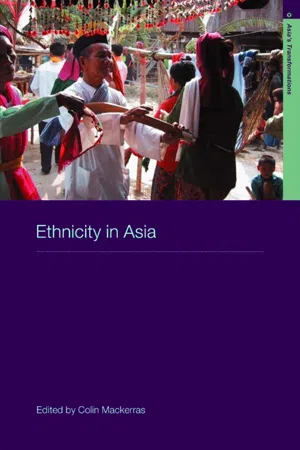
Ethnicity in Asia
About this book
This book is designed as a comprehensive comparative introduction to ethnicity in East and Southeast Asia since 1945. Each chapter covers a particular country looking at such core issues as:
· the ethnic minorities or groups in the country of concern, how many ethnic groups, population, language and culture group they belong to, traditional religions and arts
· government policy towards the ethnic minorities or groups
· the economies of the ethnic minorities or groups and the relation with the national economy;
· problems of national integration caused by the ethnic minorities or groups;
· the impact of ethnic issues on the country's overall foreign relations.
Information
1 Introduction
Colin Mackerras
With the collapse of the Soviet Union at the end of 1991 and the end of the Cold War at about the same time, the ideological divide between Marxism and capitalism lost its major impetus as an arena of world conflict. Although a few countries, notably China and Vietnam, were still run by political parties claiming to adhere to Marxism-Leninism, they too were already on the track of market reform, and did not pose nearly the same challenge to liberal capitalism as had been the case during the decades of the Cold War. Liberal capitalism, as represented mainly by the countries of North America and Western Europe, seemed triumphant. Many countries formerly socialist or neutral went over to the side of capitalism, some though by no means all of them adopting the form of government most strongly advocated by the main capitalist states, namely liberal democracy. The United States and its allies had won the Cold War.
Ethnicity and ethnic conflict in the contemporary world
However, it did not take long for other issues to replace the ideological ones to stoke the fires of conflict. Among these issues, a particularly important one was ethnic divisions and tensions. Of course, these were hardly new when the Cold War ended. In many places throughout the world they had been endemic for decades or centuries. What shocked the world, however, was that the splintering of states like the Soviet Union and Yugoslavia involved terrible ethnic warfare and conflict. When Yugoslavia, which many had once considered a model both of socialism and ethnic harmony, split apart, several wars broke out in succession throughout the 1990s. The most serious was in Bosnia-Herzegovina. No sooner did this country declare itself independent on 5 April 1992 than an extremely savage war broke out between Serb, Croat and Muslim communities, which had earlier appeared to get on with each other reasonably, if not very, well. The war saw human rights abuses of a severity not seen in Europe since the end of the Second World War, and lasted until 1995.
Meanwhile, ethnic conflict seemed to spread to many other parts of the globe. The worst case was in the tiny Central African state of Rwanda, where the minority Tutsis came under attack from the majority Hutus, who comprised about 90 per cent of the total population. Ethnic war amounting to genocide raged there from April to June 1994. It is estimated that throughout 1994 over one million people were killed in genocide or civil war, with even larger numbers fleeing into neighbouring countries. According to the 1991 census, the total population of Rwanda was 7,164,994, but a 1996 estimate showed only about 5.1 million.1 The conflict had taken the lives of a gigantic proportion of the total population.
Although Asia saw no example as savage as the Rwanda genocide or the war in Bosnia-Herzegovina, it was by no means free of ethnic conflict. In Central Asia, several wars followed the collapse of the Soviet Union, including some fuelled by ethnic hostilities. The independence of Tajikistan, which formerly belonged to the Soviet Union, was followed by a very bitter war lasting from 1992 to 1997. In Indonesia the small territory of East Timor fought a long and violent secessionist struggle. The fall of Suharto in 1998 led on to its independence, though only after further violence and bitter conflict, while anti-Chinese rioting swept Java, ethnic and sectarian violence erupted in several parts of Indonesia, notably Aceh and the Moluccas, and the long-simmering independence struggle of Papua grew in intensity. Myanmar has seen a whole series of insurgencies based on ethnicity. Indeed, very few of the countries of East and Southeast Asia have been completely free of ethnic conflict or tensions.
In Sri Lanka, the Tamils have long been struggling for a separate homeland, and ethnic violence amounting to civil war began in the 1980s, continuing with enormous bloodshed and casualties until a ceasefire came into effect in February 2002. One of the features of this civil war was the Tamil use of suicide bombing, a factor that has become a prominent feature of world news since terrorists hijacked aircraft and flew them into the World Trade Center in New York on 11 September 2001, destroying the two towers of the Center and killing not only themselves but nearly 3,000 other people as well.
Despite examples such as the Tamil war in Sri Lanka, most ethnic conflict does not involve war. One could cite many examples from the countries discussed in the present book. Xinjiang, Tibet and Inner Mongolia have seen periodic ethnic rioting since the 1980s, but it has been sporadic and hardly amounts to anything one could describe as warfare. In Indonesia, we find no generalized civil war, despite the severity of the ethnic problems in some places.
The fact that ethnic conflict has to a large extent replaced ideological conflict since the end of the Cold War makes it of enormous importance for understanding the contemporary world. Despite the fascinating ethnic tapestry of East and Southeast Asia, the region has rarely been studied through the lens of ethnicity and ethnic conflict. The importance of the topic and the lack of literature covering it are the main reasons for writing this book.
There are several extremely important general issues that flow from the rise of ethnic conflict in the wake of the end of the Cold War. One of them is the way dominant ethnic groups look down on, discriminate against and even persecute minorities. In most of the countries discussed in this book, there is a tendency for the majority ethnic group to conceptualize the nation-state with its own culture as the highest and most important, with the minorities holding the function of ‘essentializing’ the majority, as one scholar has described the relations between Han and minorities in China.2 Many other examples illustrate the point, such as Kinh Vietnamese nationalism in relation to minorities and Japanese nationalism with respect to Koreans, burakumin or Ainu.
One way in which this majority nationalism often expresses itself is through migration into minority areas. We shall see several examples of this phenomenon in the pages of this volume, such as in China and Vietnam. The majority may see such migration as both sensible and their right. After all, the minority areas are, on the whole, much less thickly populated than the majority ones, and this is ‘our’ country, so obviously it is fine for us to send our people there. Also, the majority is more advanced and can render useful assistance to the minority areas in economic and other terms. On the other hand, the minorities may not see it that way at all. They may think their land is being taken away from them, and that the ‘majority nationality’ is more like an invader than a friendly assistant. What is perfectly clear is that these migrations of majority peoples into minority areas often cause immense resentment.
Another issue, which is to some extent fuelled by this chauvinism of the majority, is the growth of ‘ethnonationalism’. This means the pride and sense of identity that people feel in belonging to a particular ethnic group within a larger nation-state. Nationalism has long been a feature of world politics. During and after the Second World War it was a major factor leading to the independence of a host of colonies throughout Asia and Africa. And nationalism is still very much alive at the beginning of the twenty-first century. But since the end of the Cold War, ethnonationalism has come to the fore. In other words, the nationalism of ethnic minorities within larger nation-states has become a factor, in some cases rivalling the nationalism of nation-states themselves.3
Ethnonationalism leads not only to a strengthening of ethnic identities. In many places it has also resulted in a strong feeling that ethnic minorities wish to separate themselves from the larger nation-state and set up their own independent nation-state. Generally, the larger nation-state begins by resisting this pressure, because no state wishes to accept division, and all of them fear that if one ethnic group secedes, then others will wish to follow suit. The examples of the Soviet Union and Yugoslavia suggest that there is some basis to this fear. On the other hand, the separation of East Timor from Indonesia has not so far led to a cascade of further independent nation-states once part of Indonesia. To be sure, Chapter 4 shows that there are several wishing to follow the example of East Timor.
States usually respond to attempts at secession by sending in troops to suppress the disturbances, and Indonesia is among several states considered in this book to fall into that category. Even democratic states sometimes react in this way, as the case of British troops sent into Northern Ireland shows. These wars sometimes do lead to the independence of a new nation-state. Prominent examples are Eritrea in northeastern Africa and East Timor in the southeast corner of Asia. In Eritrea, independence from Ethiopia and sovereignty for the new state was proclaimed in May 1993 after victory in a long and bloody war. In this case, bitter wars followed with Ethiopia. East Timor formally became a sovereign state in May 2002 after centuries as a Portuguese colony and twenty-four years as part of Indonesia.
Wars nation-states regard as secessionist, but which the ethnic proponents call independence struggles, do not necessarily lead to the result either party desires. A prominent example is the Tamils of Sri Lanka. The military suppression of the Tamil independence movement by the Sri Lankan state led in 2002 to a political compromise in which a ceasefire led to negotiations implying a form of autonomy that left both sides without their basic goals satisfied. On the whole, the only guarantee of such wars is that many innocent people will get killed.
In the modern world, populations have also had a strong tendency to become more mixed than was the case in the past. Majority populations in large nationstates have tended to move into the areas inhabited by ethnic minorities and tried to dominate them. What this means is that new nation-states that establish themselves on part of an older and much larger nation-state or empire, are usually much more ethnically mixed than the same area had been decades or centuries earlier. Even the emergence of a new nation-state does not foreclose the possibility of renewed ethnic conflict. We have already noted the example of Bosnia-Herzegovina, and many others could be cited.
Since the dissolution of the Soviet Union, the process of national splitting has mostly been violent. The most significant exception to this pattern in the 1990s was Czechoslovakia, which divided peacefully into the Czech Republic and Slovakia in January 1993.
It is necessary to emphasize that most ethnic minorities throughout the world are not at all interested in independence. They simply want a better deal for the people belonging to their ethnic group. They want better jobs, and more of the good things that a decent economy brings. They may feel discrimination, and there are many examples covered in the present book, but the solution is not necessarily independence. They may seek better policy and treatment from the states where they live. We shall see many illustrative examples in the chapters of this book.
One alternative option to independence, and fitting into the category of better policy, is a system of autonomy for ethnic minorities. While these do not necessarily solve the problems of ethnic conflict or discrimination, they can represent and be part of a process of negotiation between states and ethnic minorities that is highly preferable to open violence and fighting. Diverse forms of autonomy have been tried in various parts of the world,4 and a few are considered in the present book.
The discourse of rights
The role of ethnicity in public policy and its potential for conflict amply demonstrate its significance in the contemporary world. Another reason why ethnicity is so important is because of its association with the discourse of rights. The strengthening of human rights discourse in international relations was undoubtedly one of the most important features of the late twentieth century.
Discourse in human rights took many forms, including civil, political and democratic rights.5 The United Nations sponsored the World Conference on Human Rights, held in Vienna in 1993. In the diplomacy of the last remaining superpower, the United States, human rights came to assume a major place in its relations with other countries. In the cases of quite a few countries, such as China, they came to be a highly significant factor in bilateral relations. At the same time, human rights came to occupy a far more prominent role in the discourse of commentary on international relations, including in scholarly literature.
Of course, there is much disagreement over the nature and ideals of human rights. Two prominent schools of thought are the universalist or individualistic and the culturalist or communitarian. The former is dominant among relevant non-government organizations like Amnesty International and Western social human rights movements, and also Western governments. It also enjoys considerable support among ordinary people, including journalists and scholars, outside the West. It argues that human rights are universal and should focus on all people as individuals, because they are human beings.
The culturalist or communitarian view, espoused by many governments in Asia and elsewhere, and with considerable social support both in their own countries and outside, argues that it is more sensible to see human rights not in terms of the rights of individuals but of communities as a whole. What matters most is not what happens to individuals but to large groups of people. This view argues that the universalist attitude, having grown out of Western experience, takes insufficient account of the culture of Asian countries, and the unusually difficult histories to which they have been subjected, often by the European powers and the United States themselves.
There is a strong dimension of power in this debate. Proponents of the universalist view tend to see governments arguing the alternative opinion for opportunistic purposes, especially to maintain their own authority and grip on power. On the other hand, advocates of the communitarian viewpoint often charge universalists with cultural imperialism.6 By its very nature the universalist approach is applicable everywhere, making those who depart from it open to criticism on the grounds of human rights abuses. Because many Asian governments advocate the culturalist or communitarian view, many have dubbed this controversy ‘the Asian values debate’.7
Of all forms of human rights the one with the greatest relevance to the present book is obviously ethnic rights. These attracted enormous scholarly and political attention during the late years of the twentieth century and continue to do so in the twenty-first. The United Nations declared 1993 the International Year of the World’s Indigenous Peoples, showing the importance the world body attached to this issue. The collapse of the Soviet Union and of the ideological divide between liberal capitalism and Marxism-Leninism was one reason for the attention given to ethnic matters. Another was the renewed struggle against racism, symbolized by the continuing attacks on apartheid in South Africa, the struggle attaining a triumphant victory with the election of Nelson Mandela as the first black President on 9 May 1994. Meanwhile, revulsion against the Holocaust of the Jews under the explicitly racist German Nazi regime lost none of its momentum, even though it had occurred half a century before.
The scholarly discourse that accompanied these political developments adopted various views. Although most scholars were very happy at the victory of Nelson Mandela and favoured the establishment of multiculturalism in democratic countries, many remained deeply sceptical of the intentions of states, even democratic ones. There was a common belief that the changes had not gone nearly far enough towards accommodating minority rights.
One important area is the political one. Support in Western countries for secessionist movements in other parts of the world has tended to be strong, with human rights activists loud in their view that minorities are being suppressed. The implication is clearly that Western governments should support such independence movements. In the 1990s, a very prominent example was the movement in Chechnya. Long ruled as part of Russia, the Chechnyans actually declared independence in November 1991, but brought down on their heads the ire and savage intervention of successive Russian governments, including those of Boris Yeltsin (president of the independent Russian Federation from 1991 to 1999) and his successor Vladimir Putin, who became president in 2000.
Support for independence movements is frequently promoted by diasporas living in the West or somewhere else outside their original homeland, but hailing from the region seeking independence. Such diasporas often collect money for the independence cause. In some cases, support is much more obvious and widespread than in others. A very good example of a people with an independence movement supported very strongly outside the homeland is the Tibetans. The Dalai Lama lives in India, but frequently visits Western and other countries, where he enjoys enormous veneration. Tibetans living in the West and India are a major element providing inspiration and support for the Tibetan independence movement as it exists outside Tibet itself.
Scholars frequently see it as a task to provide an intellectual basis for the idea of secession or sovereignty of minorities, or for individual separatist claims. There are issues that deal with law, morality, cultural separateness, land rights and other matters of very great importance for a people seeking independence.8 Scholars, activists and members of diasporas frequently overlap, with universities being common sites of activism on behalf of ethnic rights and independence movements.
It is not only politics that is so important. Another area of scholarly discourse is culture. A common complaint against states is that they suppress minority cultures. One prominent scholar in the field of ethnic rights, Will Kymlicka, has argued that the liberal tradition was too individualist to accord any status to ethnic groups that lay between the individual and the state, but also sharply criticized soc...
Table of contents
- Cover Page
- Title Page
- Copyright Page
- Illustrations
- Contributors
- Preface
- 1 Introduction
- 2 Ethnic minorities in China
- 3 In Japan, but not of Japan
- 4 Ethnicity in Indonesia
- 5 Ethnicity and class in Malaysia
- 6 Singapore
- 7 Vietnam
- 8 Ethnicity in the Philippines
- 9 Ethnicity and the politics of ethnic classification in Thailand
- 10 Myanmar/Burma
- 11 Cambodia
- 12 Laos
Trusted by 375,005 students
Access to over 1.5 million titles for a fair monthly price.
Study more efficiently using our study tools.
Frequently asked questions
Yes, you can cancel anytime from the Subscription tab in your account settings on the Perlego website. Your subscription will stay active until the end of your current billing period. Learn how to cancel your subscription
No, books cannot be downloaded as external files, such as PDFs, for use outside of Perlego. However, you can download books within the Perlego app for offline reading on mobile or tablet. Learn how to download books offline
Perlego offers two plans: Essential and Complete
- Essential is ideal for learners and professionals who enjoy exploring a wide range of subjects. Access the Essential Library with 800,000+ trusted titles and best-sellers across business, personal growth, and the humanities. Includes unlimited reading time and Standard Read Aloud voice.
- Complete: Perfect for advanced learners and researchers needing full, unrestricted access. Unlock 1.5M+ books across hundreds of subjects, including academic and specialized titles. The Complete Plan also includes advanced features like Premium Read Aloud and Research Assistant.
We are an online textbook subscription service, where you can get access to an entire online library for less than the price of a single book per month. With over 1.5 million books across 990+ topics, we’ve got you covered! Learn about our mission
Look out for the read-aloud symbol on your next book to see if you can listen to it. The read-aloud tool reads text aloud for you, highlighting the text as it is being read. You can pause it, speed it up and slow it down. Learn more about Read Aloud
Yes! You can use the Perlego app on both iOS and Android devices to read anytime, anywhere — even offline. Perfect for commutes or when you’re on the go.
Please note we cannot support devices running on iOS 13 and Android 7 or earlier. Learn more about using the app
Please note we cannot support devices running on iOS 13 and Android 7 or earlier. Learn more about using the app
Yes, you can access Ethnicity in Asia by Colin Mackerras in PDF and/or ePUB format, as well as other popular books in Social Sciences & Asian History. We have over 1.5 million books available in our catalogue for you to explore.