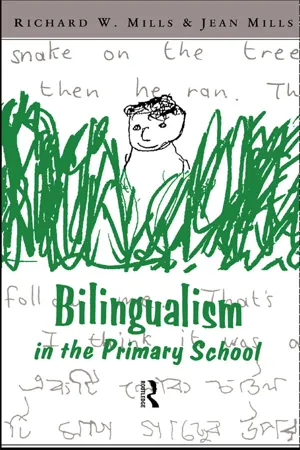
Over the past few years bilingualism has come to be seen not as a hinderance to assimiliation but as an asset which, properly nurtured, will benefit children's linguistic awareness, cultural sensitivity and cognitive functioning. Bilingualism in the Primary Classroom gives primary teachers a window on the experience of the bilingual children in their care and by doing so helps them to make the most of what the children and their parents have to offer as well as giving them a good start in the National Curriculum. Many of the contributors to the book are themselves bilingual and are thus able to understand the children's experience from within, but they are also particularly careful to show monolingual teachers how they too can make use of children's mother tongue experience. The book is based throughout on rich case study material of individual children at various stages on the bilingual spectrum.
- 174 pages
- English
- ePUB (mobile friendly)
- Available on iOS & Android
eBook - ePub
About this book
Information
Section II
Assessment of and through language
Chapter 3
Monolingual teachers assessing bilingual children
EDITORS’ INTRODUCTION
This chapter serves as a general introduction to those which follow and which focus on specific situations. Any assessment is problematic and one could develop this declension by saying: assessment is difficult; oral assessment is very difficult; bilingual assessment is extremely difficult.
The term ‘assessment’ itself requires definition. Do we mean assessment of abilities, such as maths concepts, by using mother tongue? Or do we mean, the assessment of an individual’s language skills in English and in mother tongue? Whichever aspect is chosen, it is still important to examine the basic premises that underlie any assessment, namely, what is ‘good practice’ in this area? Obviously, in assessing bilingual children, the same issues will occur, but there will be the added complications of cultural relevance; the influence of particular contexts; the nature of children’s abilities in their different languages.
Comfort is offered to teachers who do not share the languages of the children they teach. (Such teachers, of course, may, or may not, be monolingual.) Again, the recommendation is ‘back to basics’, i.e. to call upon those skills of observation and reflection in which most professionals are already adept. Teachers may then note, as part of formative assessment, children’s development of language-learning strategies and, in particular, their knowledge about language (KAL). Assessment in these terms ultimately rests on the collection, and interpretation, of apparently chance remarks in a range of situations. As the examples suggest, reflection on such instances increases a teacher’s ability to develop insight into children’s language repertoire.
Without bilingual skills, teachers are trying to find the best highjumper by seeing who’s good at running.
(Monolingual teacher)
How do we, as primary school teachers, assess oral language? Do we use tick-off categories on checklists? Do we analyse transcripts of tape recordings? Do we monitor with ongoing judgements as the spoken language is uttered? Perhaps we use combinations of all these, but experience over the past twenty years indicates just how difficult the task is. (See Appendices 3 and 4).
Even the Assessment of Performance Unit (APU) surveys during the 1980s, using a fairly structured technique, only attempted to assess 11- year-olds in the primary range, and then within a circumscribed set of categories (viz. Instructing/Directing, Giving and Interpreting Information, Narrating, Describing, Discussing). How much more difficult it is to achieve anything comprehensive across the age and ability range, when children in the same class speak two or three different languages.
This chapter lays down the premises for the case studies which follow.
It attempts to give a conceptual framework to the more detailed and specific discussion in those chapters.
Where, then, can bilingual assessment begin if, by that, we mean:
- the assessment of specific abilities (such as maths or history concepts)through mother tongue; and
- the more general assessment of a child's linguistic abilities in English and mother tongue?
It begins from the same fundamental premises that good practice for monolingual children should also be good practice for bilingual children, and that basic assessment procedures will be the same for both groups, albeit with different emphases.
Here, then, are some general criteria which apply as much to multilingual, as to monolingual, classrooms.
(a) A good language classroom supports all the languages, varieties and dialects which are spoken in it.
Thus, it may be appropriate for children to compare their local dialect with standard English (as the National Curriculum requires, see AT1, Level 5, e; 6, d); to write explanations of dialect words; to carry out role play in dialect and standard English.
Similarly, children who can write in scripts other than English can use these skills in any investigation of the history of writing and of alphabets.
Likewise in spoken language where, as the Cox Report indicates, the experience of language of bilingual children is ‘greater than that of their monoglot peers’ and provides ‘a focus for discussion about language forms’ (1988:58).
b) Assessment of standard English is only one dimension of a child’s all-round language abilities. Some children have a very wide linguistic repertoire, made up of several language varieties. The very term ‘bilingual’ (see the Introduction and Baetens Beardsmore 1986: Chapter 1) may obscure this, sin...
Table of contents
- Cover
- Half Title
- Title Page
- Copyright Page
- Table of Contents
- Figures and tables
- Contributors
- Acknowledgements
- Introduction: Setting the scene
- Section I Living and learning in two languages
- Section II Assessment of and through language
- Section III The bilingual experience
- Bibliography
- Index
Trusted by 375,005 students
Access to over 1.5 million titles for a fair monthly price.
Study more efficiently using our study tools.
Frequently asked questions
Yes, you can cancel anytime from the Subscription tab in your account settings on the Perlego website. Your subscription will stay active until the end of your current billing period. Learn how to cancel your subscription
No, books cannot be downloaded as external files, such as PDFs, for use outside of Perlego. However, you can download books within the Perlego app for offline reading on mobile or tablet. Learn how to download books offline
Perlego offers two plans: Essential and Complete
- Essential is ideal for learners and professionals who enjoy exploring a wide range of subjects. Access the Essential Library with 800,000+ trusted titles and best-sellers across business, personal growth, and the humanities. Includes unlimited reading time and Standard Read Aloud voice.
- Complete: Perfect for advanced learners and researchers needing full, unrestricted access. Unlock 1.5M+ books across hundreds of subjects, including academic and specialized titles. The Complete Plan also includes advanced features like Premium Read Aloud and Research Assistant.
We are an online textbook subscription service, where you can get access to an entire online library for less than the price of a single book per month. With over 1.5 million books across 990+ topics, we’ve got you covered! Learn about our mission
Look out for the read-aloud symbol on your next book to see if you can listen to it. The read-aloud tool reads text aloud for you, highlighting the text as it is being read. You can pause it, speed it up and slow it down. Learn more about Read Aloud
Yes! You can use the Perlego app on both iOS and Android devices to read anytime, anywhere — even offline. Perfect for commutes or when you’re on the go.
Please note we cannot support devices running on iOS 13 and Android 7 or earlier. Learn more about using the app
Please note we cannot support devices running on iOS 13 and Android 7 or earlier. Learn more about using the app
Yes, you can access Bilingualism in the Primary School by Richard Mills,Jean Mills in PDF and/or ePUB format, as well as other popular books in Pedagogía & Educación general. We have over 1.5 million books available in our catalogue for you to explore.