eBook - ePub
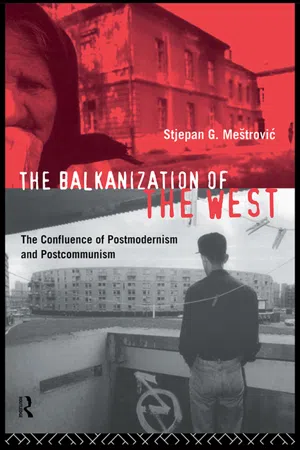
The Balkanization of the West
The Confluence of Postmodernism and Postcommunism
- 240 pages
- English
- ePUB (mobile friendly)
- Available on iOS & Android
eBook - ePub
About this book
Passionate, vigorous and uncompromising this book takes the lid off the confused Western response to the Balkan war. The author raises a series of timely and acute questions about the future of postmodernism and postcommunism. The author claims that the Balkan war has de-railed the movement for unification in Europe. The Islamic world has seen that the West is quite willing to bomb Muslim targets, from Iraq to Somalia, but absolutely unwilling to wage a `just war' to save the Bosnian Muslims. He concludes that the Balkan war is a key catalyst in the unravelling of the West.
Information
Chapter 1
From the postmodern culture of fun to the grim realities of postcommunism
The collapse of communism at the present fin de siècle coincided with widespread interest among intellectuals in a phenomenon known as postmodernism, itself a confluence of apocalyptic themes found in the previous fin de siècle (Meštrović 1991) and the fun-culture uncovered by David Riesman in his Lonely Crowd (1950). The confluence of these two phenomena, postcommunism with postmodernism (as a fun version of the apocalypse), produced the giddy, optimistic belief that democracy and tolerance would emerge from the ruins of communism, a widespread belief that only a fun-culture could produce. This nexus of sometimes contradictory cultural forces, and their consequences, will be the theme of the rest of this book, yet it requires some immediate clarification.
First, the “collapse of communism” was not complete, because communism continues to rule China, Cuba, North Korea and other nations in the world. Communism’s apparent demise in Eastern Europe and the former Soviet Union does not rule out the possibility that the cultural roots of communism have remained in the countries that were once ruled by this ideology, nor the possibility that these same cultural roots will sprout new forms of authoritarianism.1 In the words of Aleksander Solzhenitsyn, “Time has finally run out for communism, but its concrete edifice has not yet crumbled. And we must take care not to be crushed beneath its rubble instead of gaining liberty” (1991:3). Second, it is nearly impossible to settle on a consistent definition of “postmodernism” (Rosenau 1992),2 even though this concept seems to imply the collapse of modernism. As with the alleged collapse of communism, this characterization does not preclude the possibility that the cultural roots of what is called modernity will sprout new forms of modernism—despite the rhetoric of protest found in postmodern discourse. Yet, with the notable exception of Akbar Ahmed (1992), most intellectuals involved in this discourse have overlooked Islam as a distinct form of postmodernism or anti-modernism. Third, the French term, fin de siècle, which binds much of the rhetoric of protest across the two end-points of the twentieth century, implies so much more than the straightforward translation: end of the century. It connotes a spirit or world-view characterized by anxiety, uneasiness, pessimism and disgust at some of the unwelcome consequences of modernity. Thus, the dramatic, contemporary confluence of the purported endings of communism, modernity, the twentieth century—even the millennium—demand a new and creative analysis of social phenomena that often have been taken for granted.
A discussion of the sort being proposed here would be crippled from the outset if one were to limit it to the analytic issue of whether postmodernism— whatever it is—constitutes a rebellion or extension of modernity. The way this problem is posed in the existing literature betrays the very Enlightenment narratives that are in question,3 for it assumes a “before” and “after” to modernity, as well as a linear progression to history. We shall gain much more room for discussion, and may be able to learn something new, by allowing the possibility that tradition, modernity, and postmodernity (or various forms of postmodernity) are able to co-exist. True, such an assertion seems illogical from the many perspectives found in modernist theories that assume progress from “primitive” to “civilized” societies. Yet the notion of linear progress is one of the assumptions that is called into question by the postmodern rebellion against narratives spun from the Enlightenment. Besides, it often seems that in the present fin de siècle, one finds that fundamentalism,4 nationalism, and many other sorts of traditional cultural phenomena do thrive alongside modernity.
Let us return to the coincidence that was noted in the first sentence of this chapter: namely, that communism seems to have collapsed at nearly the same time that postmodernism asserted itself in intellectual discourse. In rough tandem, the high priest of postmodernism, Jean Baudrillard (1986), declared the end of modernity and of culture, Francis Fukuyama (1992) declared the end of history, and the high priest of foreign affairs, Zbigniew Brzezinski (1989), pronounced the death and end of communism. All these dramatic endings seem to have coincided with the end of the millennium, at a time when the prestige of sociology relative to the other social sciences—not to mention the so-called “hard sciences”—seems to be at an all-time low (Kantrowitz 1992). Thus, one might add the end of sociology to the long list of dramatic endings that seem to be invoked in contemporary intellectual discourse (see also Bauman 1992).
To be sure, the meaning of all these alleged endings is far from clear, and such claims provoke controversy in any case. In contradistinction to Baudrillard, Anthony Giddens (1990, 1992) and other modernists deny the existence of any break with modernity, and prefer to speak of “high modernity.” To contradict Fukuyama’s claim that humanity had finally reached the end of history—by which he means that with the end of the Cold War, liberal democracy had triumphed over racism as well as historical wars for ideology, nationalism, and imperialism—one has only to consider the brutal war that has continued in former Yugoslavia since 1991, among many other nationalistic wars currently raging in the world, from formerly Soviet Georgia to Somalia.5 Indeed, the race riots that spread from Los Angeles to many other cities in the USA in April 1992 led many commentators to remark, with considerable amazement, that America suddenly seemed like the Balkans—that they could not believe that the United States of America could be racked by ethnic conflict this late in its historical development. The Western media frequently referred to the Balkan crisis as contagious, as if ethnic hatred were some sort of virus.6 I shall have more to say in Chapter 2 and elsewhere on this postmodern use of metaphors such that the modern West became Balkanized while the reality of the current Balkan War became a mere metaphor. At this point in the discussion, it is worth stressing that this ominous conceptual linkage between Los Angeles and the former Yugoslavia was strengthened by President Clinton on 17 April 1993, on the occasion of the reading of the verdict in the second trial of the policemen who abused Rodney King. Mr. Clinton said that the second verdict, in which two officers were found guilty of violating Rodney King’s rights, proved that America would not succumb to the ethnic hatred that consumed the former Yugoslavia.7 But why should he have made such a statement were it not for the fear, largely unconscious, that the USA could fall victim to the “virus” of ethnic hatred? In any event, countering Fukuyama, Alan Ryan (1992:7) writes that “the most obvious complaint against the view that the whole world is committed to liberal democracy is that most of it is not.”8
Consider Mikhail Gorbachev’s ominous warning, made on the occasion of his resignation as President of the Soviet Union on Christmas Eve, 1991, that the former Soviet Union would follow in the bloody wake of the Balkans. Indeed, the turmoil in the Balkans seems to have foreshadowed ominously the potential for widespread racism and ethnic conflict throughout the world, from China and Africa to Western Europe and the United States. In addition, the news media reported noticeable increases in hate crimes committed by skinheads in Britain, neo-Nazis in Germany, “gaybashers” in the United States military, and anti-Semites in France, among many others. By 1993, the cheerful confidence concerning a New World Order based on rationality and tolerance, which was popularized by postmodern writers as well as by President George Bush in 1991, turned into a cynical pessimism in relation to a New World Disorder (Wall Street Journal, 1 June 1992:A13).
Neither Mr. Gorbachev nor popular opinion-makers have explained why the Balkans emerged as the paradigm for dissolution and hatred in a world that was assumed to be moving in the contrary direction of postmodern tolerance, the modernist unification of markets, and the growth of democracy. The remainder of this book is devoted to explicating this unexpected turn of events, so that only a thumbnail sketch of the argument will be offered in this chapter.
Let us begin with the widespread understanding of postmodernism as rebellion against the grand narratives of the Enlightenment (Gellner 1992b, Lyotard 1984, Rosenau 1992). Again, this is a deceptively simple definition that begs many questions which will be taken up later, including the following: are these “narratives” mere fictions or are they truths rooted in reality? In other words, are these “narratives” actually “traditions,” such that the Enlightenment constitutes a tradition even though the hallmark of the Enlightenment was rebellion at all traditions, customs, and other components of culture? Does the period referred to as the Enlightenment signify a particular time and place in European history, as argued by Ernest Gellner (1992a), or does it imply a universal stage of development through which all of humanity passes on the road from traditionalism to modernity? Is the postmodern focus on circulating fictions really new, or merely the latest version of Sophistry that even Plato had to contend with? Let us set aside these important issues for now, and focus on how rebellion at Enlightenment narratives might lead to the unwelcome turn of events described above, as opposed to tolerance and democracy.
One of the most notable, and ironic, examples of promoting tolerance through intolerant methods is the following: “Speaking on the opening day of the first World Conference on Human Rights in 25 years, Secretary of State Warren Christopher said the universality of human rights set a single standard of acceptable behavior around the world, a standard Washington would apply to all countries” (New York Times, 15 June 1993:A1). He added that “we cannot let cultural relativism become the last refuge of repression” (ibid.). But representatives of other nations at this conference accused the West of applying double standards with regard to human rights and, in general, of using the notion of universality as “a mask for Western domination” (ibid.). Ironically, the US was intolerant in pushing its version of tolerance, such that the US “seems to be developing a flexible carrot-and-stick approach, using incentives to modify the behavior of countries it considers capable of improvement, like Turkey and China, while punishing those it considers renegades, like Iran” (ibid.). One should note that sociologists routinely accept the notion that no standards are universal and that all social phenomena are culturally relative. Hence, the official actions of the US government, while promoting the Enlightenment project, go against the grain of a century’s worth of sociological theorizing and research.
The ethnocentrism in America’s approach lies in the fact that the US focuses almost exclusively on civil and political rights such as free speech, press, and elections, while it does not recognize the tendency in most of the rest of the world to view human rights as a matter of employment, education, housing, and food (Stephens 1993). Moreover, “although most nations have banned the death penalty, [the US] refuses to acknowledge international law on this issue” and the US ignores the international requirement that refugees be given an opportunity to apply for political asylum, particularly with regard to Haitian refugees (ibid.).
Communism emerged as an important narrative spun from the Enlightenment, with its utopian assumptions, emphasis on central planning and bureaucracy, and disdain for the traditionalism suggested by nationalism and religion, among other characteristics (Bauman 1992). Barry Smart (1992) is right to conclude that neither socialism nor communism was a fundamental alternative to capitalism, and that all three politico-economic systems were refractions of modernity. It seems to follow logically that rebellion against communism as a modernist system would unleash the anti-modernist forces that communism tried to contain, among them Islamic cultural identity, nationalism, fundamentalism, separatism, anti-Semitism and other phenomena up to and including the white heat of hatred demonstrated in the Balkans since 1991. Moreover, if it is true that communism, socialism, and capitalism are all modernist doctrines, and if all three doctrines are collapsing as part of a postmodern rebellion against modernity, then Islamic cultural movements, nationalism, fundamentalism, and other anti-rational phenomena ought to affect the USA and Western Europe, not just the Balkans and the former Soviet Union. How is it that this obvious connection was missed so completely by analysts who took up Fukuyama’s concept of the end of history as their banner? In other words, why did so-called Western nations gloat at the collapse of communism without realizing that the infrastructure of capitalism might be collapsing alongside communism?
One reply is that the so-called capitalist and socialist nations of the industrialized West perceived communist nations as the Evil Empire (to borrow a phrase from former President Ronald Reagan). The Cold War pitted Western capitalism against a supposedly Oriental communism (we shall deconstruct this false polarity of West and East later). Western intellectuals and politicians interpreted the demise of communism as victory for capitalism. This attitude might be termed cosmopolitan provincialism, because it assumes that Western capitalism and democracy are universal occurrences superior to all others. Such an ethnocentric assumption ignores the obvious: communism, socialism, and capitalism are modernist doctrines that are opposed by many anti-modernist happenings, from nationalism to fundamentalism and a good portion of the Islamic world. Thus, as predicted by Emile Durkheim in his 1928 treatise, Socialism and Saint-Simon, socialism, communism and capitalism are all destined to fall because they are erected on the incorrect, modernist premise that rationalism and egoism can eradicate and replace the traditions and habits that comprise culture.
FROM THE COLD WAR TO THE ISLAMIC THREAT?
The conclusion that capitalism is next in line for demolition strikes terror in the hearts of so-called Westerners, even if it flows logically from the premise that all narratives spun from the Enlightenment are in serious jeopardy in the postmodern era. Yet evidence abounds to support this hypothesis, even if it is disturbing and therefore rarely admitted openly (Kennedy 1992, Lukacs 1992, Paepke 1992). For example, following the end of the Cold War, capitalist, socialist, and formerly communist nations have focused on Islamic fundamentalism as a threat, sometimes even as a common enemy. Akbar Ahmed (1992) as well as Gellner (1992b) have depicted Islamic culture as the opposite of modernity.9 In a sense, contemporary Islam constitutes a genuinely postmodern phenomenon in that it rebels at Western, modern cultures. Consider the following passage from a report to the United States House of Representatives by the Task Force on Terrorism and Unconventional Warfare:
In Western Europe, Muslim communities will constitute 25 per cent of the population by the year 2000. (At present, Muslims constitute 7–9 per cent of the population in the US, and 8–10 per cent in France.) Moreover, the Muslim emigre community, and especially the younger, European born, generation is rapidly becoming militant Islamist in outlook. The fundamental source of the problem lies in the irreconcilable difference between Muslim society and the West European environment. The Islamists in Europe have fundamental and uncompromising differences with the society in which they live. The Islamists consider democracy as “the worst scourge the West inflicted on Muslim society in order to destroy it from the inside and annihilate its ancestral values,” and are therefore determined to strike it at its core. The Muslim communities demand to be allowed to retain all aspects of Islam, including laws unacceptable in the West.
(3 September 1992:1)
It is instructive that since the end of the Cold War, Western nations have waged war against Iraq, a Muslim nation—albeit, not a fundamentalist one—but hesitated for three years to wage war to rescue the Muslims in Bosnia-Herzegovina from Serbian aggression. To put the matter another way, “the world goes to war so Kuwait won’t disappear, but Bosnia-Herzegovina disappears and the world does nothing” (New York Times 17 July 1992:A8). President Bush bombed Iraq during the last days of his tenure in office, in January 1993, ostensibly to enforce a no-fly zone and other United Nations resolutions imposed on Iraq. But no Western power bombed Serbia in order to enforce a similar no-fly zone over Bosnia-Herzegovina and other United Nations resolutions that were imposed—but never effectively enforced—against Serbia.10 President Clinton bombed Iraq in June 1993 as an act of “self-defense”11 justified by Article 51 of the United Nations Charter, but would not invoke this same article to allow the Bosnian Muslims to defend themselves. Alexander Cockburn labeled President Clinton’s action as American-style state-sponsored terrorism:
Thus far, bloodletting appears to be the dynamic core of his [President Clinton’s] politics of meaning whether in Waco, Mogadishu or Baghdad. The president has also grasped the important principle that it’s better to pick on targets emphatically not your own size and to shoot from a safe distance…. Among the usual attributes of a civilized country is its determination to abide by the law. The missile attack [on Baghdad] was entirely lawless, as exemplified by the ludicrous invocation of the self-defense provisions in Article 51 of the UN Charter.
(Wall Street Journal, 1 July 1993:A15)
According to the New York Times, “The Egyptian Foreign Minister, Amr Moussa, said he hoped US policy would be as firm toward the crimes the Serbs of Bosnia and Herzegovina are committing in violation of legitimacy and all international charters” (28 June 1993:A5). Albert Wohlstetter argued that the United States was employing a double standard:
The [weapons] embargo was imposed at the request of the Serbs before Slovenia, Bosnia, Croatia, Macedonia, et al. became independent states and members of the UN with the right under Article 51 to receive arms for individual or collective self-defense. That is the article that President Clinton cited when he justified unilateral action in air strikes against Baghdad.
(Wall Street Journal, 2 July 1993:A12)
In fact, the only UN resolution that was truly and strictly enforced relative to former Yugoslavia was the one that prevented the Muslims and Croats from defending themselves against Serbian aggression.12 According to the editors of the Wall Street Journal,
The talk from the West about an air strike against Saddam comes in the wake of Europe’s feckless handling of the Serbs’ increasingly horrifying predations. What is mainly being lost here is the West’s credibility. The peopl...
Table of contents
- Cover Page
- Title Page
- Copyright Page
- The Balkanization of the West
- Preface and Acknowledgements
- Chapter 1: From the Postmodern Culture of Fun to the Grim Realities of Postcommunism
- Chapter 2: Still Hunting Nazis, and Losing Reality
- Chapter 3: Unwelcome Alternatives
- Chapter 4: The Postmodernist as Voyeur
- Chapter 5: The End of Morality?
- Chapter 6: What Went Wrong with the Enlightenment Project?
- Chapter 7: What Would a Genuine Post-Marxism Be Like?
- Chapter 8: Conclusions
- Notes
- References
Trusted by 375,005 students
Access to over 1.5 million titles for a fair monthly price.
Study more efficiently using our study tools.
Frequently asked questions
Yes, you can cancel anytime from the Subscription tab in your account settings on the Perlego website. Your subscription will stay active until the end of your current billing period. Learn how to cancel your subscription
No, books cannot be downloaded as external files, such as PDFs, for use outside of Perlego. However, you can download books within the Perlego app for offline reading on mobile or tablet. Learn how to download books offline
Perlego offers two plans: Essential and Complete
- Essential is ideal for learners and professionals who enjoy exploring a wide range of subjects. Access the Essential Library with 800,000+ trusted titles and best-sellers across business, personal growth, and the humanities. Includes unlimited reading time and Standard Read Aloud voice.
- Complete: Perfect for advanced learners and researchers needing full, unrestricted access. Unlock 1.5M+ books across hundreds of subjects, including academic and specialized titles. The Complete Plan also includes advanced features like Premium Read Aloud and Research Assistant.
We are an online textbook subscription service, where you can get access to an entire online library for less than the price of a single book per month. With over 1.5 million books across 990+ topics, we’ve got you covered! Learn about our mission
Look out for the read-aloud symbol on your next book to see if you can listen to it. The read-aloud tool reads text aloud for you, highlighting the text as it is being read. You can pause it, speed it up and slow it down. Learn more about Read Aloud
Yes! You can use the Perlego app on both iOS and Android devices to read anytime, anywhere — even offline. Perfect for commutes or when you’re on the go.
Please note we cannot support devices running on iOS 13 and Android 7 or earlier. Learn more about using the app
Please note we cannot support devices running on iOS 13 and Android 7 or earlier. Learn more about using the app
Yes, you can access The Balkanization of the West by Stjepan Mestrovic in PDF and/or ePUB format, as well as other popular books in Politics & International Relations & Communism, Post-Communism & Socialism. We have over 1.5 million books available in our catalogue for you to explore.