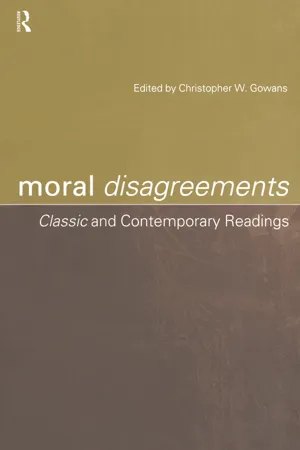
Can moral disagreements be rationally resolved? Can universal human rights be defended in face of moral disagreements?
The problem of moral disagreement is one of the central problems in moral thinking. It also provides a stimulating stepping-stone to some of the perennial problems of philosophy, such as relativism, scepticism, and objectivity. Moral Disagreements is the first anthology to bring together classic and contemporary readings on this key topic. Clearly divided into five parts; The Historical Debate; Voices from Anthropology; Challenges to Moral Objectivity; Defenses of Moral Objectivity; and New Directions, the anthology presents readings from the following key thinkers:
* Sextus, Empiricus, Chagnon, Wong, MacIntyre
* Aquinas, Shweder, Brink, Rawls
* Montaigne, Turner, Nussbaum, Narayan
* Hume, Mackie, Gewirth
* Nietzsche, Williams, Berlin.
A distinctive feature of the anthology is that it brings philosophers into dialogue with well-known anthropologists. Also included is a comprehensive introduction by Christopher Gowans, introducing the problem of moral disagreement to those coming to the topic for the first time.
- 278 pages
- English
- ePUB (mobile friendly)
- Available on iOS & Android
eBook - ePub
About this book
Information
Part I
THE HISTORICAL DEBATE
1
OUTLINES OF SCEPTICISM
Book I
(i) The most fundamental difference among philosophies
…[3] Those who are called Dogmatists in the proper sense of the word think that they have discovered the truth – for example, the schools of Aristotle and Epicurus and the Stoics, and some others.The schools of Clitomachus and Carneades, and other Academics, have asserted that things cannot be apprehended.And the Sceptics are still investigating.[4] Hence the most fundamental kinds of philosophy are reasonably thought to be three: the Dogmatic, the Academic, and the Sceptical.The former two it will be appropriate for others to describe: in the present work we shall discuss in outline the Sceptical persuasion.By way of preface let us say that on none of the matters to be discussed do we affirm that things certainly are just as we say they are: rather, we report descriptively on each item according to how it appears to us at the time….
(iv) What is Scepticism?
[8] Scepticism is an ability to set out oppositions among things which appear and are thought of in any way at all, an ability by which, because of the equipollence in the opposed objects and accounts, we come first to suspension of judgement and afterwards to tranquillity….
[10] By “opposed accounts” we do not necessarily have in mind affirmation and negation, but take the phrase simply in the sense of “conflicting accounts.” By “equipollence” we mean equality with regard to being convincing or unconvincing: none of the conflicting accounts takes precedence over any other as being more convincing.Suspension of judgement is a standstill of the intellect, owing to which we neither reject nor posit anything.Tranquillity is freedom from disturbance or calmness of soul….
(vii) Do Sceptics hold beliefs?
[13] When we say that Sceptics do not hold beliefs, we do not take “belief” in the sense in which some say, quite generally, that belief is acquiescing in something; for Sceptics assent to the feelings forced upon them by appearances – for example, they would not say, when heated or chilled, “I think I am not heated (or: chilled).” Rather, we say that they do not hold beliefs in the sense in which some say that belief is assent to some unclear object of investigation in the sciences; for Pyrrhonists do not assent to anything unclear.
[14] Not even in uttering the Sceptical phrases about unclear matters – for example, “In no way more,” or “I determine nothing” …– do they hold beliefs.For if you hold beliefs, then you posit as real the things you are said to hold beliefs about; but Sceptics posit these phrases not as necessarily being real….
[15] …[I]n uttering these phrases, they say what is apparent to themselves and report their own feelings without holding opinions, affirming nothing about external objects.
(viii) Do Sceptics belong to a school?
[17] …[I]f you count as a school a persuasion which, to all appearances, coheres with some account, the account showing how it is possible to live correctly (where “correctly” is taken not only with reference to virtue, but more loosely, and extends to the ability to suspend judgement) – in that case we say that Sceptics do belong to a school.For we coherently follow, to all appearances, an account which shows us a life in conformity with traditional customs and the law and persuasions and our own feelings….
(x) Do Sceptics reject what is apparent?
[19] Those who say that the Sceptics reject what is apparent have not, I think, listened to what we say.As we said before, we do not overturn anything which leads us, without our willing it, to assent in accordance with a passive appearance – and these things are precisely what is apparent.When we investigate whether existing things are such as they appear, we grant that they appear, and what we investigate is not what is apparent but what is said about what is apparent – and this is different from investigating what is apparent itself.[20] For example, it appears to us that honey sweetens (we concede this inasmuch as we are sweetened in a perceptual way); but whether (as far as the argument goes) it is actually sweet is something we investigate – and this is not what is apparent but something said about what is apparent….
(xi) The standard of Scepticism
[21] That we attend to what is apparent is clear from what we say about the standard of the Sceptical persuasion.“Standard” has two senses: there are standards adopted to provide conviction about the reality or unreality of something (we shall talk about these standards when we turn to attack them); and there are standards of action, attending to which in everyday life we perform some actions and not others – and it is these standards which are our present subject.
[22] We say, then, that the standard of the Sceptical persuasion is what is apparent, implicitly meaning by this the appearances; for they depend on passive and unwilled feelings and are not objects of investigation….
[23] Thus, attending to what is apparent, we live in accordance with everyday observances, without holding opinions – for we are not able to be utterly inactive.These everyday observances seem to be fourfold, and to consist in guidance by nature, necessitation by feelings, handing down of laws and customs, and teaching of kinds of expertise.[24] By nature's guidance we are naturally capable of perceiving and thinking.By the necessitation of feelings, hunger conducts us to food and thirst to drink.By the handing down of customs and laws, we accept, from an everyday point of view, that piety is good and impiety bad.By teaching of kinds of expertise, we are not inactive in those which we accept.
And we say all this without holding any opinions.
(xii) What is the aim of Scepticism?
[25] It will be apposite to consider next the aim of the Sceptical persuasion.Now an aim is that for the sake of which everything is done or considered, while it is not itself done or considered for the sake of anything else.Or: an aim is the final object of desire.Up to now we say the aim of the Sceptic is tranquillity in matters of opinion and moderation of feeling in matters forced upon us.[26] For Sceptics began to do philosophy in order to decide among appearances and to apprehend which are true and which false, so as to become tranquil; but they came upon equipollent dispute, and being unable to decide this they suspended judgement.And when they suspended judgement, tranquillity in matters of opinion followed fortuitously.
[27] For those who hold the opinion that things are good or bad by nature are perpetually troubled.When they lack what they believe to be good, they take themselves to be persecuted by natural evils and they pursue what (so they think) is good.And when they have acquired these things, they experience more troubles; for they are elated beyond reason and measure, and in fear of change they do anything so as not to lose what they believe to be good.[28] But those who make no determination about what is good and bad by nature neither avoid nor pursue anything with intensity; and hence they are tranquil.
A story told of the painter Apelles applies to the Sceptics.They say that he was painting a horse and wanted to represent in his picture the lather on the horse's mouth; but he was so unsuccessful that he gave up, took the sponge on which he had been wiping off the colours from his brush, and flung it at the picture. And when it hit the picture, it produced a representation of the horse's lather.[29] Now the Sceptics were hoping to acquire tranquillity by deciding the anomalies in what appears and is thought of, and being unable to do this they suspended judgement.But when they suspended judgement, tranquillity followed as it were fortuitously, as a shadow follows a body.
We do not, however, take Sceptics to be undisturbed in every way – we say that they are disturbed by things which are forced upon them; for we agree that at times they shiver and are thirsty and have other feelings of this kind.[30] But in these cases ordinary people are afflicted by two sets of circumstances: by the feelings themselves, and no less by believing that these circumstances are bad by nature.Sceptics, who shed the additional opinion that each of these things is bad in its nature, come off more moderately even in these cases….
Book III
(xxi) The ethical part of philosophy
[168] There remains the ethical part of philosophy, which is thought to deal with the distinction among fine, bad and indifferent things.In order to give a summary account of this part too, let us investigate the reality of good, bad and indifferent things….
(xxiii) Is anything by nature good, bad or indifferent?
[179] Fire, which heats by nature, appears heating to everyone; and snow, which chills by nature, appears chilling to everyone: indeed, everything which affects us by nature affects in the same way everyone who is in what they call a natural state.But none of the so-called good things affects everyone as good, as we shall suggest.Nothing, therefore, is by nature good.
That none of the things said to be good affects everybody in the same way is, they say, clear.[180] Let us pass over ordinary people – of whom some deem bodily wellbeing good, others sex, others overeating, others drunkenness, others gambling, others still worse things.Among the philosophers themselves some say (e.g.the Peripatetics) that there are three kinds of goods – some concern the soul (e.g.the virtues), some the body (e.g.health and the like), and others are external (e.g.friends, wealth and the like).[181] The Stoics also say that there is a triple division of goods – some concern the soul (e.g.the virtues), some are external (e.g.virtuous people and friends), and others neither concern the soul nor are external (e.g.the virtuous in relation to themselves).The things concerning the body, however, which the Peripatetics say are good they say are not good.
Some have embraced pleasure as a good, while others say that it is downright bad – so that one philosopher exclaimed: “I would rather go mad than feel pleasure.”
[182] If, then, things which affect us by nature affect everyone in the same way, while we are not all affected in the same way in the case of so-called goods, then nothing is by nature good.It is impossible to be convinced either by all the positions set out above (because of the conflict) or by any one of them.For anyone who says that we should find this position convincing but not that one has opposing him the arguments of those who take different views and becomes a part of the dispute.And so he will himself need to be judged along with the rest rather than being a judge of others.Since, then, there is no agreed standard or proof (because of the undecidable dispute about them), he will end up in suspension of judgement and hence be able to make no affirmation as to what is by nature good….
[190] …For these reasons nothing is by nature bad either.Things which some think bad others pursue as goods – for example, indulgence, injustice, avarice, lack of self-control and the like.Hence, if things which are so and so by nature naturally affect everyone in the same way, while so-called bad things do not affect everyone in the same way, nothing is by nature bad.
[191] Similarly, nothing is by nature indifferent, because of the dispute over indifferent things.The Stoics, for example, say that among indifferents some are preferred, others dispreferred, others neither preferred nor dispreferred.Preferred are things which have an adequate value, such as health and wealth.Dispreferred are things which have an inadequate value, such as poverty and disease.Neither preferred nor dispreferred are such things as stretching out or crooking your finger.[192] But some say that nothing indifferent is by nature either preferred or dispreferred: each indifferent thing appears sometimes preferred, sometimes dispreferred, depending on the circumstances.For instance, they say, if a tyrant were to plot against the rich while the poor were left in peace, everyone would choose to be poor rather than rich, so that wealth would become dispreferred.[193] Hence, since each so-called indifferent is said by some to be good and by others to be bad, while if it were by nature indifferent everyone would deem it indifferent in the same way, nothing is by nature indifferent….
[197] Those who say that the life of virtue is by nature good are turned about in the same way – by the fact that some sages choose a life including pleasure, so that the dispute among them overthrows the claim that anything is thus-and-so by nature.[198] In addition, it is no doubt not out of place to dwell briefly in a more specific way on the suppositions made about what is shameful and not shameful, unlawful and not so, about laws and customs …and the like.In this way we shall discover much anomaly in what ought to be done and not done.
[199] Among us, for instance, homosexual sex is shameful – or rather, has actually been deemed illegal – but among the Germani, they say, it is not shameful and is quite normal.It is said that among the Thebans in the old days it was not thought shameful, and that Meriones the Cretan was so called to hint at this Cretan custom.And some refer to this the ardent friendship of Achilles for Patroclus.[200] What wonder, when Cynic philosophers and the followers of Zeno of Citium and Cleanthes and Chrysippus say that it is indifferent?
Having sex with a woman in public, though shameful among us, is deemed not shameful among some Indians – at any rate, they have sex indifferently in public – and we hear the same about the philosopher Crates.[201] Among us it is shameful and a matter of reproach for women to prostitute themselves; but with many Egyptians it is glorious – at any rate, they say that the women who have been with the most men wear amulets or ornaments, tokens of the esteem they enjoy; and among some of them the girls collect their dowry before marriage from prostitution and then marry.We see the Stoics too saying that there is nothing out of place in cohabiting with a prostitute or living off a prostitute's earnings.
[202] Further, among us tattooing is thought to be shameful and a dishonour, but many Egyptians and Sarmatians tattoo their babies.[203] Among us it is shameful for men to wear earrings, but among some foreigners, such as the Syrians, this is a token of noble birth – and some of them extend this token of noble birth by piercing their children's nostrils and hanging silver or gold rings from them, something no-one among us would do.[204] In the same way no male here would wear a brightlycoloured full-length dress, although among the Persians this, which among us is shameful, is thought highly becoming….
[205] Among us it is unlawful to marry your own mother or sister; but the Persians – especially those of them thought to practise wisdom, the Magi – marry their mothers, Egyptians take their sisters in marriage …Again, Zeno of Citium says that there is nothing out of place in rubbing your mother's private parts with your own – just as nobody would say that it was bad ...
Table of contents
- Cover
- Half Title
- Full Title
- Copyright
- Contents
- Preface
- Acknowledgments
- Introduction
- PART I The historical debate
- PART II Some voices from anthropology
- PART III Challenges to moral objectivity
- PART IV Defenses of moral objectivity
- PART V New directions
- Bibliography
- Index
Trusted by 375,005 students
Access to over 1.5 million titles for a fair monthly price.
Study more efficiently using our study tools.
Frequently asked questions
Yes, you can cancel anytime from the Subscription tab in your account settings on the Perlego website. Your subscription will stay active until the end of your current billing period. Learn how to cancel your subscription
No, books cannot be downloaded as external files, such as PDFs, for use outside of Perlego. However, you can download books within the Perlego app for offline reading on mobile or tablet. Learn how to download books offline
Perlego offers two plans: Essential and Complete
- Essential is ideal for learners and professionals who enjoy exploring a wide range of subjects. Access the Essential Library with 800,000+ trusted titles and best-sellers across business, personal growth, and the humanities. Includes unlimited reading time and Standard Read Aloud voice.
- Complete: Perfect for advanced learners and researchers needing full, unrestricted access. Unlock 1.5M+ books across hundreds of subjects, including academic and specialized titles. The Complete Plan also includes advanced features like Premium Read Aloud and Research Assistant.
We are an online textbook subscription service, where you can get access to an entire online library for less than the price of a single book per month. With over 1.5 million books across 990+ topics, we’ve got you covered! Learn about our mission
Look out for the read-aloud symbol on your next book to see if you can listen to it. The read-aloud tool reads text aloud for you, highlighting the text as it is being read. You can pause it, speed it up and slow it down. Learn more about Read Aloud
Yes! You can use the Perlego app on both iOS and Android devices to read anytime, anywhere — even offline. Perfect for commutes or when you’re on the go.
Please note we cannot support devices running on iOS 13 and Android 7 or earlier. Learn more about using the app
Please note we cannot support devices running on iOS 13 and Android 7 or earlier. Learn more about using the app
Yes, you can access Moral Disagreements by Christopher W. Gowans in PDF and/or ePUB format, as well as other popular books in Philosophy & Ethics & Moral Philosophy. We have over 1.5 million books available in our catalogue for you to explore.