- 200 pages
- English
- ePUB (mobile friendly)
- Available on iOS & Android
eBook - ePub
About this book
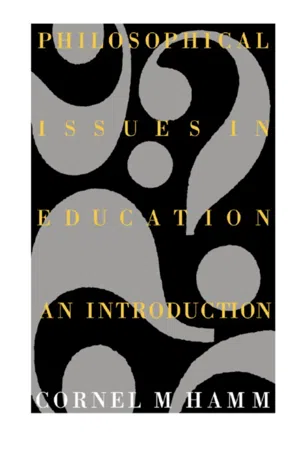
First published in 1989. This introductory book in philosophy of education has been produced for the beginning student in the discipline. No previous experience in formal studies in either philosophy or education is a requirement for a full comprehension of the text. It is a product of the author's experience over a number of years of offering elementary courses in philosophy of education to first and second year college and university students who had either a general interest in the study of education or a more specific interest in becoming teachers. This text is suitable for both such groups and would therefore be useable in Departments of Philosophy as well as Faculties of Education.
Information
Topic
EducationSubtopic
Education GeneralCHAPTER 1
The Nature of Philosophical Inquiry into Educational Discourse
Most adults at some time or other philosophize about education; but most of them do not do so often enough and well enough. To help them think philosophically about educational matters better and more often is one of the main purposes of this book. So the book begins with a discussion of the nature of philosophical inquiries into education in the hope that the reader will become more aware of what philosophical thought is like and as a result engage in it more deliberately and competently. This first chapter focuses on the nature of philosophy of education and how philosophical study can help solve the burgeoning problem of meaning in educational discourse. The second chapter focuses on the use of metaphors in educational language as attempts to gain understanding of the nature of education. The two chapters together help to show how the remaining parts of the book proceed and how philosophy is done and seen to be invaluable in educational studies.
What is Philosophy of Education?
To understand what philosophy of education is, it is necessary to gain an understanding of what philosophy is, since philosophy of education is simply philosophy about education. As such it can be thought of as a branch of the discipline of general philosophy. Not all serious thinkers about education would agree that philosophy of education is a branch of philosophy; and a number of people who have called themselves ‘philosophers of education’ doing ‘philosophy of education’ are engaged in activities other than, and only peripherally to, what is here considered philosophy of education. So perhaps the best way to start to clarify what philosophy of education is, is to state what it is not.
Distinguishing Educational Theory from Philosophy of Education
First, philosophy of education is not synonymous with educational theory. Many practically-minded people in schools and faculties of education have thought long and hard and well about educational aims, curricular content and implementation, teaching and classroom strategies, and come up with a theory, or system, of education around which they plan their activities. What this system or theory includes are elements of various disciplines such as psychology (When do children best learn generalizations or abstractions?), sociology (What is the social impact of having separate schools for boys and girls?), organizational theory (What is the ideal role of the school principal?), and other disciplines, including philosophy (In what sense is a school an educational institution as distinct from a place for training people?) Most people have theories of education in the above sense, some more thorough and factually secure than others. And we all should, and particularly educators should, have sound theories of education. But building theories of education is not doing philosophy of education. And those who have ‘progressive’, or ‘monitorial’, or ‘Herbartian’, or ‘wholeness’, or ‘child-centered’ philosophies of education are using ‘philosophy’ in a sense almost equivalent to the notion of theory under discussion. Philosophy of education as understood here is only one necessary element of educational theory.
Philosophy of education also is not a study of the history of educational thought. In some circles what passes as philosophy of education is really only a study of the thought of so-called ‘great educators’ or of other serious thinkers about education, particularly those thinkers who are philosophers in their own right such as Plato, Locke, or Kant. Often these thoughts, however, are merely the statements of the individual’s ideals in education and favourite prescriptions for child rearing. Interesting though some of these ideas are, they are not necessarily philosophical in kind, nor do the thinkers arrive at their beliefs by reasoning philosophically. Writers such as Comenius, Rousseau, Pestalozzi, Froebel, Montessori, and Dewey say interesting things about a variety of topics roughly related to education such as experimentation, play, nature, instinct, democracy, freedom, harmony, wholeness and so on. Yet often these thoughts are conceptually crude and confused, highly speculative, unfounded or contradictory. At other times they are startingly clear and factually sound but not philosophical. Even when first-rate philosophers, such as Kant and Rousseau, write on education, they often fail to be philosophical about the issues connected with education.
Philosophy of education, furthermore, is not a matter of drawing conclusions, making extrapolations, and eliciting implications from bodies of systematic and doctrinaire thought of a metaphysical, socialpolitical, or religious nature. Such an activity can be thought of as the ‘isms’ approach to philosophy of education. This sort of activity was predominant in courses in ‘philosophy of education’ in times past, particularly in the United States. In some institutions this is still going on and some books on the topic still organize their material in this fashion. M.L.Bigge, in Educational Philosophies for Teachers,1 for example, has chapter titles based on topics such as idealism, realism, theism, empiricism, existentialism, and experimentalism. Others might include in such list of topics Marxism, Thomism, liberalism, humanism, secularism, pragmatism, phenomenalism, classicism, essentialism. These various ‘isms’ take a particular position on a variety of highly speculative issues and attempt to build some sort of practical educational system around the core ideas. In this they resemble the educational theorists discussed briefly above, though they are even less concerned with philosophical method and rigour. Many of the core ideas are highly questionable and the implications drawn from them extremely weak and tenuous. Modern philosophy of education fortunately has turned away from this type of enterprise.
Turning now to what philosophy of education is, it is well to remind ourselves how we began by noting that philosophy of education is a branch of philosophy and that to get a grip on how philosophers of education think and function one must become clear on what philosophy itself is. That will not be an easy task because what philosophy as such is, is itself highly controversial and difficult to define. In the discussion to follow we may not be able to remove all the problems surrounding the controversy nor clearly to define philosophy, but we can to a considerable extent move in that direction.
The Many Uses of ‘Philosophy’
One of the problems concerning the nature of philosophy in general is that the term ‘philosophy’ is used in many different non-professional senses. Thus we read in the newspaper about ‘the Queen’s philosophy of horse racing’, or ‘the philanderer’s philosophy of love’, or ‘the school teacher’s philosophy of spelling’. In these examples, the term ‘philosophy’ could without loss of meaning be replaced with a term similar to ‘considered view about’. But of course not every considered view is philosophical or the result of philosophizing. So these examples do very little to help us understand what professional philosophers mean by the term. At other times we say things like, ‘Be more philosophical!’ to someone in an excited or emotional state with the intent that the person take a more relaxed, detached, and reflective view of a situation. Here again we have a use of ‘philosophy’ that does not help us to understand what philosophers do when they philosophize. And there are numerous other such uses.
But even when philosophers attempt to define what it is they do when they philosophize, they often do not agree on how ideally they should proceed nor how to define precisely what it is they do even when they agree roughly on how to proceed. To think of philosophy as the search for and dispensing of wisdom, a view derived from the Greek meaning of the word ‘philosophy’ (‘love of wisdom’) is mistaken in that it claims far too much for philosophy and philosophers. Many people who are wise are not philosophers and many good philosophers are not wise. To think of philosophers as lovers of wisdom rather than achievers of wisdom is perhaps more appropriate, emphasizing as it does method or approach to certain problems rather than emphasizing a product or a body of knowledge and prescriptions for wise living. Other definitions of ‘philosophy’ often suffer the same fate; they allude to aspects of philosophy which are either not necessary or not sufficient. Bertrand Russell’s view of philosophy as persistent attempt at clearheadedness is deficient in that clearheadedness certainly is necessary for doing philosophy, but it is not sufficient. One would hope that many people, including pilots, doctors, and nuclear scientists, would be consistently clearheaded in their concerns, but that does not mean that they are therefore doing philosophy. A view alleged to be Wittgenstein’s, that philosophy is a form of language therapy in which idle language is put back to work through a process of conceptual clarification, errs in the opposite direction. The form of conceptual analysis suggested is a sufficient condition for doing philosophy, but it is not necessary. There are philosophical concerns that go beyond clarity and analysis. Other philosophers think of philosophy as a second-order activity, or taking the stance of a Martian. The main idea alluded to in these analogies is that philosophical thought and language is about our ordinary ways of thinking and speaking; it is language about language or thought about thought. Thus P.H.Hirst writes: ‘It is a rather distinctive type of higherorder pursuit, primarily an analytic pursuit, with the ambition of understanding the concepts used in all other forms of lower-order knowledge and awareness…of our primary forms of understanding…in the sciences, in morals, in history and the like’.2 Philosophy thus starts at the common sense level of thought and eventually forces one to think at levels beyond the ordinary. Thoughts such as these prompt one to offer the suggestion that philosophy is an uncommon amount of common sense. But this too is only a necessary, not a sufficient, condition; though it does help to make the point that philosophy is not a mysterious discipline trafficking in esoteric and difficult ideas that only a brilliant few are capable of understanding. Other definitions offered, such as: ‘Philosophy is the pursuit of truth’, ‘…is the search for the meaning of life’, ‘…is that which deals with ultimate reality’, and so on, all fail to transmit satisfactorily to the uninitiated a knowledge and understanding of philosophy. In sum, one or two short-sentence definitions by themselves inevitably fail to convey the full meaning of philosophy and cannot hope to describe the complex activity which philosophy is. In fact, if one focuses on the kind of activities philosophers engage in, it is easier to understand what philosophy is. What, then, do philosophers do when they philosophize? The answer is that they ask, and try in various ways to answer, three sorts of questions: (1) What do you mean? (Or, what does it—the word, the concept—mean?) (2) How do you know? (Or, what, in general constitute the grounds or kinds of grunds for claiming to know something?) (3) What is presupposed? (Or, what assumptions or presuppositions are you now making or must you make for the proposition you are now asserting?) It is when one acquires the habit of asking these questions about one’s own and others’ speech and writings that one begins to be a philosopher. As you acquire the habit of asking (and also answering) these sorts of questions in the context of education you will be on your way to becoming a philosopher of education.
Lest you think this habit of mind is easily acquired and does not require effort and practice, it is well for us to dwell on each of these questions in turn to see just what is involved.
Three Philosophical Questions
What do you mean?
When a philosopher asks, ‘What do you mean?’ he is not so much enquiring into what you as an individual mean by a term, but into the meaning of the words you are using, or more accurately the concepts for which the words you are using are the labels. It is therefore a conceptual, not merely a verbal, inquiry. The question is equivalent to ‘What is an X?’, where X is the concept (or word) under scrutiny and the ‘is’ is one of identity, not predication. This last distinction between two kinds of uses for ‘is’ should be clearly kept in mind because it is one of the ways in which philosophical activity (and a philosophical statement) is identified. When we say, ‘A bachelor is an unmarried adult male’, the words following the ‘is’ are (perhaps, see below) collectively identical to the meaning of the term ‘bachelor’. Thus we can speak of the ‘is’ of identity. When we say such things as, ‘A bachelor is unlikely to have children’, we are predicating things (giving some additional information) about bachelors. This can be called the ‘is’ of predication. Often it is difficult to say which ‘is’ is being employed. (Consider, for example, ‘Peace is disarming’.) But it is the mark of a good philosopher to be able to sort this out. One way he proceeds is by attempting to provide the necessary and sufficient (jointly sufficient) conditions for calling something an X. This is not an easy thing to do with concepts that puzzle us and are in need of philosophical inquiry. Even for concepts that do not puzzle us, it is not easy to do. Where the X stands for ‘bachelor’, consider the following:
A bachelor is (a) unmarried.
(b) happy.
(c) female.
(d) male.
(e) adult.
(b) happy.
(c) female.
(d) male.
(e) adult.
Are conditions (a) to (e) jointly sufficient, that is, both necessary and sufficient for calling someone a bachelor? Clearly (b) is predication and therefore does not belong in this series where the ‘is’ in the statement is one of identity. Some women have suggested that (c) should be included because of the negative connotation surrounding ‘spinster’, the female equivalent of bachelor. But of course this would amount to legislating a new use for the term, which has problems of its own (see below, Programmatic definitions). An accurate analysis would have to exclude (c). Conditions (a), (d), and (e) are clearly necessary; but are they sufficient? One could argue that they are not. A divorced man is not usually called a ‘bachelor’, though he is unmarried, adult, and male. So one would probably want to include another condition such as ‘never married’. Others have suggested that ‘homo sapiens’ should be a condition, since bachelor is a term reserved for human beings. So even with very non-puzzling easy concepts the task is difficult to complete accurately. That is because so many of the concepts we use are not that precise. And the less precise, the more puzzling, and the more profound and complex the concept, the more in need of philosophical scrutiny they are likely to be. So perhaps, as Hirst and Peters observe3, one may not always be successful in finding and specifying all the necessary conditions for difficult concepts. We may have to be satisfied with pin-pointing only some necessary conditions, i.e., with a weak sense of definition. The reason for this is not only that language changes (as social life itself changes), but also that certain words have never been used very precisely in speech in general. The provision of necessary and sufficient conditions for the use of words is then only an ideal. It is the ideal philosophers strive for as they attempt to find the principles or rules that govern the use of words in a living public language. This is what philosophers are after when they ask ‘What do you mean?’ The importance of this task is difficult to overemphasize. Many impatient, practically-minded educationalists have been critical of the analytic task of philosophy of education, arguing that philosophers ‘fiddle’ with words while the educational ‘Rome’ burns. The criticism is misplaced. Educational language is full of jargon and educational literature replete with inherently difficult concepts. Added to this is careless use and misuse of ordinary terms, all of which warrants a great deal of philosophical attention. In fact one is tempted to say that failure to convey meaning is one of the major problems in educational discourse and causes much unnecessary confusion, lack of progress in educational research, and even animosity and distrust. Philosophy can be of great help in avoiding these. Yet despite this important function of philosophy in dealing with the problem of meaning, that is only one important first task of philosophy. Philosophers are also concerned with questions of truth and knowledge, but only after questions of meaning have been settled. Questions of meaning are always logically prior to questions of truth. But once meaning is clear, philosophers ask ‘How do you know?’
How do you know?
Not all ‘How do you know?’ questions are of a philosophical kind. If in response to the statement ‘Smoking causes cancer’ you ask ‘How do you know?’ all that is required is for the speaker to cite the appropriate evidence. There is very little philosophical interest in such remarks. But suppose someone answers: ‘Because a lot of people say so’. Now the philosopher might well remark that that is not the appropriate kind of evidence. No matter how many people believe something to be true, that could not constitute the reason or grounds for it to be true. Mere believing is just not the sort of thing that constitutes the grounds (or the evidence) for anything. It is not in the right type of category. Philosophers, that is to say, are not so much interested in a particular claim to knowledge but about a class of claims, about the general sorts of grounds for supporting various types of statements. They ask and try to answer questions like: What sort of statement is this? Is it historical? empirical? logical? aesthetic? moral? And once it is known what type of statement is made, philosophers ask after the appropriate evidence for that type of statement.
Sometimes a statement by itself has little interest for a philosopher, but a great deal of interest in context with other statements. Thus a philosopher may observe that a series of statements does not lead to an alleged conclusion, perhaps because premises are missing or a derivation is not allowed according to the rules of logic. Philosophy in fact is very much concerned with the rules of logic and various kinds of errors in logical argument. Philosophers typically point out such thinking errors as: contradiction, inconsistency, ad hominem attacks, circularity, incompleteness, category mistakes, and so on. Philosophers, in other words, are very much concerned with argument and assessment of argument.
At other times they are interested in singular statements when such statements are themselves puzzling because of the unusual nature of their claim. (Actually, any and every statement can have philosophical dimensions, since all statements have meaning and function, and reflect thought about which there can be second-order...
Table of contents
- Cover Page
- Title Page
- Copyright Page
- Acknowledgments
- Introduction
- CHAPTER 1: The Nature of Philosophical Inquiry into Educational Discourse
- CHAPTER 2: Metaphors in Educational Discourse
- CHAPTER 3: An Analysis of the Concept of Education
- CHAPTER 4: ‘Aims’ in Education
- CHAPTER 5: Educational Curricula and the Nature of Knowledge
- CHAPTER 6: Child-Centered Curricula
- CHAPTER 7: Teaching and Learning and Education
- CHAPTER 8: Inter-personal and Social Issues in Education
- CHAPTER 9: Moral Education
- CHAPTER 10: The Justification of Education
- Bibliography
Trusted by 375,005 students
Access to over 1.5 million titles for a fair monthly price.
Study more efficiently using our study tools.
Frequently asked questions
Yes, you can cancel anytime from the Subscription tab in your account settings on the Perlego website. Your subscription will stay active until the end of your current billing period. Learn how to cancel your subscription
No, books cannot be downloaded as external files, such as PDFs, for use outside of Perlego. However, you can download books within the Perlego app for offline reading on mobile or tablet. Learn how to download books offline
Perlego offers two plans: Essential and Complete
- Essential is ideal for learners and professionals who enjoy exploring a wide range of subjects. Access the Essential Library with 800,000+ trusted titles and best-sellers across business, personal growth, and the humanities. Includes unlimited reading time and Standard Read Aloud voice.
- Complete: Perfect for advanced learners and researchers needing full, unrestricted access. Unlock 1.5M+ books across hundreds of subjects, including academic and specialized titles. The Complete Plan also includes advanced features like Premium Read Aloud and Research Assistant.
We are an online textbook subscription service, where you can get access to an entire online library for less than the price of a single book per month. With over 1.5 million books across 990+ topics, we’ve got you covered! Learn about our mission
Look out for the read-aloud symbol on your next book to see if you can listen to it. The read-aloud tool reads text aloud for you, highlighting the text as it is being read. You can pause it, speed it up and slow it down. Learn more about Read Aloud
Yes! You can use the Perlego app on both iOS and Android devices to read anytime, anywhere — even offline. Perfect for commutes or when you’re on the go.
Please note we cannot support devices running on iOS 13 and Android 7 or earlier. Learn more about using the app
Please note we cannot support devices running on iOS 13 and Android 7 or earlier. Learn more about using the app
Yes, you can access Philosophical Issues In Education by Cornel M. Hamm in PDF and/or ePUB format, as well as other popular books in Education & Education General. We have over 1.5 million books available in our catalogue for you to explore.