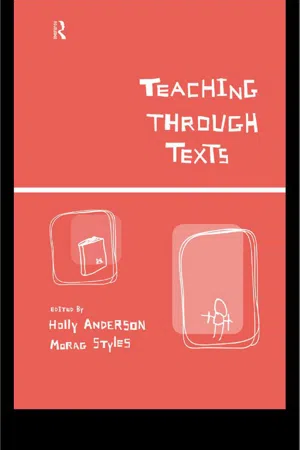
eBook - ePub
Teaching Through Texts
Promoting Literacy Through Popular and Literary Texts in the Primary Classroom
- 184 pages
- English
- ePUB (mobile friendly)
- Available on iOS & Android
eBook - ePub
Teaching Through Texts
Promoting Literacy Through Popular and Literary Texts in the Primary Classroom
About this book
Drawing on many popular and literary texts, the contributors to this book write with enthusiasm about opportunities for creative teaching and learning, and provide many examples of good practice both inside and outside the Literacy Hour
Information
Chapter I
Give Yourself a Hug
Reading between the rhymes
Vivienne Smith
Poetry is never better understood than in childhood, when it is felt in the blood and along the bone.
(Meek 1991:182)
One, two, three, four,
Put your bottom on the floor.
Five, six, seven, eight,
Cross your legs and sit up straight.
Are you ready? Nine, ten:
I’ve lost the register again!
So, with rhyme and an admission of inadequacy, the day in my reception/ year 1 classroom would begin; and the children thought it was wonderful. They would stop their chatter, sit down, bristle with straightness and chant the rhyme with an enthusiasm and volubility that was sometimes difficult for me to share first thing in the morning.
Our rhyme is nothing special. I include it here because it illustrates the central importance that poetry of all sorts came to have in our classroom. This rhyme, for us and about us, celebrated the delight we found in each other, in rhythm and in language. It was an expression of our community.
This chapter sets out to describe how this sense of community came about. It will consider the work we did in the classroom, but it must begin before that. For most children know poetry from the cradle. It lives and grows with them throughout babyhood and through the pre-school years. Mostly, they know it in the form of nursery rhyme.
In the nursery
One day, in a spare ten minutes, I asked the children in my class to tell me all the nursery rhymes they knew, and we made a list. We were short of time, so the list was not exhaustive, but it contained thirty-five or so songs and rhymes with which the children were familiar. The list contained some texts that I would not call nursery rhymes: The Wheels on the Bus Go Round and Round was there and so was the Ahlbergs’ Each Peach Pear Plum. It seemed that for these children a ‘nursery rhyme’ was any text that was rhythmic enough to be sung or chanted, was easy to remember and was (probably) associated with the time before they started school.
They showed great enthusiasm for the task: they vied with one another to be first to mention the really well-known rhymes; they exclaimed with delighted recognition when anyone volunteered a rhyme they knew but had forgotten; and they giggled with joy when they found one I did not know.
The rhymes were special to these children. They told me eagerly about the contexts in which they knew them best. ‘My mum sings that to me,’ said one. ‘We used to sing that at playgroup!’ ‘That’s on my tape!’ Kitty and Daisy, identical twins, became most excited by two of the rhymes. ‘That’s mine!’ shouted Kitty when we remembered Humpty Dumpty. ‘It’s on my cup. Daisy has got Jack and Jill.’ The children were surrounded by rhymes. They heard them on tapes, watched them on videos and saw them on the television. Nursery rhymes, or the characters from them, were depicted on cups, on curtains, on toys and in books. The adultcontrolled culture in which small children live their daily lives is thick with nursery rhymes and with reference to them.
I asked the children how they first came to know these rhymes, but they could not tell me. For each of them, some rhymes were so deeply entrenched in memory that they could not remember a time when the rhymes were unfamiliar. The learning of them, it seems, had taken place in such a way or at such a time that no effort of conscious recall was needed.
Their mothers confirmed this impression. They told me how they had used rhyme most often when their children had been babies and toddlers. They had sung rhymes and lullabies to rock and soothe the children to sleep. They had amused them and distracted them with finger rhymes and bouncing games. Pat-a-Cake, Pat-a-Cake, Baker’s Man was mentioned, and so was This is the Way the Ladies Ride. Physical contact and rhythmic movement were usually part of the experience. These were not occasions of planned cultural induction. Rather they were impromptu moments of fun and tenderness between mother and child.
The mother or nurse does not employ a jingle because it is a nursery rhyme per se, but because in the pleasantness (or desperation) of the moment it is the first thing which comes to mind.
(Opie and Opie 1951:6)
But more is happening here than the amusement of children or the learning of a set of words. In the interaction of the game, in the rocking of the lullaby, a loving relationship of trust and joint experience is being built up and cemented. When, in the classroom, I first read the following poem by Christina Rossetti to the children, they were enchanted:
Love me, I love you,
Love me, my baby;
Sing it high, sing it low,
Sing it as it may be.
Love me, my baby;
Sing it high, sing it low,
Sing it as it may be.
Mother’s arms under you,
Her eyes above you
Sing it high, sing it low,
Love me, I love you.
Her eyes above you
Sing it high, sing it low,
Love me, I love you.
They responded, I think, not only to the gentle lyricism of the verse, or the seemingly effortless rocking of the rhythm, but to the unexpressed memories it engendered of comfort and trust, of their own babyhood in the security of their mothers’ arms.
Nursery rhymes are so very important for small children, I suggest, because they become personal and because the children use them to build and to define relationships. When Lauren announced, ‘Me and my mum sing that,’ she was claiming the rhyme as family property. It was not her rhyme, but theirs, part of who she and her mother were and what they did together. Similarly, the children who proudly said they had sung a particular rhyme at playgroup made sure I knew which playgroup they meant and which children had attended it. It was part of a shared experience that forged them together as a group. They wanted me to know who was and who was not included. Even Kitty and Daisy, with their insistence on ‘That’s my one!’, were using the rhymes to define themselves as individuals. ‘This rhyme is the property of Kitty and not Daisy. We are not the same, and I am a separate person’ seemed to be the message.
The rhymes, then, have a positive effect: they affirm children in their relationships and they establish their individuality. This goes some way, perhaps, towards explaining how children use nursery rhymes. It says nothing about why they are attractive in the first place or what is their lasting appeal.
Nursery rhymes are strong. The origins of many are obscure and some rhymes are ancient. The Opies (1951) discovered that at least 25 per cent of those we know today were probably current in Shakespeare’s time. They are predominantly oral traditions. As a child, I never owned a nursery-rhyme book; nor do most of the children in my class. Yet, between us, we know a vast number of rhymes. The rhymes survive, passed on from adult to child, changing as language and circumstance require.
Oral rhymes are the true waifs of our literature in that their original wording, as well as their authors, are usually unknown. But this does not mean that they are necessarily sickly strays to whom only the indulgent and undiscriminating nursery will give shelter. Rather it is true that having to fend for themselves, without the benefit of sponsor or sheep-skin binding, they have had to be wonderfully fit to have survived.
(Opie and Opie 1963:7)
They are fit. They are lithe and energetic, and ready to play. They have immediacy:
Jack be nimble,
Jack be quick,
Jack jump
Over the candlestick.
Jack be quick,
Jack jump
Over the candlestick.
They are technically faultless. Either the years and usage have pruned away imperfection or, more likely, their virtuosity in the first place has made them memorable. They all have a strong and regular pulse, yet within that pulse metres can vary and frolic as much as the form and subject matter will allow. Here is an example:
Hickory dickory dock
The mouse ran up the clock.
The clock struck one The mouse ran down.
Hickory dickory dock.
No child stops to notice how the mouse scurries up the clock with scampering dactyllic feet, or how the slower iambic metre of the middle lines echoes the chiming of the hour. The Jack rhyme is just as effective. He is made physically to jump over that candlestick by rhythm alone. It is impossible to say line three, with those two strongly stressed syllables at the beginning followed by three unstressed ones, without a leap and a running landing. This virtuoso marriage of form and content is not unusual in nursery rhymes, and must be part of their strength and appeal.
So, too, must be the games that so many of them play with sound and language. ‘Hey diddle diddle, the cat and the fiddle’ is simply fun to say. It reproduces (or perhaps initiates) the sort of word game that young children find so attractive. The verses glitter with rhyme and alliteration.
But though the technical brilliance of nursery rhymes undoubtedly makes them easier to remember, their lasting strength cannot reside in that alone. There must be something more in their matter to make them so sustaining to small children. John Goldthwaite (1996) explores this issue. He makes two main points. One is that nursery rhymes are useful. They provide the child with a vast cast-list of eccentrics, all eager to be recognised and befriended, as well as a catalogue of lore about numbers, the weather and animals that helps the child to comment on and negotiate a path through everyday life.
His second point is that nursery rhymes are make-believe and part of nonsense. This he defines as ‘a flirtation with disorder, a turning upside down of the world for the pleasure of seeing it come right again’. This nonsense, which he calls allsense, is harmony: ‘that which transports our sensible, disparate understandings into something—a kind of light perhaps —that precludes and justifies them all’ (1996:16).
For Goldthwaite, allsense is a quality that can be found in all really good children’s literature. It is not something that can be deliberately written in and cannot be found for the looking. It is ‘the enlightening ether that touches the child with a quickening gladness’ (p. 16). It is, if I might borrow from Goldthwaite’s theological vocabulary, grace—a sense of joyous liberty and rightness that comes free with the work.
Well, perhaps it is this that children recognise and cherish in nursery rhymes. Certainly there is a grace and a lightness of touch in the best of them, and a joy, a spirited eagerness for life, that many children appreciate. When they come to school, aged nearly 5, they carry it with them —a great, positive treasure hoard of knowledge of and enthusiasm for verse. What happens to it when they come through the playground gates will be considered next.
In the playground
One morning in the playground where 1 was on duty a pair of year 2 girls sang:
I saw a box of matches
Upon the kitchen floor, floor, floor,
And when I wasn’t looking
They danced upon the floor, floor, floor.
Singing aye, aye, yippee, yippee aye.
Singing aye, aye, yippee, yippee aye.
Singing aye, aye yippee
Granny’s such a hippie
Aye, aye yippee, yippee aye.
With the song went a complicated clapping ritual. To begin, they stood facing each other. On the first and all subsequent unstressed syllables of the verse, they clapped. On each stress, they put their hands in front of them, palms forward, and clapped each other’s hands. For the chorus, the girls put their own hands together and swung their arms across their bodies, brushing the backs of each other’s hands in time with the beat. It looked good fun.
Games such as this are common in the playground. Clusters of girls, usually around 7 years of age, are the main participants. Sometimes they graciously and somewhat patronisingly initiate a younger child. Occasionally that child is a boy. (I have watched little boys, from reception and year 1 classes, look on wistfully at these performances, longing for a turn, but rightly suspecting that it was not to be—at least, not in public!)
These rhymes are lively and energetic—and meaningless. The fun of them is in the movement, the physical mastery of clapping and singing and of keeping the rhythm going all at the same time. As with nursery rhymes, rhythm is important: it is part of the structure that makes them memorable. And even more than nursery rhymes, this form stems from an oral tradition. The rhymes are passed on from child to child, from generation to generation, and it is this that makes them distinctive.
While the nursery rhyme passes from the mother or another adult to the small child on her knee, the school rhyme circulates simply from child to child, usually outside the home and be...
Table of contents
- Cover Page
- Title Page
- Copyright Page
- Figures
- Contributors
- Acknowledgements
- Introduction: Teaching Through Texts—Contexts, Conventions and Contributors
- Chapter I: Give Yourself a Hug Reading Between the Rhymes
- Chapter 2: ‘Never Be Without a Beano!’: Comics, Children and Literacy
- Chapter 3: From Minnie the Minx to Little Lord Fauntleroy: Understanding Character In Fiction
- Chapter 4: Juvenile Leads
- Chapter 5: Into the Woods: Animating Stories Through Drama
- Chapter 6: Drawing Lessons from Anthony Browne
- Chapter 7: Beyond the Text: Metafictive Picture-Books and Sophisticated Readers
- Chapter 8: Reading the Movies: Learning Through Film
- Chapter 9: ‘My Mum’s Favourite Yoghourt Is “Diet Choice”’: Language Study Through Environmental Texts
- Chapter 10: ‘And They Lived Happily Ever After…Not Really!’: Working With Children’s Dictated Texts
- Chapter 11: Telling Facts: Contrasting Voices In Recent Information Books for Children
- Chapter 12: Anne Fine’s Stories for Life
Trusted by 375,005 students
Access to over 1.5 million titles for a fair monthly price.
Study more efficiently using our study tools.
Frequently asked questions
Yes, you can cancel anytime from the Subscription tab in your account settings on the Perlego website. Your subscription will stay active until the end of your current billing period. Learn how to cancel your subscription
No, books cannot be downloaded as external files, such as PDFs, for use outside of Perlego. However, you can download books within the Perlego app for offline reading on mobile or tablet. Learn how to download books offline
Perlego offers two plans: Essential and Complete
- Essential is ideal for learners and professionals who enjoy exploring a wide range of subjects. Access the Essential Library with 800,000+ trusted titles and best-sellers across business, personal growth, and the humanities. Includes unlimited reading time and Standard Read Aloud voice.
- Complete: Perfect for advanced learners and researchers needing full, unrestricted access. Unlock 1.5M+ books across hundreds of subjects, including academic and specialized titles. The Complete Plan also includes advanced features like Premium Read Aloud and Research Assistant.
We are an online textbook subscription service, where you can get access to an entire online library for less than the price of a single book per month. With over 1.5 million books across 990+ topics, we’ve got you covered! Learn about our mission
Look out for the read-aloud symbol on your next book to see if you can listen to it. The read-aloud tool reads text aloud for you, highlighting the text as it is being read. You can pause it, speed it up and slow it down. Learn more about Read Aloud
Yes! You can use the Perlego app on both iOS and Android devices to read anytime, anywhere — even offline. Perfect for commutes or when you’re on the go.
Please note we cannot support devices running on iOS 13 and Android 7 or earlier. Learn more about using the app
Please note we cannot support devices running on iOS 13 and Android 7 or earlier. Learn more about using the app
Yes, you can access Teaching Through Texts by Holly Anderson,Morag Styles in PDF and/or ePUB format, as well as other popular books in Education & Education General. We have over 1.5 million books available in our catalogue for you to explore.