The Archaeology of Communities develops a critical evaluation of community and shows that it represents more than a mere aggregation of households. This collection bridges the gap between studies of ancient societies and ancient households. The community is taken to represent more than a mere aggregation of households, it exists in part through shared identities, as well as frequent interaction and inter-household integration.
Drawing on case studies which range in location from the Mississippi Valley to New Mexico, from the Southern Andes to the Blue Ridge Mountains of Madison County, Virginia, the book explores and discusses communities from a whole range of periods, from Pre-Columbian to the late Classic. Discussions of actual communities are reinforced by strong debate on, for example, the distinction between 'Imagined Community' and 'Natural Community.'
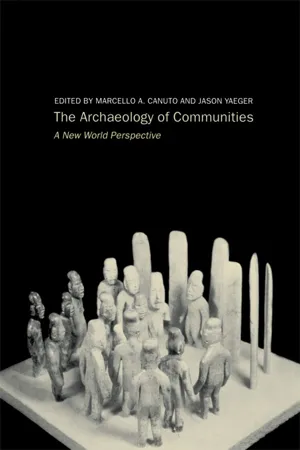
eBook - ePub
Archaeology of Communities
A New World Perspective
- 288 pages
- English
- ePUB (mobile friendly)
- Available on iOS & Android
eBook - ePub
About this book
Information
1
INTRODUCING AN ARCHAEOLOGY OF COMMUNITIES
With this volume, we hope to invigorate the study of past communities. Archaeologists have long pursued theoretically and methodologically innovative research on social institutions like polities, households, and regions. However, research on the community has stagnated, despite a multitude of sociological, ethnographic, and ethnohistoric studies that have shown it to be one of the most important and meaningful contexts for social interaction. Given the community's central place in most societies, it is incumbent upon archaeologists to contribute to this study by finding ways to recover ancient communities embedded within the archaeological record. First, however, archaeologists must define “community” and then seek ways to make that definition archaeologically meaningful. Because we feel this goal is best achieved through comparative analysis, this volume brings together ten studies in which scholars with diverse models of community examine specific archaeological cases in the Americas, from Formative-period South America to nineteenth-century Appalachia. Joyce Marcus and William Isbell each provide concluding chapters that examine the themes unifying the contributions and assess the potential contributions of what we call an “archaeology of communities.”
We would like to introduce this volume with a broader discussion of the community and the major issues that we feel an archaeology of communities must address. We do not intend this discussion or the volume as a whole to be programmatic. The contributors bring a diversity of approaches to the study of past communities, and we hope that this multiplicity of perspectives will invigorate discussion and stimulate critical examination of the ideas that archaeologists have adopted in regard to the community. Despite their different theoretical approaches, however, the contributors agree that a more explicit and focused archaeology of communities, situated between household archaeology and regional studies, promises to yield unique insights on identity and group membership, social organization, and socioeconomic integration.
Theoretical perspectives on the community
Ethnographic and sociological research have long engaged in community studies, using many distinct models and approaches. Here, we distinguish four such approaches that we label structural-functionalist, historical-developmental, ideational, and interactional. The following brief descriptions of these perspectives serve as a background for our examination of how archaeologists have defined the community.
Structural-functionalist research has focused primarily on the functions that a community serves within a social structure. From this perspective, the community is a co-residential collection of individuals or households characterized by day-to-day interaction, shared experiences, and common culture (Murdock 1949). Structural-functionalists and functionalists see the community as a natural “human whole” that serves as a society's principal unit of biological and cultural reproduction (Arensberg 1961; Redfield 1955). Although this approach has been an important stimulus for community studies in archaeology, its practitioners often assume the existence of community integration and rarely problematize the community's origins and maintenance because it is teleologically assumed to be a pre-existing and natural social entity.
These short-comings spurred historical-developmental reactions to the structural-functionalist approach. Led by Eric Wolf (1956), researchers began to ask how communities come into existence. Wolf and others (Gould 1959; Marriott 1955; Mintz 1956) stressed the roles of external and historical forces in conditioning a community's internal structure, arguing that distinct conditions would create different kinds of communities (Wolf 1955). By studying extra-community factors, these scholars rejected the notion of the community as a social isolate reflective only of local integrative mechanisms. However, the political economy and world systems analyses that mark this perspective not only de-emphasize the role of local generative forces in the development of communities, but also ignore the fact that external forces are inevitably transformed as they are refracted through the community's local structures and social relationships.
Ideational approaches focus on how people perceive themselves and their place in a community. Recent anthropological thinking (Cohen 1994) has conceived of identity as a more plastic conception of self, in which individuals shift or change identities situationally. Identities, including community membership, are based in part on qualities that people see themselves as sharing with others, as well as criteria they perceive as distinguishing themselves from others (Anderson 1991; Cohen 1985). From this perspective, social identity represents the coalescence of mutually agreed upon and self-ascribed cultural categories. This does not imply, however, that all community members share the same idea of what constitutes community membership or which underlying issues unite them. Although shared identity is a key component of the community, strongly ascriptive models of community identity can lose sight of the important complementing and constraining role that external structures place on self-identification.
Finally, interactional approaches ask how people create communities through their relationships. Most definitions of community have seen interaction between community members as a necessary condition of its existence (after Murdock 1949), and models of social organization often recognize the importance of interaction in structuring society (Barth 1966; Firth 1961). It has been the practice theory perspective, however, that has emphasized interaction most strongly, positioning individual practice as the locus for the production of the patterned processes that create and recreate society (Bourdieu 1977; Giddens 1984). Instead of seeing the community as the basis for social interaction and reproduction, a practice or agent-oriented approach views all social institutions, including the community, as socially constituted (also Anderson 1991). However, this perspective does not ignore spatial and material conditions, viewing them as constitutive of the structures that pattern practice (Bourdieu 1973; Cunningham 1973).
The community in archaeology
Following broader trends in anthropology, archaeologists have often taken a special interest in communities. However, relatively few have problematized it as an object of study by posing the deceptively simple question: “What is a community?” Following George Murdock (1949), they often envision communities as relatively static, conservative, closed, and homogenous social units maintained by residential proximity, a shared normative culture, and the daily experiences common to its members. Despite the range of alternatives summarized above, most archaeologists have adopted (often implicitly) a variation of Murdock's definition, in part because it includes several archaeologically visible material markers: discrete spatial patterning of activities, residential nucleation, and shared material culture. In other words, Murdock's definition appears to be neatly compatible with the unit of archaeological analysis called “the site.”
In the early part of this century, when site-based research dominated archaeology, archaeologists generally equated community and site. As New World archaeologists became disenchanted with the culture-historical paradigm in the 1950s, they began to focus on issues of cultural ecology and social evolution, topics that often implied a scale of analysis larger than the site. These new research questions energized the nascent field of regional settlement pattern research, which was soon strongly informed by the generalizing and positivist epistemology of processualism (Clarke 1977; Trigger 1967). Even though these new questions were not incompatible with community analyses, as witnessed by The Early Mesoamerican Village (Flannery 1976; also Chang 1968 and Willey 1968), most scholars addressed them from a large-scale, regional perspective (Johnson 1977; Parsons 1972; Roper 1979; Sanders 1956), More recently, household archaeology has emerged as a complement to regional approaches and as a reaction to an earlier emphasis in many areas on large sites and elite members of society (Rathje 1983; Wilk and Rathje 1982). Most household archaeologists adopt a behavioral perspective in studying ancient societies at their smaller scales. In so doing, they adopt processual and comparative frameworks (Netting, Wilk, and Arnould 1984) that address broad issues of social and economic organization and social evolution.
Settlement archaeology and household archaeology have made contributions to the study of the past that should not be underestimated. However, the building-block typologies and functionalist frameworks they often adopt have had negative consequences for the archaeological study of communities, the most debilitating of which has been the continued equation of the archaeological site with the social community. Settlement pattern studies often conceive of communities as settlement types that fulfill specific functions within a larger social system. In contrast, household archaeology generally views the community as an aggregation of households. Despite some exceptions, neither regional nor household approaches have generally examined the community as a dynamic and complex social institution, reinforcing instead a decades-old socio-spatial, static model of community.
The conjunction of processual archaeology's problem-oriented paradigm and its interest in issues of environmental adaptation, cultural materialism, political economy, and economic structure has also contributed to the paucity of community-based archaeology in recent decades. As was the case with ethnographic community studies (Chambers and Young 1979), the community ceased to be an object of study in-and-of-itself as archaeologists became increasingly question-oriented. The site – and implicitly the community – came to be the laboratory in which to ask research questions and test hypotheses (also Arensberg 1961). Thus, despite processual archaeology's important contributions to our field, it did not stimulate much explicit community-level research (exceptions include Hill 1970; Longacre 1970).
Recently, there has been a surge in archaeological research interest in the community, driven in part by an awareness of the community's importance in larger social processes and an interest in interaction (Kolb and Snead 1997; Rogers and Smith 1995; Schwartz and Falconer 1994; Wills and Leonard 1994). Unfortunately, many scholars continue to adopt what we believe to be unrealistic and limiting functionalist and behavioralist definitions of the community. In a welcome presentation of an explicit and robust archaeological definition of the community, Michael Kolb and James Snead (1997) offer a view of the community heavily influenced by their theoretical interests in political economy. They cast the community in terms of three archaeologically visible functions – social reproduction, subsistence production, and self-identification/social recognition – that they correlate with archaeological indices of labor investment, inter- and intra-site spacing, and exchange and stylistic patterning. Together, these three functions characterize the community as a “sociospatial setting” (Kolb and Snead 1997: 611). Although their cross-cultural approach and explicit definition form a useful and important contribution, their definition seems to us to be overly functionalist, bypassing intricate issues concerning community development and change. Furthermore, in focusing their definition on archaeological correlates, they establish a somewhat circular relationship between their methods and their theory, resulting in descriptive rather than analytical interpretations of their evidence.
One problem we see with archaeologically-driven definitions of social institutions like the community is that, because they are born of a keen awareness of the limits of the material record, they often represent methods for operational recognition rather than analytical theories. An emphasis on recognition over analysis allows concepts like “community” to remain unproblematized, because the object of study arises directly from the data. Furthermore, such approaches frequently ignore issues of social creation, manipulation, and meaning that have become increasingly important as we inject concepts of agency, practice, structuration, and interaction into our models of the past (Blanton 1994; Brumfiel 1994; Hayden 1990; Johnson 1989; Jones 1997; Saitta 1994). This growing focus on agency and interaction actively discourages the reification of social institutions like the community by emphasizing how individual actors competently manipulate their place within multiple social contexts, which are in turn contingent on agents’ practices. Consequently, we eschew definitions that essentialize the community by focusing on its form and function. Instead, we advocate conceiving of the community as a dynamic socially constituted institution that is contingent upon human agency for its creation and continued existence.
The community as a socially constituted institution
In our studies of the community, we found the four theoretical perspectives discussed above to be useful, but individually insufficient. We believe that a modified interactionalist paradigm, informed by practice theory, holds the most promise for understanding communities. We see the community, in its simplest description, as the conjunction of “people, place, and premise,” to borrow a phrase from John Watanabe (1992). More specifically, it is an ever-emergent social institution that generates and is generated by supra-household interactions that are structured and synchronized by a set of places within a particular span of time. Daily interactions rely on and, in turn, develop shared premises or understandings, which can be mobilized in the development of common community identities. We do not neglect the spatial aspect of the community because there must exist physical venues for the repeated, meaningful interaction needed to create and maintain a community, but we reject notions of the community as solely a socio-spatial unit. Although this view does not imply co-residence of a community's members, it does require their frequent co-presence, at least for periods prior to the invention of technologies like the Internet and telephone that allow for frequent, but physically distanced, interaction.
This interactionalist perspective focuses our attention squarely on the relationship between the interactions that occur in a given space and the sense of shared identity that both fosters and is fostered by these interactions. Furthermore, pairing the concepts of shared space and practice yields models that avoid the reification or essentialization of “community.” However, this definition also has a level of inherent flexibility that could lead to models that generalize the concept beyond the point of analytical usefulness. The systematic inclusion of a community's temporal context can mitigate this tendency by showing how every community contains an irreducible and historically contingent dimension, an insight derived from both the historical-developmental and interactionalist paradigms.
Conceiving it as both an institution that structures the practices of its members within defined spaces and the continually emergent product of that interaction requires acknowledging that we study instances of communities that have a definite and irreducible historical quality. The sets of mutually understandable interactions that in part constitute it are interlaced by a historically contingent and dynamic context that gives particular meanings to those interactions. In this sense, a community is defined not just by spaces, people, and their synchronized interaction, but also by its historical context. This type of contextualization guards against over-generalization by reminding us of the specificity of meanings and interactions produced within any particular community (Hodder 1987, 1990).
Exploring the socially constitut...
Table of contents
- Front Cover
- THE ARCHAEOLOGY OF COMMUNITIES
- Title Page
- Copyright
- Dedication
- CONTENTS
- List of figures
- List of tables
- List of contributors
- Preface
- Acknowledgements
- 1 Introducing an archaeology of communities
- 2 Politicization and community in the Pre-Columbian Mississippi Valley
- 3 Heterarchy and hierarchy: the community plan as institution in Cahokia’s polity
- 4 Making Pueblo communities: architectural discourse at Kotyiti, New Mexico
- 5 Between the household and the empire: structural relationships within and among Aztec communities and polities
- 6 “Crafting” communities: the materialization of Formative Maya identities
- 7 The social construction of communities in the Classic Maya countryside: strategies of affiliation in western Belize
- 8 Heterarchy, history, and material reality: “communities” in Late Classic Honduras
- 9 Gender, status, and community in Early Formative Valdivia society
- 10 Communities without borders: the vertical archipelago and diaspora communities in the southern Andes
- 11 Archaeological considerations of “Appalachian” identity: community-based archaeology in the Blue Ridge Mountains
- 12 Toward an archaeology of communities
- 13 What we should be studying: the “imagined community” and the “natural community”
- Index
Trusted by 375,005 students
Access to over 1.5 million titles for a fair monthly price.
Study more efficiently using our study tools.
Frequently asked questions
Yes, you can cancel anytime from the Subscription tab in your account settings on the Perlego website. Your subscription will stay active until the end of your current billing period. Learn how to cancel your subscription
No, books cannot be downloaded as external files, such as PDFs, for use outside of Perlego. However, you can download books within the Perlego app for offline reading on mobile or tablet. Learn how to download books offline
Perlego offers two plans: Essential and Complete
- Essential is ideal for learners and professionals who enjoy exploring a wide range of subjects. Access the Essential Library with 800,000+ trusted titles and best-sellers across business, personal growth, and the humanities. Includes unlimited reading time and Standard Read Aloud voice.
- Complete: Perfect for advanced learners and researchers needing full, unrestricted access. Unlock 1.5M+ books across hundreds of subjects, including academic and specialized titles. The Complete Plan also includes advanced features like Premium Read Aloud and Research Assistant.
We are an online textbook subscription service, where you can get access to an entire online library for less than the price of a single book per month. With over 1.5 million books across 990+ topics, we’ve got you covered! Learn about our mission
Look out for the read-aloud symbol on your next book to see if you can listen to it. The read-aloud tool reads text aloud for you, highlighting the text as it is being read. You can pause it, speed it up and slow it down. Learn more about Read Aloud
Yes! You can use the Perlego app on both iOS and Android devices to read anytime, anywhere — even offline. Perfect for commutes or when you’re on the go.
Please note we cannot support devices running on iOS 13 and Android 7 or earlier. Learn more about using the app
Please note we cannot support devices running on iOS 13 and Android 7 or earlier. Learn more about using the app
Yes, you can access Archaeology of Communities by Marcello-Andrea Canuto,Jason Yaeger both at in PDF and/or ePUB format, as well as other popular books in Social Sciences & Latin American & Caribbean History. We have over 1.5 million books available in our catalogue for you to explore.