- 240 pages
- English
- ePUB (mobile friendly)
- Available on iOS & Android
eBook - ePub
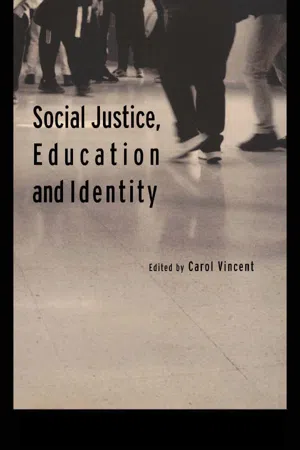
Social Justice, Education and Identity
About this book
This book answers key questions regarding social justice in education. Its central theme is how the education system, through its organization and practices, is implicated in the realisation of just or unjust social outcomes. In particular, the writers examine the ways in which the identities of individuals and groups are formed and transformed in schools, colleges and universities.
The book contains examples drawn from early years through to higher education. It has a dual focus, addressing:
* theoretical debates in social justice, including how the concept of social justice can be understood, and theoretical issues around social capital, and class and gender reproduction
* the formation of learner identities focusing on how these are differentiated by class, ethnicity, gender, sexuality and (dis)ability.
Carol Vincent has assembled a wide-ranging collection of lucidly argued essays by a panel of internationally respected contributors. The authors draw on their current and recent research to inform their writing and so theory is balanced with extensive empirical evidence. Therefore the debates continued here have implications for policy and practice, as well as being theoretically and analytically rich.
This book will provide unrivalled coverage of the subject for researchers, academics, practitioners and policymakers in education.
Information
Chapter 1
Towards a sociology of just practices
An analysis of plural conceptions of justice
Alan Cribb and Sharon Gewirtz
Introduction
Much current writing on social justice or social justice-related issues in policy sociology is based on a conception of social justice as plural. In other words social justice is viewed as having a variety of facets. For example, it is viewed as simultaneously concerning the distribution of goods and resources on the one hand and the valorisation of a range of social collectivities and cultural identities on the other. Whilst we want to welcome the use of such plural conceptions of social justice, there is, we want to suggest, a failure in much of this work to appreciate fully the implications for sociological analysis of such plural notions of justice. This is reflected in two tendencies about which we have some concern.
The first tendency is a common failure to engage adequately with the tensions that may arise between different facets of or claims to social justice (although there are, of course, exceptions, for example, Carspecken 1991). Thus, for example, participative models of education governance are often advocated concurrently with a curriculum which fosters respect for and recognition of diverse cultural identities. Yet potential conflicts between the two positions are often either ignored or glossed over so that there is a failure to address the question of what happens when, for example, participative models of governance produce curriculum policies which either fail to recognise or which disparage particular cultural identities. This is just one example of a tension that might arise between different facets of justice. There are of course many others which are similarly ignored or glossed over in many instances.
The second tendency is what we call ‘critique from above’. This is the tendency to treat the work of sociological analysis as something which takes place at a distance from or above the realm of practice. From this perspective, the role of the analyst is to offer a critical account of educational policies and practices from outside the education system. In so far as such analysts view their work as informing practice, this is limited to pointing out to practitioners the social, economic and political contexts which shape or constrain their work or the mechanisms of social reproduction to which they are often presented as contributing. Those engaged in ‘critique from above’ do not think it is part of their job to consider how the practical difficulties that teachers have to face in trying to implement socially just practices, particularly within a hostile context, might be resolved or accommodated. Critique from above is often linked to a political position that Michael Apple has described as fatalistic—the idea that ‘it is impossible to change schools unless the social and economic relations of wider society are transformed first’ (Apple 1996:107). However this position is not very helpful for those who are struggling in schools to, for example,
create an education that highlights and opposes in practice social inequalities of many kinds, helps students to investigate how their world and their lives have come to be what they are, and seriously considers what might be done to bring about substantial alterations to this.
(Apple 1996:108)
In this chapter we want to argue that if we take seriously the plural nature of social justice then we need to find ways of adequately engaging with the tensions between different facets of and claims to social justice in ways which help to inform the work of those struggling in and around schools to create more socially just educational policies and practices.
We begin by explaining what we mean by the plural nature of social justice. We then look at some of the implications of plural conceptions of justice for socio-logical analysis. Finally we consider what can be done about these implications. Our aim is to contribute to the development of a mode of analysis which enables sociologists to provide a critical perspective on educational policies and practices whilst at the same time taking seriously and helping to inform the work of those involved in creating those policies and practices.
Table 1.1 Plural models of justice—dimensions of pluralism
In Table 1.1 we bring together and briefly summarise six dimensions of pluralism in models of social justice. The column on the left represents the tendency towards monism and that on the right the tendency towards pluralism. We are not pretending to synthesise these different dimensions into a single theory or model; here we are merely listing the dimensions and thereby indicating some of the complexities in the field. The first row relates to the kind of concern represented by social justice. Is it treated as a single kind of concern—for example, a concern with the distribution of goods (or alternatively with fair procedures for exchange of goods), or does justice relate to a non-reducible set of concerns including distribution of goods but also encompassing contexts and processes of social relations and political association? The second, and closely connected, row relates to the kind of good included within models of social justice. Are goods treated as if they form a single currency captured by labels such as ‘material goods’ or ‘primary goods’, or do we proceed as if a range of different, and sometimes competing, kinds of goods have to be considered together? The third row relates to the kind of claim which underlies models of justice. Do we fasten upon a single relevant criterion for justice claims, such as needs, or do we recognise that a number of different, and sometimes incompatible, criteria for claims may all have relevance for justice? The fourth row—again closely connected to the others – relates to the scope of models of justice, in particular whether the relevant criteria for justice, or the appropriate model of justice is context-dependent. Is one model of justice adequate for every sector and every kind of good, or should models shift between contexts and related goods? The fifth row, which we might call the scope of allocative principles, raises the familiar distinction between tendencies towards universalism and differentiation with regard to the beneficiaries of justice. The sixth and final row raises the perhaps less familiar, but equally important, question of the scope of responsibility. Do our models assume the existence of some real or hypothetical central agent (such as the state) bearing the responsibility for arbitrating and meeting claims of social justice, or is this responsibility diffused across a plurality of agents?
Implications of plural conceptions of social justice for sociological analysis
It seems to us that there are at least three significant implications of plural conceptions of justice for sociological analysis: first, the social justice agenda is enlarged; second, tensions within and between different facets of justice need to be acknowledged and responded to; and third, the distinction between evaluation and action collapses.
The social justice agenda is enlarged
Plural models of justice substantially enlarge the agenda of evaluation. Many things which might traditionally have been treated as falling outside the scope of a concern for justice come to be seen as falling within it. This raises the question of whether these more ‘comprehensive’ models of justice are sufficient in themselves—i.e. would an adequately constructed model of ‘comprehensive justice’ be the only necessary axis against which critical educators need evaluate things, or are there other morally relevant considerations which fall outside social justice? We will not pursue this question further here but simply offer a summary account of social justice which indicates what, for the purposes of this discussion, we take to be its broad scope and parameters: a concern with social justice is a concern with the principles and norms of social organisation and relationships necessary to achieve, and act upon, equal consideration of all people in their commonalities and differences.1
Tensions within and between different focets of justice need to be acknowledged and responded to
If we accept that social justice has a variety of facets, then we must also accept that these facets might sometimes be in tension with one another. Whilst there are many ways of conceptualising what are the significant categories of social justice, we want to use an analytic framework here which one of us has used in the past (Gewirtz 2000, Power and Gewirtz 2001, Gewirtz 2002). This framework, which draws upon but extends the models developed by Nancy Fraser (1997) and Iris Marion Young (1990), identifies three concerns of justice/injustice—distributive, cultural and associational.
Distributive justice refers to the principles by which goods are distributed in society. This is the conventional conception of justice, defined by Rawls (1972:7) as concerning ‘the way in which the major social institutions…distribute fundamental rights and duties and determine the distribution of advantages from social cooperation’. Distributive justice includes concerns about what Fraser calls economic justice, defined as the absence of the following:
- Exploitation (having the fruits of one’s labour appropriated for the benefit of others)
- Economic marginalisation (being confined to undesirable, poorly paid work or having access to none)
- Deprivation (being denied an adequate material standard of living) (1997:13)
But it also can include concerns about the distribution of cultural and social resources (or in Bourdieuan terms cultural and social capital).2
The second form of justice, cultural justice, is defined by Fraser in terms of the absence of the following:
- Cultural domination (being subjected to patterns of interpretation and communication that are associated with another culture and are alien and/or hostile to one’s own)
- Non-recognition (being rendered invisible by means of…authoritative representational, communicative, and interpretative practices…)
- Disrespect (being routinely maligned or disparaged in stereotypic public cultural representations and/or in everyday life situations) (1997:14)
Fraser argues that, where there are injustices of distribution, a politics of redistribution, aimed at producing a more equal distribution of goods, is required. Whilst for cultural injustices, a politics of recognition, aimed at producing respect for and a positive affirmation of the cultural practices and identities of oppressed groups, is necessary. Fraser also argues that the politics of redistribution and the politics of recognition can have contradictory aims. For example, in the case of material inequalities, redistribution remedies often call for the elimination of the ‘economic arrangements that underpin group specificity’ (1997:16) and are therefore aimed at undermining group differentiation. Recognition remedies, on the other hand ‘often take the form of calling attention to, if not performatively creating, the putative specificity of some group and then of affirming its value. Thus, they tend to promote group differentiation’ (Fraser 1997:16).
For groups that suffer from distributive and cultural injustices, for example groups subordinated by sexist or racist practices, the two different kinds of remedies can work in opposite directions producing what Fraser calls a ‘redistribution-recognition dilemma’ (Fraser 1997:23). We return to this dilemma below, but first we want to introduce the third form of justice in this framework—associational justice.
Associational justice can be defined by the absence of patterns of association amongst individuals and amongst groups which prevent some people from participating fully in decisions which affect the conditions within which they live and act.
(Power and Gewirtz 2001:41)
Associational justice can be viewed as both an end in itself and as a means to the ends of distributive and cultural justice. That is, for distributive and cultural justice to be achieved it is necessary for previously subordinated groups to participate fully in decisions about how the principles of distribution and recognition should be defined and implemented. However, it is important to acknowledge that it is far from straightforward in practice for subordinated groups to become involved in decision making, even when the opportunities are there, given the history of these groups’ exposure to distributive and cultural injustices.
Much work in policy sociology operates implicitly with an understanding of social justice as having all three facets. However, attempts to engage adequately either implicitly or explicitly with the tensions between these are rare. At best the tensions are acknowledged but attempts to engage with their practical consequences are few and far between. Thus, for example, whilst the conflict that Fraser identifies between a politics of redistribution and a politics of recognition might be accepted as valid, there seems to be a reluctance to grapple with how such tensions might be resolved or accommodated in practice. There are however some notable exceptions and we look below at some examples of work that takes seriously these tensions. One example we consider is from the work of Ken Jones and Anton Franks on progressive approaches to English teaching which implicitly attempts to resolve tensions between distributive and cultural injustices. Another example is an article by Luis Gandin and Michael Apple (2002) which grapples with the tensions that inhabit an educational programme being implemented in Porto Alegre, Brazil; a programme which is attempting simultaneously to promote economic, cultural and associational forms of justice. But, first, to illustrate the kind of tensions we are talking about, we want to use a third example, from the work of Alastair Bonnet and Bruce Carrington on ethnic monitoring and classification.
The decision of whether or not to support and implement policies of ethnic monitoring is problematic for those who are committed to challenging both distributive and cultural injustice. From the perspective of distributive justice, ethnic monitoring can be viewed as having a vital role to play in providing the information needed to combat discrimination on the basis of ‘race’. Thus in education it has historically been supported by those concerned about the over-representation of minority ethnic groups in some educational settings, for example, schools for the ‘educationally subnormal’, and the under-representation of minority ethnic groups in other settings, for example, universities (Bonnett and Carrington 2000: 491). From this perspective
policies to widen access and achieve more balanced student intakes, to improve pastoral care provision or to increase equal opportunities in staffing should be informed by reliable data rather than anecdote or hunch.
(Bonnett and Carrington 2000:499)
From a cultural justice perspective, however, ethnic monitoring can be viewed as problematic. From this position, which often draws on Foucauldian-inspired concerns about governmentality and the production and use of statistics, ethnic monitoring is to be discouraged because it operates as a normalising, racialising and essentialising form of classification or discourse:
The collection of statistics and the proliferation of inscriptions, with their technologies for classifying and enumerating, become effective techniques of governmentality, allowing civil domains to be rendered visible, calculable and, therefore, governable.… [E]numeration requires categorisation, and [the] defining [of] new classes of people for the purpose of statistics has consequences for the way in which we conceive of others and think of our own possibilities and potentialities.
(Hacking 1990:6, cited in Bonnett and Carrington 2000:489)
“Counting” leads to the articulation of “norms” whereby people are considered“normal” if in their characteristics they conform to the c...
Table of contents
- Cover Page
- Title Page
- Copyright Page
- Illustrations
- Notes On Contributors
- Acknowledgements
- Introduction
- Chapter 1: Towards a Sociology of Just Practices: An Analysis of Plural Conceptions of Justice
- Chapter 2: Social Justice In the Head: Are We All Libertarians Now?
- Chapter 3: Shifting Class Identities?: Social Class and the Transition to Higher Education
- Chapter 4: Social Justice and Non-Traditional Participants In Higher Education: A Tale of ‘Border Crossing’, Instrumentalism and Drift
- Chapter 5: Education and Community Health: Identity, Social Justice and Lifestyle Issues In Communities
- Chapter 6: Male Working-Class Identities and Social Justice: A Reconsideration of Paul Willis’s Learning to Labour In Light of Contemporary Research
- Chapter 7: Avoiding the Issue: Homophobia, School Policies and Identities In Secondary Schools
- Chapter 8: Masculinities, Femininities and Physical Education: Bodily Practices As Reified Markers of Community Membership
- Chapter 9: Science Education for Social Justice
- Chapter 10: The Development of Young Children’s Ethnic Identities: Implications for Early Years Practice
- Chapter 11: Special Educational Needs and Procedural Justice In England and Scotland
- Chapter 12: Social Justice, Identity Formation and Social Capital: School Diversification Policy Under New Labour
Trusted by 375,005 students
Access to over 1.5 million titles for a fair monthly price.
Study more efficiently using our study tools.
Frequently asked questions
Yes, you can cancel anytime from the Subscription tab in your account settings on the Perlego website. Your subscription will stay active until the end of your current billing period. Learn how to cancel your subscription
No, books cannot be downloaded as external files, such as PDFs, for use outside of Perlego. However, you can download books within the Perlego app for offline reading on mobile or tablet. Learn how to download books offline
Perlego offers two plans: Essential and Complete
- Essential is ideal for learners and professionals who enjoy exploring a wide range of subjects. Access the Essential Library with 800,000+ trusted titles and best-sellers across business, personal growth, and the humanities. Includes unlimited reading time and Standard Read Aloud voice.
- Complete: Perfect for advanced learners and researchers needing full, unrestricted access. Unlock 1.5M+ books across hundreds of subjects, including academic and specialized titles. The Complete Plan also includes advanced features like Premium Read Aloud and Research Assistant.
We are an online textbook subscription service, where you can get access to an entire online library for less than the price of a single book per month. With over 1.5 million books across 990+ topics, we’ve got you covered! Learn about our mission
Look out for the read-aloud symbol on your next book to see if you can listen to it. The read-aloud tool reads text aloud for you, highlighting the text as it is being read. You can pause it, speed it up and slow it down. Learn more about Read Aloud
Yes! You can use the Perlego app on both iOS and Android devices to read anytime, anywhere — even offline. Perfect for commutes or when you’re on the go.
Please note we cannot support devices running on iOS 13 and Android 7 or earlier. Learn more about using the app
Please note we cannot support devices running on iOS 13 and Android 7 or earlier. Learn more about using the app
Yes, you can access Social Justice, Education and Identity by Carol Vincent in PDF and/or ePUB format, as well as other popular books in Education & Education General. We have over 1.5 million books available in our catalogue for you to explore.