- 300 pages
- English
- ePUB (mobile friendly)
- Available on iOS & Android
eBook - ePub
About this book
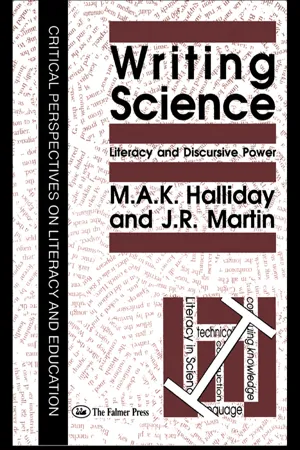
This book is about the use of language in the science classroom. It discusses the evolution of scientific discourse for learning in secondary schools, and examines the form and function of language across a variety of levels including lexiogrammar, discourse semantics, register, genre and ideology. Special attention is paid to how this knowledge is imparted. It will be of particular interest to educators involved with linguistics and/or science curriculum and teachers of English for special and academic purposes.; It is aimed at teachers of undergraduates in science and literacy, linguists teaching in English for special and academic purposes and students in higher education with an interest in science and literacy.
Information
Part 1
Professional Literacy: Construing Nature
Introduction
The first chapter in Part 1, ‘On the Language of Physical Science’, begins by examining the grammatical features of a typical sentence of modern scientific English. These are then placed in a historical context, going back to the writings of the founders of experimental science. From Newton to the present day there has steadily evolved a form of clause construction characterized, not by objectivity as in the popular idea of scientific discourse (which was a late nineteenth-century refinement), but by objectification—that is, representing actions and events, and also qualities, as if they were objects. As a corollary to this, the relations between events came to be construed as if they were the events themselves: thus instead of ‘we did this, then that happened’ the scientist writes ‘this action of ours was followed by that event’. The reasons why the favourite clause type changed in this way become clear when we take account of the context—both the linguistic context (that of the surrounding discourse) and the social and political context, the way science has evolved in recent centuries in the west.
This kind of grammatical metaphor, whereby a phenomenon of one kind is construed in a way that typically represents a phenomenon of some other kind (actions, events, qualities as if they were things) is probably the major source of problems facing those who are apprenticed to the discourse of science, whether they come to this discourse with English as their mother tongue or with English as a second language. Most of the other linguistic problems they face are related to grammatical metaphor in one way or another: for example complex technical taxonomies, and a high concentration of content words (lexical density). These problems are discussed and illustrated in the second chapter.
Among the writings of major scientific figures in the English-speaking world since Newton’s day certain works stand out for the influence they have had on the development of knowledge. One of these is Darwin’s Origin of the Species. Darwin waited a long time before publishing his findings, which he knew were contentious and would be reviled and misunderstood. In the chapter 5, following a brief historical sketch which picks up the motifs of the third Chapter, Halliday has focused on a key passage in the Origin of the Species, the final two paragraphs in which Darwin sums up his ideological stance and reaffirms the rectitude of his own conclusions. A grammatical analysis of the texture of these two paragraphs shows how their effect is achieved.
The first three chapters of this part, taken together, show scientific English at work; in doing so they adopt three complementary perspectives. The first takes typical patterns and treats them historically, as an evolving social semiotic; the second takes problematic examples and treats them developmentally, from the perspective of a learner; the third takes one highly valued passage and treats it as a critical moment in the unfolding of a particular text.
In the sixth chapter language is problematized as being both a part of nature, physical, biological and social, and at the same time a metaphorical construction of the nature of which it is a part. Scientific language has largely reconstrued experience, in ways which scientists themselves now find one-sided and distorting: it creates a massive disjunction between everyday commonsense knowledge and the systematized knowledge of the disciplines. On the other hand, the grammar of everyday language offers an alternative construal of reality which seems more in tune with scientists’ current perceptions (as well as being less elitist)—something which becomes especially relevant at a time when communicative (that is, semiotic) systems, of which language serves as prototype, are increasingly invoked as models for understanding physical and biological processes.
The final chapter in Part 1 offers a brief comparison of scientific English and scientific Chinese. Our book as a whole is concerned with English; but it is important to give some indication of how far the features of scientific English may be shared by scientific registers in other languages. It seems likely that nominalizing metaphors in grammar are common to all languages which are used in the construction of science as currently understood in the late twentieth century. Other features differ more or less randomly; thus, Chinese loses more information in the process of nominalizing than English does, but is more explicit in the way it constructs technical taxonomies. Any language, of course, is capable of being evolved as a resource for doing science; the greater the cultural distance, as in any other such semogenic operation, the more work there is to be done.
Other works of Halliday’s that are relevant to the chapters in Part 1 include ‘New ways of meaning’, concerned with the ecological significance of grammar; ‘Systemic grammar and the concept of a “science of language”’; and ‘Poetry as scientific discourse’, on a scientific text of a different kind—lines from Tennyson’s ‘In Memoriam’. A further sketch of the development of the grammar of scientific English from Chaucer to the present day has been written and will appear in another publication.
Chapter 3
On the Language of Physical Science*
The term ‘scientific English’ is a useful label for a generalized functional variety, or register, of the modern English language. To label it in this way is not to imply that it is either stationary or homogeneous. The term can be taken to denote a semiotic space within which there is a great deal of variability at any one time, as well as continuing diachronic evolution. The diatypic variation can be summarized in terms of field, tenor and mode: in field, extending, transmitting or exploring knowledge in the physical, biological or social sciences; in tenor, addressed to specialists, to learners or to laymen, from within the same group (e.g., specialist to specialist) or across groups (e.g., lecturer to students); and in mode, phonic or graphic channel, most congruent (e.g., formal ‘written language’ with graphic channel) or less so (e.g., formal with phonic channel), and with variation in rhetorical function—expository, hortatory, polemic, imaginative and so on. So for example in the research programme in the linguistic properties of scientific English carried out at University College London during the 1960s the grid used was one of field by tenor, with three subject areas (biology, chemistry and physics) by three ‘brows’, high, middle and low (learned journals, college textbooks, and magazines for the general public).
This space-time variation in no way distinguishes scientific English from other registers. A register is a cluster of associated features having a greater-than-random (or rather, greater than predicted by their unconditioned probabilities) tendency to co-occur; and, like a dialect, it can be identified at any delicacy of focus (Hasan, 1973). Whatever the focus, of course, there will always be mixed or borderline cases; but by and large ‘scientific English’ is a recognizable category, and any speaker of English for whom it falls within the domain of experience knows it when he sees it or hears it.
In this paper I propose to focus on the physical sciences, and to adopt a historical perspective—one which in turn will restrict me to the written mode, since we have had no access to spoken scientific English until very recently. I shall look mainly at material that was written (in its time) for specialists; but seeing the specialist not as a pre-existing persona but as someone brought into being by the discourse itself. I shall concentrate on what seems to me to be the prototypical syndrome of features that characterizes scientific English; and what I hope to suggest is that we can explain how this configuration evolved—provided, first, that we consider the features together rather than each in isolation; and secondly, that we are prepared to interpret them at every level, in lexicogrammatical, semantic, and socio-semiotic (situational and cultural) terms.
? ? ?
Let us begin with a short example:
The rate of crack growth depends not only on the chemical environment but also on the magnitude of the applied stress. The development of a complete model for the kinetics of fracture requires an understanding of how stress accelerates the bond-rupture reaction.
In the absence of stress, silica reacts very slowly with water. (Michalske and Bunker, 1987, p. 81)
Here are instances of some of the features that form part of the syndrome referred to above:
1 The expression rate of growth, a nominal group having as Head/Thing the word rate which is the name of an attribute of a process, in this case a variable attribute: thus rate agnate to how quickly?;
2 the expression crack growth, a nominal group having as Head/Thing the word growth which is the name of a process, agnate to (it) grows; and as Classifier the word crack which is the name of an attribute resulting from a process, agnate to cracked (e.g., the glass is cracked), as well as of the process itself, agnate to (the glass) has cracked; crack growth as a whole agnate to cracks grow;
3 the nominal group the rate of crack growth, having as Qualifier the prepositional phrase of crack growth; this phrase agnate to a qualifying clause (the rate) at which cracks grow;
4 the function of the rate of crack growth as Theme in the clause: the clause itself being initial, and hence thematic, in the paragraph;
5 the finite verbal group depends on expressing the relationship between two things, ‘a depends on x’: a form of causal relationship comparable to is determined by;
6 the expression the magnitude of the applied stress: see points 1 and 3 above; its function as culminative in the clause (i.e., in the unmarked position for New information);
7 the iterated rankshift (nominal group in prepositional phrase in nominal group in…) in the development [of [a complete model [for [the kinetics [of [fracture]]]]]];
8 the finite verbal group requires expressing the relationship between two things, development…requires…understanding (see point 5 above);
9 the parallelism between (rate of) growth… depends on…(magnitude of) stress and development…requires…understanding, but contrasting in that the former expresses an external relationship (third person, in rebus: ‘if (this) is stressed, (that) will grow’), while the latter expresses an internal relationship (first-and-second person, in verbis: ‘if (we) want to model, (we) must understand’) (see Halliday and Hasan, 1976, p. 240);
10 the expression an understanding of how…, with the noun functioning as Head/Thing being the name of a mental process: agnate to (we) must understand; and with the projected clause how stress accelerates…functioning, by rank shift, in the Qualifier;
11 the clause stress accelerates the bond-rupture reaction, with finite verbal group accelerates as the relationship between two things which are themselves processes: one brings about a change in an attribute of the other, agnate to makes…happen more quickly;
12 the simple structure of each clause (three elements only: nominal group+verbal group+nominal group/prepositional phrase) and the simple structure of each sentence (one clause only);
13 the relation of all these features to what has gone before in the discourse.
To pursue the last point more fully we should have to reproduce a lengthy passage of text; but the following will make it clear what is meant. Prior to the rate of crack growth we had had, in the preceding five paragraphs (citing in reverse order, i.e., beginning with the nearest): speed up the rate at which cracks grow, will make slow cracks grow, the crack has advanced, and as a crack grows. If we now go right back to the initial section of the text, in the second paragraph we find (the mechanism by which) glass cracks, (the stress needed to) crack glass, and (the question of how) glass cracks; and if we pursue the trail back to the title of the paper, The Fracturing of Glass. The title, in other words, is a technical nominalization involving grammatical metaphor; in the text, the metaphor is constructed step by step, (glass) cracks—to crack (glass)—a crack (grows)—the crack (has advanced)—(make) cracks (grow)—(rate of) crack growth. We might predict that l...
Table of contents
- Cover Page
- Half Title page
- Series Page
- Title Page
- Copyright Page
- Contents
- Tables
- Figures
- Series Editor's Introduction
- Introduction: The Discursive Technology of Science
- Part 1 Professional Literacy: Construing Nature
- Part 2 School Literacy: Construing Knowledge
- Reference
- Index
Trusted by 375,005 students
Access to over 1.5 million titles for a fair monthly price.
Study more efficiently using our study tools.
Frequently asked questions
Yes, you can cancel anytime from the Subscription tab in your account settings on the Perlego website. Your subscription will stay active until the end of your current billing period. Learn how to cancel your subscription
No, books cannot be downloaded as external files, such as PDFs, for use outside of Perlego. However, you can download books within the Perlego app for offline reading on mobile or tablet. Learn how to download books offline
Perlego offers two plans: Essential and Complete
- Essential is ideal for learners and professionals who enjoy exploring a wide range of subjects. Access the Essential Library with 800,000+ trusted titles and best-sellers across business, personal growth, and the humanities. Includes unlimited reading time and Standard Read Aloud voice.
- Complete: Perfect for advanced learners and researchers needing full, unrestricted access. Unlock 1.5M+ books across hundreds of subjects, including academic and specialized titles. The Complete Plan also includes advanced features like Premium Read Aloud and Research Assistant.
We are an online textbook subscription service, where you can get access to an entire online library for less than the price of a single book per month. With over 1.5 million books across 990+ topics, we’ve got you covered! Learn about our mission
Look out for the read-aloud symbol on your next book to see if you can listen to it. The read-aloud tool reads text aloud for you, highlighting the text as it is being read. You can pause it, speed it up and slow it down. Learn more about Read Aloud
Yes! You can use the Perlego app on both iOS and Android devices to read anytime, anywhere — even offline. Perfect for commutes or when you’re on the go.
Please note we cannot support devices running on iOS 13 and Android 7 or earlier. Learn more about using the app
Please note we cannot support devices running on iOS 13 and Android 7 or earlier. Learn more about using the app
Yes, you can access Writing Science by M.A.K. Halliday,J.R. Martin in PDF and/or ePUB format, as well as other popular books in Social Sciences & Teaching Science & Technology. We have over 1.5 million books available in our catalogue for you to explore.