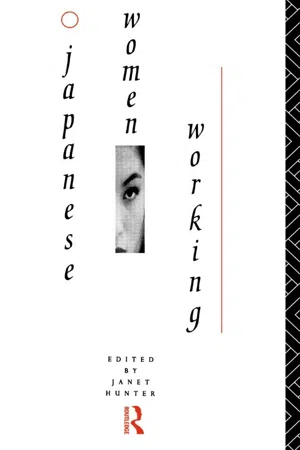
Japanese Women Working provides a wide range of perspectives on the study of working women in Japan over the last century. Contributors address issues of state policy towards and management of women workers, and also provide accounts of the experiences of particular groups of workers: domestic servants, hospital care assistants, textile workers , miners, homeworkers and 'professional' housewives.
The book highlights many of the issues and decisions that have faced working women in Japan, and calls into question the accuracy of the prevailing domestic stereotype of Japanese women. Essays included span a period rapid economic change, and look at Japan as an industrializing country, indicating the importance of the overall economic environment, as well as taking into account cultural factors, in determinig women's position in the labour market.
Bringing together contributions by historians, economists, anthropologists and management specialists from Europe, Japan and the United States, the book underlines the importance of a multidisciplinary approach to the study of women working. It is a major addition to the existing English language literature on Japanese Women, and will make life easier for non-specialists to inform themselves about a critical area of Japanese social and economic development.
- 264 pages
- English
- ePUB (mobile friendly)
- Available on iOS & Android
eBook - ePub
Japanese Women Working
About this book
Information
Chapter 1
Introduction
Janet Hunter
In Japan, as elsewhere, patterns and conditions of work in both the preindustrial and industrial economies have become differentiated by gender. The reasons for this are ideological, political, economic and social, or, more accurately, a complex interaction of all of these. For much of the twentieth century, in almost all countries, this differentiation was taken for granted. That women invariably earned lower wages than men, had less bargaining power in the labour market and only ventured outside the domestic sphere because of economic necessity, tended to be taken as axiomatic. Few asked why. In the early twentieth century a small, very exceptional group of writers began to question these assumptions by looking in more detail at the past and contemporary experiences of working women. In the case of England, for example, there are the pioneering works of writers such as Clementina Black (1915), Alice Clarke (1919), Vera Brittain (1928) and Ivy Pinchbeck (1930), but many aspects of women’s work remained unstudied. Following the appearance of pioneering theoretical and empirical works in the 1960s and 1970s, more attention began to be paid to contemporary issues of women’s work. Some of its neglected history began to be resurrected as scholars started to look further back, in an attempt to see how women’s economic position had changed over time, especially in response to the industrialization process. A partial integration of gender issues into theories of development followed, though there is still a long way to go. Sadly, gender studies—too often, but understandably, identified with women’s studies—remains a largely female area of research. It is regrettable, though unsurprising, that this volume has only one male contributor, while another recent compilation, Recreating Japanese Women, edited by Gail Lee Bernstein, can also boast only one out of a total of thirteen. This has not, however, totally prevented a wider recognition of the importance of women in the economy, which has led in turn to substantial reappraisal of how economies operated in the past, and how they may develop in the future.
In Japan, too, women’s work has moved away from being considered exclusively as a women’s issue. It is now widely recognized that an understanding of the factors influencing female labour force participation and the way in which women’s involvement in economic activity has evolved is a crucial element in understanding the dramatic transformation of Japanese economy and society in general. Female labour force participation is a crucial question for contemporary Japanese economic policy makers, and will remain so into the twentyfirst century, particularly in the light of labour shortages and the rapidly ageing population. The role of women in Japan, and their position in the work-force, is thus a key issue for all those concerned with the past and future development of a country which is now one of the world’s economic superpowers.
In some ways Japan’s working women have been neglected less than those in some other countries, particularly as far as the modern period covered in this book is concerned. Almost any Japanese of the twentieth century is likely to be aware that Japan’s early industrialization was spearheaded by textile industries worked overwhelmingly by young female workers. With agriculture of continuing significance, and with more women than men working in the sector from the 1930s, the work of agricultural women has been often highlighted in surveys and in government policy. Some particular groups, such as divers and geisha, gained some attention for their reputedly high status, religious significance or notorious behaviour, or because for some reason they attracted the attention of westerners. Female labour assumed considerable importance in the Japanese capitalism debate, as shown, for example, in the writings of Yamada Moritarō (1934). By categorizing the earnings of the young female workers in the early textile mills as kakei hojoteki (supplementary to the household income), Yamada identified the ‘premodern’ agricultural household as a basis of Japanese capitalism, and at the same time called attention to one of the most critical issues of all discussions relating to women’s position in the workplace.
Yet the attention given to these women workers has been extremely patchy. Moreover, it has often been of a kind to distort any broader, more balanced picture. Female textile workers, for example, have been constantly cited as examples of the iniquitous exploitation resulting from the capitalist system. Women workers on family farms, performing what was essentially considered part of their domestic duties, were only doing what was expected of them. If the state was concerned about them, it was often because it feared that they were unable to bear healthy children, or were less able to contribute to the national good through efficient use of labour. For protagonists in the Japanese capitalism debate, women were important in the production and reproduction processes, but these writers’ perspectives were far from revising the understanding of Japanese development in the direction of more ‘woman-centred’ historical interpretations. The study of women’s work in Japan, therefore, has suffered from a different kind of neglect. It is all the more disadvantaged, perhaps, because of the strong ideology of domesticity which has prevailed in the country for much of the twentieth century, and continues to prevail. The works of pioneering writers like Takamure (1954–8), Sanpei (1936; 1948; 1957; 1961) and Shimazu (1953)—again, all of them women —broke new ground but were slow to find successors among the next generation of scholars.
To explore further the position of women in the Japanese economy has not been easy for Japanese academics. Some disciplines have proved more encouraging than others to a move in this direction, which has been strongly dependent on the committed lone scholar to lead the way. In general, entrenched academic attitudes and social conservatism have contributed to the subject’s being categorized as ‘peripheral’. Nevertheless, over the past two decades major theoretical and empirical works have appeared in economics, history, political theory, sociology and other fields. In history, for example, major compilations of source material, such as Nihon Fujin Mondai Shiryō Sh sei (Collected Materials on the Women’s Problem in Japan) (Domesu Shuppan 1976– 81), have made it easier to study the position of Japanese women without engaging in primary research. Bibliographical guides such as Nihon Joseishi Kenky Bunken Mokuroku (Bibliography of Research on the History of Japanese Women) (Joseishi Sōgō Kenky kai 1988) have revealed the wealth of materials which can be used by researchers wanting to explore the subject further. Substantial compilations of authoritative articles include the multi-volume Nihon Joseishi (History of Japanese Women) (Joseishi Sōgō Kenky kai 1982) and Nihon Josei Seikatsu-shi (History of the Life of Japanese Women) (Joseishi Sōgō Kenky kai 1990). The compilations have sought to remedy the longstanding gender bias in historical interpretation, and arouse interest in the activities and lives of Japanese women, many of which have not been the subject of conventional historiography.
While there is evidence that in studies of both the past and the present scholars are moving away from the study exclusively of women’s work to look at the totality of women’s lives, the study of work has continued to play a pivotal part in studies of women. As in many other economies, it has been widely assumed in Japan that achievement of equality in the workplace is essential if women are individually and collectively to attain to economic independence and self-respect. It is not possible here to discuss in any detail the various lines of argument which Japanese scholars have taken on this subject. The substantial literature on the Tokugawa period (1600–1867) alone raises complex issues and fierce debate, and the situation is multiplied for the post-Meiji years. Nevertheless, two particular strands in the debate are worthy of mention here. One is the locating of the study of women’s work in the context of the patriarchal ie (family) system of Japan, which has led many writers to argue that any change in women’s earnings, or in women’s position in the workplace or labour force, requires a fundamental change in that patriarchal family system (for example, Takenaka 1989, 1991; Ueno 1985, 1990). The other is the contribution of economists, whose analysis of women’s work ascribes current features to factors such as segmentation of the labour market (for example, Shinotsuka 1982). These perspectives, and many others, have been expressed in a considerable literature of books and articles, scholarly and popular.
So far little of this Japanese writing on women’s work has made its way into English. These important contributions are therefore largely inaccessible to non-Japanese speakers. Their non-availability makes it proportionately more difficult to incorporate Japan as an element in comparative history, economics or gender studies—a major gap, given the importance of modern Japan. The lacuna is being filled, at least in part, by works in English by western scholars, particularly those from the United States. The scholarship of many of these writers not only draws on Japanese language materials, but is increasingly informed by a knowledge of western theoretical and empirical studies on gender issues. Not all, of course, concern the position of women in the economy, but many have some bearing on it. Earlier works such as those of Lebra, Paulson and Powers (1976), T.S.Lebra (1984) and Sievers (1983) have much which concerns women’s work. The papers in the above-mentioned Recreating Japanese Women (Bernstein 1991) contain major contributions to this area of research. Important monographs in which the working life plays a focal part have been published by writers such as Kidd (1978); Cook and Hayashi (1980); R.J.Smith and Wiswell (1982); Bernstein (1983); Tsurumi (1990); Saso (1990); Kondo (1990); and Lo (1990). Works in other western languages include that by Lenz (1984). Several of the contributors to this volume have books in press, and others are in preparation. A succession of important articles have appeared. The high quality of many of these books and articles, as well as their number, are making it easier to bring a critical area of Japanese economic development and activity to the attention of non-specialists.
It remains the case, though, that the sum contribution is inadequate. An important aim of the present collection is therefore to add to the literature, making it easier for more people to study and know about the past and present of women working in Japan. The papers are not limited to a single disciplinary approach. Women’s work is a topic of shared interest for economists, historians, sociologists, anthropologists and others, and this volume includes contributions from a variety of disciplinary perspectives as well as from a range of academic and geographical backgrounds. The inclusion of two historical papers by Japanese economists will, it is hoped, help to give some flavour of the research being undertaken there. The contributors are brought together in a search to understand some aspect of the interrelationship between women’s role and position in the work-force, the growth and industrialization of the Japanese economy and the influence of state policy and social attitudes towards women. The volume is not, of course, an attempt to provide a comprehensive picture of the past and present of women’s work in Japan, although it should give some pointers in that direction.
An understanding of the way in which women’s involvement in economic activity has evolved over the last century is of enormous importance if we are to understand women’s current position in the Japanese labour market, and their domestic role as housewives and mothers. For these reasons, and in order to emphasize the importance of longer-term historical perspectives, the papers in this volume appear in a broadly chronological order. In this context one factor in particular is of major significance in trying to understand what has happened to women’s roles in the Japanese economy over the past century. Japan has moved within a relatively short space of time from being a nondeveloped, agrarian economy, to being a highly-developed, industrial one. Both before and since the Pacific War dramatic changes have taken place in the economy as a whole and in its discrete sectors. The rapid transformation of the Japanese economy over this period means that Japan has combined features of both developing and industrial economies, and that the experiences of women in the Japanese economy at least up to the 1960s may have important implications for the study for women in development.
The multidisciplinary approach contained in this volume has, if anything, highlighted the existence of common issues, notwithstanding the wide range of subject matter covered in the contributions. These themes are by no means new. Many of the issues which confront Japanese women operating in the labour market transcend national and cultural boundaries. The locational and institutional manifestations may be different, but the underlying issues suggest that when it comes to their position in the economy, Japanese women have much in common with women elsewhere.
In pre-industrial economies the distinction between ‘work’ and domestic responsibilities was rarely clear cut. In the predominantly agricultural Tokugawa Japan (1600–1867) the majority of women not only discharged domestic duties, but worked in the fields or performed other tasks associated with the family economy. The pursuit of byemployment (subsidiary or secondary occupation) by both women and men increased with the move away from subsistence, but only with the onset of industrialization in the late nineteenth century were increasing numbers of women compelled to consider work (in agriculture or elsewhere) and domestic duties as alternatives, rather than as parts of an integrated whole. Nor did this happen overnight. The papers here which deal with the pre-war period demonstrate that in various ways traditional forms of economic activity continued to influence women’s work. Regine Mathias shows that, in Kyushu coal-mining, women’s work in the industry only gradually lost its character of family/by-employment operation, a process which eventually undermined women’s position in this particular occupation. This was accompanied by a shift away from indirect to direct forms of labour management, though in the case of the care assistants studied by Eiko Shinotsuka this intermediary activity has persisted. In another area, homeworking, the apparent coexistence of paid work and domestic activities persisted, though Kathleen Uno’s paper mounts a powerful challenge to the idea that such homeworking was necessarily easier to combine with child care and other home responsibilities.
In the decision to enter the labour market, too, earlier modes of economic activity continued to play a major role. Konosuke Odaka’s paper clarifies how in one major occupation, domestic service, working girls made choices based on labour supply conditions in the agricultural sector from which most of them came. The rural connection remained of the utmost importance not only in determining the decision of many women to enter the labour market, but their choice of employment within it, their duration of service and the conditions which they experienced there. The underlying importance of this connection, shown not only in Odaka’s paper, but in those by Mathias, Shinotsuka and myself as well, serves to characterize the nature of Japan as a developing economy. Even where industrialization takes place rapidly, there is no instant appearance of a fully-fledged industrial or ‘modern’ labour force, and the economy must find means of accommodation between modern methods of production and management and distinctly ‘unmodern’ human capital and social practices. This is not to deny the arguments of historians such as T.C.Smith (1988), who has suggested convincingly that many Japanese men and women were better prepared for industrial values and methods than their counterparts in other countries, only to note that the transition to industrial society is never instant nor easy.
Once women have made a decision to enter the emerging labour market they have to cope with a quite different set of conditions from those encountered by men. As many of the papers in this volume show, the labour market itself is highly gendered, with sharp distinctions between ‘men’s jobs’ and ‘women’s jobs’, between male and female wage rates and working conditions. The maids, care assistants and textile workers who figure in this volume were pursuing what were widely thought of as ‘women’s work’, while the formalization of such categories which accompanied the industrialization process helped to encourage a decline in women’s participation in mining, considered by many as socially unsuitable work for women. Mathias notes that genderrelated wage differentials in mining increased with the progress of industrialization. Alice Lam’s paper shows that such job segregation has persisted, with women finding themselves predominantly outside the formal job hierarchy and organizational structure. For much of Japan’s recent development, there have effectively existed two separate labour markets, the rationale for whose existence is gender. In post-war Japan the degree of labour market segmentation has, if anything, become even greater, and Alice Lam’s study of the effectiveness of the 1985 Equal Employment Opportunity legislation shows just how difficult it is in the Japanese case to make headway against such entrenched labour market segmentation.
Perceiving accurately the disadvantages which they face in attempting to break down this gendered situation in the labour market and compete with men, many Japanese women, economic circumstances permitting, pursue an entirely rational course of action and opt out of the unequal struggle altogether. The ‘professional housewives’ studied by Joy Hendry accept the logic of their situation and maximize the advantages of it. For these women, Hendry shows, domestic respo...
Table of contents
- Cover Page
- Title Page
- Copyright Page
- Figures
- Tables
- Contributors
- Preface
- Chapter 1: Introduction
- Chapter 2: Redundancy utilized: the economics of female domestic servants in pre-war Japan
- Chapter 3: One day at a time: work and domestic activities of urban lowerclass women in early twentiethcentury Japan
- Chapter 4: Textile factories, tuberculosis and the quality of life in industrializing Japan
- Chapter 5: Female labour in the Japanese coal-mining industry
- Chapter 6: Equality versus difference: the Japanese debate over ‘motherhood protection’, 1915–50
- Chapter 7: Japanese care assistants in hospitals, 1918–88
- Chapter 8: Women as bosses: perceptions of the ama and their work
- Chapter 9: Equal employment opportunities for Japanese women: changing company practice
- Chapter 10: The role of the professional housewife
Trusted by 375,005 students
Access to over 1.5 million titles for a fair monthly price.
Study more efficiently using our study tools.
Frequently asked questions
Yes, you can cancel anytime from the Subscription tab in your account settings on the Perlego website. Your subscription will stay active until the end of your current billing period. Learn how to cancel your subscription
No, books cannot be downloaded as external files, such as PDFs, for use outside of Perlego. However, you can download books within the Perlego app for offline reading on mobile or tablet. Learn how to download books offline
Perlego offers two plans: Essential and Complete
- Essential is ideal for learners and professionals who enjoy exploring a wide range of subjects. Access the Essential Library with 800,000+ trusted titles and best-sellers across business, personal growth, and the humanities. Includes unlimited reading time and Standard Read Aloud voice.
- Complete: Perfect for advanced learners and researchers needing full, unrestricted access. Unlock 1.5M+ books across hundreds of subjects, including academic and specialized titles. The Complete Plan also includes advanced features like Premium Read Aloud and Research Assistant.
We are an online textbook subscription service, where you can get access to an entire online library for less than the price of a single book per month. With over 1.5 million books across 990+ topics, we’ve got you covered! Learn about our mission
Look out for the read-aloud symbol on your next book to see if you can listen to it. The read-aloud tool reads text aloud for you, highlighting the text as it is being read. You can pause it, speed it up and slow it down. Learn more about Read Aloud
Yes! You can use the Perlego app on both iOS and Android devices to read anytime, anywhere — even offline. Perfect for commutes or when you’re on the go.
Please note we cannot support devices running on iOS 13 and Android 7 or earlier. Learn more about using the app
Please note we cannot support devices running on iOS 13 and Android 7 or earlier. Learn more about using the app
Yes, you can access Japanese Women Working by Janet Hunter in PDF and/or ePUB format, as well as other popular books in Social Sciences & Social History. We have over 1.5 million books available in our catalogue for you to explore.