eBook - ePub
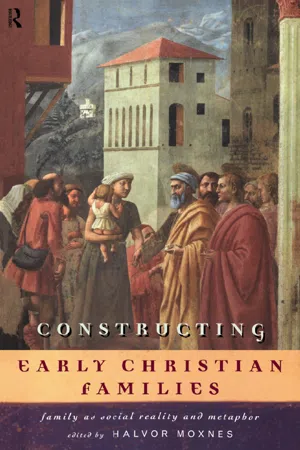
Constructing Early Christian Families
Family as Social Reality and Metaphor
- 288 pages
- English
- ePUB (mobile friendly)
- Available on iOS & Android
eBook - ePub
About this book
The family is a topical issue for studies of the Ancient world. Family, household and kinship have different connotations in antiquity from their modern ones. This volume expands that discussion to investigate the early Christian family structures within the larger Graeco-Roman context.
Particular emphasis is given to how family metaphors, such as 'brotherhood' function to describe relations in early Christian communities. Asceticism and the rejection of sexuality are considered in the context of Christian constructions of the family. Moxnes' volume presents a comprehensive and timely addition to the study of familial and social structures in the Early Christian world, which will certainly stimulate further debate.
1
INTRODUCTION
Halvor Moxnes
What happened to family life within the early Christian movement? How did the first Christians react vis-à-vis the social structures of household and kinship in Palestine and the Graeco-Roman world? Why were family metaphors so important for the self-definition of early Christian communities? And why did they choose some metaphors over others to express their identity and the inter-relationships between group members?
Strangely enough, although ‘family’ is such an important topic in Christianity, there have been few comprehensive studies of family in early Christianity. There has been much interest in certain aspects, in particular in ethical issues concerning marriage or the so-called ‘household’ codes, but much less in the social behaviour and forms of family as a social institution among early Christians (but see Lampe 1992 and Osiek 1996). This corresponds to the situation in Graeco-Roman studies until a few years ago. Keith R.Bradley speaks of family history as ‘virtually a new field of Roman historical scholarship’ (Bradley 1991:5). Under the impact of the new social history it has been possible to study the ‘dynamics of Roman family life’ as well as to ‘understand the family as a social organism’. The result has been a number of exploratory and experimental studies. The same has been the case to a lesser degree concerning Greek and Jewish studies of family.
But the situation for early Christianity as a whole is very similar to J.H. Neyrey’s description of studies of the Gospel material in the Q source:
more serious consideration needs to be given to the basic social institution of antiquity, namely the family and the role of the paterfamilias. Further studies in Q would do well to investigate the role of families in socialising new members and exercising social control. Issues of family and (fictive) kinship remain underdeveloped in scholarship.
(Neyrey 1995:156–57)
Neyrey also points to the need for further studies of fictive kinship, that is, the ways in which the first Christians regarded and treated each other as ‘family’. The goal of this collection of essays is to combine the study of the family as a social institution in early Christianity with a study of Christian communities as examples of ‘fictive kinship’. This combined interest was expressed in the title of the seminar in which most of these essays originated: ‘Family as social reality and metaphor in early Christianity’. In order to understand the meaning of early Christian use of family terminology to describe groups and inter-relationships between members, we need to know more about their ideals and social experiences of family, and their expectations of kinship relations.
To draw this picture it is not sufficient to study only those early Christian texts that speak explicitly about family, marriage, children, etc. Social structures of family and cultural assumptions and values associated with family underlie many more passages than those which explicitly speak of family relations. Consequently, there is a need for studies which illuminate the family structure of Palestinian and Graeco-Roman societies in which the Christian movement took hold. It follows that studies of early Christianity must be in dialogue with parallel studies of the Graeco-Roman world. In a recent collection of essays on family in ancient Rome, Beryl Rawson points to the need to analyse the social behaviour of Christian groups developing in this period within the Roman world: ‘The interaction of Christians and pagans (my italics), and their influence on each other, are large subjects, and of great relevance to the topics of this book—marriage, divorce and children—but they require a separate study… ‘(Rawson 1991: v).
Many of the essays in this collection share an interest in this interaction between Christians and the larger Graeco-Roman world. The Jewish and the Graeco-Roman social and cultural worlds do not merely form the ‘background’ for Christianity, they represent the surrounding milieu, so that we must speak of a continuous interaction, be it in dialogue, in positive exchange or in conflicts and controversies. Studies of social and cultural worlds in ancient societies are today influenced by methods and perspectives from social anthropology. In Biblical studies this approach has been highly influential in attempts to establish the historical context of literary texts. This interaction between classical and Biblical studies on the one hand, and anthropology on the other, is visible in several of the essays in this collection.
The first group of essays deals with family within the social context of Palestine and the larger Graeco-Roman world, that is, with family as a social reality. But what do we mean by ‘family’? Did ‘family’ mean the same in Mediterranean societies in the first century CE as it does today, in the Western world of the twentieth century? In the opening essay (Chapter 2), Halvor Moxnes situates the present study within the context of modern family studies. He suggests that studies of early Christian families should draw on various social sciences and the different perspectives they have developed. Since ancient language did not have a word that is equivalent to the modern ‘(nuclear) family’, it is necessary when studying early Christiantexts about ‘family’ to use various perspectives: household, kinship, marriage, inter-relations between members. Moreover, the study of early Christian families should situate them in their appropriate social and cultural context: Mediterranean societies in antiquity with their honour and shame culture.
Whereas Moxnes attempts to provide a basis for methodological approaches to the study of family, Santiago Guijarro, in Chapter 3, provides a material basis for the study of family in one area of early Christianity by focusing on Galilee. His study combines several approaches: literary, historical and sociological. Most important is his use of archaeological evidence based on recent excavations of domestic architecture in Galilee and Palestine. Combining the evidence from these various sources, Guijarro is able to reconstruct four different family types in Galilee in the first century. They are set apart by the type of house they inhabited, by the number of family members, their capacity for mutual support, the amount of land they possessed, and the social group they belonged to. This reconstruction forms the basis upon which to discuss the ways in which the Jesus movement interacted with ‘family’. It is not a matter of just one type of family—different family situations must be studied:
perhaps the consideration of their family situation, which is indicative of privilege or of dependency, may help to understand their reaction towards Jesus: on the one side, the people that followed him and acclaimed him and on the other, their rulers and their retainers that questioned his message.
(Guijarro: this volume, 63)
Guijarro has described the material, social and economic basis and function of families as households. John M.G.Barclay, in his study (Chapter 4), adds the dimension of the religious function of the household, and shows how religion is embedded in family, understood as household and kinship. Barclay addresses the question to what extent religion was embedded in the lives and ideologies of families in the ancient world, especially Judaism and the early Christian movement. He pays special attention to the question of socialisation of children and focuses on the central role of the family in the preservation of Jewish tradition.
By contrast, Barclay claims, the early Christian movement was ambiguous in its attitude to family life and the relationship between the household and the faith. Thus, Barclay distinguishes between two trends, one that was ‘antifamilial’, and another that attempted to re-embed Christian discipleship within the household. With his study Barclay presents a picture of early Christianity where these trends occur as separate tendencies and developments which need not be forced into one harmonious picture. The following chapters focus more clearly on one or the other of these trends: those by Barton, Martin, Uro, and Gilhus on the ‘anti-familial’trend; those by Esler, Sandnes and Aasgaard on the attempts to re-embed discipleship in some forms of family structures.
Stephen C.Barton (Chapter 5) explores the topic, hitherto little discussed, of subordination of mundane ties, among these family ties, to be found in Jewish monotheism as well as in demands addressed to the philosopher in Graeco-Roman traditions. This material is of obvious relevance for an understanding of the ‘anti-family’ material in the Gospels. It is particularly helpful to see how rejection of the social family is often combined with joining groups with a family-like character. Jewish writers like Philo of Alexandria and Josephus often describe conversion to Judaism in terms of its effect on family ties. The model communities, the Therapeutae and the Essenes, lived an ascetic life in renunciation of family ties, but their communities are described as alternative groups, modelled after the household.
There is enough material from Jewish and Graeco-Roman sources to indicate that the Gospel tradition relativising family ties could resonate against a wider background of well-known religious and philosophical topics. However, there were differences: the Cynic tradition renounces kinship ties to emphasise individual freedom and self-sufficiency, whereas in the Gospel tradition their subordination is the price of the eschatological mission started by Jesus.
The descriptions by Philo and Josephus of the Essenes and the Therapeutae in terms of ‘spiritual kinship’ or ‘spiritual household’ are similar to those used of Christian groups by various New Testament authors as well as in Gnostic scriptures. Thus, household and kinship/ family metaphors provided a powerful idiom for ‘chosen’ groups, as well as for the larger society.
In the second section of the book, ‘Family as metaphor’, the focus moves towards the use of family language to denote fictive kinship, that is, the use of family terminology for Christian communities. But these essays also keep the social situation in mind, and relate the use of family terminology in fictive kinship to that of ‘real’ kinship. The close relationship between the two is also visible in Stephen Barton’s study in the first section. In Chapter 6 Eva Marie Lassen provides a broader context to the function of fictive kinship terminology in early Christianity. Her essay is a study of some of the ways in which the Roman family served as an ideal as well as a metaphor in the classical Roman period, especially in the first century CE. Family metaphors played an important role in Roman society; especially important was the metaphor of father-son. It is significant that the Romans saw themselves not as a society of mothers and daughters or of brothers, but of fathers and sons. The father image became particularly significant in the form of the title pater patriae used of the emperor. And the family of the emperor became the state family and reinforced the image of the emperor as the father of the state.
It is into this context of a society described by the means of familymetaphors that Christianity entered—as a religion and a social group that also used family metaphors, both to describe relations between God and the faithful, and to describe internal relations within the group. Thus, family metaphors constituted a well-known means of communication with Roman society, but at the same time the content of the metaphors was partly unfamiliar. In light of the Roman tradition of describing society as a ‘father-son’ relationship, it is striking that the most popular term to describe interrelationships among the first Christians was ‘brother’.
Why did this term, which describes only a relatively small segment of the full system of family relations, gain prominence? Several studies in this volume focus on the use of ‘brothers’ (adelphoi), three of them focus on a Pauline letter or section of a letter: Galatians (Esler), 1 Thessalonians (Fatum) and Philemon (Sandnes); the last one (Aasgaard) makes a general comparison between brother terminology in Plutarch and Paul.
Philip F.Esler (Chapter 7) studies the way in which Paul uses family images, especially that of relations between brothers, in his exhortations in Gal 5:13 to 6:10. It is Paul’s purpose to create an identity for the Christian groups in Galatia. Esler’s study is an example of the use of models from social sciences. He employs findings from studies of social psychology into the formation of group identity through inter-group conflict, as well as anthropological studies of honour and shame in a Mediterranean context. In a Mediterranean society the sense of collective honour within a family meant that it was particularly shameful if members of a family publicly displayed inter-family strife. In addition to the social science models, Esler also provides Greek and Roman texts which illustrate the importance of upholding family honour and avoiding strife. Moreover, Esler finds that the meetings in family houses, in contrast to Gentile collegia and Jewish synagogues, enhanced the familial dimension of Christian identity, and stimulated the adoption of the language of kinship in their interrelationships. In his study Esler establishes a methodology to study Paul’s use of the ‘brother’ language as part of the social dynamics of the formation of group identity.
In Chapter 8 Karl Olav Sandnes also situates Paul’s use of brotherhood terminology within a wider context of the development of social structures and relations within the first Christian communities. Sandnes enters into a discussion with the views of K.Schäfer (1989), who considers household and brotherhood to be contrasting models in Pauline ecclesiology: the one represents a patriarchal model, the other an egalitarian and participatory one. Similarly E.Schüssler Fiorenza (1983) sees the two models as two different stages of development within early Christianity: an egalitarian brotherhood came first, followed later by the hierarchical household. Sandnes claims that the social reality of early Christianity was more patriarchal and householdlike than most modern theologians are happy with. His thesis is that there was a convergence of household and brotherhoodstructures. The brotherhoodlike nature of Christian fellowship was not a first stage—rather, it was embedded in household structures. Household structures underwent some modifications when their members became Christians. Sandnes studies an example of such modifications in Paul’s letter to Philemon. It concerns Philemon’s slave, Onesimus, who had become a Christian, and Paul’s use of ‘brother’ terminology to describe the relations between the master and his slave. The juxtaposition of two types of terminology: master-slave and brotherhood, leaves us with a picture of ambiguity and tension; egalitarian structures are emerging, but the patriarchal structures of the household are still in place.
Esler and Sandnes presupposed that there were links between the brotherhood terminology in Christian texts and their socio-historical context. In his essay on Paul and Plutarch, Reidar Aasgaard (Chapter 9) makes an explicit study of these links. He investigates the brotherhood ideas in Paul’s letters, and attempts to understand them on the basis of their social context in family life. The main example of a contemporary understanding of brotherhood in Antiquity is the treatise ‘On brotherly love’ by Plutarch. Plutarch was a popular moral philosopher and his ideas often represent a general mentality in Hellenism. Aasgaard argues (against H.D.Betz 1978) that Plutarch’s brotherhood ethics can be distinguished both from family ethics and friendship ethics, that is, it has a distinctive character. Much of Plutarch’s discussion is concerned with conflicts between brothers, which should be avoided at all costs. Aasgaard finds many similarities between Plutarch and Paul. Paul likewise is concerned with brotherhood, in the form of fictive brotherhood applied to relations within the Christian community. This raises interesting questions about Paul’s situation within the Hellenistic world (see T.Engberg-Pedersen 1995)—is he strongly embedded in this world, so that when he discusses conflicts between brothers in a Christian community, he participates in a discussion of a topos of general interest?
In Chapter 10 Lone Fatum adds a new perspective to the study of Paul’s brotherhood terminology when she undertakes a ‘gender hermeneutical reading’ of 1 Thessalonians. Fatum, too, relates Paul’s use of the brotherhood terminology to the social context of his readers, in particular to the divisions based on gender. She argues that 1 Thessalonians must be read as an example of an androcentric and patriarchal perspective: Paul addresses a group of male Christians. His main form of address to them is as ‘brothers’, and Paul applies the moral obligation of brotherhood in order to create a strong sense of community. Fatum argues that Paul strives to organise the brothers according to the social and moral obligations of the patriarchal family, in which Paul represents the fatherly authority. In this male world, there is almost no indication of a female presence, it is the patriarchal, male pattern of social values and virtues that is taken for granted. In partial contrast to other feminist interpreters, Fatum finds it difficult to imagine howChristian women could be integrated into the Thessalonian community. According to the patriarchal ideology, women could be among the converts, but not among the brothers of Christ, and not members of the new community. Fatum’s interpretation seriously undermines the understanding of the Bible as a source of equality for women and thereby challenges our hermeneutical capacities.
The third section of essays focuses on one of the most important factors that influenced attitudes to family life as well as metaphors of family among the early Christians: the impact of asceticism and the rejection of sexual desire. Among New Testament authors, the most explicitly ascetic statements are found in Paul’s writings. Dale B.Martin’s purpose, in Chapter 11, is to show the precise structure of Paul’s asceticism, and to compare it to that of other ancient writers. Main texts are 1 Cor 7, 1 Thess 4 and Rom 1. Paul argues that Christians should experience sexual intercourse only in the context of marriage, and only in absence of sexual desire. The passion of desire is part of the dirty, polluted cosmos in opposition to God. Sexual desire is connected with the Gentile world. Martin compares Paul to two major groups of contemporary writers: medical and Aristotelian as well as Stoic writers. Martin discusses critically M.Nussbaum’s position in Therapy of Desire (1994). She holds that only the Stoic position is the rational one, whereas the others are ‘irrational’. Martin criticises her concept of ‘rational’, and proceeds to show that the various positions are carried by different systems characterised by their own internal logic.
Paul simply follows a different rationality from the Stoics. For Paul, every human being receives his identity by his place, either in ‘this cosmos’ or ‘in Christ’. Thus, the free will and free moral agency that is a necessary precondition for the Stoic position is absent from Paul. Paul saw man threatened by cosmic forces, coming from outside, which could possibly enter the body as pollution. Thus, Paul feared sexual desire as a polluting force that threatened the Christian’s body.
Paul’s view on desire is not just an individual position on a single topic, it is part and parcel of his total world view of human beings and their position in the world, cosmology, theology and anthropology. This rejection of desire shows a different ‘logic’ from modern positions, but it shows how marriages and family can be conceived of in very different categories from those that we know and take for granted. Martin’s exposition of Paul’s rejection of desire illuminates the development towards the Gnostic perception of desire (see Gilhus, Chapter 13).
Risto Uro’s purpose, in Chapter 12, is to pose the question of the specific nature of asceticism in the Gospel of Thomas, through a study of passages related to marriage and sexuality. The Gospel of Thomas has been the subject of widely diverging interpretations, from an extreme emphasis on the encratic nature of the Gospel to an almost complete rejection of this view. Uro undertakes a careful investigation that provides a nu...
Table of contents
- Cover Page
- Title Page
- Copyright Page
- Illustrations
- Contributors
- Preface
- Abbreviations
- 1: Introduction
- Part I: The Social Context of Early Christian Families
- Part II: Family as Metaphor
- Part III: Family, Sexuality and Asceticism in Early Christianity
Trusted by 375,005 students
Access to over 1.5 million titles for a fair monthly price.
Study more efficiently using our study tools.
Frequently asked questions
Yes, you can cancel anytime from the Subscription tab in your account settings on the Perlego website. Your subscription will stay active until the end of your current billing period. Learn how to cancel your subscription
No, books cannot be downloaded as external files, such as PDFs, for use outside of Perlego. However, you can download books within the Perlego app for offline reading on mobile or tablet. Learn how to download books offline
Perlego offers two plans: Essential and Complete
- Essential is ideal for learners and professionals who enjoy exploring a wide range of subjects. Access the Essential Library with 800,000+ trusted titles and best-sellers across business, personal growth, and the humanities. Includes unlimited reading time and Standard Read Aloud voice.
- Complete: Perfect for advanced learners and researchers needing full, unrestricted access. Unlock 1.5M+ books across hundreds of subjects, including academic and specialized titles. The Complete Plan also includes advanced features like Premium Read Aloud and Research Assistant.
We are an online textbook subscription service, where you can get access to an entire online library for less than the price of a single book per month. With over 1.5 million books across 990+ topics, we’ve got you covered! Learn about our mission
Look out for the read-aloud symbol on your next book to see if you can listen to it. The read-aloud tool reads text aloud for you, highlighting the text as it is being read. You can pause it, speed it up and slow it down. Learn more about Read Aloud
Yes! You can use the Perlego app on both iOS and Android devices to read anytime, anywhere — even offline. Perfect for commutes or when you’re on the go.
Please note we cannot support devices running on iOS 13 and Android 7 or earlier. Learn more about using the app
Please note we cannot support devices running on iOS 13 and Android 7 or earlier. Learn more about using the app
Yes, you can access Constructing Early Christian Families by Halvor Moxnes in PDF and/or ePUB format, as well as other popular books in History & Ancient History. We have over 1.5 million books available in our catalogue for you to explore.