- 339 pages
- English
- ePUB (mobile friendly)
- Available on iOS & Android
eBook - ePub
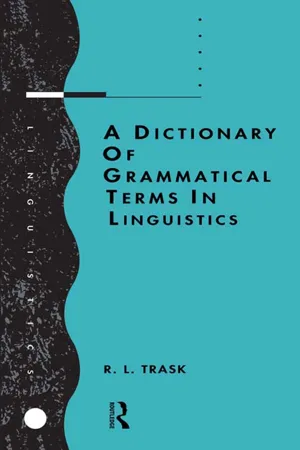
A Dictionary of Grammatical Terms in Linguistics
About this book
This dictionary of grammatical terms covers both current and traditional terminology in syntax and morphology. It includes descriptive terms, the major theoretical concepts of the most influential grammatical frameworks, and the chief terms from mathematical and computational linguistics. It contains over 1500 entries, providing definitions and examples, pronunciations, the earliest sources of terms and suggestions for further reading, and recommendations about competing and conflicting usages. The book focuses on non-theory-boumd descriptive terms, which are likely to remain current for some years.
Aimed at students and teachers of linguistics, it allows a reader puzzled by a grammatical term to look it up and locate further reading with ease.
Information
A
A 1. See adjective. 2. See under SAP.
A-bar /ˈeıˌbα:/ n. The one-bar projection of the lexical category Adjective, posited to provide suitable structures for adjective phrases like very proud of Lisa, analysed as [AP[Degvery] [A′[AProud][ppof Lisa]]].
A-bar binding /ˈeıbα:ˌbaındıŋ/ n. (also non-argument binding) In GB, binding by a category which is not in argument position, such as a fronted WH-item: Whoi did you see ei? A-bar binding applies to variables (WH-traces); such a trace must be bound by a suitable WH-item which c-commands it. Cf. A-binding.
A-bar position /ˈeıbα: pəˌzı∫ņ/ n. In GB, an NP-position which is not an A-position, particularly the Comp position.
abbreviatory convention /əˈbri:viətri kənˈven∫ņ/ n. Any conventional notation which allows two or more distinct rules with elements in common to be written as a single rule schema. Common conventions include parentheses, braces, vertical bars and the Kleene star.
abbreviatory variable n. A variable whose possible values are restricted to a specified set. Cf. essential variable.
abessive /æbˈesıv/ n. or adj. A case form typically expressing the meaning of ‘without’: Finnish rahatta ‘without money’ (raha ‘money’).
A-binding /ˈeı ˌbaındıŋ/ n, (also argument binding) In GB, binding by a category which is in argument position, such as a subject or a (direct) object. A-binding applies to anaphors (reflexives, reciprocals and NP-traces): each of these must be bound in its governing category; that is, it must be coindexed with a c-commanding category within this domain. A category so bound is ‘A-bound’; otherwise, it is ‘A-free’. Cf. A-bar binding.
ablative /ˈæblətıv/ n. or adj. A case form which typically indicates the source of a movement: Turkish evden ‘from the house’ (ev ‘house’).
ablaut /ˈæblaʊt/ n. (also vowel alternation) Grammatical inflection by variation in the vowel of a root, as in English sing, sang, sung. Cf. umlaut, and see the remarks there. Grimm (1819).
absolute comparative /ˈæbsəlu:t/ n. A construction involving a comparative form with no overt standard: the younger generation; Whizzo washes whiter.
absolute construction n. A constituent linked semantically and intonationally to the rest of its sentence, but lacking any overt expression of a syntactic linkage: [The day being cloudy,] we decided to stay home; The two women, [their business completed,] retired to the bar. Often the term is extended to sentence adverbs like however.
absolute exception n. In some analyses, a label applied to certain lexical items which obligatorily undergo, or fail to undergo, a process which is usually optional. Thus, for example, while passives like She is considered to be clever are normally related to corresponding actives like They consider her to be clever, the verb say is exceptional: it can only appear in the passive form She is said to be clever, the active form *They say her to be clever being non-existent. Hence say is a ‘positive absolute exception’ to passivization. The term is also sometimes used in morphology: while verbs in -ition (like prohibition) are often derived from related verbs (like prohibit), perdition has no such corresponding verb, at least superficially, and some analysts would posit an underlying verb stem perdit- which is a positive absolute exception to noun formation.
absolute possessive n. A possessive form of a personal pronoun which functions as a pronoun, rather than as a determiner, such as English mine or yours: Mine is bigger than yours. NOTE: The term ‘possessive pronoun’ would seem more appropriate, but unfortunately that term has long been in use to label the possessive determiners like my and your.
absolute-relative tense n. A tense form which takes as its intrinsic point of reference a point in time other than the present moment, such as the past anterior (I had already seen him) or the future-in-the-past (I was going to see him), both of which take some past moment as their point of reference. Cf. absolute tense, relative tense. See Comrie (1985a) for discussion.
absolute tense n. A tense form which takes the present moment as its point of reference, such as the simple past, present and future tenses found in many languages. The term is traditional, but regrettable, since the so-called absolute-relative tenses have just as much claim to being considered ‘absolute’. Cf. relative tense, absolute-relative tense. See Comrie (1985a) for discussion.
absolute transitive n. A construction in which an intrinsically transitive verb occurs with no overt direct object, the subject of the verb being interpreted as an agent and the construction being interpreted as active: Janet smokes; Lisa is eating. The term is also applied to the distinctive subclass with a reflexive interpretation: Lisa undressed; John is shaving. See also unspecified object deletion, pseudo-intransitive. Jespersen (1961, III: 320).
absolute universal n. A universal which holds for every single natural language without exception. Some linguists would argue, for example, that the structure-dependence of grammatical rules is just such a universal. Cf. relative universal.
absolutive /ˈæbsəlu:tıv/ n. or adj. 1. In an ergative language, the case form which marks both the subject of an intransitive verb and the direct object of a transitive verb, and which contrasts with the ergative (sense 1). For example, in the ergative language Basque the NPs gizona ‘the man’ and mutila ‘the boy’ take the absolutive case suffix zero in such examples as Gizona heldu da ‘The man arrived’, Gizonak mutila ikusi du ‘The man saw the boy’ and Mutilak gizona ikusi du ‘The boy saw the man’, while the transitive subjects bear the ergative case suffix -k. 2. By extension, the category consisting of intransitive subjects and transitive direct objects.
abstract /ˈæbstrækt/ adj. Denoting an analysis of a structure or phenomenon which is significantly different from its surface representation; sometimes more specifically denoting an element which is postulated as being present even though it has no overt phonetic realization. For example, some analyses of the sentence I enjoy bridge would postulate an abstract node called AUX or INFL in the tree which serves as a locus for tense marking but which has no overt realization in the sentence, and some analyses of Lisa seems to be happy would posit an abstract underlying structure along the lines of seems [Lisa to be happy]. Abstr. n. abstractness/æbˈstræktnıs/.
abstract noun n. A noun whose meaning is an abstract concept (truth, beauty, magnitude, consequence) or a noun denoting an event (arrival, explosion). Cf. concrete noun.
acceptability /əkseptəˈbılıti/ n. The degree to which a proposed sentence or utterance is adjudged permissible and interpretable by native speakers. A sentence which is well-formed according to the requirements of the grammar may be considered unacceptable because of processing difficulties or pragmatic factors: Flounder flounder badger badger flounder; The book the professor the students who are doing well like recommended is good; Arabic is learning John. Adj. acceptable /əkˈseptıbļ/.
accessible subject /əkˈsesıbļ/ n. In GB, a particular structural relation which may hold between nodes in a sentence. A node A is an accessible subject for another node B if the coindexation of A and B does not violate any grammatical principles. The notion of an accessible subject is important in the definition of a governing category. Chomsky (1981).
accidence /ˈæksıdəns/ n. A traditional term for what is now usually called inflectional morphology.
ACC-ing /ækˈıŋ/ n. The co...
Table of contents
- Cover Page
- Half Title page
- Title Page
- Copyright Page
- Dedication
- Contents
- Preface
- Acknowledgements
- List of abbreviations
- Guide to pronunciation
- A
- B
- C
- D
- E
- F
- G
- H
- I
- J
- K
- L
- M
- N
- O
- P
- Q
- R
- S
- T
- U
- V
- W
- X
- Y
- Z
- References
Trusted by 375,005 students
Access to over 1.5 million titles for a fair monthly price.
Study more efficiently using our study tools.
Frequently asked questions
Yes, you can cancel anytime from the Subscription tab in your account settings on the Perlego website. Your subscription will stay active until the end of your current billing period. Learn how to cancel your subscription
No, books cannot be downloaded as external files, such as PDFs, for use outside of Perlego. However, you can download books within the Perlego app for offline reading on mobile or tablet. Learn how to download books offline
Perlego offers two plans: Essential and Complete
- Essential is ideal for learners and professionals who enjoy exploring a wide range of subjects. Access the Essential Library with 800,000+ trusted titles and best-sellers across business, personal growth, and the humanities. Includes unlimited reading time and Standard Read Aloud voice.
- Complete: Perfect for advanced learners and researchers needing full, unrestricted access. Unlock 1.5M+ books across hundreds of subjects, including academic and specialized titles. The Complete Plan also includes advanced features like Premium Read Aloud and Research Assistant.
We are an online textbook subscription service, where you can get access to an entire online library for less than the price of a single book per month. With over 1.5 million books across 990+ topics, we’ve got you covered! Learn about our mission
Look out for the read-aloud symbol on your next book to see if you can listen to it. The read-aloud tool reads text aloud for you, highlighting the text as it is being read. You can pause it, speed it up and slow it down. Learn more about Read Aloud
Yes! You can use the Perlego app on both iOS and Android devices to read anytime, anywhere — even offline. Perfect for commutes or when you’re on the go.
Please note we cannot support devices running on iOS 13 and Android 7 or earlier. Learn more about using the app
Please note we cannot support devices running on iOS 13 and Android 7 or earlier. Learn more about using the app
Yes, you can access A Dictionary of Grammatical Terms in Linguistics by R.L. Trask in PDF and/or ePUB format, as well as other popular books in Languages & Linguistics & Linguistics. We have over 1.5 million books available in our catalogue for you to explore.